Music Career Management for Independent Artists
Music career management means running a repeatable growth engine that converts discovery into owned fans and revenue. The single next step: pick a release cadence of one single every several weeks and build an owned-audience capture around every drop. Berklee research confirms that consistent releases are a primary discovery tool in today’s singles-based economy, because each release gives DSP algorithms fresh data points — saves, full listens, playlist adds — to evaluate your audience fit. Upncomer’s Amplitude AI is built to monitor exactly those signals and surface the ones that matter.
Your next action today: Set your next release date, then create a pre-save landing page to start capturing emails before the track goes live.
Table of Contents
- What does a music career growth engine actually look like?
- How to build a release strategy that actually works
- How do you build an audience you actually own?
- What KPIs actually predict growth for independent artists?
- How do you build multiple revenue streams as an indie artist?
- What should you handle yourself vs. outsource?
- How can automation and AI speed up your workflow safely?
- Your 90-day starter plan: from setup to first three releases
- Key Takeaways
- The part most artists skip
- Upncomer gives you the whole growth engine in one place
- Useful sources and further reading
- FAQ
What does a music career growth engine actually look like?
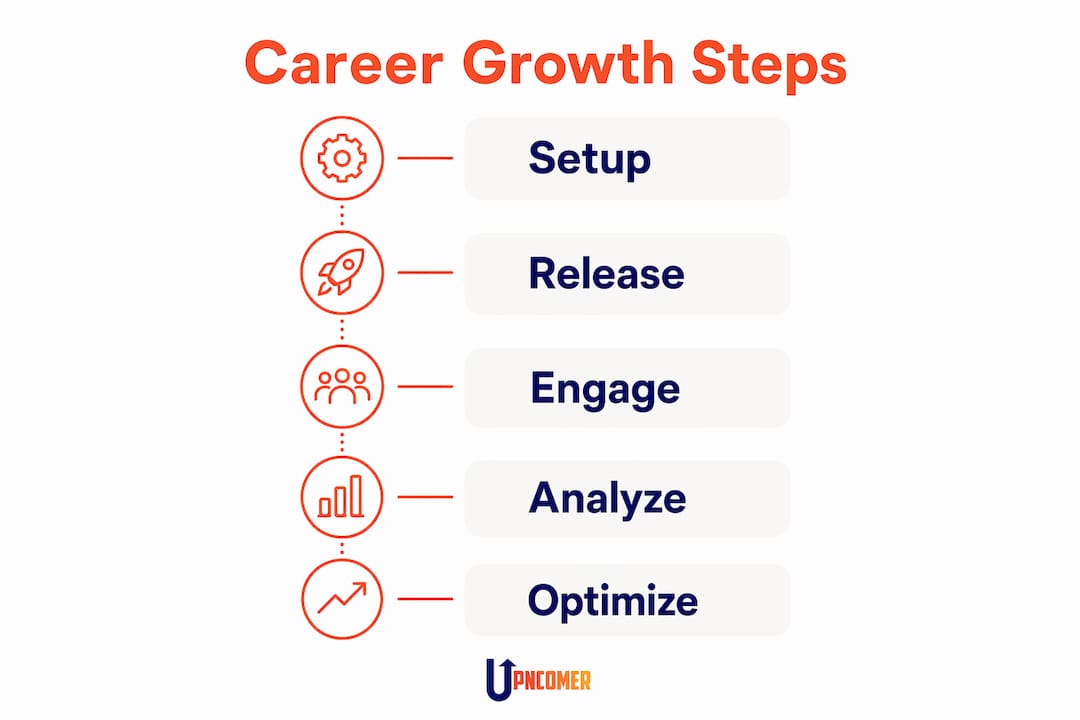
Treating your career as a business separates sustainable artists from talented ones who never break through. The growth engine has six components, and every section of this guide maps to one of them.
- Release strategy: A consistent cadence that feeds algorithms and keeps fans engaged.
- Audience building: Converting algorithmic reach into owned channels (email, Discord, Patreon).
- Analytics and KPIs: Tracking intent signals, not vanity metrics, to make smarter decisions.
- Monetization: Stacking revenue from live, merch, sync, memberships, and streaming.
- Operations and team: Knowing what to own, what to delegate, and when.
- Tools and automation: Reducing repetitive work so you can focus on creating.
Upncomer’s Growth Engine module maps directly to release strategy and planning. Data Analyst covers your KPI layer. Distribution handles store delivery. Think of these six components as the gears — when they turn together, the engine runs.
Pro Tip: Focus on the component that’s currently your biggest bottleneck. Early-stage artists almost always need release strategy and audience building first. Monetization comes after you have a signal.
How to build a release strategy that actually works
Singles every 4–8 weeks is the right cadence for most independent artists. That frequency gives TikTok seeding windows time to build, keeps DSP algorithms fed with fresh data, and prevents the “one big release, then silence” pattern that kills momentum.
Use this timeline for every single:
| Weeks Before Release | Task |
|---|---|
| T-8 weeks | Finalize mix/master; register ISRC; confirm metadata |
| T-6 weeks | Submit to editorial playlists (3–4 weeks minimum lead time) |
| T-4 weeks | Upload to distributor; launch pre-save landing page; brief 20–40 micro creators |
| T-2 weeks | Publish content calendar; schedule social assets; confirm artwork |
| T-1 week | Send creator assets; schedule release-day posts |
| Release day | Push email list; activate Discord; post across all platforms |
| Post-release (weeks 1–2) | Pitch user-curated playlists; analyze save rate and completion rate; plan follow-up content |
Your pre-release checklist should include: metadata accuracy, ISRC registration, artwork at correct specs, pre-save landing page live, and editorial pitch submitted. Post-release: engagement push within 24 hours, playlist outreach to independent curators, and a 14-day KPI review.
Pro Tip: Ship at 90% finished rather than waiting for perfect. Cadence builds careers; perfection breaks them.
How do you build an audience you actually own?
Owned audiences are more valuable than rented reach. An algorithm can bury your profile overnight. Your email list cannot be taken away. Discord communities, Patreon memberships, and direct email lists are the assets that compound over time.
Here’s how to build them:
- Email lead magnets: Offer an exclusive acoustic version or unreleased demo in exchange for an email address on your pre-save page.
- Discord community playbook: Create channels for behind-the-scenes content, early listens, and direct Q&A. Give superfans a reason to stay.
- Creator seeding: Brief 20–40 micro creators in your content category on TikTok before release. Ongoing partnerships outperform one-off campaigns every time.
- Activation flow: Pre-save → gated lead magnet → email nurture sequence → release-day activation message → post-release re-engagement.
Explore fan engagement platforms to find the community tools that fit your workflow. Upncomer’s fan engagement system and Content Creator module can automate the scheduling side of this flow so you’re not doing it manually every cycle.
Pro Tip: When pitching playlist curators, use your creator content as social proof. A TikTok with 50K plays is a stronger pitch than a cold email.
What KPIs actually predict growth for independent artists?
Stop watching follower counts. Intent signals predict growth; vanity metrics do not. DSPs use saves, full listens, playlist adds, and repeat plays to decide who gets recommended next.
| Metric | Why It Matters | How to Measure | Benchmark Guidance |
|---|---|---|---|
| Save rate | Shows listener intent to return | Spotify for Artists | Early: any saves are positive; growing: aim higher over time |
| Completion rate | Signals song quality to algorithms | DSP dashboards | Higher is better; drops signal a hook or structure issue |
| Playlist adds | Expands discovery reach | Spotify for Artists / Apple Music for Artists | Track week-over-week growth |
| Repeat listens | Strongest intent signal | Streaming analytics dashboards | Even a small repeat-listen rate is meaningful early on |
| Email open rate | Measures owned-audience health | Email platform analytics | Industry average varies; track your own trend |
Check saves and completion rate weekly for the first 14 days after release. If your save rate is low after two weeks, adjust your seeding strategy before the next drop. Monthly, review audience data trends across all platforms to spot which channels are converting listeners into fans. Upncomer’s Data Analyst and Amplitude AI automate this monitoring and flag anomalies so you’re not manually pulling reports.
How do you build multiple revenue streams as an indie artist?
Streaming alone rarely sustains independent artists at early stages. Stack revenue from multiple sources and treat streaming as the top of your funnel, not the paycheck.
| Revenue Source | Time to Income | Effort Level |
|---|---|---|
| Live shows / ticketing | Near-term | Medium |
| Merch | Near-term | Medium |
| Direct memberships (Patreon) | Medium-term | Low once set up |
| Sync licensing | Longer-term, higher per placement | High (catalog fit required) |
| Teaching / session work | Near-term | Medium |
| Streaming royalties | Ongoing, slow build | Low |
A basic monthly budget outline: track your fixed costs (distribution, tools, recording), set a promotion budget per release, calculate your cash runway, and set a conversion target — how many monthly listeners do you need to turn into buyers or supporters to cover costs? Read more about fan revenue strategies to sharpen your monetization thinking.
Pro Tip: Prioritize predictable, owned income — memberships and teaching — during early stages. They stabilize cash flow while streaming builds slowly.
What should you handle yourself vs. outsource?
Keep strategy and audience relationships in-house. Outsource specialized scaling tasks when the cost is less than the value of your time. Integrating creative, business, and self-management time into overlapping cycles produces better long-term outcomes than treating them as separate jobs.
Core roles and who owns what:
- Self-manager (you): Strategy, fan relationships, creative direction, KPI review.
- Content producer: Social assets, video editing — outsource when volume exceeds your capacity.
- Publicist: Press outreach, blog placements, media relations — outsource when a release warrants press coverage. Upncomer’s Publicist module automates pitching workflows.
- Booking rep: Live show negotiation — outsource once you have consistent demand.
- Mixing/mastering engineer: Outsource or use Upncomer’s UrStudio for AI-assisted mastering.
- Data analyst: Outsource the reporting layer to Upncomer’s Data Analyst module.
Decision rule: if a task takes more than two hours per week and doesn’t require your creative judgment, it’s a candidate for outsourcing or automation.
How can automation and AI speed up your workflow safely?
Automation should reduce repetitive work while preserving your creative decision points. Scheduling, reporting, and A/B testing ad creatives are all safe to automate. The story behind the music is not.
Practical use cases:
- Content scheduling: Queue social posts across platforms in advance using Upncomer’s Content Creator module.
- Auto-reporting dashboards: Pull streaming and ad data into a single view without manual exports.
- AI-assisted mastering: Upncomer’s UrStudio delivers fast, consistent masters without a full studio session.
- Playlist pitching reminders: Automate follow-up sequences so no curator outreach falls through the cracks.
- Ad creative variation testing: Run multiple versions of a short-form video ad and let performance data pick the winner.
Risk guardrails to keep in mind: always review AI-generated content before publishing, double-check metadata accuracy on every release, and verify copyright clearance on any sample or interpolation. Using AI tools safely means keeping humans in the loop on anything that touches your brand or legal standing.
Your 90-day starter plan: from setup to first three releases
Follow this sequence to go from zero infrastructure to your first three releases and an initial owned audience.
Weeks 1–2 (Setup, ~8 hours): Register on all major DSPs, set up your artist profiles, create your email capture page, and choose your distribution channel. Map your first three release dates on a calendar.
Weeks 3–5 (First release cycle, ~10 hours): Submit your first single to editorial playlists, brief your first batch of micro creators, and launch your pre-save page. Build your email nurture sequence.
Weeks 6–8 (Growth activities, ~8 hours): Release single one, push to your email list and Discord, analyze 14-day KPIs, and begin creator outreach for single two.
Weeks 9–12 (Optimization, ~6 hours/cycle): Release singles two and three using the same workflow. Run a quarterly review of top-of-funnel discovery, owned-audience conversion, and revenue per fan.
| Phase | Key Tasks | Hours/Week | Priority |
|---|---|---|---|
| Setup (weeks 1–2) | Profiles, email capture, release calendar | 4 | A |
| First release (weeks 3–5) | Editorial pitch, creator brief, pre-save | 5 | A |
| Growth (weeks 6–8) | Release, KPI review, creator outreach | 4 | A |
| Optimization (weeks 9–12) | Repeat cycle, quarterly review, budget check | 3 | B |
Data-driven decisions at each phase keep you from wasting budget on tactics that aren’t working.
Key Takeaways
Sustainable music career management means running a repeatable system: consistent releases, owned audiences, and KPI-driven decisions that compound over time.
| Point | Details |
|---|---|
| Release cadence | Singles every 4–8 weeks feed DSP algorithms and maintain fan momentum. |
| Owned audiences | Email lists, Discord, and Patreon give you direct fan access no algorithm can remove. |
| Intent signals | Track saves, completion rate, and repeat listens — not follower counts — to predict growth. |
| Revenue stacking | Combine live, merch, memberships, sync, and streaming; no single source is enough early on. |
| Upncomer as your system | Upncomer’s Growth Engine, Amplitude AI, and Data Analyst modules operationalize every component of this playbook in one place. |
The part most artists skip
Most of the artists I see struggle aren’t lacking talent or even work ethic. They’re missing a system. They release a track, watch the streams for a week, feel deflated, and wait too long before the next one. The growth engine framing in this guide exists because the music industry has changed: algorithms reward consistency and intent signals, not one-off moments. What Upncomer’s team built with Amplitude AI and the Growth Engine came directly from watching independent artists burn out trying to manage six disconnected tools at once. The platform’s mission is to give DIY artists the same operational infrastructure a label team would provide, without the loss of creative or financial control. That’s not a marketing line. It’s the reason the product exists.
Upncomer gives you the whole growth engine in one place
Running this playbook across six separate tools is where most independent artists lose momentum. Upncomer is an AI-powered operating system that maps directly to every component of the growth engine covered here: Growth Engine for release planning, Amplitude AI for intent-signal monitoring and alerts, Distribution for getting your music to every major store, Artist Manager for workflow and task tracking, Data Analyst for KPI dashboards, UrStudio for AI mastering, and Content Creator for social assets. Instead of stitching together a fragmented stack, you get one unified system built specifically for independent artists who want to move fast without losing control.
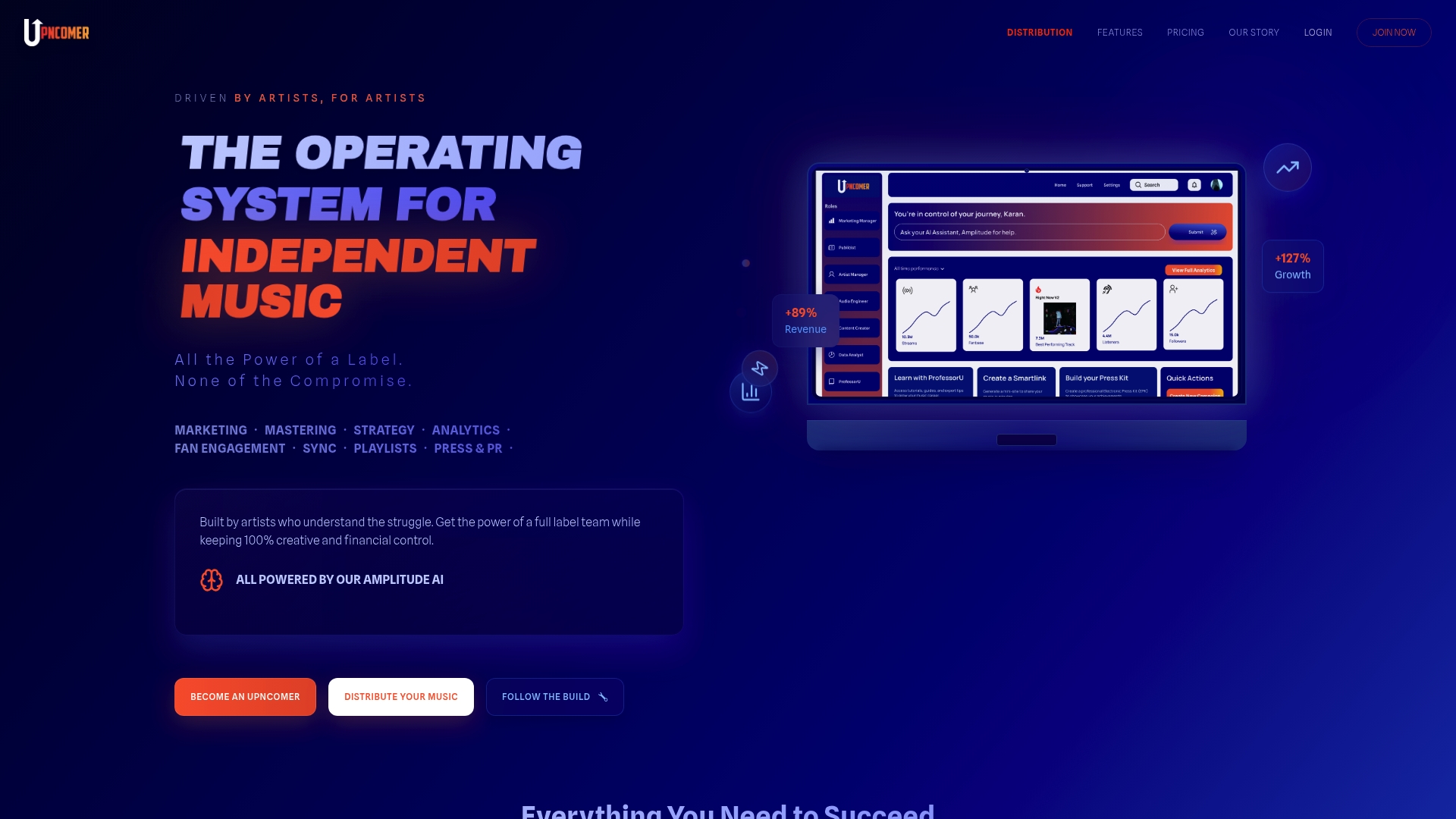
The clearest next step is to see the full feature set and decide which modules fit your current stage. Visit Upncomer’s features page to explore the platform, or check community updates for ongoing education, product news, and resources built for DIY artists like you.
Useful sources and further reading
- Berklee: Music Marketing Strategies — Foundational research on release cadence and DSP discovery in a singles economy.
- IQ Artist Management: Artist Career Development — Strategic growth frameworks and the business-literacy argument for structured planning.
- Slow Oak Studio: Independent Artist Marketing Strategy 2026 — Intent signals, owned audiences, and creator seeding playbooks.
- AndR. Learning Center: DIY Marketing Strategy 2026 — Release timelines, distribution lead times, and low-budget organic stacks.
- Liminl: Music Marketing for Indie Artists 2026 — Owned-channel strategies and Discord/email community building.
- Cari Cole: Music Career Self-Management 101 — Integrating creative, business, and self-care cycles for long-term sustainability.
- Upncomer Blog: Music Analytics Practical Guide — Step-by-step KPI setup and dashboard configuration for independent artists.
- Upncomer Blog: Artist Campaign Management Best Practices — Campaign timelines, automation workflows, and reporting templates.
FAQ
What is music career management for independent artists?
Music career management is the practice of running your music career as a structured business: planning releases, building owned audiences, tracking KPIs, and stacking revenue streams. Independent artists who apply systematic career planning generate materially stronger outcomes than those relying on talent alone.
How often should an independent artist release music?
One single every 4–8 weeks is the recommended cadence for most independent artists. Berklee research confirms this frequency keeps DSP algorithms fed with data points and maintains fan engagement between releases.
Which streaming metrics actually matter for growth?
Focus on saves, completion rate, playlist adds, and repeat listens. These intent signals are what DSPs use to decide who gets recommended next, making them far more predictive than total stream counts or follower numbers.
Can Upncomer replace a full management team?
Upncomer functions as an AI-powered operating system that covers the operational layer: release planning, analytics, distribution, mastering, content scheduling, and fan engagement. It reduces the need for multiple disconnected tools and gives solo artists the infrastructure of a full team.
How long does it take to see results from a consistent release strategy?
Most independent artists begin to see measurable algorithmic traction within two to three release cycles when they combine consistent cadence with creator seeding and owned-audience capture. The compounding effect builds over months, not weeks.