Music Marketing Tools for Independence: 2026 Artist Guide

The most effective music marketing tools for independence in 2026 are Spotify for Artists, Feature.fm, Linkfire, Chartmetric, SubmitHub, Groover, Mailchimp, Buffer, Canva, Hypeddit, and NotNoise. Used together with a consistent release cadence and owned audience strategy, these tools give independent artists the infrastructure to grow without a label. The core insight: no single tool wins alone. The artists building real careers are combining smart links, playlist pitching, email capture, and social scheduling into a repeatable system.
Here is what that system looks like in practice:
- Distribution and DSP presence: Get your music on every major platform and claim your Spotify for Artists profile immediately.
- Smart links: Use Feature.fm or Linkfire to send fans to their preferred streaming service from a single URL.
- Playlist pitching: Submit to Spotify editorial through Spotify for Artists, then reach independent curators via SubmitHub or Groover.
- Email marketing: Build your list with Mailchimp and treat it as your most valuable asset.
- Social content scheduling: Use Buffer to plan posts in advance and stay consistent without burning out.
- Design: Canva handles release graphics, press kits, and social visuals without a designer.
- Analytics: Chartmetric gives you cross-platform data so you know what is actually working.
- Fan engagement: Hypeddit and NotNoise round out the stack for giveaways, lead capture, and niche playlist placement.
Upncomer offers an integrated alternative for artists who want all of these functions inside one platform, powered by AI.
What music marketing tools for independence actually do for your career

The tools above are only as useful as the strategy behind them. Here is how to put them to work.
Build your online presence first
Your website is the one place you fully control. Social platforms keep people scrolling; your site captures emails, sells merch, and tells your story without distraction. Use the same handle across every platform so fans can find you without guessing. Beyond your site, claim your profile on every major DSP: Spotify, Apple Music, Amazon Music, YouTube Music, and SoundCloud. Spotify for Artists and Apple Music for Artists both let you customize your profile, pitch to editorial playlists, and track listener data.
Bandsintown is worth setting up early too. It syncs your tour dates automatically and notifies fans when you play near them, which is passive promotion you would otherwise have to manage manually.
Structure your release campaigns around a timeline
A structured 8-week release campaign starting 3–4 weeks pre-release with editorial pitching is the standard that consistently outperforms ad-hoc launches. Upload to your distributor at least four weeks out. Submit to Spotify editorial through Spotify for Artists at least 7 days before release, though three to four weeks is the realistic target for a real shot at placement. Be specific in your pitch: genre, mood, and comparable artists give curators something to work with. “Cinematic pop with an uplifting feeling” is too vague. Name the emotional register and cite a reference artist.
Pro Tip: Spotify’s editorial pitch window closes the moment your track goes live. Miss it once and there is no retroactive path in. Build the pitch into your release calendar as a hard deadline, not an afterthought.
Two weeks before release, launch your pre-save campaign using your smart link tool. Feature.fm and Linkfire both let you build a landing page that captures emails while fans pre-save. That email list becomes your release-day asset.
Release consistently, not constantly
Releasing singles every 6 to 8 weeks satisfies streaming algorithms and keeps listeners engaged without burning you out. This frequency feeds Discover Weekly and Release Radar while giving each track enough runway to build momentum. One announcement post on release day is not a campaign. Plan content for at least two weeks after the drop.
Social media: platform by platform
TikTok is still the highest-leverage discovery platform for independent artists. The mechanism that works is seeding your audio with relevant creators before release, not just posting your own videos constantly. Instagram operates as the follow-up layer: someone finds you on TikTok, searches for you, and your grid and bio decide whether they stay. YouTube sits in its own category as the second-largest search engine in the world. Music videos, lyric videos, and studio sessions drive discovery through search for months after posting.
Facebook remains useful for paid ad targeting, particularly for older demographics and event promotion. Snapchat has a younger audience and works best for behind-the-scenes content that feels raw and unpolished. Each platform rewards different formats, so tailor your content rather than cross-posting the same asset everywhere.
Email marketing is your owned audience
An email list safeguards you from algorithm changes and platform shutdowns in a way that no follower count can. Social accounts get hacked. Platforms restrict reach. Your email list is yours. Mailchimp’s free tier supports up to 500 subscribers with basic automation, which is enough to get started. Use segmentation to send show announcements only to fans in the relevant city. Send your most engaged subscribers exclusive previews before the public release date.
Before spending on paid ads, aim for at least 1,000 followers and 200 email subscribers as baseline validation. Below that threshold, ad budgets tend to evaporate without meaningful conversion.
Audience segmentation and ROI tracking
Chartmetric lets you track performance across Spotify, Apple Music, YouTube, TikTok, and Instagram from one dashboard. Use it to identify which playlists are driving saves, which markets are growing, and which content formats are converting listeners into followers. ROI for indie artists is not just streams: it is email signups per campaign, save rate per release, and cost per new follower from paid ads. Track those numbers per release and you will know exactly where to put your next dollar.
How do the top music marketing tools compare?
Every tool in this stack serves a distinct function. The table below maps each one against the dimensions that matter most for independent artists making real decisions.
| Tool | Best For | Free Tier | Ad Campaign Support | Analytics | Email Capture | Pricing |
|---|---|---|---|---|---|---|
| Spotify for Artists | Playlist pitching and streaming analytics | Yes | No | Yes (streaming) | No | Free |
| Feature.fm | Smart links and ad campaigns | Yes | Yes | Yes | Yes | Free to paid |
| SubmitHub | Playlist and blog submissions | Yes (limited) | No | Basic | No | Free to paid |
| Groover | Curator pitching with feedback | No | No | Basic | No | Credit-based |
| Hypeddit | Fan giveaways and lead capture | Yes | No | Basic | Yes | Free to paid |
| NotNoise | Niche playlist pitching | No | No | Basic | No | Paid |
| Linkfire | Smart links and traffic analytics | Yes | No | Yes (deep) | No | Free to paid |
| Chartmetric | Cross-platform analytics | Yes (limited) | No | Yes (advanced) | No | Free to paid |
| Mailchimp | Email marketing and automation | Yes | No | Yes (email) | Yes | Free to paid |
| Buffer | Social media scheduling | Yes | No | Yes (social) | No | Free to paid |
| Canva | Marketing design and visuals | Yes | No | No | No | Free to paid |
| YouTube | Video discovery and search | Yes | Yes | Yes | No | Free |
| Paid ads and community | Yes | Yes | Yes | No | Free | |
| Visual branding and Reels | Yes | Yes | Yes | No | Free | |
| TikTok | Organic discovery | Yes | Yes | Yes | No | Free |
| Snapchat | Behind-the-scenes content | Yes | Yes | Basic | No | Free |
| Bandsintown | Tour promotion and fan alerts | Yes | No | Basic | No | Free to paid |
Smart links: Feature.fm vs. Linkfire
Feature.fm is the stronger pick if you want ad campaign management built into your smart link workflow. It integrates streaming tracking, email capture, and retargeting in one place, which matters when you are running a pre-save campaign and want to know exactly how many fans converted. Linkfire goes deeper on analytics, with integrations across more DSPs and granular data on where your traffic originates. For artists who prioritize data over campaign management, Linkfire edges ahead.
Playlist pitching: SubmitHub vs. Groover
SubmitHub returns curator feedback even on rejections, which makes it genuinely useful for learning what is and is not landing about your music. Groover operates on a credit system where curators are contractually obligated to respond within seven days, giving you direct artist-to-curator communication with a guaranteed reply. Both are worth using. SubmitHub works better for volume outreach across blogs and playlists; Groover is better when you want quality feedback from specific curators.
NotNoise sits in a narrower lane: a curated network of independent playlist managers focused on niche genres. If your sound does not fit mainstream playlist categories, NotNoise often reaches audiences that SubmitHub and Groover miss.
Analytics: Chartmetric vs. Spotify for Artists
Spotify for Artists gives you streaming-specific data: saves, listener-to-stream ratio, source of streams, and playlist placements. Chartmetric pulls data from Spotify, Apple Music, YouTube, TikTok, Instagram, and more into a single view. For artists releasing across multiple platforms, Chartmetric is the more complete picture. Spotify for Artists remains non-negotiable regardless, because it is the only way to access the editorial pitch form.
Social scheduling and design
Buffer handles multi-platform scheduling with a clean interface and a free tier that covers three to ten posts per platform. Pair it with Canva for release graphics, press kit assets, and social templates. Canva’s free tier handles most needs; the Pro plan adds brand kits and premium templates, which become worth it once you are releasing consistently.
Key differentiators at a glance
- Hypeddit is the only tool in this stack built specifically for fan giveaways and contest-based email capture.
- Mailchimp’s segmentation features let you send location-specific show announcements, which no social platform replicates reliably.
- Bandsintown automates tour date promotion to fans who have already opted in, making it one of the highest-ROI tools for touring artists.
- YouTube’s search-driven discovery compounds over time in a way that TikTok’s algorithm-driven feed does not.
How do you build a sustainable marketing infrastructure with AI?
The artists who grow consistently treat marketing as a system, not a series of one-off campaigns. That system has four layers: distribution, analytics, audience ownership, and campaign automation. AI-powered platforms are changing how quickly independent artists can build and operate that system.
As of 2026, there are 106,000 new tracks released daily on streaming platforms—a 7% increase from the previous year—so standing out is not about working harder. It is about working smarter with better data.
Marketing amplifies music that already resonates organically. If the signal is weak, spending money and energy on promotion means more people hear something forgettable, faster. Build organic traction first, then amplify what is already connecting.
The practical sequence looks like this. Start with organic validation: post consistently on one or two platforms, track which content gets saves and shares, and identify the songs that generate repeat listens without paid support. Once you have that signal, paid promotion amplifies it rather than manufacturing it from scratch.
Upncomer is built around exactly this model. Its Amplitude AI module gives artists real-time guidance on release timing, ad optimization, and audience insights without requiring a separate analytics subscription. The Growth Engine manages campaign automation, the Data Analyst surfaces cross-platform performance data, and the Artist Manager module helps coordinate release planning across the full timeline. For artists juggling distribution, playlist pitching, email capture, and social content simultaneously, having those functions inside one platform reduces the cognitive load that burns most independents out before they gain traction.
The DIY marketing approach emphasizes keeping your tool stack lean, ideally under $100 per month for essentials. AI platforms like Upncomer change that calculus by replacing several single-purpose subscriptions with one integrated system. You keep full creative and financial control while accessing the kind of infrastructure that used to require a label or an expensive agency.
Pro Tip: Validate organic engagement before running any paid campaign. An ad that sends cold traffic to a song with a low save rate will not fix the underlying problem. It will just make more people skip it.
Audience ownership is the foundation everything else sits on. Successful independent marketing treats email lists, organic engagement, and validated release momentum as a system, not isolated tactics. Upncomer’s fan engagement tools and Distribution module connect those layers so your release momentum carries through to your email list and back into your next campaign.
How these tools were evaluated
The tools featured in this guide were assessed using a combination of real campaign data from independent artist releases, published user reviews across platforms including Trustpilot and the App Store, and hands-on evaluation of each tool’s core workflow. The evaluation criteria covered five dimensions: feature depth relative to price, free tier usability for early-stage artists, quality of analytics and reporting, ease of integration with other tools in a typical indie stack, and responsiveness of customer support.
Pricing tiers were verified directly from each platform’s published plans. Tools were excluded if they required minimum spend thresholds that put them out of reach for artists under $100 per month. The comparison prioritizes tools available to US-based independent artists without geographic restrictions.
What do independent artists need to know about data privacy?
Every tool in your marketing stack collects data, and as an independent artist, you are responsible for how that data is handled, both legally and ethically.
The most immediate compliance concern for US-based artists is the CAN-SPAM Act, which governs commercial email. Every marketing email you send through Mailchimp or any other platform must include a physical mailing address, a clear unsubscribe option, and honest subject lines. Mailchimp’s compliance tools handle most of this automatically, but you still need to understand what you are agreeing to when you import a contact list.
If you have fans in the European Union, the General Data Protection Regulation (GDPR) applies to your email list regardless of where you are based. That means explicit opt-in consent, the right to be forgotten on request, and clear disclosure of how you use subscriber data. Mailchimp and most major email platforms offer GDPR-compliant signup forms out of the box.
For social platforms, read the data-sharing terms before connecting third-party tools. Some analytics integrations request broader permissions than they need. Grant only the minimum access required and audit your connected apps periodically. Chartmetric, for example, pulls public streaming and social data rather than requiring account-level access, which limits your exposure.
Smart link tools like Feature.fm and Linkfire collect fan click data and sometimes email addresses through pre-save pages. Make sure your landing page includes a clear privacy notice explaining what data you collect and how you use it. This is not just a legal requirement in many jurisdictions. Fans who trust you with their email address are more likely to stay subscribed and buy from you later.
Key Takeaways
The most effective independent music marketing in 2026 combines owned audience building, consistent release cadence, and platform-specific content, with tools chosen for integration rather than feature count.
| Point | Details |
|---|---|
| Release cadence drives discovery | Releasing singles every 6 to 8 weeks satisfies streaming algorithms and sustains listener engagement. |
| Email is your most durable asset | An owned email list protects you from algorithm changes and platform shutdowns that erode social followings. |
| Validate before you spend | Build at least 1,000 followers and 200 email subscribers before running paid ads to avoid wasted budget. |
| Match tools to your stage | Early-stage artists need distribution, a smart link, and Mailchimp. Add Chartmetric and paid promotion once organic traction is established. |
| Upncomer unifies the stack | Upncomer combines analytics, campaign management, AI guidance, and distribution in one platform, replacing several single-purpose subscriptions. |
The real cost of building your stack one tool at a time
Most independent artists start by grabbing whatever free tool solves the immediate problem. That works until you have six subscriptions that do not talk to each other, data scattered across four dashboards, and no clear picture of what is actually driving growth.
The conventional advice is to keep your stack lean and under $100 per month. That is sound guidance for the early stage. But the hidden cost is not the money. It is the time you spend switching between platforms, reconciling data, and rebuilding your workflow every time one tool changes its pricing or drops a feature you relied on.
What actually works long-term is treating your marketing infrastructure the same way you treat your recording setup: invest in tools that work together, learn them properly, and stop chasing every new platform that promises viral growth. TikTok is powerful, but it is not a strategy by itself. Groover gets you curator feedback, but feedback without a strong release plan does not move the needle. The artists who grow are the ones who pick a system and repeat it long enough for it to compound.
There is also a tendency to over-index on follower counts and playlist placements as the primary metrics. Save rate on Spotify, email open rate, and repeat listens are better indicators of whether your music is actually connecting. A song with 500 saves from warm listeners will outperform a song with 50,000 streams from cold playlist traffic almost every time, because the algorithm reads engagement signals, not raw numbers.
The 2026 independent music market rewards artists who treat their career like a business without losing the creative instinct that made people care in the first place. That balance is harder than it sounds, and no tool automates it for you. What the right tools do is remove the friction so you can spend more time on the part that actually matters.
Upncomer brings your whole marketing operation together
Juggling six separate tools for distribution, analytics, smart links, email, design, and campaign management is exactly the kind of friction that slows independent artists down. Upncomer was built to replace that fragmented setup with one AI-powered platform designed specifically for musicians who want to grow without a label.
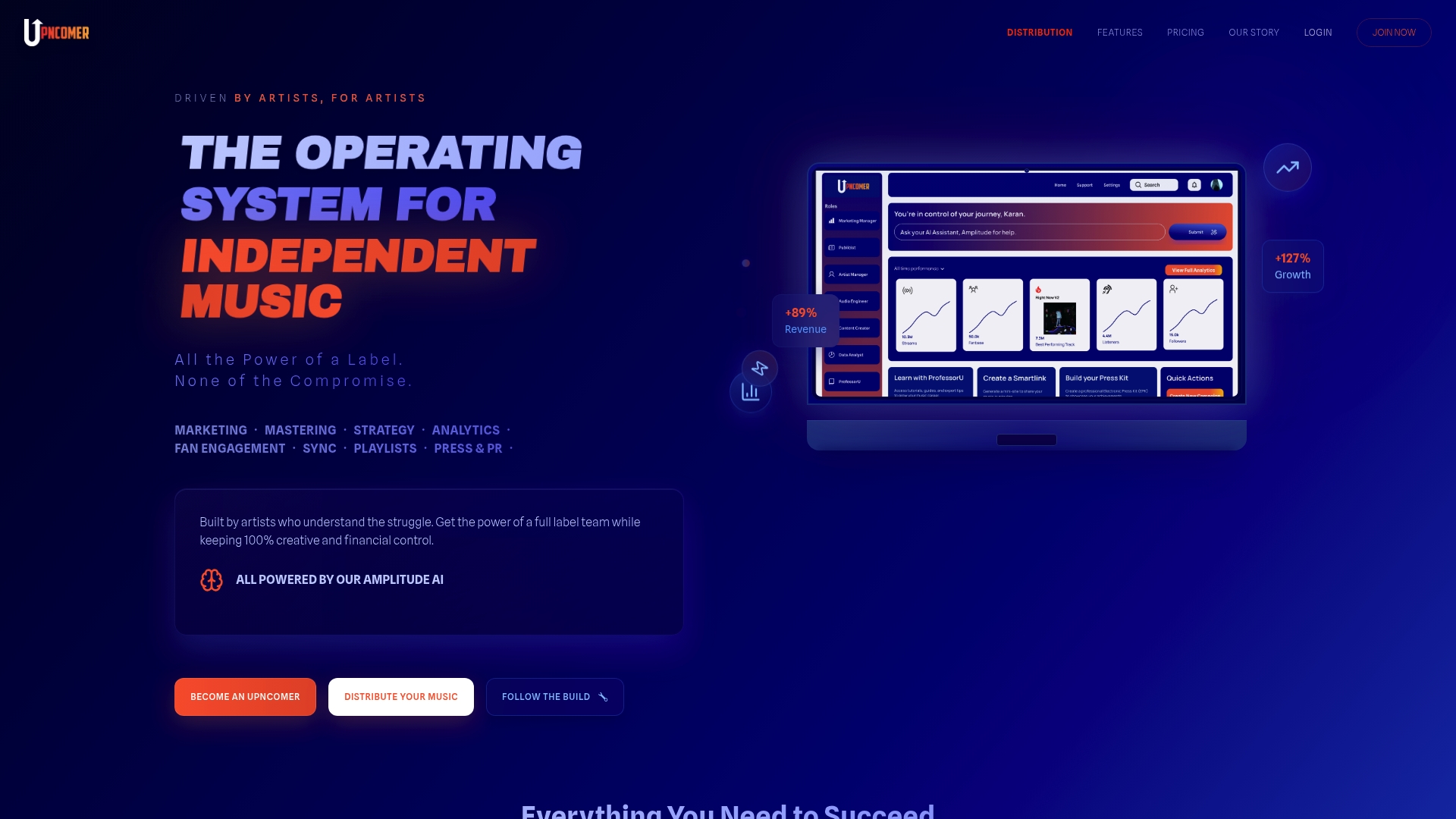
The platform’s full feature set covers everything from Amplitude AI-driven release guidance and ad campaign management to streaming analytics, fan engagement, AI mastering through UrStudio, and smart links, all inside one dashboard. The Growth Engine handles campaign automation. The Publicist module supports press outreach. ProfessorU gives you on-demand music industry education. Distribution gets your music to every major DSP without the per-release fees that add up fast. For independent artists who are serious about building a data-driven career, Upncomer is the alternative to paying for five tools that were never designed to work together.
FAQ
What are the most important music marketing tools for independent artists?
Spotify for Artists, a smart link tool like Feature.fm or Linkfire, an email platform like Mailchimp, and a social scheduler like Buffer form the core stack. Add Chartmetric for cross-platform analytics once you have consistent release activity.
How early should you pitch Spotify editorial playlists?
Submit through Spotify for Artists at least 7 days before your release date, though 3–4 weeks is the realistic target for a real shot at placement. The pitch window closes permanently once the track goes live.
When should independent artists start running paid ads?
Build at least 1,000 followers and 200 email subscribers before spending on paid ads. Below that threshold, ad budgets tend to produce minimal returns because the audience pool is too small for efficient conversion.
What is the best release cadence for independent artists?
Releasing singles every 6 to 8 weeks is the cadence that best satisfies streaming algorithms while keeping listeners engaged, according to Berklee College of Music guidance on discovery strategy.
Can Upncomer replace multiple single-purpose marketing tools?
Yes. Upncomer combines distribution, smart links, analytics, campaign management, AI mastering, fan engagement, and educational resources in one platform, replacing the fragmented stack most independent artists currently use.