Why Artists Need Audience Data to Grow Their Careers

Audience data is the structured information independent artists collect about who listens to their music, where those listeners live, and how they engage across platforms. Understanding why artists need audience data is no longer optional in 2026. It is the difference between guessing what your fans want and knowing it. Tools like Spotify for Artists, Upncomer’s Amplitude AI, and social media analytics platforms give you direct access to demographic breakdowns, behavioral patterns, and geographic trends that used to require a label’s budget to uncover. The artists building sustainable careers right now are not just making great music. They are reading the numbers behind it.
Why artists need audience data: the core case
Audience data, in industry terms often called first-party fan data or audience analytics, covers every measurable signal your fans leave behind. That includes age, gender, location, listening frequency, saves, shares, playlist adds, and direct engagement on platforms like Instagram, TikTok, and YouTube. Each of those signals tells you something a gut feeling cannot.
The importance of audience data for artists becomes obvious when you consider what AI-driven analysis can surface. Billie Eilish’s “Bad Guy” showed a 40% higher playlist addition rate among target demographics detected by AI tools. That kind of signal tells a team exactly where to focus promotional energy. Without it, you are spending money and time in the dark.

For independent artists without a label’s infrastructure, this matters even more. You are your own A&R, marketing director, and tour manager. Audience data gives you the same strategic clarity that major-label teams pay analysts to produce.
What types of audience data are most valuable to artists?
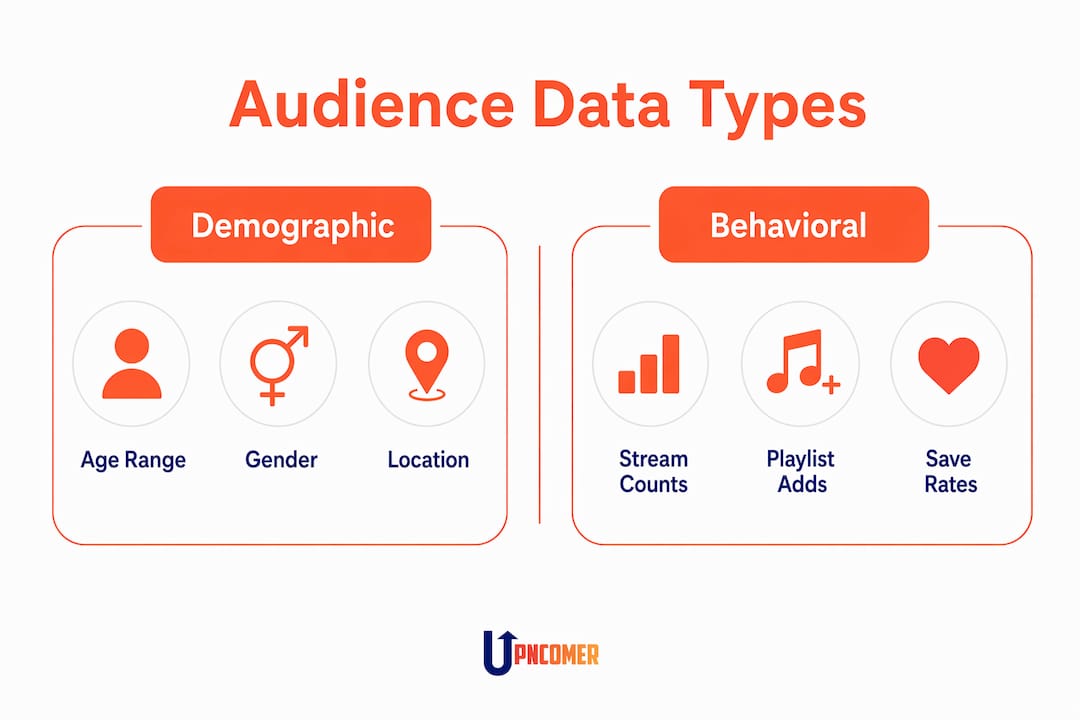
Not all data is equally useful. The most valuable types fall into two categories: demographic data and behavioral data.
Demographic data tells you who your audience is. Age range, gender split, and geographic location are the three pillars. If 60% of your listeners are between 18 and 24 and concentrated in Atlanta and Houston, that shapes every decision from release timing to tour routing.
Behavioral data tells you how your audience engages. Stream counts, save rates, skip rates, playlist additions, and social shares all reveal the depth of connection. A song with a high save rate signals that listeners want to return to it. A high skip rate on a track’s intro tells you something specific about the arrangement.
Here is a practical comparison of data types and where to find them:
| Data type | What it tells you | Where to find it |
|---|---|---|
| Geographic location | Where your listeners are concentrated | Spotify for Artists, Apple Music for Artists |
| Age and gender | Who your core audience is | Instagram Insights, TikTok Analytics |
| Save and skip rates | How deeply fans connect with tracks | Spotify for Artists |
| Playlist additions | Organic discovery and resonance | Spotify for Artists, Chartmetric |
| Email open and click rates | Engagement depth of owned audience | Mailchimp, ConvertKit |
| Ticket buyer data | Real-world fan location and intent | Venue CRM, Eventbrite |
Beyond platform dashboards, owned data sources like email lists, SMS subscribers, and direct ticket sales give you information no algorithm can take away. Ticket buyer data sharing between venues and artists is now recognized as a key factor in smarter tour routing and reducing promoter risk. That is data you own and control.
Pro Tip: Export your Spotify for Artists data monthly and cross-reference it with your social analytics. Patterns that appear across multiple platforms are the ones worth acting on.
How audience data transforms your marketing strategy
Once you know who your audience is and how they behave, you can stop broadcasting to everyone and start speaking directly to the people most likely to respond. That shift is where data-driven music marketing separates working artists from struggling ones.
Here is a practical sequence for using audience insights to sharpen your marketing:
-
Identify your highest-engagement locations. If your streaming data shows strong listener concentration in Chicago and Miami, those are your priority cities for ad spend, press outreach, and tour stops. Do not spread your budget evenly across the country.
-
Match your content format to platform behavior. If your TikTok audience skews 18 to 22 and your Instagram audience skews 25 to 34, those two groups want different content. Short, high-energy clips for TikTok. Behind-the-scenes or story-driven content for Instagram.
-
Use engagement data to inform playlist pitching. Songs with high save rates and strong skip-through performance are your strongest pitching candidates. Understanding which tracks resonate helps you pitch playlists effectively rather than submitting blindly.
-
Build owned channels based on where fans are most active. If your email list converts better than your social following, double down on growing it. First-party fan data consistently outperforms platform algorithms for building long-term fan relationships. Algorithms change. Your email list does not.
-
Time your releases around audience activity peaks. Analytics platforms show you when your audience is most active by day and hour. Releasing on a Friday at 12 PM EST is a default, but your audience might peak on Thursday evenings. Use the data.
Pro Tip: Set a recurring monthly calendar block to review your streaming and social analytics together. Thirty minutes of focused review beats two hours of scattered checking.
Why owning your audience data is crucial for a lasting career
Here is the uncomfortable reality: streaming platforms control most of the fan data you generate. Platforms monetize fan behavior data but share only simplified dashboards with artists. You can see total streams and top cities, but you cannot export individual listener profiles, contact details, or behavioral histories. That data belongs to Spotify, not to you.
This is why building direct-to-fan data infrastructure is one of the most important things an independent artist can do. The benefits of owning your audience data include:
- Tour confidence. When you know exactly where your fans are concentrated, you can book venues with accuracy instead of hope. You stop playing 300-capacity rooms in cities where you have 50 listeners and start targeting markets where demand already exists.
- Smarter release planning. Owned data tells you when your audience is growing fastest, which informs the best windows for new releases. A music release checklist built around real audience data performs better than one built around industry convention.
- Budget control. Knowing which platforms and channels drive the most engaged fans means you stop wasting money on ads that reach the wrong people.
- Resilience against algorithm changes. When a platform shifts its recommendation logic, artists with strong email lists and SMS audiences barely feel it. Artists who relied entirely on algorithmic reach lose momentum overnight.
“Algorithms are only useful for discovery. Real career stability demands controlling owned fan data.” — Sonikit
The practical move is to treat every platform as a top-of-funnel discovery tool and every owned channel as your long-term asset. Convert streaming listeners into email subscribers. Convert social followers into SMS contacts. That is how you build a career that does not depend on any single platform’s goodwill.
How to interpret audience data and make smarter career decisions
Collecting data is step one. Reading it correctly is where most independent artists fall short. The goal is not to check your numbers daily. It is to spot meaningful trends over time.
The most useful signals to track on a weekly or monthly basis:
| Metric | What to look for | What it means |
|---|---|---|
| Week-over-week stream growth | Consistent upward trend | Momentum is building, worth amplifying |
| Geographic expansion | New cities appearing without promotion | Organic discovery, potential tour market |
| Save-to-stream ratio | High saves relative to streams | Deep fan connection, strong release candidate |
| Superfan vs. casual listener ratio | Repeat listeners vs. one-time plays | Indicates monetization potential |
| Email open rate trends | Rising or falling over time | Health of your owned audience relationship |
A song growing 40% week over week in streams signals real momentum, even if the total stream count looks modest. Weekly growth rates tell you far more about trajectory than a static total. That 40% growth track deserves more promotional energy. The static two-million-stream track does not.
Geographic data deserves special attention. Unsolicited geographic growth is the best free indicator for smart tour routing and market expansion. If listeners in Portland or Nashville start appearing in your data without any targeted promotion, that city is raising its hand. Respond to it before a competitor does.
AI platforms can segment audience behaviors across platforms to separate superfans from casual listeners. Superfans stream repeatedly, save tracks, buy merch, and attend shows. Casual listeners play once and move on. Knowing the ratio helps you decide where to invest in fan engagement versus where to focus on acquisition.
Pro Tip: Focus your data review on patterns across three to six months rather than reacting to single-week spikes. Long-term pattern focus, not daily checking, is what reveals meaningful growth.
Key takeaways
Artists who treat audience data as a core career tool consistently outperform those who rely on instinct alone.
| Point | Details |
|---|---|
| Own your fan data | Build email and SMS lists so you control audience access regardless of platform changes. |
| Track growth rates, not just totals | A 40% weekly stream increase signals momentum better than a large static number. |
| Geographic data drives tour decisions | Unsolicited listener growth in a city is a direct signal to route your next tour there. |
| Segment superfans from casual listeners | AI tools identify repeat engagers so you can focus monetization efforts where they convert. |
| Data review needs a schedule | Monthly cross-platform analysis reveals trends that daily checking obscures. |
Data literacy is the skill no one told you to develop
I have watched hundreds of independent artists treat analytics as an afterthought, something to glance at after a release and then ignore until the next one. That approach burns momentum and money simultaneously.
The artists I see building real traction in 2026 share one habit: they read their numbers, not just check them. There is a meaningful difference. Checking means opening Spotify for Artists, seeing your stream count, and closing the tab. Reading means asking why a particular city spiked, which track drove the save rate up, and what that tells you about your next move.
The common misunderstanding I encounter most is that data is for marketers, not artists. That framing is outdated and costly. Your data is a direct conversation with your audience. Every save, every skip, every geographic cluster is a fan telling you something. The artists who listen to those signals make better records, book better tours, and build stronger fan relationships.
AI tools like Upncomer’s Amplitude AI are making this more accessible than ever. You no longer need a data analyst on retainer to surface the insights that matter. The infrastructure exists. The question is whether you are using it.
— Karan
See your audience clearly with Upncomer
If you are ready to stop guessing and start building with real data, Upncomer is built exactly for this. The platform brings together streaming analytics, audience insights, Amplitude AI guidance, and fan engagement tools inside one place designed for independent artists.
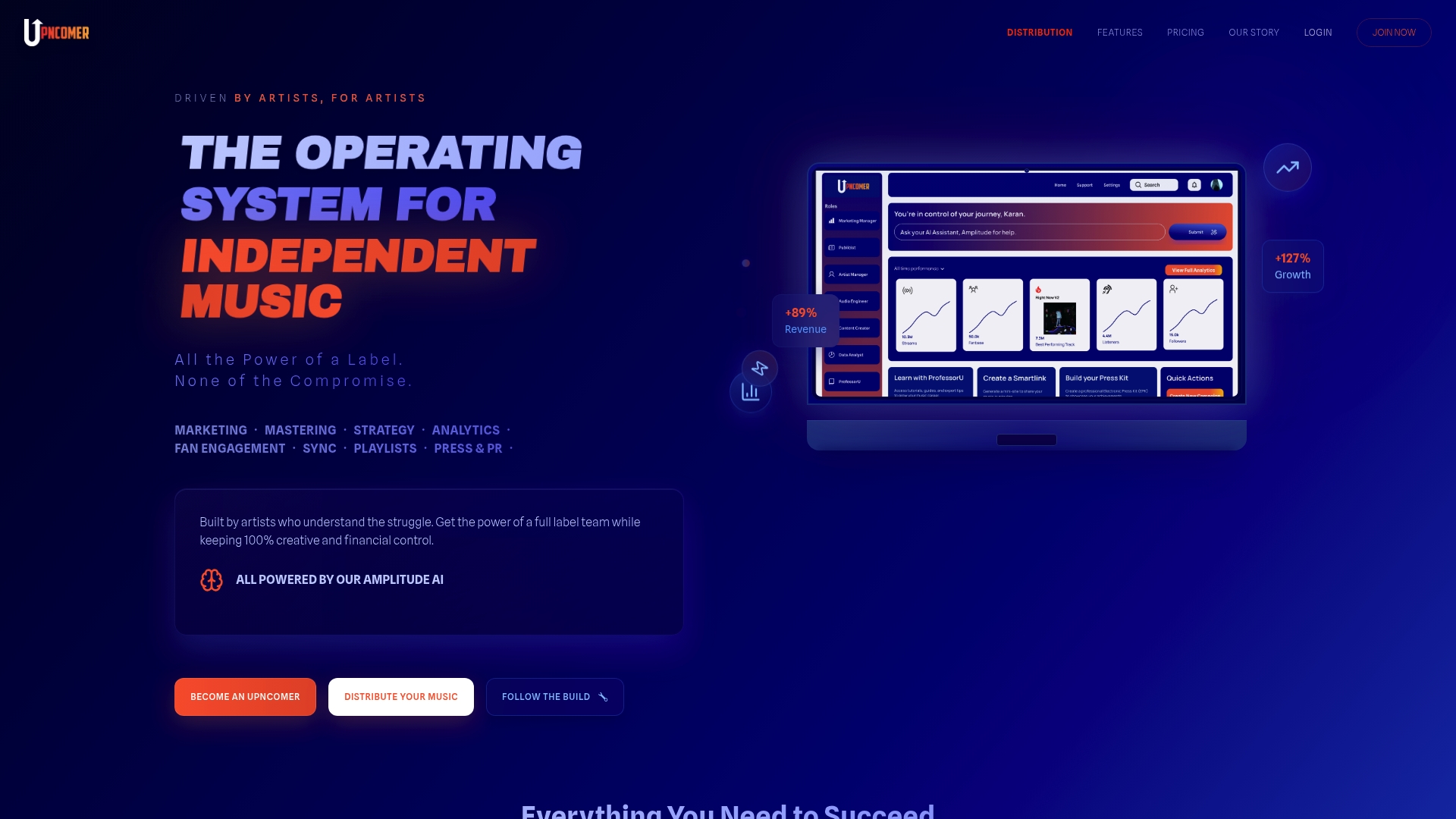
Upncomer’s Data Analyst and Artist Manager modules give you a clear picture of who your fans are, where they are growing, and how to reach them directly. You can track geographic expansion, monitor engagement trends, and build the owned audience channels that create long-term career stability. Check the latest tools and updates on Upncomer’s community updates page, or explore the full platform at upncomer.co to see how it fits your workflow.
FAQ
Why do independent artists need audience data?
Audience data tells independent artists who their fans are, where they live, and how they engage, replacing guesswork with decisions grounded in real behavior. Without it, marketing budgets, tour routes, and release timing are based on assumption rather than evidence.
What is the difference between platform data and owned fan data?
Platform data like Spotify dashboards shows aggregate trends but cannot be exported or used for direct outreach. Owned fan data, such as email lists and SMS subscribers, gives artists direct access to their audience regardless of algorithm changes.
How often should artists review their audience analytics?
Monthly reviews of cross-platform data reveal meaningful growth trends better than daily checking. A song showing consistent week-over-week stream growth is a stronger signal than a high total stream count with no momentum.
What is a superfan and why does it matter for monetization?
A superfan is a listener who streams repeatedly, saves tracks, engages on social media, and buys merch or tickets. Identifying superfans through audience segmentation lets artists focus monetization efforts, like merch drops and VIP experiences, on the fans most likely to convert.
How does geographic audience data help with tour planning?
Unsolicited listener growth in a city, meaning fans appearing without targeted promotion, is a direct indicator of organic demand. Artists who respond to those geographic signals with tour dates or targeted campaigns consistently see stronger ticket sales and lower promotional risk.