Music Analytics: A Practical Guide for Artists in 2026

Music analytics is the systematic collection and interpretation of data from streaming platforms, radio airplay, social media, and audience behavior to help artists and music professionals make smarter career decisions. Where gut instinct once drove release timing, tour routing, and marketing spend, data now does the heavy lifting. Platforms like Soundcharts, Chartmetric, and Apple Music for Artists give independent artists, producers, and managers access to the same song performance analytics that major labels have used for years. The difference now is that you do not need a label deal to use them.
What are the essential music analytics metrics?
Music analytics covers a wide range of data points, but not all of them carry equal weight. Understanding which numbers actually matter is the first skill any music professional needs to develop.
Standard performance metrics form the baseline of any music data analysis:
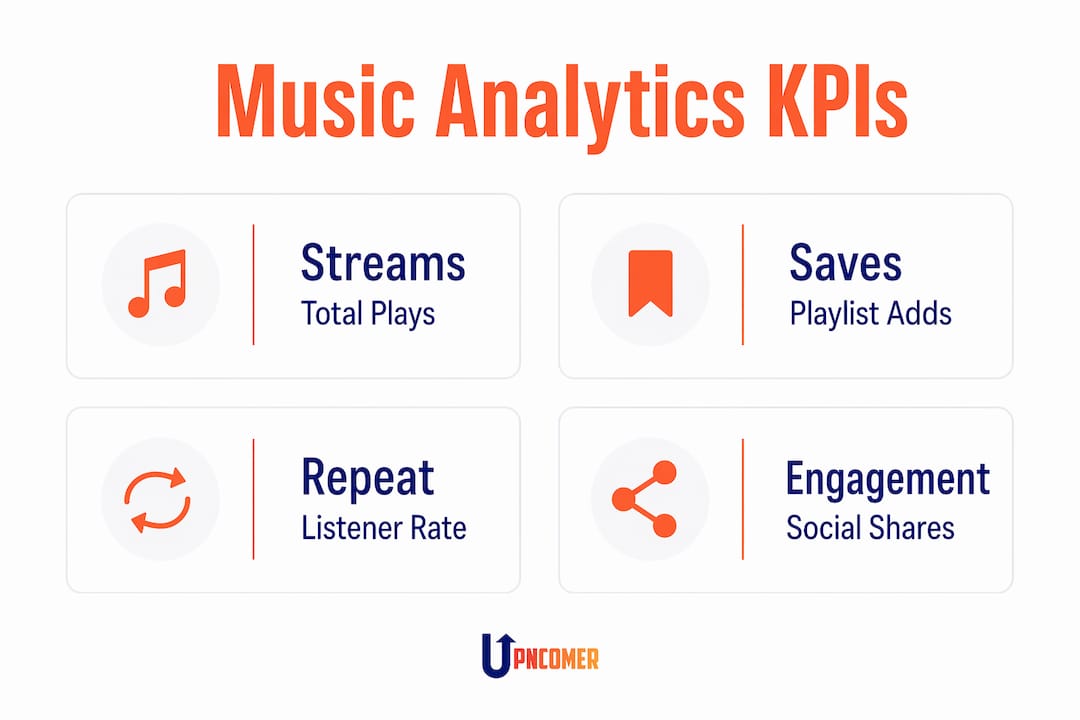
- Streams and daily listeners: Raw reach across Spotify, Apple Music, Amazon Music, and YouTube
- Saves and library adds: A listener saving your track signals intent to return, which is stronger than a single play
- Playlist inclusions: Getting added to editorial or algorithmic playlists multiplies your exposure exponentially
- Radio spins: Still relevant for genre-specific audiences, particularly in country, gospel, and adult contemporary
- Social engagement: Shares, comments, and video uses on TikTok and Instagram Reels
These numbers tell you how far your music is traveling. They do not tell you whether it is landing.
Deeper signals: human listener proof
The most reliable music performance metrics require a human to take a deliberate action. Music creator Jack Righteous calls these human listener proof metrics: playlist adds by real users, repeated listens, email replies, community joins, and product purchases. These actions cannot easily be faked by bots. They reflect a listener who chose to engage beyond a passive stream.
Repeat listens are particularly telling. An algorithm can inflate your stream count overnight. It cannot make someone replay your chorus three times because it got stuck in their head.
Pro Tip: Track your save-to-stream ratio on Spotify for Artists. A ratio above 10% suggests your music is resonating deeply enough for listeners to want it in their library. Below 5% is a signal to examine your hook, release strategy, or audience targeting.
How do leading music analytics platforms and AI tools work?
The best music analytics tools pull from multiple data sources simultaneously and surface patterns you would never catch manually. Here is how the major platforms and emerging AI frameworks operate.

Data sources and real-time tracking
Soundcharts monitors over 200 million daily data points, including global radio airplay from 2,465 stations across 87 countries, and tracks data from 23,738 charts and 7.3 million playlists. That scale means a manager can spot a breakout moment in Brazil before it shows up in their Spotify dashboard. Real-time cross-platform monitoring is the core value proposition of tools like Soundcharts and Songstats. They consolidate streaming data, social metrics, playlist activity, and radio performance into a single view.
Live event analytics are catching up fast. Insights.live uses anonymized, verified ticket sales data and real-time settlement reports to give promoters accurate demand predictions within 48 hours of event settlement. The platform tracks over $1 billion in ticket sales. That kind of data gives booking agents a factual basis for routing decisions instead of relying on social media follower counts.
AI-driven quality and popularity prediction
AI is now entering the music data analysis space in a meaningful way. The APEX framework can predict music popularity from audio alone, generating engagement scores from 0 to 100 and qualitative markers from 1 to 5. It was trained on over 211,000 AI-generated songs for multi-dimensional evaluation. That means an artist or A&R team can run a track through APEX before release and get a data-informed read on its commercial potential.
MuQ-Eval takes a different angle. It is an open-source neural quality metric that predicts per-sample music quality with system-level correlation up to 0.957 against human ratings. It uses frozen MuQ-310M representations. Together, APEX and MuQ-Eval offer multi-dimensional analysis covering predicted streams, likes, coherence, memorability, and naturalness.
Platform comparison: key features at a glance
| Platform | Primary data focus | Best for | Standout feature |
|---|---|---|---|
| Soundcharts | Radio, charts, playlists, streaming | Managers and labels | 200M+ daily data points across 87 countries |
| Chartmetric | Streaming, social, playlist tracking | Artists and A&R | Cross-platform audience growth tracking |
| Apple Music for Artists | Apple Music streams and Shazam data | Artists on Apple ecosystem | Shazam discovery data by city |
| Insights.live | Ticket sales and live demand | Promoters and booking agents | Real-time settlement reports within 48 hours |
| APEX / MuQ-Eval | Audio quality and popularity prediction | Producers and AI music teams | Pre-release popularity scoring from audio alone |
What are the common challenges with music analytics data?
Raw numbers lie. That is not a cynical take. It is a documented reality that every music professional needs to account for when reading their dashboards.
The bot problem is real and growing. As AI and bots inflate vanilla stream counts, engagement metrics requiring human intent become the only defensible data for sustainable career planning. A track can accumulate hundreds of thousands of streams from automated sources without a single real fan hearing it. Distributors and streaming platforms do flag and remove fraudulent streams, but the process is slow and imperfect.
Here are the most common data pitfalls to watch for:
- Inflated stream counts: Playlist placement on bot-heavy playlists can spike your numbers without adding real listeners
- Misleading follower growth: A sudden jump in social followers after a viral moment does not mean those followers will engage with your next release
- Geographic anomalies: Streams concentrated in unusual markets with no corresponding social activity often signal artificial traffic
- Surface-level saves: Saves driven by playlist algorithms rather than genuine discovery tend not to convert into superfans
How to validate your data
The fix is to use composite metrics and cross-reference multiple sources. If your streams spiked but your email list did not grow, your save rate did not move, and your social engagement stayed flat, the spike is probably not organic. Real growth shows up across multiple channels at once.
Pro Tip: Set up a simple tracking sheet that logs your weekly streams, save rate, email signups, and social follower growth side by side. When one metric moves without the others, investigate before celebrating.
How can music professionals use analytics to build a career strategy?
Data without a plan is just noise. The artists and managers who get the most from music trend analysis are the ones who build it into their decision-making process at every stage.
Here is a practical framework for integrating analytics into your career and marketing strategy:
-
Establish your baseline before a release. Pull your current monthly listeners, save rate, playlist count, and top markets from Spotify for Artists or Apple Music for Artists. This gives you a benchmark to measure your campaign against.
-
Use geographic data to target your marketing. If your data shows strong listener density in Atlanta and Houston but you have never toured there, that is your next routing decision. Audience data drives smarter tour planning, ad targeting, and press outreach.
-
Pitch playlists based on where your listeners already are. Playlist pitching works best when you can show curators that your audience overlaps with theirs. Demographic and listening behavior data from Chartmetric or Soundcharts makes that case concrete.
-
Align your team around a shared dashboard. Music managers who use analytics platforms can benchmark an artist’s performance against similar acts, track global growth, and consolidate data from multiple sources into one workflow. When your manager, publicist, and booking agent all read from the same numbers, decisions get faster and smarter.
-
Time your releases around your audience’s listening patterns. Streaming data shows when your listeners are most active by day and time zone. Releasing on a Friday is industry standard, but pitching your pre-save campaign on a Tuesday when your core audience is most engaged can move the needle on first-week numbers.
-
Measure campaign performance in real time and adjust. Data-driven marketing campaigns that use audience insights from Spotify and Apple Music improve independent artist breakthrough success. The key is checking your numbers weekly during a campaign window and reallocating ad spend toward the markets and demographics that are converting.
The through-line in all of this is that analytics should inform your creative and business decisions, not replace them. The data tells you where your audience is and what they respond to. You still decide what to make and how to say it.
Key takeaways
Music analytics works best when you combine platform data, engagement signals, and AI-driven tools to make decisions grounded in real audience behavior rather than inflated stream counts.
| Point | Details |
|---|---|
| Prioritize human listener proof | Saves, email signups, and repeat listens reveal genuine fans better than raw stream counts. |
| Use multi-source platforms | Tools like Soundcharts and Chartmetric consolidate streaming, radio, and social data for a complete picture. |
| Validate spikes with cross-channel data | Real growth shows up across streams, saves, and social engagement simultaneously. |
| Apply geographic data to marketing | Listener density by city should drive tour routing, ad targeting, and press strategy. |
| AI tools add a pre-release edge | Frameworks like APEX score audio for predicted popularity before you commit to a release plan. |
Why I think most artists are reading their data wrong
Here is something I have noticed working with independent artists and their teams: most people check their analytics after something happens. A stream spike, a playlist add, a viral moment. They treat the data as a scoreboard instead of a compass.
The artists who actually grow sustainably are the ones who check their numbers before they make decisions. They look at their save rate before they book a tour. They check their geographic data before they spend money on ads. They watch their repeat listen rate before they decide whether a track is worth pushing harder.
The other thing worth saying plainly: data will not save a bad song. I have seen artists obsess over their Spotify dashboard while ignoring the fact that their music is not connecting emotionally. Analytics can tell you that something is not working. It cannot tell you how to fix it creatively. That part is still yours.
The future of music data analysis is moving toward intent-based metrics and predictive modeling. Tools like APEX and MuQ-Eval are early signals of where this goes. Within a few years, artists will be able to get a pre-release read on a track’s commercial potential the same way a film studio tests a trailer. That is exciting. But the artists who will use it best are the ones who already understand what their audience actually wants, not just what the algorithm rewards.
Stay curious about your data. Just do not let it make you anxious. Use it to confirm what your gut already suspects, and to catch the blind spots your gut misses.
— Karan
How Upncomer brings music analytics together for independent artists
If you are tired of jumping between five different platforms to get a clear picture of your career, Upncomer was built to fix exactly that.
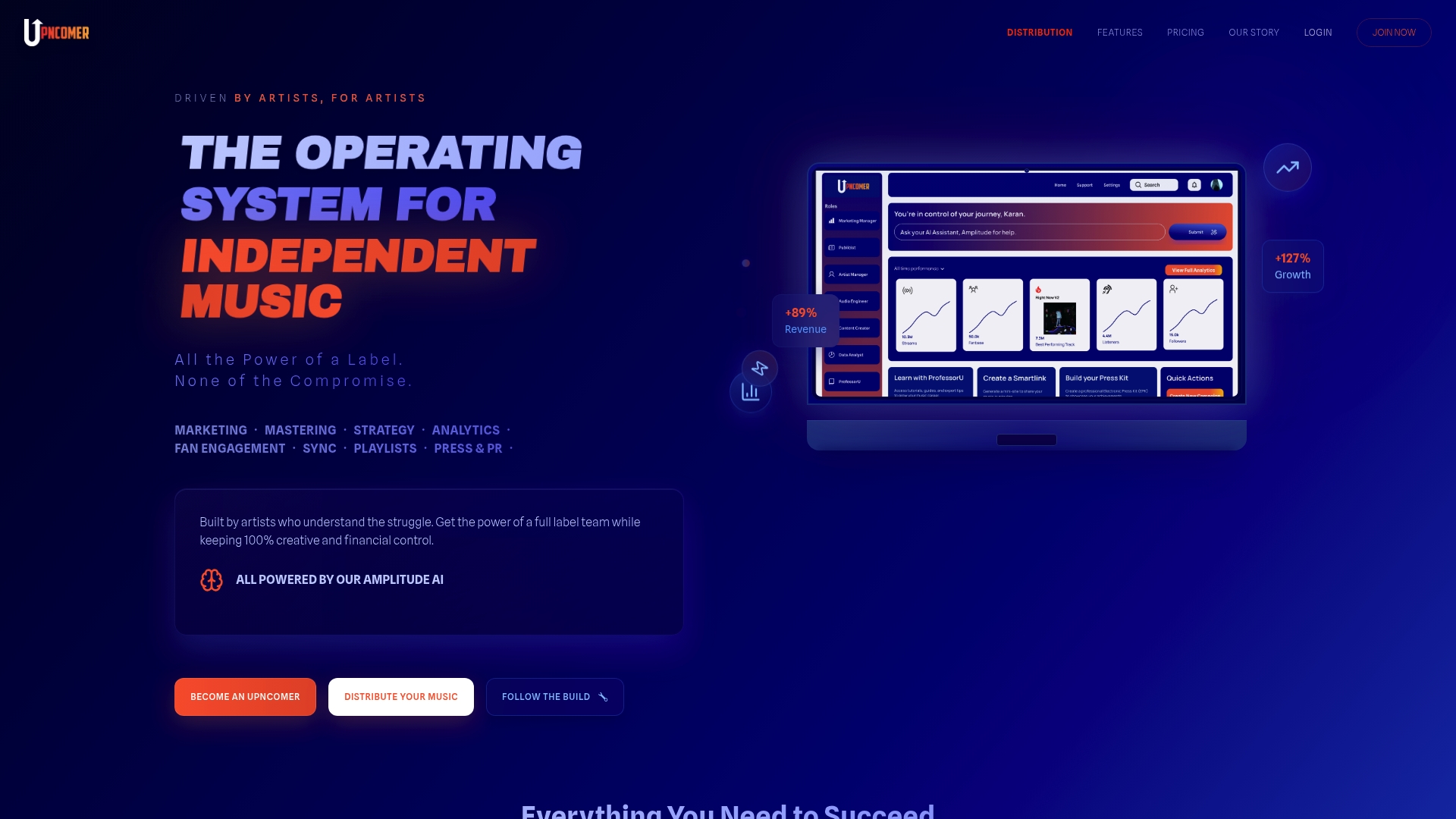
Upncomer’s Growth Engine and Data Analyst modules pull your streaming analytics, audience insights, and campaign performance into one place. Amplitude AI acts as your always-on data advisor, helping you interpret what the numbers mean and what to do next. Whether you are planning a release, pitching playlists, or figuring out where to focus your marketing budget, Upncomer gives you the tools a full music team would use, without the overhead. Explore what Upncomer can do for your career, or check out the latest community updates to see what is new on the platform.
FAQ
What is music analytics?
Music analytics is the collection and interpretation of data from streaming platforms, radio, social media, and audience behavior to inform artist growth and marketing decisions. It covers metrics like streams, playlist adds, listener demographics, and engagement rates.
Which music analytics tools are most widely used?
Soundcharts, Chartmetric, and Apple Music for Artists are among the most widely used platforms. Soundcharts alone monitors over 200 million daily data points across radio, charts, and playlists globally.
Why are raw stream counts unreliable?
Bot traffic and automated playlists can inflate stream counts without adding real listeners. Metrics requiring deliberate human action, such as saves, email signups, and repeat listens, provide more reliable evidence of genuine audience engagement.
How do AI tools fit into music data analysis?
AI frameworks like APEX can predict a track’s popularity and quality from audio alone before release, scoring engagement potential on a 0 to 100 scale. These tools complement traditional analytics by adding a pre-release forecasting layer.
How should independent artists start using analytics?
Start by establishing a baseline across streams, save rate, and top markets using free tools like Spotify for Artists. Then cross-reference that data with social engagement and email growth to identify where your real audience is building.