Talent Agency vs. Management: A DIY Artist’s Guide

A talent agency (booking agent) legally finds and negotiates work for you. A manager handles long-term career strategy and day-to-day business. That’s the short version of the talent agency vs. management question — but the fees, contracts, and legal differences matter a lot before you sign anything.
Agents focus on booking and negotiating specific jobs; managers advise on career direction, hire staff, and coordinate PR. Agents typically take a commission of about 10% on deals they procure. Managers usually charge 15–20% across multiple income streams. In many U.S. states, agents must be licensed to legally solicit or procure work for you. Managers are far less regulated.
If you’re self-managing with AI tools right now, the immediate question isn’t “which rep do I hire?” It’s “do I actually have a capacity problem or a bookings gap that a human rep solves better than my current platform?” If the answer is no, keep building your metrics. When the workload or opportunity volume grows past what your workflows can handle, that’s when this decision gets real.
Table of Contents
- What Is Talent Agency vs. Management at a Glance?
- What Does a Talent Agency Actually Do Day to Day?
- What an Artist Manager Does Differently
- How Agents and Managers Get Paid, and What to Watch in Contracts
- When Should You Hire an Agent, a Manager, Both, or Neither?
- How AI Tools Change the Hire vs. DIY Trade-Off
- How to Evaluate and Interview an Agent or Manager
- Practical Hybrid Setups That Actually Work
- What Outcomes Actually Look Like: Agency vs. Management
- Key Takeaways
- The Honest Trade-Off Nobody Talks About
- Upncomer Handles the Routine So You Can Focus on the Right Hire
- FAQ
What Is Talent Agency vs. Management at a Glance?
| Dimension | Talent Agent (Booking Agent) | Artist Manager |
|---|---|---|
| Primary responsibilities | Procures gigs, pitches to venues and promoters, negotiates contracts | Career strategy, team coordination, PR, scheduling, brand guidance |
| Typical fees | ~10% commission on booked deals | 15–20% (sometimes higher) across multiple income streams |
| Who they represent | Often large rosters; less individual attention | Smaller rosters; closer, hands-on involvement |
| Exclusivity | Often exclusive per territory or genre | Usually exclusive; broad scope |
| Contract length | Shorter term, deal-by-deal or 1–2 years | 1–3 years, sometimes longer |
| Best for | Artists ready to tour or place work at scale | Artists needing strategic direction and team oversight |
| Key risk | Roster size dilutes attention | Broad scope can blur into unlicensed booking |

What Does a Talent Agency Actually Do Day to Day?
An agent’s job is transactional in the best sense. They pitch you to venues, promoters, and buyers. They negotiate the deal terms, handle the paperwork, and take their cut when the contract closes. That’s it. They’re not thinking about your five-year arc or your brand partnerships. They’re thinking about the next booking.
Core agent activities include:
- Pitching clients to venues, festivals, promoters, and media buyers
- Negotiating performance fees, contract terms, and rider requirements
- Submitting clients for auditions, placements, or licensing opportunities
- Managing deal paperwork and coordinating logistics around confirmed bookings
- Maintaining relationships with buyers who can offer repeat work
The legal side matters here. In California and other states, only licensed talent agents may legally solicit or procure employment for performers. Some agents also operate under union franchise agreements with organizations like SAG-AFTRA, which adds another layer of regulation to how they work and what they can charge.
Agents often maintain large rosters, which means your priority on their list depends heavily on your earning potential. A newer artist can get lost.
Pro Tip: Ask any prospective agent for the names of three similar artists they’ve booked in the last six months and the venues or deal sizes involved. An agent with genuine market access will answer that question without hesitation. One who can’t is likely making transactional submissions without real buyer relationships behind them.
What an Artist Manager Does Differently
Where an agent closes deals, a manager builds the conditions that make better deals possible. They’re involved in your career at a strategic level: which opportunities to take, which to pass on, how your public image is developing, and whether your team is set up to support growth.

Day-to-day manager responsibilities typically include career strategy and long-term planning, coordinating with your publicist, lawyer, and agent, overseeing scheduling and administrative operations, guiding brand and creative direction, and advising on which income streams to prioritize.
Managers generally charge 15–20% commission, though structures vary widely. Some apply that percentage to gross earnings across all revenue streams, including touring, sync, merch, and endorsements. That’s a meaningful number when your income grows.
One important nuance: managers frequently advise on contract terms and coordinate with lawyers, but in most jurisdictions they cannot legally negotiate or sign contracts on your behalf. The practical model is a three-way collaboration between you, your manager, and your agent, with your entertainment lawyer reviewing anything significant. When both a manager and agent are on your team, the manager typically sets the strategic direction and the agent executes the booking side within that framework.
How Agents and Managers Get Paid, and What to Watch in Contracts
Fee structures are straightforward on paper but get complicated fast in real agreements.
Common fee models:
- Agent commissions: commonly around 10%, with some union-regulated caps depending on the context
- Manager commissions commonly range from 15–20%, sometimes higher for newer managers or those with broad responsibilities.
- Retainer or salary models for managers exist but are rare outside large, established artist teams
Contract terms to check before signing:
- Term length and renewal conditions
- Exclusivity scope (territory, genre, income type)
- Commission base: gross vs. net earnings (gross is more common and more expensive for you)
- Key-man clause: what happens if your specific rep leaves the company
- Sunset clause: how long they collect commission on deals they originated after the contract ends
- Termination rights and notice periods
“A management agreement that effectively functions as an agency contract can be voidable under state Talent Agencies Acts. Artists should explicitly define the manager’s scope and include a sunset clause with a defined end date — not an open-ended one.” — Art and Media Law
Red flags to watch for: a manager who offers to book gigs directly in a state that requires agent licensing, any verbal promise not reflected in the written contract, pressure to sign long exclusive terms before you’ve seen verifiable results, and sunset clauses with no defined expiration. Entertainment lawyers occupy a distinct legal lane from both agents and managers. Get one to review any representation agreement before you sign.
When Should You Hire an Agent, a Manager, Both, or Neither?
The right answer depends on your career stage, not your ambition level.
- Emergent stage (building your first audience): Self-manage with AI tools. Focus on music release planning, streaming analytics, and fan engagement. External commissions don’t make sense when your income base is still small.
- Growing stage (consistent shows, growing streams, inbound interest): Consider a booking agent if you’re getting more venue inquiries than you can handle or if you want to break into markets where you have no relationships. Keep managing strategy yourself or with your team.
- Scaling stage (touring regularly, multiple income streams, team complexity): Add a manager when the strategic and administrative load is pulling you away from creating. At this point, data-driven decisions about which opportunities to take become critical.
- Established stage (consistent revenue, brand partnerships, media presence): Both an agent and a manager typically make sense, with clear scope defined for each.
Capacity signals that suggest you need outside help: you’re missing booking opportunities because you can’t respond fast enough, you’re spending more time on admin than on music, or you’re being offered deals you don’t have the legal knowledge to evaluate. If the gap is bookings and market access, hire an agent. If the gap is strategy and coordination, hire a manager. If it’s both, hire both — but define their scopes in writing so they don’t overlap.
How AI Tools Change the Hire vs. DIY Trade-Off
AI platforms have genuinely shifted the math on when you need external representation. Routine tasks that used to require a manager or agency relationship are now automatable: release planning, targeted music marketing, distribution logistics, basic playlist pitching, streaming analytics, ad campaign optimization, and content scheduling.
What AI doesn’t replace well: high-stakes contract negotiations, relationship-based introductions to major promoters or labels, delicate reputation management in a crisis, and complex entertainment law. Those still need humans.
Upncomer’s platform covers the automatable side directly. The Growth Engine handles campaign management and audience targeting. Amplitude AI gives you strategic guidance based on your actual data. The Distribution module manages release logistics. The Artist Manager module helps coordinate your team’s workflows. The Publicist module handles press and playlist pitching. Together, these reduce the routine tasks you’d otherwise pay an outside commission to cover.
Pro Tip: Track your DIY workflow ROI by comparing your monthly platform cost against what a 15–20% manager commission would cost at your current income level. Use your streaming analytics and campaign metrics to make that comparison concrete. When the commission math starts to favor a human rep, that’s your signal to start interviewing.
How to Evaluate and Interview an Agent or Manager
Your music performance portfolio is the first thing a rep will evaluate. Before you get to that conversation, know what you’re evaluating in return.
Questions to ask:
- Which artists similar to me have you worked with in the last year, and what were the outcomes?
- How many clients are currently on your roster, and how do you prioritize attention?
- What is your commission base — gross or net — and what income streams does it cover?
- What does your sunset clause look like, and what’s the defined end date?
- Do you have a key-man clause, and what happens if you leave the company?
- Are you licensed as a talent agent in the states where you’d be procuring work for me?
Evidence to request:
- A sample contract before any commitment
- References from current or former clients, with permission to contact them
- Verifiable examples of deals negotiated, including deal sizes or venue tiers
- Proof of agent licensing or union franchise where applicable
Red flags: refusing to provide a written contract, inability to name verifiable client references, promising to book work in regulated states without holding an agent license, and pressure to sign exclusive long-term agreements before you’ve seen any results.
Practical Hybrid Setups That Actually Work
Most independent artists don’t need to choose between full DIY and full representation. Hybrid models are common and often smarter.
One practical setup: use platform workflows for distribution, marketing, and analytics while hiring a booking agent specifically for touring and large venue placements. Define the agent’s scope narrowly in the contract — touring only, specific territories, specific deal types. That keeps your commission exposure limited while gaining real market access.
Another setup: bring in a part-time or consulting manager for strategic guidance while keeping day-to-day admin in-house. This works well at the scaling stage when you need someone to think about your career arc but don’t yet need full-time management overhead.
When writing any narrow-scope agreement, explicitly list what the rep is not authorized to do. Define deliverables, excluded activities, and the income streams subject to commission. Vague agreements invite scope creep, and scope creep is expensive.
A reasonable transition timeline: start interviewing agents or managers when your live performance metrics show consistent booking demand, your streaming numbers demonstrate audience growth, and your admin workload is measurably cutting into creative time. Revenue thresholds vary, but the pattern is consistent: representation makes financial sense when the commission cost is smaller than the opportunity cost of doing it yourself.
What Outcomes Actually Look Like: Agency vs. Management
The difference between hiring an agent and hiring a manager shows up most clearly in what changes after you sign.
With a booking agent, the immediate change is market access. An agent with real promoter relationships can get your name in front of venues and festivals that don’t respond to cold outreach. The outcome is more bookings, better-negotiated fees, and deals you couldn’t have closed alone. What doesn’t change: your strategic direction, your brand positioning, your team structure.
With a manager, the change is coordination and clarity. A good manager reduces the number of decisions you’re making alone, filters opportunities against a defined career strategy, and keeps your team aligned. Artists who add management at the right stage often describe it as the point where their career stopped feeling reactive. What doesn’t change: you still need an agent if you want someone actively pitching bookings.
The artists who get the most from both roles are the ones who hire each at the right stage, define scope clearly, and use data to evaluate whether the commission is earning its keep. That last part is where platform analytics become leverage, not just reporting.
Key Takeaways
A talent agent procures and negotiates work; a manager builds the career strategy around it — and knowing which gap you actually have determines which hire makes sense first.
| Point | Details |
|---|---|
| Role distinction | Agents book work legally; managers guide strategy and coordinate your team. |
| Fee ranges | Agents typically take ~10%; managers usually charge 15–20% across income streams. |
| Legal risk in contracts | Managers booking gigs in regulated states can void your agreement under Talent Agencies Acts. |
| Hire by career stage | Add an agent when bookings exceed your capacity; add a manager when strategy and admin overwhelm you. |
| Upncomer as a starting point | Upncomer’s AI modules cover distribution, marketing, analytics, and pitching — reducing the need for outside commissions at early and mid stages. |
The Honest Trade-Off Nobody Talks About
The music industry has a habit of making representation sound like a milestone — like signing with an agent or manager means you’ve made it. That framing gets artists into expensive agreements before they’re ready.
The more useful frame is this: representation is a solution to a specific problem. An agent solves a market access and negotiation problem. A manager solves a strategy and coordination problem. If you don’t have those problems yet, you don’t need those solutions. What you need is to build the metrics that make you worth representing — and that’s exactly where AI tools earn their place.
The artists who negotiate the best representation deals are the ones who walk in with data. Streaming growth, engagement rates, booking history, revenue trends. When you can show a prospective rep what your trajectory looks like, you’re not asking for a favor. You’re offering a business case. That shift in leverage is worth more than any introductory meeting.
Upncomer Handles the Routine So You Can Focus on the Right Hire
Paying a 15–20% manager commission for tasks a platform can automate is a real cost that compounds fast. Upncomer gives independent artists the tools to handle distribution, campaign management, streaming analytics, playlist pitching, AI mastering, and release planning without outsourcing any of it.
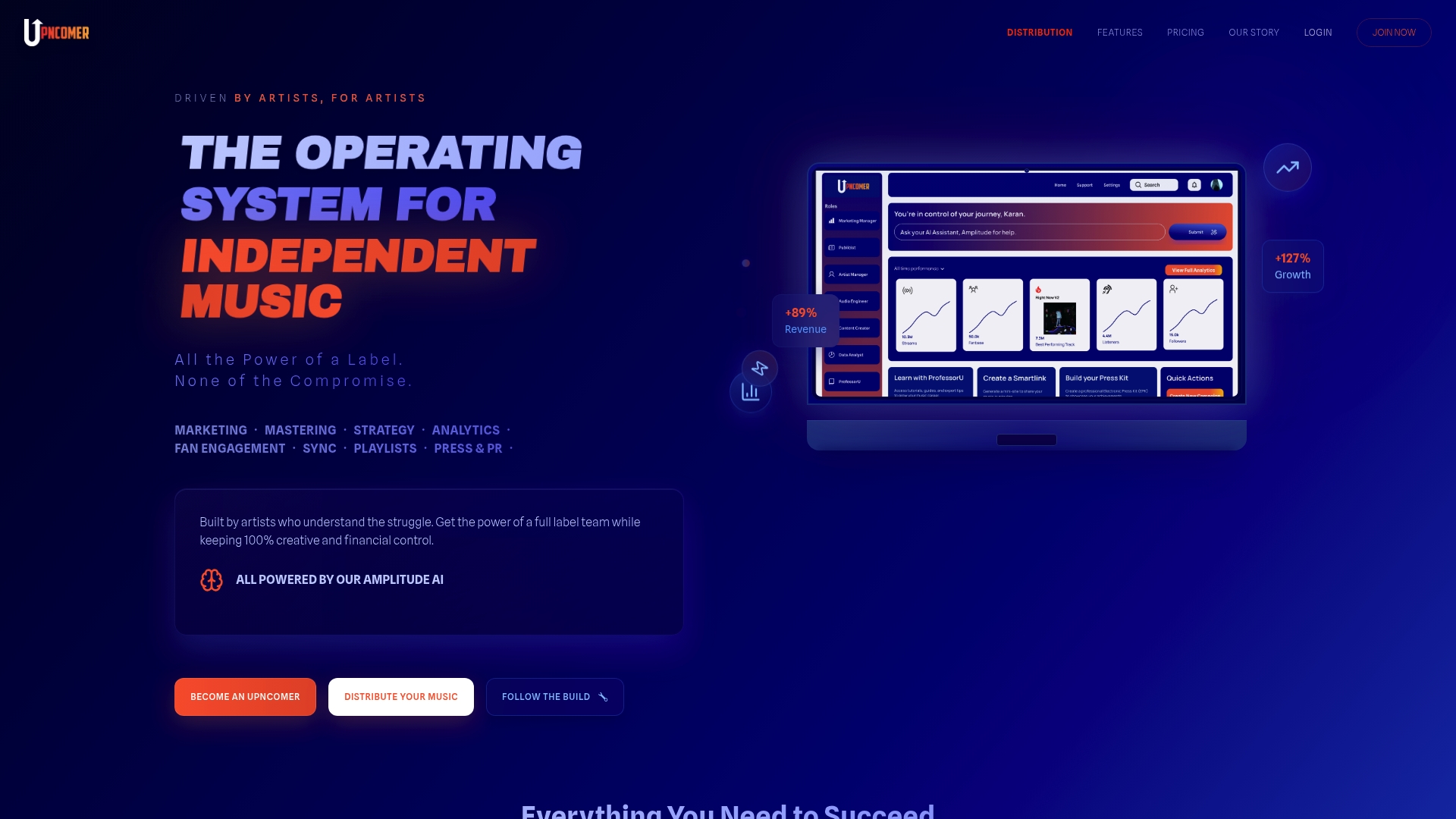
The Growth Engine runs your marketing campaigns with audience targeting built in. Amplitude AI gives you strategic guidance based on your actual performance data. The Distribution module gets your music to streaming platforms without a label. The Publicist module handles press and playlist pitching. The Artist Manager module keeps your team workflows organized. Together, they cover the routine work that would otherwise cost you a commission on every dollar you earn.
When you’re ready for human representation, you’ll have the data to negotiate from a position of strength. Until then, explore Upncomer and see what your career looks like when the operational side runs itself.
FAQ
What is the main difference between a talent agent and a manager?
A talent agent legally procures and negotiates work for you, typically taking around 10% commission. A manager guides your long-term career strategy and day-to-day operations, usually charging 15–20% across multiple income streams.
Can a manager legally book gigs for me?
In many U.S. states, including California, only licensed talent agents may legally solicit or procure employment for performers. A manager who books gigs without an agent license risks having the contract voided under state Talent Agencies Acts.
When should an independent artist hire a manager vs. an agent?
Hire a booking agent when you have more venue interest than you can handle or need market access you lack. Hire a manager when strategic decisions and administrative work are pulling you away from creating music.
What should I look for in a management or agency contract?
Check the commission base (gross vs. net), exclusivity scope, term length, sunset clause with a defined end date, key-man clause, and termination rights. Have an entertainment lawyer review any agreement before signing.
Can AI tools replace an agent or manager?
AI platforms like Upncomer can automate distribution, marketing, analytics, and basic pitching, reducing the need for outside commissions on routine tasks. High-stakes negotiations, relationship-based introductions, and complex contract law still require human representation.