Music PR for Artists: Your Practical Release Playbook

Music PR creates third-party credibility for your releases — and the fastest first step is locking your release date, building a basic EPK, and assembling a short media target list before you pitch a single journalist.
Here’s what you need to know upfront:
- PR delivers earned media (reviews, features, premieres, interviews), not paid placement. No reputable agency can guarantee editorial placements — that decision always rests with journalists or editors.
- Realistic outcomes include increased discoverability, credibility signals that help with festival bookings and sync opportunities, and a growing press archive that opens doors over time.
Your first three moves, in order:
- Confirm your release date and build a 6–12 week campaign window around it.
- Assemble a basic EPK (bio, press photo, streaming links, one-sheet).
- Build a target list of multiple outlets and writers who cover your genre.
Table of Contents
- What is music PR and how does it fit your release strategy?
- How has music PR changed in the streaming and social era?
- What PR assets do you need before you pitch anyone?
- How do you pitch music journalists step by step?
- When should you DIY your PR versus hire a professional?
- What are your options for PR help?
- How do you measure whether your PR campaign worked?
- What mistakes kill PR campaigns before they start?
- How do you handle negative press or a PR crisis?
- How does PR strategy change for different release types?
- Key Takeaways
- The honest truth about modern music PR
- Upncomer makes music PR manageable for independent artists
- Useful sources
- FAQ
What is music PR and how does it fit your release strategy?
Music PR is the practice of earning media coverage through pitching journalists, bloggers, podcast hosts, and radio programmers. The result is editorial credibility — a third party saying your music is worth attention. That’s fundamentally different from buying an ad or paying for a playlist placement.

Press placements act as credibility signals used by festival programmers, label A&R, and music supervisors. A strong press archive tells gatekeepers that your work has already passed editorial scrutiny, making PR a structural career asset rather than just a streaming spike tool.
How PR fits alongside other channels:
| Channel | What it delivers | Best timing |
|---|---|---|
| Music PR | Earned editorial coverage, credibility, discovery | 4–8 weeks before release |
| Playlist pitching | Algorithmic and editorial streams, listener reach | 7+ days before release (Spotify for Artists) |
| Influencer marketing | Social reach, short-form virality, fan activation | Release week and after |
| Paid ads | Scalable reach, retargeting, direct conversion | Post-release, amplifying proven content |
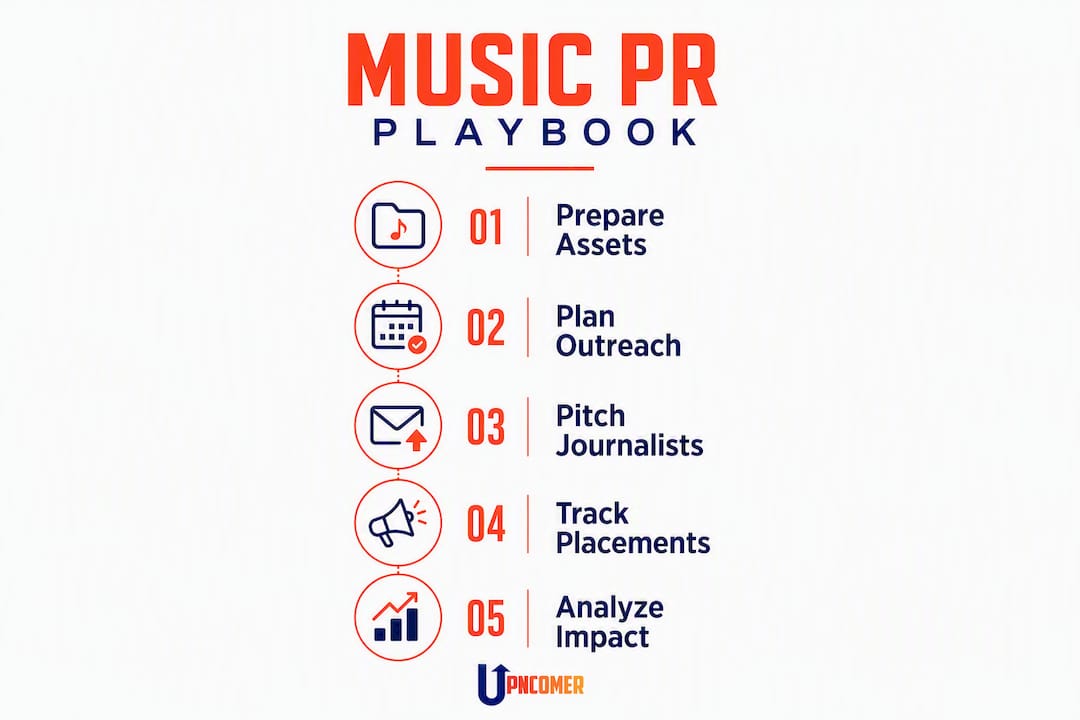
PR is not a substitute for playlist pitching or ads. It’s the piece that makes everything else more believable. When a journalist writes about you, that coverage becomes social proof you can use in every other channel.
How has music PR changed in the streaming and social era?
The workflow journalists and publicists used in 2010 barely resembles what works now. Here’s what’s actually shifted:
- TikTok discovery changed the news cycle. A song can go viral before a single press piece runs, which means PR now often follows organic momentum rather than creating it from scratch.
- Editorial playlists carry enormous weight. Getting onto a Spotify editorial playlist can drive more streams than a dozen blog features, so pitching playlists before release is now a parallel track to press outreach.
- Owned channels outperform rented ones. Building an email list should come before heavy PR or paid promotion spend. Expert guidance consistently recommends prioritizing email because social followers are far less reliable for high-value announcements.
- News cycles are faster. Music journalists cover more releases with fewer staff. Your pitch window is narrow — typically 4–6 weeks before release for blogs and 8–12 weeks for print or major outlets.
- Influencer integration is now standard. PR and influencer outreach often run simultaneously, with publicists coordinating both.
- Streaming data is now a pitch tool. Showing a journalist that a track has genuine organic traction (saves, playlist adds, listener-to-follower ratio) strengthens your story.
- Short-form content creates launch momentum. Having Reels, TikToks, and YouTube Shorts ready at launch amplifies any press coverage you earn.
Pro Tip: Have your final master and all streaming links live before you send a single pitch. Journalists won’t wait for a track to go live, and a broken link kills momentum instantly.
What PR assets do you need before you pitch anyone?
Your EPK (Electronic Press Kit) is your pitch’s foundation. A weak EPK gets ignored regardless of how good the music is.
EPK checklist
- Artist bio: Three sentences max for the short version; one paragraph for the long version. Lead with what makes you distinct, not where you’re from.
- High-res press photos: Minimum 300 DPI, at least 2–3 images in different settings. JPG or PNG, delivered via a shareable link (Google Drive, Dropbox), not email attachments.
- Streaming links: Spotify, Apple Music, and YouTube at minimum. Use a smart link tool so one URL covers all platforms.
- Social links: Instagram, TikTok, and any platform where you’re active.
- One-sheet: A single-page PDF summarizing your bio, stats, recent press, and contact info.
- Past press quotes: Even two or three short pull quotes from smaller outlets build credibility.
- Tour history or upcoming dates: Relevant for booking and context.
- Contact info: Your name, email, and management contact if applicable.
Example bio snippet you can adapt
“[Artist Name] is a [genre] artist from [city] whose music sits at the intersection of [influence A] and [influence B]. Their debut single ‘[Title]’ earned [brief result or description]. [One sentence on what’s coming or what makes this release different].”
Keep it factual and specific. Avoid phrases like “genre-defying” or “unique sound” — every journalist has read those a thousand times.
Pro Tip: Brand yourself clearly before you build your EPK. A press kit built on a vague identity confuses journalists and weakens every pitch you send.
How do you pitch music journalists step by step?
Tailored, targeted outreach consistently outperforms mass “spray-and-pray” campaigns. Here’s a repeatable workflow:
- Research outlets. Find 15–25 blogs, magazines, podcasts, or radio shows that cover your genre. Read their last 10 articles. Know the writer’s name.
- Craft your angle. What’s the story? A debut single, a personal narrative, a genre crossover, a tour announcement? One clear hook per pitch.
- Personalize the opening line. Reference a specific article the writer published. One sentence. That’s all it takes to stand out.
- Write the pitch body. Two to three short paragraphs: who you are, what you’re releasing, why it matters to their readers.
- Include your EPK link and a private streaming link. Never attach large files. Never send a public link before release date.
- Send 4–6 weeks before release for blogs; 8–12 weeks for print or major outlets.
- Follow up once, 5–7 days later, with a single polite sentence. If there’s no reply after that, move on.
Two pitch templates
Feature or premiere pitch:
Subject: Premiere opportunity — [Artist Name] “[Track Title]” ([Genre], out [Date])
Hi [Name], I’ve been following your coverage of [specific artist or genre] — your piece on [specific article] was spot on.
I’m reaching out because [Artist Name] is releasing “[Track Title]” on [Date], and I think it’s a strong fit for [outlet name]. It’s a [genre] track that [one-sentence description of the sound or story].
EPK and private stream: [link]. Happy to arrange an exclusive premiere if you’re interested.
Thanks for your time, [Your Name]
Interview or airplay pitch:
Subject: Interview request — [Artist Name] on [Topic/Release]
Hi [Name], [Artist Name] has a new [single/album] dropping [Date] and I’d love to set up a quick interview around [angle — tour, creative process, genre topic].
[One sentence on why this is timely or relevant to their audience.]
EPK: [link]. Let me know if this works for your schedule.
Subject line examples
- “Premiere: [Artist] ‘[Track]’ — [Genre], out [Date]”
- “New [genre] artist you should hear before [Date]”
- “Interview: [Artist] on [compelling angle]”
- “Review copy: [Artist] debut album — [Date]”
- “Airplay: [Artist] ‘[Track]’ — [format/genre]”
- “[Artist] tour announcement + new single — press opportunity”
Pro Tip: A “no” from a journalist is not a dead end. Reply with a brief thank-you and ask if you can keep them on your list for future releases. That one sentence turns a rejection into a warm contact.
When should you DIY your PR versus hire a professional?
The honest answer: most indie artists should DIY their first few campaigns and hire help when they have something worth amplifying. Promoting music that lacks organic traction is often an inefficient use of budget.
Readiness checklist before hiring PR help
- You have finished masters and a confirmed release date.
- You have a complete EPK (bio, photos, links, one-sheet).
- You have some audience traction: social followers, streams, or email subscribers.
- You have a release calendar with at least one clear campaign hook.
- You have a budget that covers the campaign without straining your operations.
Campaign moments that justify hiring PR
PR firms recommend timing campaigns around key career milestones to maximize narrative hooks. The strongest moments:
- Single or album release
- Tour announcement
- Major collaboration or feature
- Sync placement announcement
- Significant streaming milestone
Typical agency pricing varies: starter campaigns for a single release often begin in the low thousands, album pushes generally start around $15,000 and up, and monthly retainers for senior support often start at $4,500 per month. Pricing depends on agency, artist profile, and campaign scope. No agency can guarantee placements.
Before signing anything, ask: What outlets are on your list? How do you report results? What’s the cancellation policy? Do you work exclusively in my genre?
What are your options for PR help?
You don’t have to choose between a full agency retainer and doing everything yourself. Here’s how the options actually break down:
- Freelance publicist: Lower cost than an agency, often genre-specialized. Good for a focused single campaign. Vetting is on you — ask for references and a sample outlet list.
- Boutique PR agency: More infrastructure, established media relationships, and structured reporting. Better for album campaigns or artists with a real budget. Expect personalized pitching and transparent reporting as the baseline standard.
- Playlist and curation platforms: Focused on streaming reach rather than editorial press. Curator pitching campaigns can start near $280 and scale up. Useful alongside PR, not instead of it. For a deeper look at how playlist pitching compares to editorial PR, the difference in outcomes is significant.
- Service marketplaces: Platforms connecting artists with promotional pros at variable price points. Quality and transparency vary widely — always ask for outlet specifics before paying.
- DIY with platform tools: The most cost-effective route for early-career artists. Tools like Upncomer’s Publicist module help you organize pitches, track outreach, and manage your campaign without hiring anyone. The Growth Engine and Amplitude AI modules add data-driven targeting so your outreach is based on real audience signals, not guesswork.
How do you measure whether your PR campaign worked?
Coverage alone isn’t a success metric. Here’s what to actually track:
- Placements: Number of features, reviews, or mentions, and the tier of each outlet (niche blog vs. national publication).
- Estimated audience reach: Most outlets publish their monthly readership or social following — add these up across placements.
- Referral streams: Use Spotify for Artists to check if streams spiked during coverage windows.
- Link clicks: Tag every EPK link and press release URL with UTM parameters so you can see traffic sources in Google Analytics.
- Email signups: Did coverage drive new subscribers? This is one of the clearest signs PR is converting to owned audience growth.
- Playlist adds: Did press coverage lead to curator attention?
- Downstream outcomes: Booking inquiries, sync interest, or label conversations that reference press coverage.
Press placements function as credibility signals for festival programmers and music supervisors, so track those downstream outcomes over months, not just the week of release.
Simple PR report outline
| Metric | What to record |
|---|---|
| Placements | Outlet name, tier, date, link |
| Estimated reach | Combined audience across all placements |
| Referral streams | Spotify stream spike during coverage window |
| Link clicks | UTM-tracked clicks to profile or release page |
| Email signups | New subscribers attributed to PR period |
| Next steps | Follow-up pitches, warm contacts, future hooks |

Using audience data to connect PR activity to real growth signals is what separates artists who learn from campaigns from those who just collect clippings.
What mistakes kill PR campaigns before they start?
Most PR failures are predictable. Here’s what to avoid:
- Spray-and-pray pitching. Sending the same generic email to 200 journalists wastes everyone’s time and burns your reputation with writers you might need later.
- Launching without polished assets. A blurry press photo or a broken streaming link signals that you’re not ready, regardless of how good the music is.
- Paying for fake playlist or bot-driven services. These inflate numbers without building real audience, and Spotify’s algorithms actively penalize artificial streams.
- Skipping email capture. If PR drives traffic to your profile but you have no way to capture those visitors as subscribers, you lose them permanently.
- Pitching too late. Sending a pitch two weeks before release gives journalists no time to schedule coverage.
Red flags when evaluating PR services
- They guarantee placements at specific outlets.
- They can’t name the outlets on their contact list.
- They promise results in days, not weeks.
- They don’t offer any reporting or metrics.
- They ask for full payment upfront with no cancellation terms.
Ask every provider: “Can you show me a sample report from a recent campaign?” A legitimate publicist will have one ready.
How do you handle negative press or a PR crisis?
Negative coverage happens to artists at every level. The instinct to delete, deny, or fire back publicly almost always makes things worse.
The practical approach: respond once, calmly, and on the record if the coverage contains factual errors. If it’s a critical review, say nothing publicly. A bad review from a credible outlet still signals that the outlet thought your work was worth covering.
For a genuine crisis (a controversy, a misquote, or a damaging story), address it directly and briefly on your own channels before it spreads. Own what’s true, correct what’s factually wrong, and don’t amplify the story by over-explaining. Your existing fans will follow your lead. New audiences will form opinions based on how you handle it, not just what was said.
One practical rule: never respond to negative press in the comments section of someone else’s platform. If you need to say something, say it on yours.
How does PR strategy change for different release types?
The campaign shape changes depending on what you’re releasing.
Singles move fast. A 4–6 week window is realistic. Lead with one strong story hook (the personal narrative behind the track, a visual concept, a collaboration angle) and pitch 15–20 targeted outlets. Singles are also your best tool for building press relationships before an album cycle.
Albums need more runway. Start outreach 8–12 weeks out. Sequence your pitches: lead with a premiere for the first single, follow with a feature or interview tied to the full album story, then pitch reviews as the release date approaches. A well-structured music PR campaign for an album typically has three distinct pitch waves.
Tour announcements are underused PR hooks. Local press in each tour city is often easier to land than national coverage, and a city-by-city outreach strategy builds real regional audiences. Pitch local blogs, alt-weeklies, and radio stations 4–6 weeks before each date.
Collaborations give you two audiences to pitch to. Lead with the combined story and reach out to outlets that cover both artists’ genres. The collaboration itself is the hook — you don’t need to manufacture one.
Key Takeaways
Effective music PR for artists is built on sequencing, strong assets, and realistic expectations — not spray-and-pray outreach or guaranteed placement promises.
| Point | Details |
|---|---|
| Start with assets, not pitches | Build your EPK (bio, photos, links, one-sheet) before contacting a single journalist. |
| Sequence your campaign | Pitch editorial playlists first, then press, then coordinate influencer content at launch for effective sequencing. |
| Own your audience | Build an email list before spending on PR or ads — it’s your most durable channel. |
| Set realistic timelines | Allow 4–8 weeks for blogs, 8–12 weeks for major outlets; no agency can guarantee placements. |
| Upncomer as your PR hub | Upncomer’s Publicist, Growth Engine, and Amplitude AI modules centralize pitching, tracking, and campaign data in one place. |
The honest truth about modern music PR
There’s a version of music PR advice that treats press coverage like a vending machine: put money in, get placements out. That framing sets artists up for disappointment and wasted budgets.
What actually works is treating PR as one layer in a sequenced campaign, not the whole strategy. The artists who get the most out of press outreach are the ones who already have something to point to: a track with real organic traction, a clear brand identity, an email list they’ve been building for months. Coverage amplifies what’s already working. It rarely creates momentum from nothing.
The other thing most PR guides skip: your press archive compounds over time. A feature in a mid-tier blog today becomes a credibility signal that helps you land a bigger outlet six months from now. That’s why starting early, even with small placements, matters more than waiting until you feel “ready” for the big outlets.
Hybrid workflows tend to deliver the best return for independent artists. DIY your first campaign using a structured pitching workflow and solid assets. Then bring in a freelance publicist or a platform like Upncomer for your next release cycle, when you have data to show and a clearer story to tell. The combination of your own outreach relationships and a professional’s media contacts is often more effective than either alone.
Upncomer makes music PR manageable for independent artists
Running a PR campaign while writing, recording, and managing your own release is a lot. Upncomer is built specifically to reduce that load without handing your career over to an expensive agency.
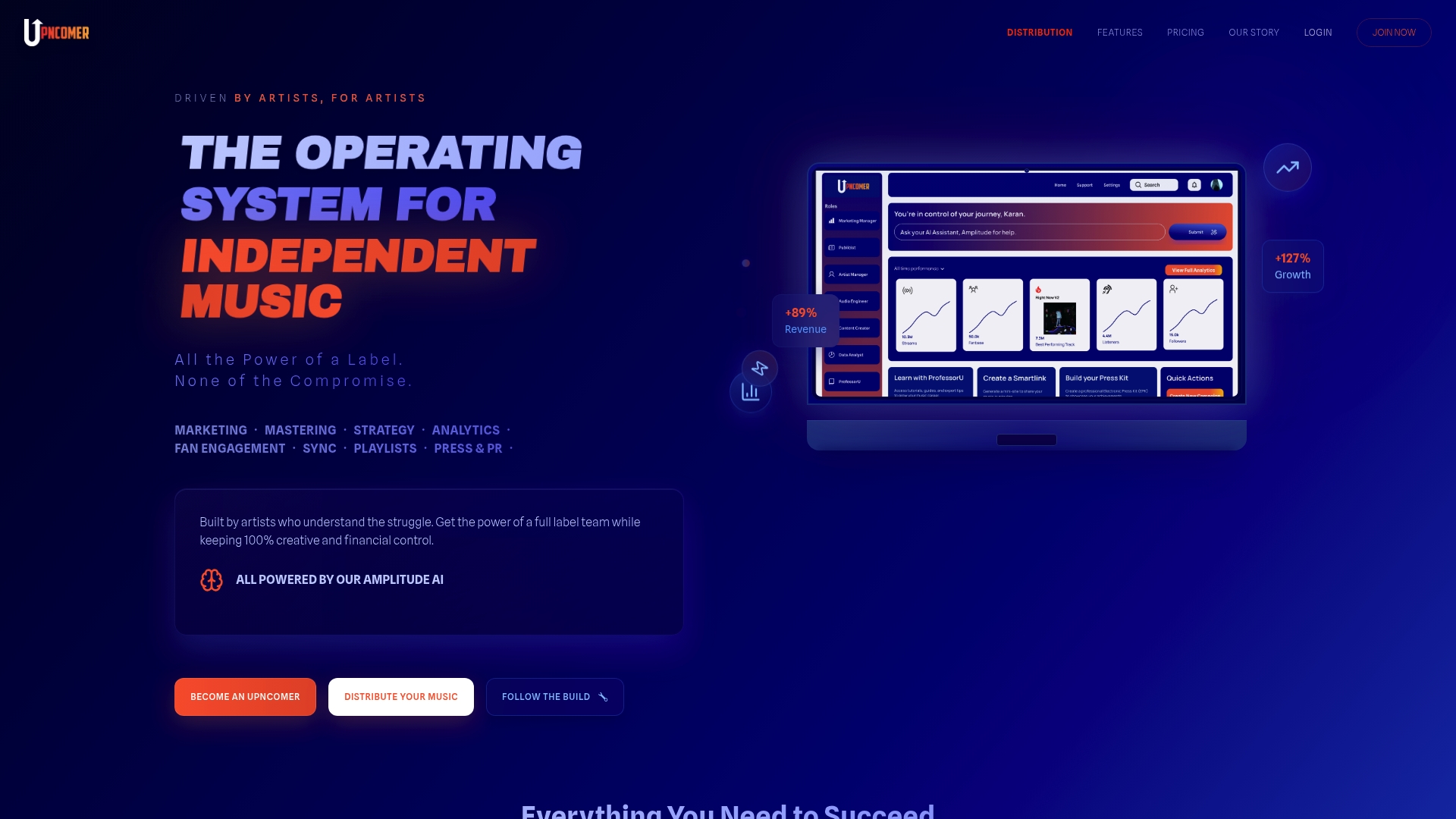
The Publicist module helps you organize and track media outreach in one place. The Growth Engine connects your PR activity to real audience data so you can see what’s actually driving streams, signups, and fan engagement. Amplitude AI gives you campaign guidance based on your specific release goals, and the Distribution module keeps your music live and accessible across every platform journalists and fans will check. The Content Creator and Artist Manager modules handle the surrounding workflow so nothing falls through the cracks during a busy release window.
For artists who want to run smarter campaigns without a full agency retainer, Upncomer is the practical next step. Explore the platform and see how it maps to your next release.
Useful sources
- MNPR Publicity — Industry standard on ethical PR practices, transparent reporting, and the “no guaranteed placements” principle.
- PTT Music — Partner perspective on personalized pitching versus mass outreach.
- UpNComer — Music PR Campaign Explained — Practical campaign framework for independent artists.
- UpNComer — Music Release Checklist — Step-by-step release preparation checklist.
This article is general educational information, not professional legal or business advice. PR outcomes vary by artist, release, and market conditions. Confirm current industry standards with a qualified music industry professional.
FAQ
What does music PR actually do for an independent artist?
Music PR earns you editorial coverage — reviews, features, premieres, and interviews — that builds third-party credibility and helps festival bookers, labels, and music supervisors take you seriously.
How far in advance should you pitch music journalists?
Pitch blogs and online outlets 4–6 weeks before your release date; major print outlets and radio programs need 8–12 weeks of lead time.
Can a PR agency guarantee you press placements?
No. Editorial control rests with journalists and editors, not publicists. Any service that guarantees specific placements is a red flag.
How much does music PR cost for an independent artist?
Typical agency pricing varies: single-release campaigns often start in the low thousands, album pushes $15,000 and up, and retainers from $4,500 per month for senior support. Exact pricing depends on agency, artist profile, and campaign scope.
Can Upncomer replace a traditional PR agency?
Upncomer’s Publicist and Growth Engine modules handle outreach organization, campaign tracking, and audience data in one place, making it a strong tool-assisted alternative for artists who want to manage PR without a full agency retainer.