How to Brand Yourself as an Artist: A 2026 Guide

Branding yourself as an artist means building a repeatable system that makes your work recognizable, findable, and monetizable — not just picking a color palette. Start with these five actions today: write a one-sentence mission statement, choose two content pillars, commit to one primary platform, pull your streaming audience data, and draft a 30-day content plan. Each step connects directly to how fans discover you, how algorithms surface your music, and how streaming analytics translate into real career decisions.
- Write your mission sentence — one line that says who you are, who you serve, and what feeling your music creates.
- Pick two content pillars — process content and finished work are the most durable starting pair.
- Choose one platform — depth beats breadth when you’re building from scratch.
- Pull your streaming data — listening locations, playlist sources, and skip rates tell you who’s already paying attention.
- Draft a 30-day content plan — even a rough calendar prevents the “what do I post today?” spiral that burns energy without building momentum.
Table of Contents
- How to brand yourself as an artist: start with mission and positioning
- Your visual identity checklist: the assets you actually need
- Use streaming analytics and audience data to find and serve your fans
- Build a repeatable release system with a calendar and promotional flow
- Turn listeners into paying fans with owned channels and direct revenue
- KPIs and testing cadence: what to track and when to scale
- Common branding mistakes and how to fix them
- Your 30/90/365-day action plan
- How to build press and media relationships that actually move the needle
- Networking and collaboration strategies that amplify your brand
- Key Takeaways
- Branding is craft, not marketing theater
- Upncomer puts this entire system in one place
- Useful sources
- FAQ
How to brand yourself as an artist: start with mission and positioning
Positioning before promotion is the rule most independent artists skip. Before you design a logo or pitch a playlist curator, you need a single sentence that anchors every public decision you make.
Use this template: “I make [genre/style] for [audience] who want [emotional outcome], and I do it differently because [unique element].” A real example: “I make cinematic lo-fi for late-night study sessions, and every track is built around a single unresolved chord that keeps listeners in the moment.”
Your positioning framework has three parts: artistic focus, audience need, and unique difference. Two audience types worth building around early are playlist-first listeners (they found you through an algorithm and need a reason to follow) and local gig-goers (they already trust you in person and convert to superfans fastest). Your mission sentence shapes everything downstream — pricing, release timing, partnership choices, and the tone of every caption you write.
“Artists who present a cohesive identity are more likely to build deep, authentic fan relationships and sustainable careers.” — Artist Branding Tips
Pro Tip: Amplify your real values rather than inventing a persona. Manufactured characters are exhausting to maintain and audiences sense the gap. Pick platforms that match your creative output, show up consistently, and let the authentic version of you do the work.
Your visual identity checklist: the assets you actually need
You don’t need a full brand agency. You need a small, consistent set of assets applied everywhere.
- Hero image — one strong photo that captures your vibe (lighting, setting, mood)
- Logo or wordmark — simple enough to read at profile-picture size
- Two palette swatches — a dominant color and one accent, chosen to match your music’s emotional register
- Two bio lengths — a 50-word social version and a 150-word press version
- Typography choice — one heading font, one body font, used everywhere
- Cover-photo templates — pre-built layouts for singles, albums, and tour announcements
- Smart link landing page — one URL that routes fans to streaming, merch, and mailing list
Your bio is a branding asset, not a résumé. The social version should open with what you sound like and close with what you want the reader to do. The press version adds context: influences, key releases, and a quote that sounds like you, not a Wikipedia entry. Apply the same palette and typography to your profile photo, single artwork, and tour poster so they read as one visual system.
Pro Tip: Batch your visual production. Set aside one afternoon per month to create all cover templates, resize assets for each platform, and update your smart link. Tools like Canva handle resizing; Upncomer’s Content Creator module handles scheduling. One session covers four weeks.
Use streaming analytics and audience data to find and serve your fans
Audience data is where personal branding stops being guesswork. The signals that matter most are listening locations, playlist sources, skip and finish rates, and listener cohorts by age and platform.
Here’s a practical workflow: pull those four data points, then build three audience segments.
- Superfans — high finish rates, repeat listens, saves. Give them early access, behind-the-scenes content, and direct purchase options.
- Playlist-discovery listeners — found you through an editorial or algorithmic playlist, low follow-through. Give them a strong hook in the first 30 seconds and a clear next step (follow, pre-save, mailing list).
- Local gig-goers — concentrated in one or two cities, moderate streaming but high show attendance. Give them event content, local references, and exclusive live recordings.
Upncomer’s Amplitude AI and Data Analyst modules sit inside this workflow directly. Instead of manually cross-referencing Spotify for Artists data with your ad metrics, Amplitude AI surfaces anomalies and suggests next-best actions. Growth Engine maps those segments to campaign types so you’re not running the same ad to three audiences who need completely different messages.
Build a repeatable release system with a calendar and promotional flow

A release without a system is just a hope. Here’s an 8-week framework that works for a solo artist or a small team.
8-week release timeline:
- Weeks 1–2: Finalize master, metadata, and artwork. Submit to distribution at least 3 weeks before release date. Open pre-save link.
- Weeks 3–4: Pitch playlists via Upncomer’s Publicist module. Send mailing list teaser. Post two process-content pieces.
- Week 5: Release week. Push across all platforms. Run a small paid test ($20–$50) to validate your best-performing organic post.
- Weeks 6–8: Sustainment. Post fan reaction content, behind-the-scenes, and one educational piece about the track’s creation.
| Phase | Owner | Key Tasks | Upncomer Module |
|---|---|---|---|
| Pre-release | Solo/Manager | Metadata, artwork, pre-save | Distribution, Artist Manager |
| Pitch & build | Solo/Team | Playlist pitch, email, content | Publicist, Content Creator |
| Release week | Solo/Team | Paid test, social push | Growth Engine |
| Sustainment | Solo | Fan content, analytics review | Data Analyst, Amplitude AI |
Budget bands: low ($0–$100 total, organic only), medium ($100–$500, one paid channel), high ($500+, multi-channel with retargeting). At the low band, repeatable content formats do the heavy lifting. At medium, a small paid test validates your message before you spend more.

Turn listeners into paying fans with owned channels and direct revenue
Streaming is the top of your funnel, not the destination. The most durable channels are ones you own: email and direct community spaces.
Your funnel has four stages: discover (streaming, social), engage (behind-the-scenes, replies, live streams), convert (merch, memberships, direct sales), and retain (exclusive content, early access, personal touches). Most artists spend all their energy on discovery and skip the middle two stages entirely.
Monetization options worth building into your brand system:
- Direct sales — Bandcamp-style pay-what-you-want or fixed pricing for downloads and physical releases
- Limited editions — numbered prints, signed vinyl, or exclusive bundles tied to a release
- Memberships — monthly access to stems, demos, or a private Discord for $5–$15/month
- Sync and licensing — register your catalog with a PRO (ASCAP, BMI, or SESAC) and pitch to music supervisors
- Teaching and workshops — production tutorials or songwriting sessions for fans who want to learn your process
Pro Tip: Sharing your process and “why” builds more trust than any sales pitch. A weekly behind-the-scenes email that shows how a track came together converts better than a promotional blast because it feels like an invitation, not an ad.
Upncomer’s Growth Engine tracks conversion from each channel, and Artist Manager keeps your fan CRM organized so you know who your top supporters are before you launch your next campaign.
KPIs and testing cadence: what to track and when to scale
Platform signals like watch time, saves, and completion rate tell you which content formats feed discovery. Pair those with these core KPIs:
- Stream growth rate — week-over-week change after a release; flat or declining means your sustainment content needs work
- Playlist adds — editorial adds signal algorithmic momentum; track them in the first 48 hours post-release
- Email open and click rate — a healthy list converts; a disengaged one means your content cadence or subject lines need a reset
- CPM and CPA on paid tests — run tests for 2–4 weeks before scaling; stop if CPA exceeds your average revenue per fan
- Revenue per fan — total direct revenue divided by active fans; this is the number that tells you whether your monetization system is working
Test one hypothesis at a time. Change one variable (hook, visual, audience segment), measure for two to four weeks, then iterate or scale. Amplitude AI flags anomalies automatically, so you’re not staring at dashboards every morning.
Common branding mistakes and how to fix them
- Unclear positioning — Fix: write your mission sentence before touching any visual asset.
- Chasing every platform — Fix: pick one primary platform and one secondary; master them before expanding.
- Inconsistent assets — Fix: run a monthly audit of your profile photos, bio text, and cover art across every platform.
- Ignoring data — Fix: build a data-driven strategy by reviewing your streaming analytics after every release, not just when something goes wrong.
- Skipping owned channels — Fix: start an email list on day one, even if it’s just 10 people.
- Copying another artist’s brand — Fix: list your top three values and check every creative decision against them.
- No legal protection — Fix: trademark your artist name, register your catalog with a PRO, and use written agreements for collaborations.
Quick self-audit: can a stranger visit your profile for 30 seconds and accurately describe what you make and who it’s for? If not, your positioning needs work before anything else.
Your 30/90/365-day action plan
30-day sprint
- Write your mission sentence and test it on three people outside the music industry.
- Audit your existing assets — website, social profiles, bio text — and flag inconsistencies.
- Set up a basic email list (even a free Mailchimp account works).
- Release one single with a full 8-week plan behind it.
- Pull your streaming data and identify your top listening city.
- Time: 5–8 hours total
- Budget: $0–$50
- Owner: Solo
90-day plan
- Complete your first full release cycle using the 8-week timeline above.
- Run two audience segment tests (superfans vs. playlist-discovery listeners).
- Set up a basic CRM inside Upncomer’s Artist Manager.
- Run one small paid experiment ($50–$100) on your best-performing organic post.
- Establish a weekly email cadence.
- Time: 3–5 hours per week
- Budget: $100–$300
- Owner: Solo or 1–2 person team
365-day roadmap
- Maintain a quarterly release cadence (four releases minimum).
- Reach audience segmentation maturity: three defined segments with tailored messaging.
- Launch one recurring revenue channel (membership, teaching, or licensing).
- Review and refresh your visual identity once per quarter.
- Use Amplitude AI to automate anomaly detection and reduce weekly dashboard time.
- Time: 8–12 hours per week at full cadence
- Budget: $300–$1,000+ depending on paid activity
- Owner: 1–3 person team
How to build press and media relationships that actually move the needle
Press coverage compounds. One placement in a credible outlet gets referenced by other outlets, playlist curators, and venue bookers for months. The mistake most independent artists make is pitching cold with no relationship and no story angle.
Start by identifying 10–15 blogs, podcasts, and local outlets that cover your genre. Follow their editors and writers on social media, engage genuinely with their content, and reference specific pieces when you reach out. Your pitch should lead with the story angle, not the song. “I recorded this EP entirely in a converted shipping container in Detroit” is a story. “Please check out my new single” is not.
Use Upncomer’s Publicist module to manage your press kit, track outreach, and follow up systematically. Your press kit should include a one-page bio, three high-resolution photos, a streaming link, and one quote from a previous placement if you have one. Keep it updated after every major release.
Networking and collaboration strategies that amplify your brand
Collaboration is one of the fastest ways to reach new audiences without paid advertising. A feature with an artist who has a complementary audience exposes you to fans who are already primed to like your sound.
Be specific about who you approach. Look for artists with a similar audience size (within 20–30% of your own follower count) and a complementary, not identical, sound. Reach out with a clear, low-commitment proposal: a co-written single, a remix exchange, or a joint live stream. The goal is a genuine creative exchange, not a transactional follower swap.
Industry relationships matter beyond other artists. Sync agents, music supervisors, venue bookers, and playlist curators are all worth cultivating over time. Attend local industry events, join online communities in your genre, and contribute value before you ask for anything. Music marketing tools that track your outreach history keep these relationships from falling through the cracks.
Key Takeaways
Building a sustainable artist brand requires a repeatable system that connects your creative identity to data-driven decisions, owned channels, and consistent execution across every release.
| Point | Details |
|---|---|
| Mission before visuals | Write your one-sentence mission statement before designing any asset or pitching any platform. |
| Two content pillars | Process content and finished work are the most durable pair; add more only after you’ve mastered these two. |
| Streaming data drives decisions | Pull listening locations, skip rates, and playlist sources after every release to shape your next campaign. |
| Owned channels convert | Email and direct community spaces outperform social platforms for monetization and long-term fan retention. |
| Upncomer unifies the system | Amplitude AI, Growth Engine, Artist Manager, and Distribution replace the fragmented tool stack most independent artists struggle with. |
Branding is craft, not marketing theater
The artists I see build real traction aren’t the ones with the slickest visuals or the biggest ad budgets. They’re the ones who treat their brand the same way they treat their music: with intention, consistency, and a willingness to iterate when something isn’t working. The data confirms what good artists already sense — talent alone no longer guarantees visibility, and the gap between a great record and a sustainable career is almost always a systems problem, not a talent problem.
What I find most artists get wrong is the sequence. They spend weeks on a logo before they’ve written a mission sentence. They run ads before they know which audience segment converts. They chase follower counts instead of tracking revenue per fan. The checklist in this guide is deliberately ordered to prevent that. Do the identity work first, pull the data second, build the system third, and then scale what’s working.
Upncomer’s Amplitude AI, Growth Engine, and Artist Manager are built for exactly this sequence. They don’t replace your creative judgment; they give you the information and infrastructure to act on it faster and with less wasted effort.
Upncomer puts this entire system in one place
Most independent artists are running their career across six or seven disconnected tools. Upncomer collapses that into one AI-powered platform built specifically for musicians and music teams.
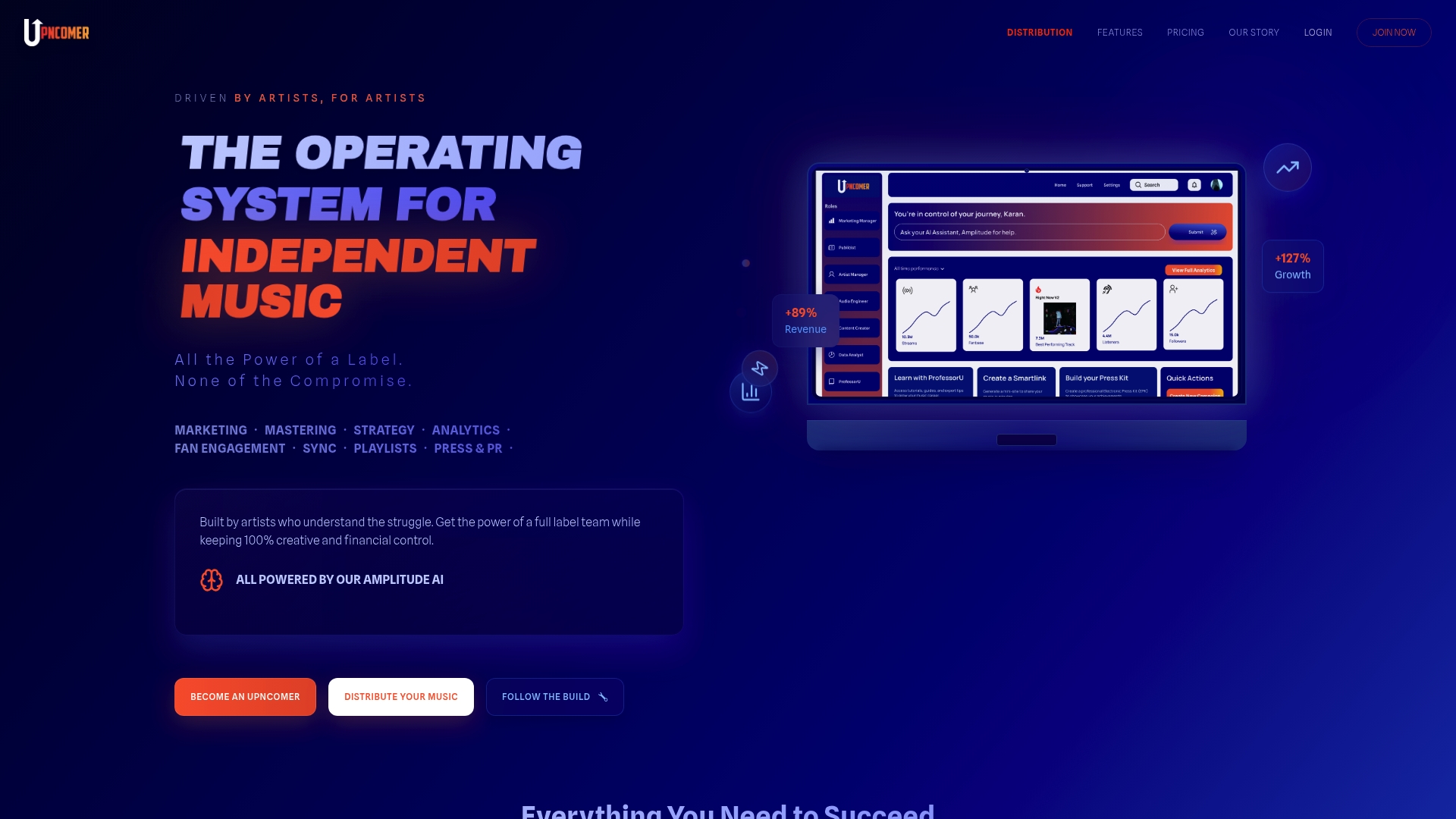
Here’s how the guide maps directly to Upncomer’s modules:
- Release calendar and distribution — Growth Engine and Distribution handle your release workflow from metadata to delivery.
- Audience segmentation — Amplitude AI surfaces your listener cohorts and suggests campaign types for each.
- Fan CRM and engagement — Artist Manager tracks your superfans, press contacts, and collaboration pipeline.
- Content creation and scheduling — Content Creator and UrStudio handle production and posting workflows.
- Press and playlist pitching — Publicist automates outreach and tracks responses.
Your next step: explore the full feature set, run your first 30-day release test with real streaming data behind it, and let the system tell you what to scale. No guesswork, no fragmented dashboards, no agency fees.
Useful sources
- Americans for the Arts: Define Your Personal Brand in 3 Steps — a practical toolkit for artists building their brand identity from scratch.
- Visual Artists Association: The Art of Personal Branding — covers the four-step brand management framework (discover, create, communicate, maintain).
- Art Marketing News: A Complete Guide for Independent Artists — positioning, trust-building, and channel strategy for independent artists.
- Format Magazine: Personal Branding for Creative Minds — storytelling, portfolio strategy, and social media application for creatives.
- Upncomer Blog — tactical guides on music promotion, analytics, distribution, and campaign management for independent artists.
FAQ
What does branding yourself as an artist actually mean?
It means building a repeatable system that makes your work recognizable, findable, and monetizable — covering your mission, visual identity, content strategy, and fan engagement in one cohesive approach.
How long does it take to build a recognizable artist brand?
Expect 90 days to establish the foundation (mission, visuals, first release system) and 12 months to reach a consistent, data-informed cadence with measurable audience growth.
Which streaming analytics should artists track first?
Start with listening locations, playlist sources, and track completion rates. These three signals tell you who your audience is, how they found you, and whether your music holds their attention.
How does Upncomer help with artist branding?
Upncomer combines Amplitude AI, Growth Engine, Artist Manager, and Distribution into one platform, replacing the fragmented tool stack most independent artists use and connecting analytics directly to campaign decisions.
Do independent artists need a press kit?
Yes. A one-page bio, three high-resolution photos, a streaming link, and one previous placement quote are the minimum. Upncomer’s Publicist module helps manage and distribute it systematically.