Online Music Promotion Explained for Independent Artists
If you think online music promotion explained means posting your tracks on Instagram and hoping for streams, you’re working harder than you need to with far less return. Digital music marketing, the industry’s formal term for what most artists call “promotion,” is a multi-layered system designed to get your music in front of the right ears at the right moment. It’s not about noise. It’s about signals. This guide breaks down exactly how the system works in 2026, from platform tools to repeatable frameworks, so you can build a promotion strategy that actually compounds over time.
Table of Contents
- Key takeaways
- Online music promotion explained: what it actually means
- Platform-specific promotion tools worth knowing
- Building a promotion system that doesn’t burn you out
- Social media and advertising for musicians
- Measuring what actually matters
- My honest take on where music promotion is heading
- How UpNComer supports your promotion strategy
- FAQ
Key takeaways
| Point | Details |
|---|---|
| Promotion is a system | Digital music marketing works best as a multi-layered, repeatable operation, not a one-off campaign. |
| Algorithms need training | Engagement signals like saves, completions, and playlist adds determine your reach far more than follower counts. |
| Platform tools have eligibility rules | Spotify Marquee and Showcase have specific stream thresholds you must hit before you can run paid campaigns. |
| Owned audience beats rented reach | Building an email list and direct fan connections protects you when platform algorithms shift. |
| Data drives improvement | Measuring real engagement metrics, not vanity stats, is what separates artists who grow from those who stall. |
Online music promotion explained: what it actually means
Most artists hear “digital music marketing” and picture ads or social media posts. That framing is what leads to frustration. Real online promotion is the full collection of strategic activities you use to get your music discovered, engaged with, and remembered by listeners who actually care about your sound.
The goal isn’t just streams. It’s engagement signals like completion rates, saves, playlist adds, shares, and repeat listens. These signals are what train platform algorithms to expand your reach organically. When a listener skips your song after ten seconds, that’s a negative training signal. When they save it, that’s a positive one. You’re not just targeting people. You’re teaching the algorithm what kind of listener belongs in your audience.
There’s an important distinction between promotion and marketing here. Marketing covers your overall brand, story, and positioning. Promotion is the specific push that gets individual releases or catalog tracks heard. Both matter, but they operate on different timescales. Marketing builds identity over months and years. Promotion drives attention in days and weeks.
Three main channels make up your promotion infrastructure. Streaming platforms, where discovery happens passively through algorithms and editorial playlists. Social media, where you build identity and context around your music. And your owned audience, meaning email lists, text subscribers, and direct fan relationships that no platform can take away from you.
Pro Tip: Start building your email list before your next release, even if it’s just 50 people. Owned audience growth is one of the few metrics in music marketing that you fully control.
Platform-specific promotion tools worth knowing
Not all music promotion platforms are created equal, and the most cost-effective options in 2026 are baked directly into the streaming services your fans already use.
Spotify’s paid display tools
Spotify offers two main paid promotion tools: Marquee and Showcase. Understanding the difference saves you money and avoids wasted spend.
| Feature | Spotify Marquee | Spotify Showcase |
|---|---|---|
| Format | Full-screen pop-up recommendation | Shelf placement in Browse/Home |
| Eligibility | 15,000 streams in 28 days | 1,000 streams in 28 days, U.S. billing |
| Best use case | New release momentum | New releases and catalog promotion |
| Starting cost | Budget-based | $0.40 CPC |
| Campaign length | Budget-determined | Up to 14 days |
Users who see a Showcase campaign are 6x more likely to listen than those who don’t, which is a compelling reason to budget for it once you hit eligibility. And when you use these tools together, Spotify Display Campaigns increase streams by an average of 3.7x, with catalog promotion driving 4.8x active streams.
The strategic logic is simple. Use Marquee for new releases when you want to spike attention on release day. Use Showcase for ongoing catalog exposure when you want to keep older music working for you.
Pro Tip: Set your Showcase campaign goal before you spend a cent. Audience growth, re-engagement, and deepening fandom require different creative approaches and targeting, even on the same platform.
Bandcamp’s human-driven discovery
Bandcamp operates on a completely different logic than Spotify. Instead of algorithmic signals, Bandcamp’s discovery is driven by human actions like purchases and follows. The Discover page, Bandcamp Daily editorial features, and their newsletters all surface artists based on real fan behavior.
This means directing your most loyal fans toward Bandcamp support has outsized impact. When someone buys your album or follows you on Bandcamp, you gain visibility across their Discover feed and “Now Selling” features. It’s a different kind of algorithm, one that rewards genuine fan investment rather than passive streams.
Building a promotion system that doesn’t burn you out
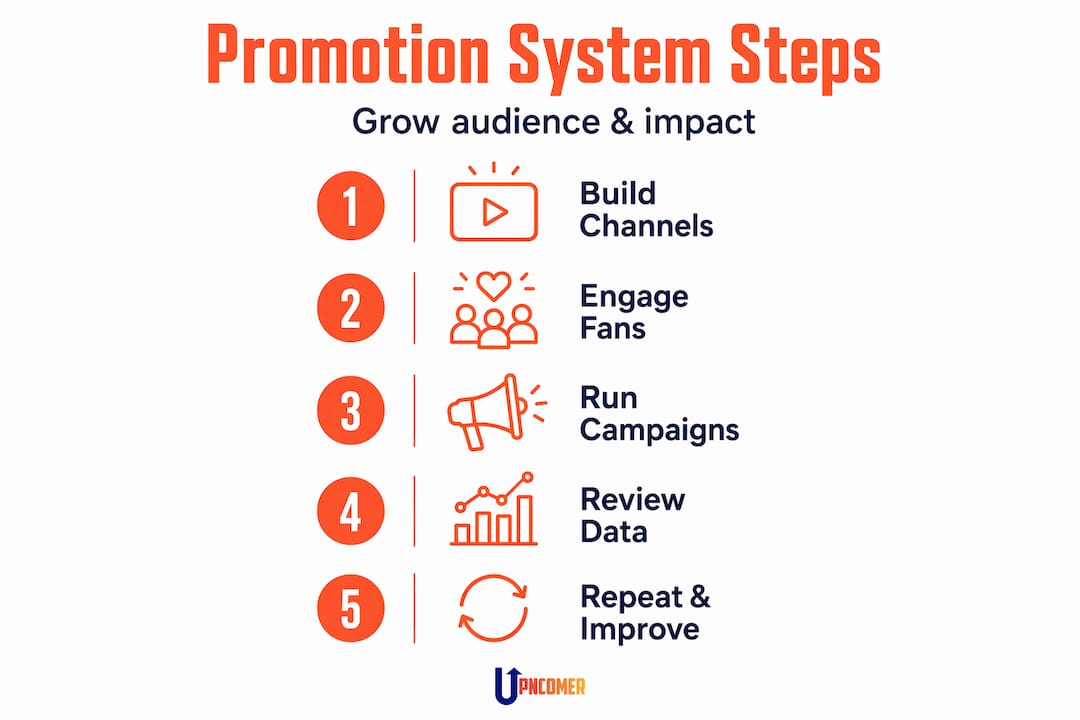
Here’s the framework most artists are missing. Treating every release like a one-off campaign is exhausting and ineffective. The artists who grow consistently build promotion as a repeatable system with defined layers.
Audiartist’s five-layer model is the clearest version of this thinking in 2026:
- Release engine. A detailed release calendar paired with reusable asset kits containing photos, bios, links, and promotional copy. You build it once per release cycle and deploy it across every channel.
- Content engine. Consistent, varied content that serves different stages of fan awareness. Teasers pull in new listeners. Behind-the-scenes posts deepen connection with existing fans. Editorial storytelling (your “why this song” narratives) creates context that drives saves and shares.
- Discovery layer. This is where streaming analytics and playlist pitching live. Playlists create a specific listening mindset that scrolling through social media simply doesn’t replicate. Getting on editorial or independent playlists puts your music in front of people actively ready to hear something new.
- Owned-audience layer. Email marketing for musicians often gets underused, but it’s your most direct line to superfans. A 500-person email list of engaged fans often outperforms 5,000 passive followers on any social platform.
- Measurement loop. Regular review of what the data is telling you so you can adjust before the next cycle, not after.
A sustainable promotion rhythm balances content creation, fan outreach, audience interaction, and data review on a weekly schedule. Not a sprint before release and then silence. A recurring rhythm you can maintain without sacrificing your creative output.
The content engine deserves more attention here. Artists often default to “post the song link” and wonder why engagement is low. Different content types do different jobs:
- Short-form video clips capture attention from cold audiences who have never heard of you
- Process or behind-the-scenes content builds trust with warm audiences already following you
- Newsletter updates and direct messages activate your superfans and drive them toward support actions
- Playlist pitching and press coverage reach audiences who are actively searching, not just scrolling
Social media and advertising for musicians
Promoting music on social media works best when you treat it as a context-building layer, not a distribution channel. Social platforms aren’t where most people go to discover music. They’re where people go to understand who you are before they decide to press play.
That shift in thinking changes everything about how you post.
- Lead with the story, feeling, or moment behind the music before you lead with the link
- Use short-form video (Reels, TikTok, Shorts) to let a snippet earn attention before you direct people to the full track
- Keep call-to-action friction low: “Save this if it hits” converts better than “check the link in bio”
- Engage in the comments genuinely, not just with one-word replies, since platform algorithms reward conversations
- Post consistently rather than in bursts around release week only
On the paid side, online music advertising methods fall into two categories: awareness campaigns and conversion campaigns. Awareness campaigns (broad targeting, short clips, low cost per view) are for listeners who have never heard of you. Conversion campaigns (retargeting warm audiences, linking to streaming or purchase pages) are for people who already know you exist.
Mixing them up wastes budget. A cold audience doesn’t need a “buy now” prompt. They need thirty seconds of music that makes them curious.

Pro Tip: Run a $5 per day awareness ad for seven days before your release, targeting listeners of three to five similar artists. Use that data to identify which audience responded best, then scale the conversion campaign to that segment on release day.
Measuring what actually matters
Data without interpretation is just noise. Here’s what to actually track and what to do with it.
- Streams and stream sources tell you where discovery is happening, whether it’s algorithmic, editorial, or direct
- Save rate (saves divided by streams) is one of the clearest signals of genuine listener intent, aim for above 10%
- Playlist adds from listeners (not just editorial) indicate that your music fits a real listening context people want to return to
- Click-through rate on ads tells you whether your creative is resonating, not whether your song is good
- Email open and click rates indicate the health of your owned audience relationship
One mistake nearly every artist makes early on: checking campaign results too fast. Spotify Showcase data has a 24-hour reporting lag, so judging performance in the first day and pulling campaigns early costs you the learning window the platform needs to optimize delivery.
Vanity metrics like total follower count and raw stream numbers feel satisfying but rarely tell you whether your promotion is working. A song with 500 streams and a 15% save rate is performing better than a song with 5,000 streams and a 2% save rate. One is building fans. The other is getting skipped.
Pro Tip: Set a two-week evaluation window for any new campaign or promotion strategy. Review the core metrics at the end, make one or two targeted changes, and repeat. Small, consistent iterations beat dramatic strategy overhauls.
My honest take on where music promotion is heading
I’ve spent years watching artists chase virality as if one breakthrough moment was the whole game. What I’ve seen actually build careers is far less exciting to talk about but far more reliable to execute. It’s systems. Boring, repeatable, data-informed systems.
The biggest shift I’ve noticed in 2026 is that systematic promotion approaches are quietly outperforming hype-focused tactics at every level. The artists growing right now aren’t the ones with the biggest launch day spikes. They’re the ones who release consistently, build owned audiences deliberately, and treat their analytics like a conversation with their listeners rather than a scoreboard.
The frustration I hear most often from independent artists is “I’m doing everything right and nothing is working.” Almost every time I dig in, the issue isn’t effort. It’s that the effort is scattered across too many channels without a measurement loop connecting them. You can be active on five platforms and still be invisible if you’re not reading the signals each one is sending back.
My take: the future of music promotion belongs to artists who treat their career like a creative business. That means integrated tools, real fan data, and a promotion rhythm that doesn’t require you to sacrifice making music to maintain it. Platforms like UpNComer exist precisely to make that integration possible without needing a full team or a major label behind you.
— Karan
How UpNComer supports your promotion strategy
If building a multi-layered promotion system sounds like a lot to manage alone, that’s because it is. Most independent artists are doing it across five to eight separate tools, losing data and context at every handoff.
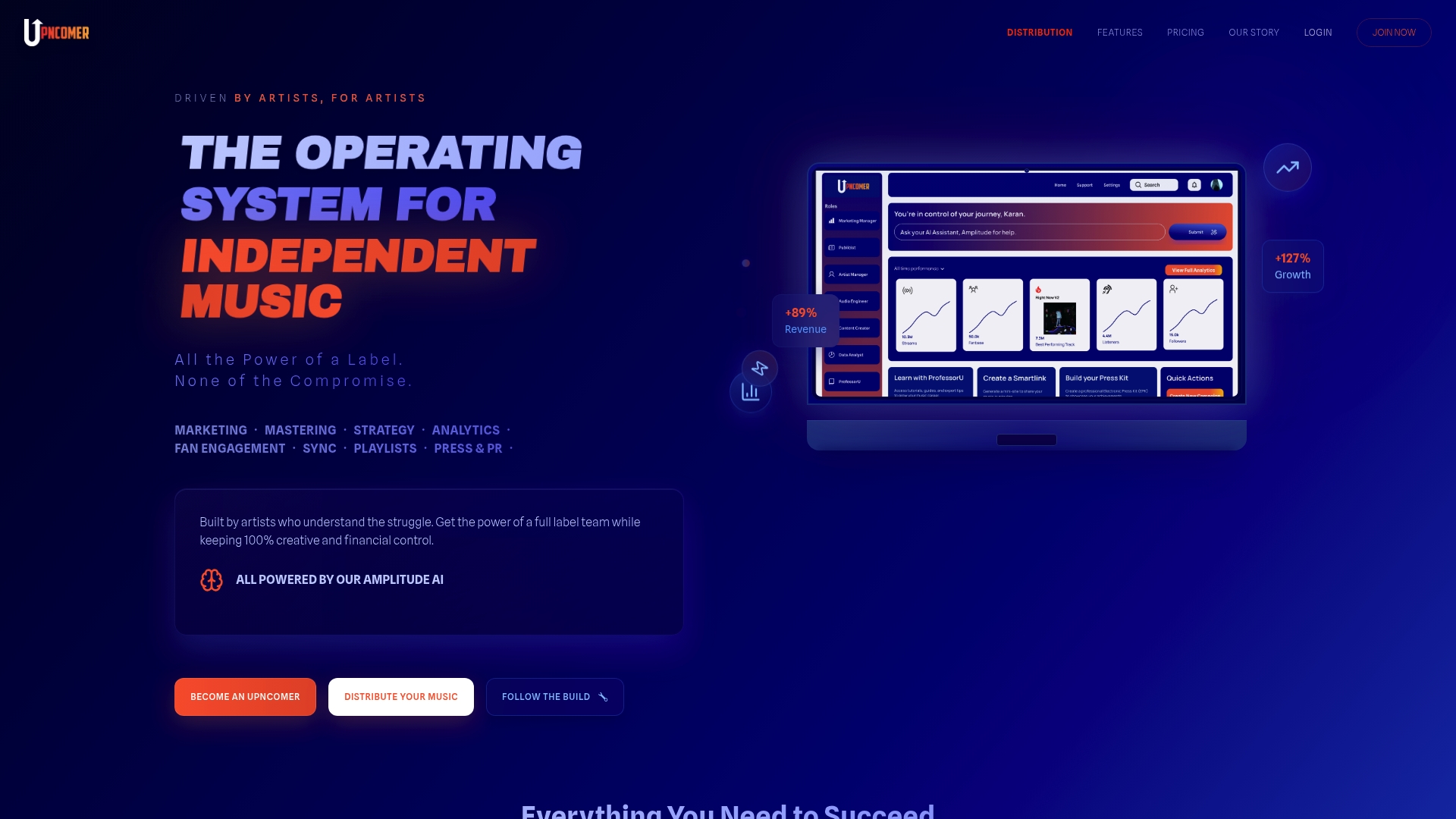
UpNComer brings the whole operation into one place. The Growth Engine and Data Analyst tools handle campaign management and streaming analytics in one view, so you can see what’s working without stitching together spreadsheets. Amplitude AI gives you guided recommendations on what to do next based on your actual release data, not generic advice. The Artist Manager module keeps your release engine organized with calendars, asset libraries, and workflow automation. And UpNComer’s distribution integrates directly with your promotion workflow so your release cycle runs as a connected system. Check out the community updates for the latest music marketing insights and platform changes that affect your strategy every week.
FAQ
What is online music promotion?
Online music promotion, also called digital music marketing, is the collection of strategies artists use to get their music discovered, streamed, and supported through digital platforms, including streaming services, social media, and direct fan channels.
How do I start promoting my music online with no budget?
Focus on organic engagement signals first. Post consistently on one or two social platforms, pitch your music to independent playlists, build an email list, and direct your most loyal fans to support you on Bandcamp, where real purchases trigger editorial discovery.
What is the difference between Spotify Marquee and Showcase?
Marquee is a full-screen pop-up campaign best suited for new releases, requiring 15,000 streams in the past 28 days. Showcase places your music on a browseable shelf, starts at $0.40 CPC, and works for both new releases and catalog promotion with a lower eligibility threshold of 1,000 streams.
How long should I run a music promotion campaign?
Most platform campaigns need at least two weeks before you have enough data to evaluate performance accurately. Spotify Showcase reports carry a 24-hour data lag, so avoid making major changes or canceling campaigns within the first day or two.
What metrics should I track to know if my promotion is working?
Prioritize save rate, playlist adds, and completion rates over raw stream counts. A high save rate indicates genuine listener intent, while completion rates signal whether your song is holding attention long enough to train the algorithm in your favor.