Music Catalog Management for Independent Artists

Most independent artists know they own their music. Far fewer know exactly what that ownership covers, where their royalties come from, or whether their metadata is accurate enough to actually collect them. That’s where music catalog management becomes the difference between leaving money on the table and building a real, lasting music business. At its core, understanding what is music catalog management means grasping how your compositions, recordings, rights, and contracts all connect — and making sure that connection is working in your favor.
Table of Contents
- Key takeaways
- What music catalog management really means
- Challenges and risks that catch artists off guard
- Top music catalog management platforms worth knowing
- How to manage your music catalog step by step
- How catalog management connects to your growth strategy
- My honest take on catalog management
- Take control of your catalog with UpNComer
- FAQ
Key takeaways
| Point | Details |
|---|---|
| Catalogs go beyond audio files | Your catalog includes compositions, masters, metadata, ownership splits, and contracts — all need active tracking. |
| Metadata accuracy drives royalties | Inaccurate ISRCs or ISWCs can result in misattributed royalties and lost revenue that’s nearly impossible to reclaim later. |
| Poor management carries real risk | Missed contract deadlines, fragmented ownership data, and metadata errors can cost you rights and revenue permanently. |
| Software changes the game | Dedicated music catalog software offers AI tagging, bulk editing, and sync-ready search far beyond what spreadsheets provide. |
| Catalog data fuels your whole career | Good catalog organization directly supports playlist pitching, sync licensing, release planning, and audience growth. |
What music catalog management really means
Music catalog management is the systematic process of organizing your musical works, sound recordings, and all the contracts and rights information that surround them. It is not just filing your MP3s into folders. It is a living operational practice.
Your catalog has several distinct layers:
- Compositions — the underlying song, including melody and lyrics, governed by publishing rights
- Master recordings — the specific recorded version of a composition, which you may or may not own depending on your distribution or label agreements
- Metadata — technical identifiers like ISRCs (International Standard Recording Codes) for recordings and ISWCs (International Standard Works Codes) for compositions, plus descriptors like genre, mood, BPM, and instrumentation
- Ownership shares — splits between co-writers, producers, and rights holders
- Contracts — distribution deals, co-publishing agreements, sync licenses, and any other legal documents that define how your music can be used and by whom
The core functions of catalog management include protecting your intellectual property, enabling accurate royalty accounting, and creating monetization opportunities through sync licensing and distribution. A catalog system organizes songs, recordings, rights, and metadata in one centralized, searchable resource you can use for both management and promotion.
Pro Tip: Register every composition and master recording with the correct performing rights organization (PRO) and Sound Exchange as soon as it is released. Retroactive registration is possible but messy, and you will almost certainly lose some royalties in the gap.
The importance of cataloging music properly also extends to interoperability. When your metadata is consistent across your distributor, PRO, and publishing administrator, royalties route correctly. When it is not, payments slip through the cracks.
Challenges and risks that catch artists off guard
Most independent artists do not neglect their catalog on purpose. The problem is that catalog management feels administrative, and it does not feel urgent until something goes wrong.
Here is what typically goes wrong:
- Metadata inconsistency — the same song title appearing differently across platforms (e.g., “Fade Out” vs. “Fade Out (Original Mix)”) can cause royalty misattribution
- Fragmented ownership data — producer splits agreed verbally but never documented formally; co-writer agreements scanned and emailed but never stored in one place
- Contract neglect — distribution or licensing agreements with renewal or option clauses that expire without notice because no one was tracking the deadlines
- One-time cleanup mentality — treating catalog management as a single metadata upload rather than an ongoing practice that grows with your releases
“The music industry faces a data crisis due to disconnected processes and information overload. Professional catalog and CRM systems are what separate artists who control their data from those who are controlled by it.” — Matt Jacoby, Octave Media
The financial consequences are real. Poor catalog management leads to misattributed royalties, missed renewal deadlines, and costly disputes that can take years to untangle legally. The harder truth: some lost royalties are simply unrecoverable. PROs have collection windows, and if your song is not registered with accurate ownership data when it gets placed, that revenue disappears.
Contract tracking deserves its own attention. Option exercise deadlines typically fall 30 to 60 days after delivery, and missing them can mean losing control over recordings you thought you owned free and clear. A calendar reminder is not enough. You need a system.

Top music catalog management platforms worth knowing
Generic cloud storage does not cut it for catalog management. Google Drive or Dropbox can hold your audio files, but they cannot tag a track by mood, generate a branded share link for a sync supervisor, or alert you when a contract is approaching its option window.
That is where dedicated music catalog software changes things. Here is a quick comparison of platforms worth knowing about:
| Platform | Best for | Key features | Price range |
|---|---|---|---|
| DropCue | Composers and libraries | AI auto-tagging, bulk metadata editing, branded sharing | $5–$50/month |
| Synchtank | Sync agencies and larger catalogs | Rights tracking, CRM integration, licensing workflows | Custom pricing |
| DISCO | Music supervisors and publishers | Fast search, collaboration tools, client-facing portals | Mid-range subscription |
Professional catalog tools for independent creators typically cost between $5 and $50 per month and offer features that immediately improve discoverability and workflow. At the lower end, you can get AI auto-classification and bulk editing. At the higher end, you get full CRM integration and detailed analytics.
Pro Tip: When evaluating music catalog software, prioritize search functionality above everything else. The ability to search by mood, instrumentation, tempo, and similarity is what makes your catalog usable for sync pitching. A catalog you cannot search is a catalog you cannot sell.
The other major consideration is how your catalog software integrates with your distribution and marketing setup. A platform that lives in isolation adds work. One that feeds into your broader workflow multiplies your output.
Advanced catalog search infrastructure transforms static storage into a living discovery tool. That matters not just for sync placements but for your own planning, playlist pitching, and A&R conversations.
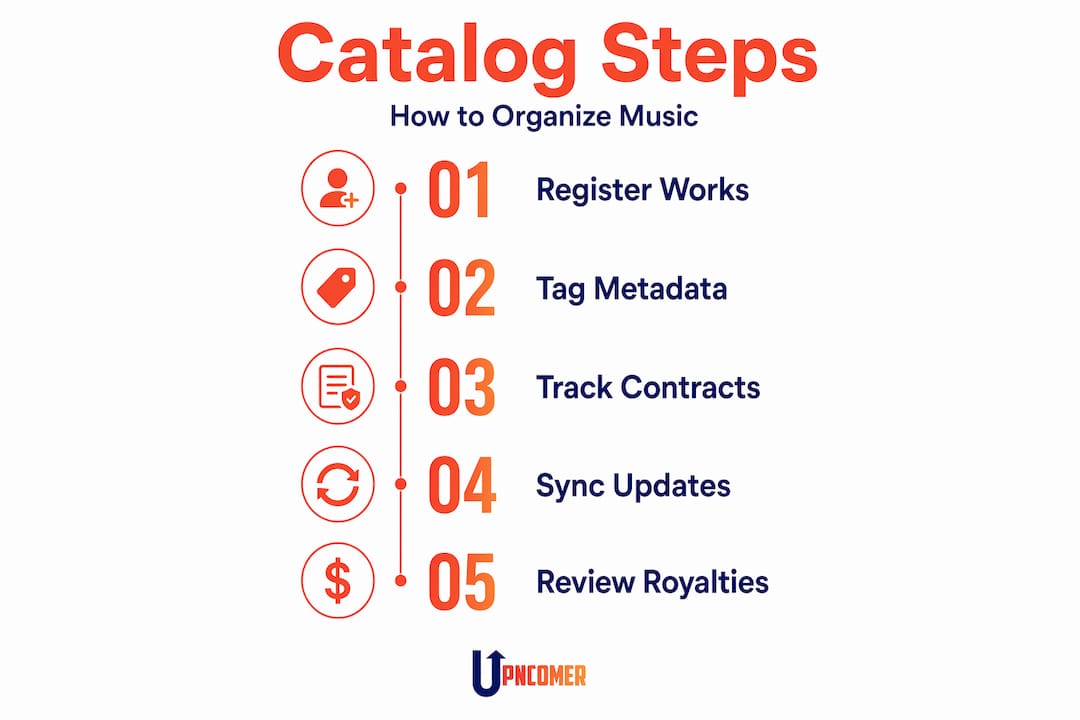
How to manage your music catalog step by step
Building a solid catalog management workflow does not require a label or a team. It requires consistency. Here is a practical framework:
-
Centralize everything first. Pick one system and move all of your compositions, masters, metadata, and contracts into it. Fragmentation is the enemy. Your goal is a single source of truth.
-
Document ownership splits immediately. Every collaboration should produce a written split sheet before the track is released. Store it in the same system as the audio. Do not trust your memory or a text thread.
-
Assign correct metadata to every track. At minimum, every recording needs an ISRC, every composition needs an ISWC, and both need accurate genre, mood, and BPM tags. Think of metadata as the address your royalties use to find you.
-
Set up contract tracking with hard deadlines. For every distribution deal, sync license, or co-publishing agreement, log the key dates: signing date, delivery deadline, option window, recoupment status. Set reminders 60 days before anything expires.
-
Use AI tagging tools to go deeper on descriptors. Mood, energy level, tempo range, instrumentation, lyrical themes, and similar artist references all improve your discoverability for sync and playlist opportunities. Catalog search tools that use audio analysis and similarity mapping make this process much faster than doing it manually.
-
Review and update your catalog after every release. New tracks mean new metadata, new ownership entries, and potentially new contracts. Build the review into your release workflow so it never gets skipped.
Pro Tip: Once your catalog is organized, use it offensively. Pull tracks by mood or instrumentation and build targeted playlists for sync pitching. A well-tagged catalog becomes your best sales tool with music supervisors.
The benefits of music cataloging go beyond admin efficiency. They connect directly to every revenue stream you have, from streaming royalties to licensing deals to merchandise tied to specific releases.
How catalog management connects to your growth strategy
Think of your catalog as the engine underneath everything else you do as an artist. Good catalog data does not just keep your rights protected. It actively feeds your growth strategy.
Here is how the connection works in practice:
- Playlist pitching becomes smarter. When you know exactly which tracks in your catalog match specific moods, genres, or listener profiles, you can pitch with precision instead of blasting the same track to every playlist curator you find.
- Release planning gets coordinated. A clear catalog view helps you see gaps in your discography, plan re-releases of underperforming tracks, and time campaigns around catalog anniversaries or content moments.
- Sync and licensing revenue opens up. Rights clarity is the prerequisite for every sync deal. A music supervisor cannot license a track with murky ownership. Clean catalog data is what gets you to yes faster.
- Audience insights become richer. When your catalog is tied into your analytics, you can see which songs resonate with which fan segments, helping you make smarter decisions about what to promote and when.
Transitioning from intuition-driven decisions to data-driven catalog workflows is increasingly what separates artists who scale from those who stay stuck. UpNComer’s Growth Engine, Amplitude AI, and Distribution modules are built specifically to connect these dots for independent artists, turning catalog data into campaign fuel.
You can also deepen this with smart campaign management strategies that use catalog insights as the foundation for targeted marketing pushes.
My honest take on catalog management
I have seen a lot of independent artists pour energy into their social media presence, their sound, their branding, and almost none into their catalog infrastructure. And then a licensing opportunity comes along and they cannot move fast enough to take it. The split sheet is missing. The ISRC is wrong. The distribution agreement has a clause they forgot about. The deal falls through.
What I have learned is that catalog management is not glamorous, but it is the hidden foundation of artist revenue. The artists who build systematic workflows early, even imperfect ones, are the ones who actually collect what they earn and capitalize on opportunities when they appear.
The technology has never been better or more accessible. AI tagging, centralized metadata tools, contract tracking systems — these used to be reserved for labels with full publishing teams. Now you can access most of these functions for under $50 a month. The barrier is not cost. It is discipline and knowledge.
My advice: treat your catalog the way you treat your creative work. Return to it regularly. Update it as you grow. Do not let it become a pile of loose files and half-remembered agreements. Your future self, trying to close a sync deal or recoup from a distributor, will be genuinely grateful.
— Karan
Take control of your catalog with UpNComer
Managing your music catalog does not have to mean juggling five different platforms and a spreadsheet from 2022. UpNComer is built to bring everything together.

With UpNComer, independent artists get access to tools that handle the full scope of modern music management. Amplitude AI gives you data-driven guidance on release timing and audience targeting. The Artist Manager module helps you track your deals and deadlines. Distribution connects your catalog directly to streaming platforms with accurate metadata. The Growth Engine ties it all together by linking catalog insights to marketing campaigns and fan engagement.
You should not need a label to run a professional operation. UpNComer gives you the infrastructure to manage your rights, track your revenue, and grow your audience on your own terms. If you are serious about your artist development as a long-term career, this is where you start.
FAQ
What is music catalog management?
Music catalog management is the systematic process of organizing and tracking your compositions, master recordings, metadata, ownership splits, and contracts to protect your rights and ensure accurate royalty collection.
Why is metadata accuracy so important for royalties?
Inaccurate metadata like wrong ISRCs or ISWCs means royalty payments cannot route correctly to you. Errors cause misattribution and, in some cases, permanent revenue loss if not corrected before collection windows close.
What does good music catalog software include?
Dedicated music catalog software typically includes AI auto-tagging, bulk metadata editing, contract tracking, advanced search by mood and genre, and integrations with distribution and licensing workflows.
How often should I update my music catalog?
You should update your catalog after every new release, every new contract, and any change in ownership splits. Treating it as an ongoing operational practice, not a one-time cleanup, is what keeps your rights and royalties secure.
Can catalog management help me get sync placements?
Yes. Clean rights documentation and detailed descriptive tagging make your tracks far easier for music supervisors to find, clear, and license quickly, which is often the difference between getting a placement and losing it to a better-organized catalog.