Artist development program components that actually matter

Choosing the right artist development program feels like standing in front of a wall of identical doors. Every program promises to “take your career to the next level,” but when you dig into what they actually offer, the differences are massive. Some give you a rigid curriculum and a certificate. Others hand you a custom roadmap and stay in your corner for months. Knowing which components genuinely move the needle, and which ones just look good on a sales page, can save you serious time, money, and energy. This guide breaks it all down so you can evaluate your options with confidence.
Table of Contents
Key Takeaways
| Point | Details |
|---|---|
| Personalized roadmaps | A custom plan based on your current career stage yields the best results. |
| Integrated brand and tools | Combining visual identity, website, and digital toolkit is critical for building credibility. |
| Analytics matter | Using data and measurable outcomes helps you make smarter decisions and scale growth. |
| Iterative consultation | Ongoing feedback and adaptation drive lasting career advancement. |
How to evaluate artist development programs
Before you sign up for anything, you need a clear lens for evaluation. Not every program is built for where you are right now, and a mismatch between your stage and a program’s structure can leave you frustrated and stalled.
Start by asking whether the program begins with a real assessment of your current situation. A good program does not assume you are starting from zero or that you are already release-ready. It figures out where you actually are, then builds a roadmap from that point. Think of it like a GPS: it needs your current location before it can give you directions.
Here is what to look for when you are sizing up any program:
-
Personalized roadmap building based on your current career stage, not a generic checklist
-
Integrated branding and digital toolkit support, including help with your website, EPK (electronic press kit), and visual identity
-
Measurable outcomes like stream growth and audience discovery rates, not just vague promises about “exposure”
-
Ongoing feedback and adjustment, meaning the program adapts as you grow rather than handing you a static blueprint on day one
-
Digital content and analytics components, which signal that the program understands how modern music careers actually work
A robust artist development system usually combines creative skill, branding, release strategy, audience mechanics, and measurable targets. If a program is missing two or more of those pillars, it is probably not going to serve you well long-term.
Pro Tip: Ask any program you are considering for specific examples of measurable outcomes from past participants. If they can not show you real numbers, that tells you something important.
Thinking about release planning strategies early in your evaluation process also helps you filter out programs that treat releases as one-time events rather than ongoing growth levers.
With evaluation in mind, let us break down the core components you should expect from top artist development programs.
Core components of modern artist development programs
Now that the evaluation lens is set, let us explore what actual program components deliver real career leverage.
The best programs are not just courses. They are structured systems that move you through distinct phases, each building on the last. Here is what those components look like in practice.
1. Stage assessment and custom artist roadmap
Every strong program starts here. A stage assessment identifies your current strengths, gaps, and opportunities across songwriting, branding, digital presence, and audience development. From that assessment, a custom roadmap is built. This roadmap is not a one-size-fits-all checklist. It is a living document that reflects your specific goals, timeline, and resources.
2. Phase-based support and consultation
Accountability is one of the most underrated parts of artist development. Phase-based programs break your journey into clear milestones, with consultation built in at each stage. This keeps you moving forward instead of getting stuck in the planning loop that kills so many independent careers.
3. Creative skills and sonic identity development
This covers songwriting, production, arrangement, and the development of a sound that is distinctly yours. Your sonic identity is what makes a listener recognize your music in the first three seconds. Programs that skip this component often produce artists who sound polished but forgettable.
4. Integrated branding and digital toolkit
Your visual identity, website, EPK, and smart links are not optional extras. They are the infrastructure that makes every other effort more effective. Independent-focused development offerings operationalize components as stage assessment, phase-based execution and consultation, and integrated brand and digital toolkit buildout. A strong EPK alone can be the difference between landing a sync deal and getting ignored.
5. Digital content and analytics system
A modern program teaches you how to create content that feeds the algorithm while staying authentic to your brand. More importantly, it shows you how to read the data that comes back. Streams, saves, playlist adds, follower conversion rates: these numbers tell you what is working and what needs to change.
6. Marketing, release strategy, and feedback loops
A common program component set is a full creative-to-release curriculum with expert instruction, artist identity and brand building, and online presence development. Release strategy is not just about picking a date. It is about building anticipation, sequencing content, coordinating your digital presence, and then analyzing the results to inform your next move.
“The cycle of assessment, execution, learning, and adaptation is what separates artists who grow sustainably from those who plateau after one good release.”
Pro Tip: When reviewing any program’s curriculum, look for audience feedback in music programs as a built-in component. Programs that teach you to listen to your audience data, not just create content, give you a serious long-term advantage.
Comparison of program features: What matters most?
To make selection concrete, here is how common program features stack up in direct benefit to independent artists.
| Program feature | Primary benefit | Career impact |
|---|---|---|
| Stage assessment | Personalized starting point | Avoids wasted effort on wrong priorities |
| Creative curriculum | Stronger songwriting and production | More memorable, marketable music |
| Brand and EPK buildout | Professional pitch materials | Higher success rate with labels, sync, press |
| Analytics system | Data-driven decisions | Sustained audience growth over time |
| Release strategy support | Coordinated launch execution | More streams, saves, and discovery |
| Phase-based consultation | Accountability and course correction | Faster progress, fewer costly mistakes |
| Smart links and digital toolkit | Centralized fan touchpoints | Better conversion from casual listener to fan |
The features that most directly drive career advancement are the ones tied to measurable outcomes. Creative curriculum matters, but if you can not track whether your music is reaching new listeners and converting them into fans, you are flying blind.
Here is a breakdown of what to prioritize based on your current stage:
-
Early stage artists: Focus on stage assessment, creative development, and brand buildout first
-
Mid-stage artists: Prioritize analytics systems, release strategy, and consultation
-
Growth-stage artists: Double down on data, marketing iteration, and digital content pipelines
The numbers back this up. TuneCore Accelerator participants generated 24 billion new streams in a single year, a result that came directly from programs built around measurable, benchmarked outcomes rather than vague creative guidance. That is not a small number. It is proof that when development programs track the right metrics, artists grow in ways that are real and repeatable.
When exploring UpNComer music growth tools, you will notice that the platform is built around exactly these kinds of measurable, integrated components, which makes it a strong reference point for what a modern development ecosystem should look like.
Integrating digital, analytics, and feedback tools
All these features mean little without robust digital tools and analytics, so let us clarify how these should work in your career context.
The shift from label-controlled development to platform-native growth is one of the biggest structural changes in the music industry over the last decade. Analytics and digital mechanics now give independent artists access to the same kind of audience intelligence that major labels used to gatekeep. The question is whether your development program actually teaches you how to use it.
Contemporary independent-artist development includes analytics-led digital systems, from algorithmic discovery to retention optimization. That means your program should not just mention analytics. It should build them into your workflow from day one.
Here is what a well-integrated digital and analytics system looks like in practice:
| Tool or mechanic | What it tracks | Why it matters |
|---|---|---|
| Streaming analytics | Streams, saves, skip rates | Shows what music resonates and what does not |
| Audience clustering | Demographics, location, listening habits | Helps you target the right fans with the right content |
| Content cadence tracking | Post frequency, engagement rates | Identifies the optimal rhythm for your audience |
| Conversion signals | Listener to follower, follower to superfan | Measures how effectively you are building real fans |
| Retention optimization | Return listeners, playlist retention | Indicates long-term audience loyalty |
The key mechanics you want embedded in any program include data clustering, content cadence analysis, conversion and retention signals, and rapid iteration cycles. Rapid iteration means you test something, read the data, adjust, and test again. It is the same process that growth teams at major companies use, and it works just as well for music careers.
Here is what this looks like in practice. Say you release a single and notice that your skip rate is high in the first 30 seconds. That is a signal that your intro is not hooking listeners fast enough. A program with a real analytics component helps you identify that pattern early and adjust your next release accordingly, rather than waiting six months to realize something was off.
Pro Tip: Set up your analytics tracking before your release goes live, not after you notice stagnation. Baseline data from the first 48 hours of a release is some of the most valuable information you will ever have about how your audience responds to new music.
Using UpNComer platform insights gives you access to exactly this kind of real-time data, so you are always making decisions based on what is actually happening, not what you hope is happening.
The overlooked truth: Customization beats one-size-fits-all
Here is a hard-earned insight from inside the industry, and it might be the most important thing in this entire article.
Most artist development programs do not fail because they are missing a feature. They fail because they are rigid. They hand you a template, walk you through it in sequence, and then send you on your way. The problem is that your career does not move in a straight line. Your audience shifts. Platforms change their algorithms. A song takes off unexpectedly and changes your trajectory. A rigid program can not account for any of that.
Custom-fit roadmaps that get revisited every few months consistently outperform pre-packaged solutions. Not because the content is necessarily better, but because the structure allows for real-world adaptation. You learn something from your last release, you bring that back to your roadmap, and you adjust. That cycle of assessment, execution, learning, and adaptation is where real breakthroughs happen.
Do not just check boxes when you are evaluating a program. Ask yourself whether the program will still be useful six months from now when your situation has changed. Ask whether there is a mechanism for revisiting your goals and adjusting your plan. Ask whether success is defined in observable metrics or just narrative milestones.
For evidence-backed planning, prefer development components that define success in observable metrics rather than only narrative milestones. Programs that measured actual streams and discoveries yielded measurable, iterative growth. That is not a coincidence. It is the direct result of building accountability into the structure.
The artists who grow the fastest are not the ones with the most talent or the biggest budgets. They are the ones who commit to the cycle of building, measuring, learning, and adjusting. A great development program gives you the structure to do exactly that. Iterative feedback strategies are what turn a good release into a career-building moment.
Ready to apply these components to your music career?
You now have a clear picture of what separates effective artist development programs from the ones that just sound good on paper. The real question is what you do with that knowledge.
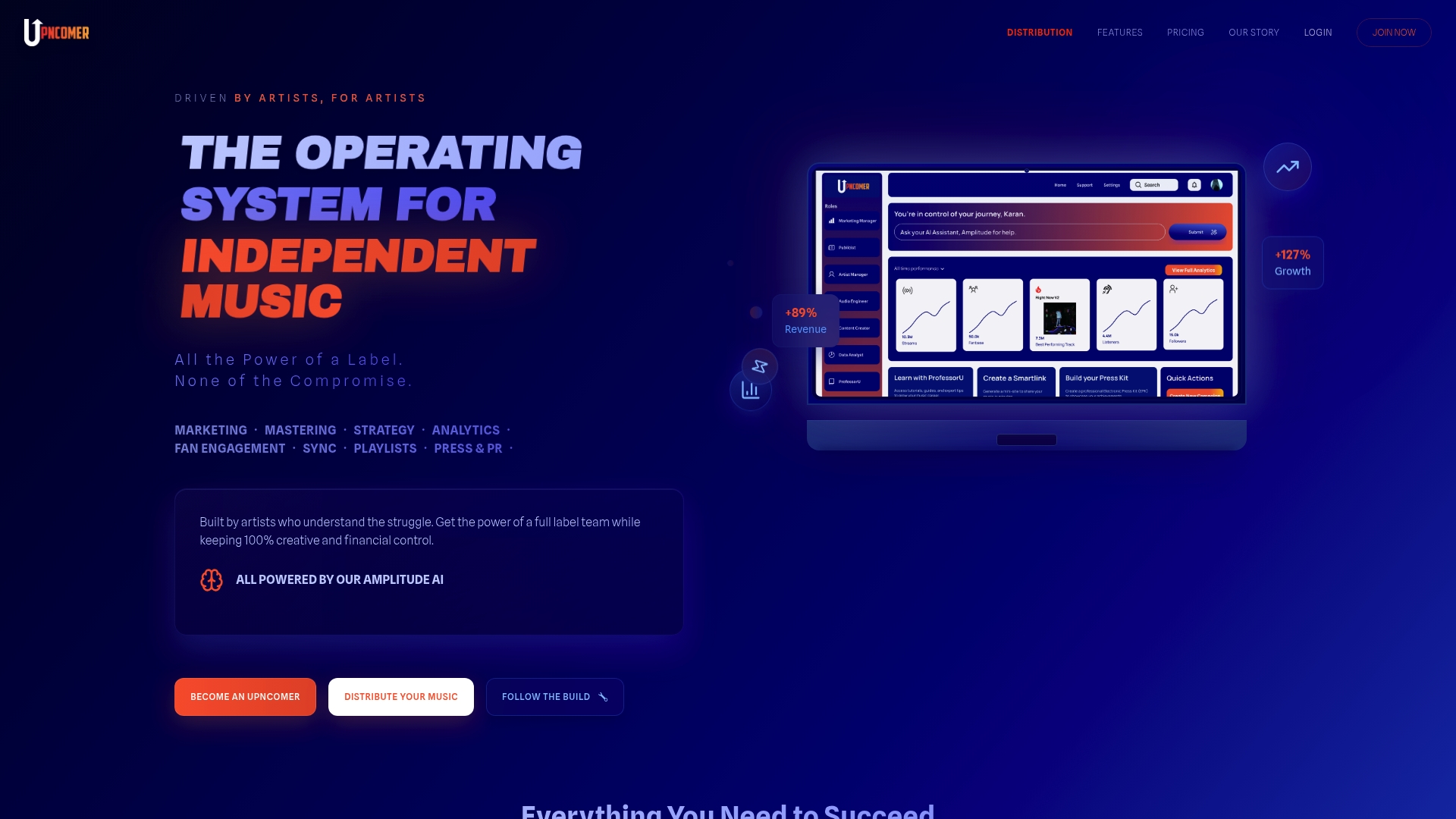
UpNComer is built specifically for independent artists who are serious about applying these components to their actual careers. Instead of piecing together a dozen different tools and hoping they work together, UpNComer brings everything into one place: custom roadmaps, streaming analytics, AI-powered guidance, release strategy, fan engagement, and more. It is the kind of infrastructure that used to be reserved for major-label artists, now available to you as an independent. If you are ready to stop guessing and start growing with real data behind every decision, artist development with UpNComer is the place to start.
Frequently asked questions
What is the most important component in artist development programs?
The most important is a personalized, phase-based plan that integrates creative skills, branding, and measurable outcomes. A robust artist development system combines creative skill, branding, release strategy, audience mechanics, and measurable targets working together, not as isolated features.
How do I know if an artist development program will help me grow my fanbase?
Look for programs that include analytics-led tools and trackable metrics like new streams and artist discoveries. Contemporary independent-artist development now includes algorithmic discovery and retention optimization as core components, not optional add-ons.
Do I need branding and a digital toolkit as an emerging artist?
Yes, and sooner than most artists think. Building your visual identity and online presence is essential for marketability and audience growth. Independent-focused development offerings consistently include integrated branding and digital toolkit buildout as foundational, not advanced, components.
Are measurable outcomes really important for independent musicians?
Absolutely. Measurable outcomes help you track progress, optimize your effort, and grow your career in a reliable, repeatable way. Empirical and benchmarked components like new streams and artist discoveries give you real evidence of what is working, so you can do more of it.