How to Earn Money with Music: 2026 Artist Guide

Music monetization is defined as the process of converting your creative output into multiple, concurrent income streams that compound over time. Knowing how to earn money with music means going far beyond streaming royalties. The artists building real financial stability in 2026 treat streaming as the top of their funnel and build direct-to-fan channels, sync deals, live income, and merchandise sales underneath it. This guide breaks down every major revenue stream, the administrative steps you cannot skip, and the practical moves that separate artists who earn from artists who just release.
1. How to earn money with music: start with digital distribution
Getting your music onto streaming platforms is the first step, but it is not where the money lives. Streaming pays fractions of a cent per play and works best as a discovery engine, not a paycheck. Think of it as proof of concept. Every stream tells a potential sync client, booking agent, or new fan that your music exists and people are listening.
The real financial move is pairing distribution with proper royalty registration. Getting started costs under $50, covering distributor fees, while PRO registration is free. That is one of the lowest barriers to entry of any professional creative career.

Use a digital distributor to get your music on Spotify, Apple Music, Amazon Music, and Tidal. Upncomer’s Distribution service handles this directly, so you are not juggling multiple platforms.
Pro Tip: Register separately as both a songwriter and a recording artist. These are two different royalty streams, and mixing them up is one of the most common ways artists leave money unclaimed.
2. Register with PROs, MLC, and SoundExchange
Registration is not optional. Signing up with PROs, The MLC, and SoundExchange is the only way to capture every royalty type your music generates. Miss one, and you are giving away money.
Here is what each organization covers:
- PRO (ASCAP, BMI, or SESAC): Collects performance royalties when your music plays on radio, TV, or live venues.
- The MLC (Mechanical Licensing Collective): Collects mechanical royalties from on-demand streaming in the United States.
- SoundExchange: Collects digital performance royalties for the recording artist when music plays on satellite radio and non-interactive streaming services.
Administrative oversights in separating songwriter and recording artist registrations lead directly to unclaimed royalties. Set this up once, correctly, and it pays you passively for years.
3. Avoid the dual administration trap
One of the most damaging mistakes independent artists make is letting both their distributor and a publishing administrator collect mechanical royalties at the same time. Dual royalty collection creates conflicts and can result in lost income that is nearly impossible to recover.
Choose one entity to handle your publishing administration. If your distributor offers publishing admin as an add-on, check whether it conflicts with a separate publishing deal you already have. The rule is simple: one administrator per royalty type, no overlap.
4. Live shows and touring income
Live performance is where independent artists can earn real money fast. Guarantee fees range from $100 to $500 per show for early-career artists and climb to $10,000 or more for established independents. That range shows how much room there is to grow simply by building a reputation in your region before expanding nationally.
The path from local to national looks like this:
- Play local venues consistently to build a draw.
- Document your shows with photos, video, and attendance numbers.
- Use that proof to pitch regional bookers and festivals.
- Add support slots for touring artists to reach new audiences fast.
- Graduate to headlining regional tours once your draw is proven.
Live shows also create the perfect environment for merchandise sales, which is where the real margin lives.
Pro Tip: Negotiate a door deal or percentage split on top of your guarantee once you can consistently draw 100 or more people. That is when live income starts to scale meaningfully.
5. Merchandise: the highest-margin income stream
Merchandise is the most profitable revenue stream most independent artists underuse. Merch at live shows carries 70%–80% profit margins, and fans buy merch at live shows at five to ten times the rate they do online. A T-shirt that costs $5–$8 to produce sells for $25–$35 at a show. That math is hard to beat.
Your best-selling items at shows are typically:
- T-shirts and hoodies with bold, wearable designs.
- Vinyl records or limited-edition CDs for collectors.
- Signed prints or lyric sheets for superfans.
- Bundled packages that combine a record with a shirt at a slight discount.
Sell through your own website when possible. Third-party print-on-demand platforms take a significant cut. For live shows, carry physical inventory and use a simple card reader to close every sale.
6. Sync licensing: the biggest single paycheck in music
Sync licensing is the practice of placing your music in TV shows, films, advertisements, video games, and online content in exchange for a fee and ongoing royalties. Sync placements pay between $500 and $50,000 or more per placement, plus performance royalties every time the content airs. One placement can outpay months of streaming income.
To pursue sync licensing effectively:
- Register every song with your PRO and copyright it through the U.S. Copyright Office before pitching.
- Build a catalog of instrumentals. Music supervisors often need versions without vocals.
- Submit to music libraries that specialize in your genre. Libraries pitch on your behalf to supervisors.
- Work with a sync agent if your catalog is large enough. Agents take a commission but open doors you cannot reach alone.
- Target brands and shows that already use music in your style. Relevance matters more than reach.
The key insight is that sync income does not require a large fanbase. It requires the right song in the right place at the right time, backed by clean copyright registration.
7. Fan subscriptions and direct-to-fan income
Platforms like Patreon let you charge fans a monthly fee for exclusive content, early access, behind-the-scenes material, or direct interaction. This model converts your most engaged listeners into paying supporters and creates predictable monthly income regardless of streaming numbers.
Direct-to-fan sales through your own website or Bandcamp give you the highest revenue per transaction. Bandcamp passes most of the sale price directly to you, unlike streaming platforms. Selling a $10 album download on Bandcamp pays more than 10,000 streams on most platforms.
Building an email list and treating each song release as a mini-campaign drives fans toward gigs, merch, and direct purchases. Your email list is the one audience you own outright. Social media algorithms change. Your email list does not.
8. Beats, sample packs, and online lessons
If you produce music, your skills are a product. Selling beats on platforms like BeatStars or your own site generates income from other artists who need production. Sample packs and loop kits sell to producers worldwide and require no ongoing effort after the initial upload.
Online music lessons are another high-value service. Teaching guitar, production, songwriting, or music theory via video call scales your time without requiring you to be in the same room as your student. Rates for specialized instruction start at $50 per hour and rise quickly with reputation.
These income streams work especially well for artists who are building their fanbase and need cash flow while their music catalog grows.
9. YouTube monetization and live streaming
YouTube’s Partner Program pays ad revenue on your videos once you meet the eligibility threshold. While the per-view rate is modest, YouTube also pays Content ID royalties when your music appears in other creators’ videos. That passive income compounds as your catalog grows.
Live streaming on platforms like Twitch or YouTube Live lets fans tip, subscribe, or donate in real time. Artists who stream consistently build a community that shows up for every release, every show, and every merch drop. The online music promotion value of live streaming extends well beyond the tips you collect during the stream itself.
10. Release strategy as a monetization tool
A consistent release rhythm is itself a monetization strategy. Artists who treat each song as a mini-campaign achieve better income consistency than those who release sporadically and hope for viral moments. Each release is an opportunity to pitch playlists, pitch sync, run ads, sell merch, and grow your email list simultaneously.
A music release checklist keeps every release coordinated across distribution, promotion, and fan engagement. Releasing without a plan means leaving money on the table at every step.
Pro Tip: Release music every 4–6 weeks if possible. Frequent releases keep your name in front of algorithms, playlist curators, and fans without requiring a major campaign budget each time.
Key takeaways
Making money from music requires building multiple income streams simultaneously, with digital distribution and royalty registration forming the non-negotiable foundation everything else depends on.
| Point | Details |
|---|---|
| Register everywhere | Sign up with a PRO, The MLC, and SoundExchange to capture every royalty type your music generates. |
| Treat streaming as discovery | Streaming pays fractions of a cent per play; use it to funnel listeners toward merch, shows, and direct sales. |
| Merch is your best margin | Live merchandise carries 70%–80% profit margins and sells at far higher rates than online. |
| Sync pays the most per placement | A single sync deal can pay $500 to $50,000 or more, outpacing months of streaming income. |
| Own your audience | An email list and direct-to-fan channels give you income that no algorithm can take away. |
What I’ve learned about stacking music income streams
The artists I see struggling most are the ones who pour everything into getting streams and then wonder why their bank account does not reflect their play count. Streaming is real, but it is not a paycheck. It is a signal. The money follows when you build the infrastructure around that signal.
The administrative side of this is genuinely boring, and that is exactly why most artists skip it. Registering with The MLC, separating your songwriter and recording artist accounts, and keeping your publishing administration clean feels like paperwork. It is also how you collect money that is already owed to you. I have seen artists discover thousands of dollars in unclaimed royalties simply by registering correctly after years of not doing so.
The other thing I would tell any emerging artist is to reinvest early. Your first $500 from a sync deal or a merch table should go back into data-driven marketing or a better release campaign, not into new gear. Gear does not grow your audience. Visibility does.
Build your email list from day one. Not when you feel ready. Not after your next release. Now. Every fan who gives you their email address is worth more than a hundred passive followers on any platform.
— Karan
Upncomer helps you build every income stream in one place
Independent artists should not need five different platforms to manage distribution, fan engagement, analytics, and release campaigns. Upncomer brings all of it together in one place, built specifically for artists who want to grow without a label.
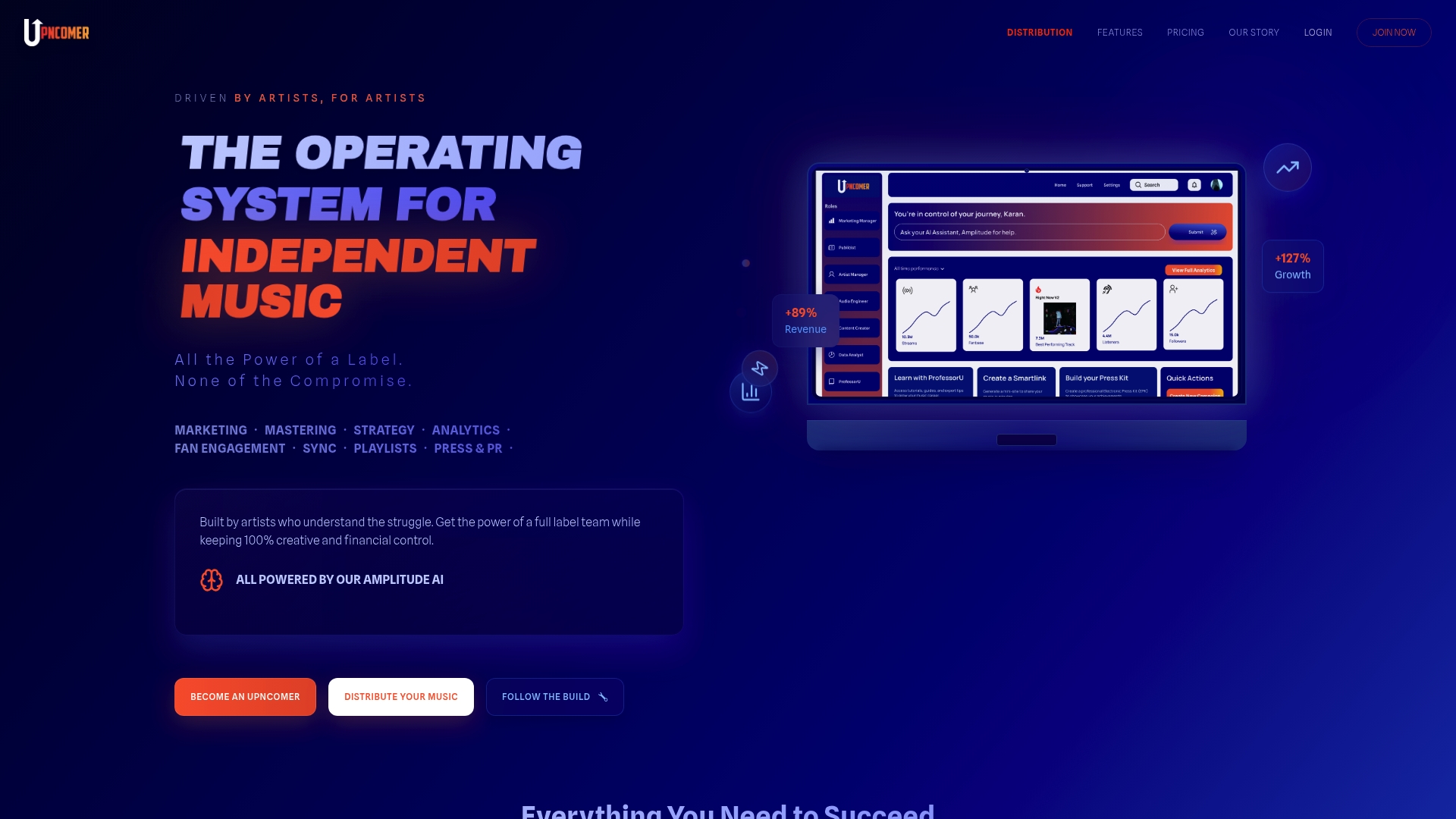
Upncomer’s Distribution service gets your music onto every major platform while supporting royalty collection from day one. The platform’s Growth Engine, Amplitude AI, and Data Analyst tools give you the streaming analytics and audience insights you need to make every release count. Whether you are pitching playlists, running ad campaigns, or building your fan engagement systems, Upncomer replaces the fragmented stack with one clear workflow. Check out community updates to see what artists are building right now.
FAQ
How much does it cost to start earning royalties?
Getting started costs under $50, covering basic distributor fees. PRO registration with organizations like ASCAP or BMI is free.
What is the fastest way to make money from music?
Live shows and merchandise sales generate income the fastest. A single show with a merch table can pay more than months of streaming royalties.
Do I need a publisher to collect all my royalties?
You do not need a traditional publisher, but you must register with The MLC and a PRO separately. Failing to register means royalties go unclaimed.
What is sync licensing and how do I get started?
Sync licensing places your music in TV, film, ads, or games in exchange for a fee and ongoing royalties. Start by registering your copyrights and submitting to music libraries that match your genre.
How do I turn streaming listeners into paying fans?
Build an email list and treat every release as a mini-campaign. Direct fans from streaming to your website, merch store, or Patreon where they can pay you directly.