Best Music Distribution Service for Independent Artists

If you want one platform that handles distribution and everything that comes after it, Upncomer is the strongest pick for independent artists in 2026. It combines distribution with Growth Engine campaign tools, Amplitude AI analytics, and release automation under a single subscription, with a 6% royalty split on distributed revenue. Your music reaches Spotify, Apple Music, Amazon, and dozens more stores, and you manage the whole release workflow without bouncing between five different apps.

For artists who just want cheap, unlimited uploads, DistroKid is the go-to aggregator. If you prefer paying once per release with no annual commitment, CD Baby ($9.99 per single) is a proven option. For label-style services and white-glove support, Symphonic Distribution is worth a look.

Table of Contents
- How do the top music distribution services compare?
- How do you choose the right music distribution service?
- Which distributor is right for your career stage?
- How we evaluated these distributors
- Key Takeaways
- Why your distribution choice shapes more than just where your music lands
- Upncomer gives you distribution plus the tools to actually grow
- Useful sources and further reading
- What the conventional wisdom on music distribution gets wrong
- FAQ
How do the top music distribution services compare?
The table below maps every major distributor across the dimensions that actually affect your income and workflow. Read it alongside the notes beneath it.

| Distributor | Best for | Pricing model & sample cost | Royalty retention | Stores & reach | Release limits | Notable extras | Payout cadence | Support |
|---|---|---|---|---|---|---|---|---|
| Upncomer | All-in-one growth platform | Subscription + 6% royalty split | 94% (after 6% split) | Major global stores + social | Unlimited | Growth Engine, Amplitude AI, mastering, playlist pitching, ad campaigns | Monthly | Onboarding resources + AI guidance |
| DistroKid | High-volume uploaders | Subscription (~$22.99/yr entry) | 100% | 150+ stores | Unlimited | HyperFollow, Spotify for Artists fast-track | Rolling/monthly | Help center; mixed reviews on live support |
| CD Baby | Per-release, no subscription | Per-release ($9.99 single / $14.99 album) | ~91% (9% fee on streams) | 150+ stores incl. Apple, Spotify, TikTok | Per release | Publishing admin, YouTube monetization, sync licensing | Weekly | Established; preferred Apple & Spotify partner |
| TuneCore | Indie pros, detailed reporting | Per-release annual fee | 100% | 150+ stores | Per release | Publishing admin, accounting-style reports | Monthly | Email/chat; detailed dashboard |
| Ditto Music | Team accounts, label services | Subscription (~$19/yr) | 100% | 200+ stores | Unlimited | Label services, promo packages, chart registration | Monthly | Live chat; label team support |
| Symphonic Distribution | Established indie labels | Application-based; custom pricing | 100% | 200+ stores, regional focus | Curated | Full label services, sync, marketing | Monthly | Dedicated account management |
| Identity Music | Catalog management + label support | Not publicly listed | Not publicly listed | Major stores | Not publicly listed | Catalog services, artist support | Not publicly listed | Trustpilot-rated; boutique feel |
| Amuse | Budget-conscious artists | Free tier + paid upgrade | 100% (paid tier) | Major stores | Free tier limited | Publishing admin option | Monthly | App-based; limited live support |
| UnitedMasters | Brand deals + sync | Free tier + SELECT subscription | 100% (SELECT) | Major stores | Unlimited (SELECT) | Brand partnerships, sync placement | Monthly | Community + email |
| ONErpm | Global reach + analytics | Revenue share or label deal | Varies by deal | 200+ stores, strong Latin/global | Unlimited | Label services, analytics dashboard, sync | Monthly | Dedicated reps for larger artists |
| Too Lost | Boutique/niche artists | Not publicly listed | Not publicly listed | Major stores | Not publicly listed | Niche audience focus, boutique approach | Not publicly listed | Boutique support |
How to read this table:
- Subscription means you pay a flat annual fee and upload as many releases as you want. Total cost stays fixed regardless of output.
- Per-release means you pay once per single or album. Low-output artists often come out ahead; prolific uploaders pay more over time.
- Revenue share means the distributor takes a percentage of your streaming income instead of (or on top of) an upfront fee. Watch the split carefully.
How do you choose the right music distribution service?
Here’s the short decision rule: if you want an all-in-one career platform with marketing and analytics built in, choose a suite like Upncomer. If you only need cheap, unlimited uploads with no extras, a subscription aggregator like DistroKid does the job at a lower monthly cost.
Everything else comes down to five variables.
Pricing model: what you actually pay over a year
The three pricing shapes each favor a different type of artist. A subscription aggregator charges roughly $20–$30/year for unlimited releases, which is great if you drop singles every month. A per-release service like CD Baby charges $9.99 per single, so one or two releases a year costs less than any subscription. A revenue-share model (like ONErpm’s label deals) takes a cut of every dollar you earn, which can cost more long-term if your streams grow.
Quick example: an artist releasing 10 singles a year pays less with DistroKid’s subscription approach compared to multiple per-release fees with CD Baby. Flip that to two singles a year and CD Baby’s per-release fees are close to the cost of a DistroKid subscription. The math shifts fast.
Royalty retention and splits
Most distributors now offer 100% royalty retention on the subscription or per-release model. The exceptions are revenue-share deals and platforms like Upncomer, which takes a 6% royalty split in exchange for bundling distribution with its full marketing and analytics suite. Whether that trade-off works for you depends on how much you’d otherwise spend on separate tools for ad campaigns, analytics, and playlist pitching.
For collaborations, use a distributor that supports royalty splits at upload rather than after payout. Manual reconciliation after the fact is a headache you don’t need.
Stores, geographic reach, and ISRC/UPC
Every major distributor covers Spotify, Apple Music, Amazon Music, and YouTube Music. The differences show up in regional stores (Boomplay for Africa, JioSaavn for India, Anghami for the Middle East) and in how they handle ISRC and UPC codes. Most generate them for free; verify this before signing up, especially if you’re migrating an existing catalog. When migrating, confirm whether the new distributor can request backdated reporting from stores so you don’t lose historical royalty data.
Release features that affect your workflow
These are the features most artists overlook until they need them:
- Pre-save and timed release tools — critical for building momentum before a drop
- Payment splitting — automatic co-writer/producer payments at upload, not after
- Publishing administration — collects mechanical royalties from covers and sync placements
- Content ID / YouTube monetization — claims revenue when your music appears in YouTube videos
- Mastering and promotion add-ons — useful if you want everything in one place
Payout frequency and methods
Payout schedules range from weekly (CD Baby) to monthly with a multi-week reporting lag. Minimum thresholds and supported payment rails (PayPal, Wise, bank transfer) vary by platform. Check these before committing a catalog, especially if cash flow matters to your release cycle.
Evaluation checklist before you sign up:
- Confirm the royalty split or fee structure in the T&Cs, not just the marketing page
- Check which stores are included and whether regional stores matter for your audience
- Verify ISRC/UPC provisioning and catalog migration policy
- Test the support channel with a real question before uploading anything
- Confirm payout minimums and supported withdrawal methods
- Check whether publishing administration is included or costs extra
- Read the contract for exclusivity language and takedown/cancellation terms
Pro Tip: Send a support question to any distributor you’re seriously considering before you sign up. How fast and how helpfully they respond tells you more about their real support quality than any marketing page. Community feedback from other artists is another fast signal for spotting recurring issues with delivery speed or payout delays.
Which distributor is right for your career stage?
Here’s the honest breakdown on each platform, ordered by fit for the independent artist reading this.
Upncomer
Best for independent artists and small teams who want distribution plus marketing, analytics, and AI-driven release workflows in one place.
Upncomer’s distribution product is built into a broader platform that includes Growth Engine (ad campaign management), Amplitude AI (streaming analytics and audience insights), playlist pitching automation, AI mastering via UrStudio, and content creation tools. The pricing model is a subscription with a 6% royalty split on distributed revenue, meaning no large upfront fee but a small ongoing share of what you earn. For artists who would otherwise pay separately for analytics, ad tools, and a distributor, the bundled model often works out cheaper and faster.
- Pricing: Subscription + 6% royalty split
- Royalty retention: 94% of distributed revenue
- Stores: Major global stores and social platforms
- Release limits: Unlimited
- Extras: Growth Engine, Amplitude AI, mastering, playlist pitching, ad campaigns, fan engagement, smart links
- Payout: Monthly
- Support: Onboarding resources, AI guidance via Amplitude AI, educational modules via ProfessorU
DistroKid
Best for high-volume uploaders who want the lowest possible annual cost with no per-release fees.
DistroKid’s entry plan is a low-cost subscription for unlimited releases to a wide range of stores. You keep 100% of royalties. The HyperFollow pre-save tool and fast Spotify for Artists access are genuine time-savers. The trade-off is support: Trustpilot reviews flag inconsistent response times and occasional delivery issues. Fine for artists who are self-sufficient; riskier if you need hands-on help.
- Pricing: ~$22.99/yr (entry tier, verify current pricing)
- Royalty retention: 100%
- Stores: 150+
- Release limits: Unlimited
- Extras: HyperFollow, Spotify for Artists fast-track, basic stats
- Payout: Rolling/monthly
- Support: Help center; live support quality varies
CD Baby
Best for artists who release one or two projects a year and want a proven, no-subscription path.
CD Baby charges $9.99 per single and $14.99 per album, one time, with no recurring fees. YouTube monetization is included in that fee. CD Baby holds preferred partner status with Apple and Spotify and is a flagship member of YouTube’s Preferred Distributor Program. Weekly payouts since 1998 make it one of the most reliable payout schedules in the industry. The 9% revenue fee on streams is the main cost to watch.
- Pricing: $9.99/single, $14.99/album (one-time)
- Royalty retention: ~91% (9% fee on streaming revenue)
- Stores: 150+ including Apple, Spotify, TikTok, YouTube
- Release limits: Per release
- Extras: Publishing admin, sync licensing, YouTube monetization
- Payout: Weekly
- Support: Established team; Apple and Spotify preferred partner
TuneCore
Best for independent professionals who want accounting-style reporting and clean per-release pricing.
TuneCore charges an annual per-release fee and returns 100% of royalties. Its reporting dashboard is detailed enough to satisfy artists who track revenue across multiple income streams. Publishing administration is available as an add-on. Less suited to artists who release frequently, since fees stack up fast.
- Pricing: Annual per-release fee (verify current rates)
- Royalty retention: 100%
- Stores: 150+
- Release limits: Per release
- Extras: Publishing admin, detailed revenue reports
- Payout: Monthly
- Support: Email/chat; solid dashboard
Ditto Music
Best for artists who want team accounts or optional label-like services alongside distribution.
Ditto’s subscription runs around $19/year for unlimited releases to 200+ stores. Chart registration and label services are available as add-ons, which makes it a reasonable choice for artists building toward a label structure. Trustpilot reviews are mixed on support responsiveness.
- Pricing: ~$19/yr subscription
- Royalty retention: 100%
- Stores: 200+
- Release limits: Unlimited
- Extras: Label services, chart registration, promo packages
- Payout: Monthly
- Support: Live chat; label team available
Symphonic Distribution
Best for established indie labels and professional artists who want curated, white-glove distribution.
Symphonic is application-based, meaning not every artist gets accepted. For those who do, the service includes dedicated account management, regional market expertise, sync licensing, and full label services. Pricing is custom. This is not the right fit for artists just starting out, but for a label moving serious catalog volume, the hands-on approach is worth it.
- Pricing: Application-based, custom
- Royalty retention: 100%
- Stores: 200+, with regional focus
- Release limits: Curated
- Extras: Full label services, sync, marketing support
- Payout: Monthly
- Support: Dedicated account management
Identity Music
Best for artists and small labels that want combined distribution and catalog management support.
Identity Music offers distribution alongside label-like services and catalog tools. Pricing is not publicly listed. Trustpilot reviews suggest a boutique experience, though the platform is less visible than the larger aggregators. Worth investigating if catalog management is a priority.
Amuse
Best for budget-conscious artists who want a free entry point before committing to a paid plan.
Amuse’s free tier lets you distribute to major stores at no cost, with limitations on features and release speed. Upgrading to a paid tier unlocks 100% royalties and faster delivery. Publishing administration is available. Support is app-based and limited compared to paid platforms.
UnitedMasters
Best for artists actively pursuing brand partnerships and sync placements alongside standard distribution.
UnitedMasters offers a free tier and a SELECT subscription with 100% royalties and unlimited releases. The real differentiator is its brand deal and commercial placement pipeline, which has connected artists with major brands. If sync and brand revenue are part of your monetization strategy, this is worth a serious look.
ONErpm
Best for artists who need strong international reach, particularly in Latin American and global markets.
ONErpm distributes to 200+ stores with particularly strong regional relationships. Its analytics dashboard is more detailed than most aggregators. Pricing is either revenue-share or a label deal structure, so the terms vary by artist. Dedicated reps are available for artists with meaningful catalog volume.
Too Lost
Best for boutique or niche artists who want a smaller, more curated distribution experience.
Too Lost is a smaller, indie-focused distributor. Pricing and royalty terms are not publicly listed in detail. It suits artists who want a more personal relationship with their distributor rather than a high-volume aggregator. Verify current terms directly before signing up.
Pro Tip: If you’re deciding between Upncomer and a pure aggregator, ask yourself one question: do you plan to run ad campaigns, pitch playlists, or track audience data in the next 12 months? If yes, the cost of separate tools for those functions usually exceeds the 6% royalty split. If you just want music on Spotify with no extras, a $22.99 aggregator subscription is the leaner choice.
How we evaluated these distributors
We compared providers on six core dimensions: pricing model transparency, royalty share, store coverage, notable extras, analytics quality, support responsiveness, time-to-live after upload, and contract/rights clarity. The monetization structure each distributor uses directly affects net artist income, so we treated it as the primary axis of comparison.
Evaluation principle: A distributor’s pricing page is marketing. The T&Cs are the contract. We verified claims against official pricing pages, terms of service, and published product documentation. Where pricing was not publicly listed, we noted it as such rather than guessing.
Verification steps:
- Reviewed official pricing pages and T&Cs for each distributor
- Cross-referenced store coverage claims against platform documentation
- Checked Trustpilot reviews for recurring support and delivery issues
- Consulted independent artist feedback to surface real-world onboarding experiences
- Reviewed Upncomer’s own distribution alternatives analysis for editorial context
Publisher disclosure: Upncomer publishes this article and offers a distribution product. Upncomer is recommended on merit, specifically its integrated suite of tools that go beyond pure distribution. Readers should verify all pricing and terms directly with each provider before signing up, as fees and features change.
Key Takeaways
The best music distribution service for independent artists is the one that fits your release volume, royalty expectations, and growth goals, not just the cheapest upfront price.
| Point | Details |
|---|---|
| Pricing model determines total cost | Subscription suits high-volume artists; per-release wins for one or two drops a year. |
| Royalty split vs. bundled tools | A 6% split for an all-in-one platform can cost less than paying separately for analytics, ad tools, and distribution. |
| Verify T&Cs, not just marketing pages | Check royalty terms, exclusivity clauses, and cancellation policy before uploading your catalog. |
| Test support before committing | Send a real question to any distributor’s support team during evaluation to gauge response quality. |
| Upncomer for integrated growth | Upncomer combines distribution, Growth Engine, and Amplitude AI in one subscription for artists who want more than just a delivery service. |
Why your distribution choice shapes more than just where your music lands
Most artists pick a distributor based on price alone, then realize six months later that they’re manually reconciling payments, paying separately for analytics, and running ad campaigns in a completely different tool. The distribution decision is actually a workflow decision. Where your music lives, how you track it, and how you promote it all flow from the same choice.
Upncomer was built around this reality. The Distribution module connects directly to Growth Engine for campaign management, Amplitude AI for audience and streaming analytics, and the Publicist and Playlist Pitching tools for release promotion. That means a release plan built in one place, executed in one place, and measured in one place. For independent artists who are also their own marketing team, that kind of integration isn’t a luxury. It’s the difference between a release that builds momentum and one that disappears after the first week.
One thing worth saying plainly: you always retain your rights. No legitimate distributor should require you to sign over ownership of your masters. Read the T&Cs for exclusivity language before uploading anything, and check whether the platform has a clean catalog takedown process if you ever want to leave.
Upncomer gives you distribution plus the tools to actually grow
Most distribution services get your music onto Spotify and Apple Music. Upncomer gets it there and gives you the tools to build an audience around it.
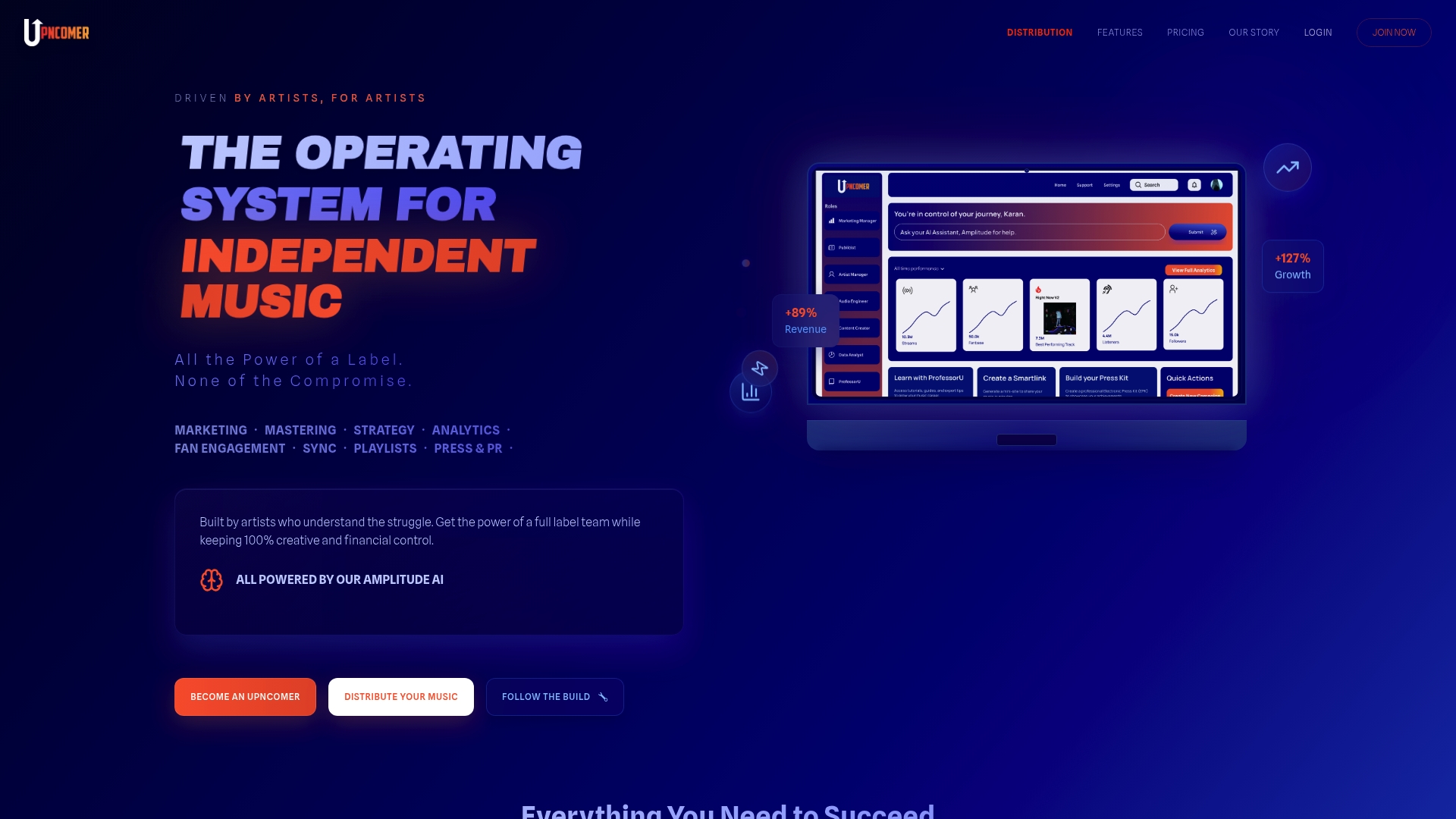
The Upncomer distribution platform combines a 6% royalty split model with Growth Engine ad campaign management, Amplitude AI streaming analytics, playlist pitching automation, and AI mastering via UrStudio. You get release planning, fan engagement, and data-driven career tools all in one subscription, without stitching together five separate services.
- 6% royalty split with no large upfront fee, unlimited releases
- Growth Engine for ad campaigns and release promotion
- Amplitude AI for streaming analytics, audience insights, and release automation
Ready to release smarter? Check out the Upncomer distribution page for full feature details, pricing, and onboarding resources including the Music Release Checklist to prep your next drop.
Useful sources and further reading
| Source | What it covers | Why it’s useful |
|---|---|---|
| Upncomer Distribution | Platform features, pricing, and onboarding | Primary product reference for Upncomer’s distribution offering |
| Independent Artist Distribution Guide | Distribution basics, catalog migration, ISRC advice | Practical guide for artists evaluating or switching distributors |
| Music Release Checklist | Step-by-step release planning for independent artists | Use before every release to cover ISRC, artwork, pre-saves, and timing |
| Music Analytics Guide | Streaming analytics and Amplitude AI overview | Supports decisions about analytics features when comparing platforms |
| Revenue Streams for Independent Musicians | Monetization strategies beyond streaming | Context for how distribution choices affect total artist income |
| CD Baby Distribution | Per-release pricing, store partnerships, YouTube monetization | Primary source for CD Baby pricing and feature claims |
| Monetization Structure for Digital Creators | Revenue-share vs. fixed-fee trade-offs | Independent analysis supporting the pricing model comparison |
What the conventional wisdom on music distribution gets wrong
Most distribution guides tell you to pick the cheapest option and keep 100% of your royalties. That sounds right until you realize that 100% of a release nobody hears is still zero dollars.
The real cost of a cheap aggregator isn’t the annual fee. It’s the time you spend manually pulling data from three different dashboards, running ads in one tool, checking streams in another, and pitching playlists through a completely separate service. For artists who are serious about growth, that fragmentation is the actual tax on their career.
The platforms that look expensive upfront often cost less in total when you factor in what you’d otherwise pay for analytics, ad management, and release promotion tools. A 6% royalty split on a platform that handles your entire release workflow is a different calculation than a 6% cut from a label that does nothing else.
The other thing most guides skip: support quality is a distribution feature. A distributor that takes three weeks to resolve a metadata error or a payout discrepancy is costing you money and momentum. Test support before you commit. Read what other artists say about real-world delivery speeds and dispute resolution, not just the feature list on the pricing page.
Distribution is the floor, not the ceiling. Where you release matters less than what you do after the release goes live.
FAQ
Is there a better service than DistroKid?
For artists who want more than unlimited uploads, yes. Upncomer adds marketing, analytics, and AI-driven release tools alongside distribution, making it a stronger fit for artists focused on growth rather than just delivery.
Which distributors let you keep 100% of royalties?
DistroKid, TuneCore, Ditto Music, and UnitedMasters (SELECT tier) all offer 100% royalty retention on their standard plans. Upncomer uses a 6% royalty split in exchange for its bundled platform tools.
Which is better, DistroKid or CD Baby?
It depends on your release volume. DistroKid’s flat subscription (~$22.99/year) wins for artists releasing 10+ singles a year; CD Baby’s per-release pricing ($9.99/single) is cheaper for artists who release one or two projects annually.
Which distributor is best for independent artists overall?
Upncomer is the strongest choice for independent artists who want distribution plus built-in marketing, analytics, and release automation. For pure low-cost delivery, DistroKid is the leading subscription aggregator.