Top 5 Unhurdmusic.com Distribution Alternatives 2026
Juggling music distribution, fan analytics, and campaign planning across separate platforms slows down artist growth and adds unnecessary costs for independent musicians. Many artist management software tools either gate essential modules behind high-priced plans or treat analytics, distribution, and promotion as disconnected workflows. This guide compares pricing, integrated features, and campaign controls across five music artist management platforms so you can pick a solution that supports both distribution and long-term fan engagement without hiring an army of vendors.
Table of Contents
- UpNComer
- Chartmetric
- StrmMusic
- MAVA Music Marketing Platform
- ORPL
- Comparing Music Artist Management Platforms
UpNComer
At a Glance
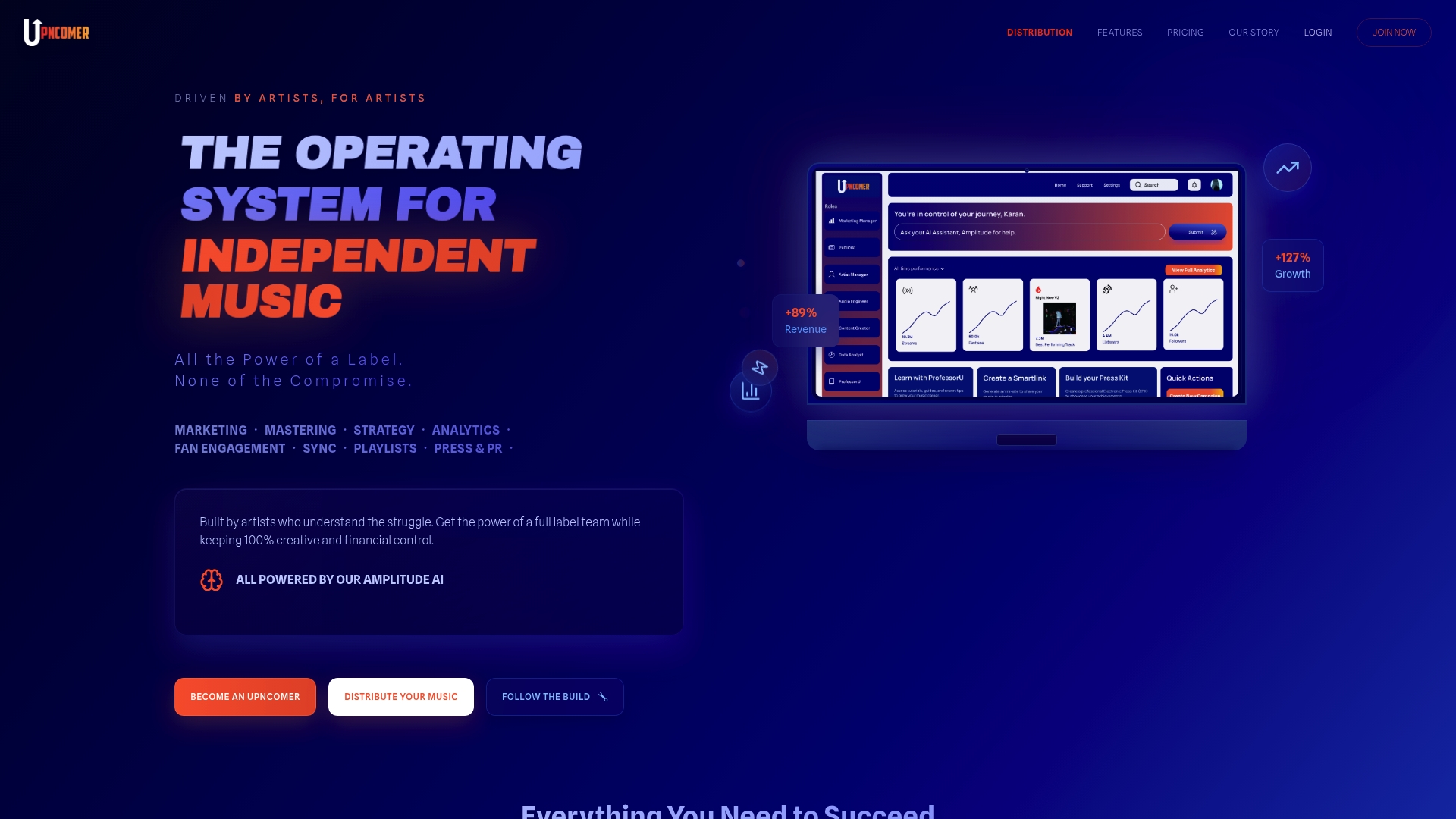
A single subscription starts at $27 per month for access to the platform suite that otherwise costs independent artists thousands in agency fees. The vendor’s marketing materials report a 127 percent growth in listeners for one artist who used the tools over a few months. That case is vendor supplied.
Core Features
UpNComer bundles release distribution with marketing and career operations inside one environment built for musicians. Key modules include Growth Engine for ad campaigns, Data Analyst for streaming analytics, and UrStudio for mastering and audio tweaks.
It also offers social content scheduling, fan tracking and revenue management, playlist pitching and press outreach automation marked as coming soon, plus education via ProfessorU and campaign workflows for release promotion.
Key Differentiator
The product data states the platform uses AI to automate tasks that traditionally require a label or manager while leaving control and rights with the artist. That AI-first approach is applied across campaign creation, targeting, analytics, mastering, and workflow automation.
Pros
-
Fast cost comparison. $27 monthly gives you a suite of label-style tools that replace multiple subscriptions and contractors, which lowers monthly operating costs for DIY artists.
-
Campaigns built for music. Growth Engine ties ad creative, audience segments, and spend pacing into a single workflow so you can launch targeted ads without juggling ad managers and spreadsheets.
-
Data you can act on. Data Analyst surfaces listener cohorts, revenue splits, and platform performance in real time so you can adapt a release midcampaign.
-
Production and promotion under one roof. UrStudio mastering and the platform’s distribution tools let you finalize audio and push to stores from the same release plan.
-
Built for independence. Tools prioritize ownership and revenue control rather than label-style rights transfers, which matches DIY artists who want to keep catalog control.
Cons
- Several modules are still in development, including the Publicist and some Content Creator features, so you may hit functional gaps if you expect every label workflow already built.
Who It’s For
Indie musicians and DIY artists who want to run label-quality campaigns without hiring a team. This fits creators willing to learn an integrated toolset and to run their own ads, analytics, and release schedules rather than outsource those tasks.
Unique Value Proposition
One subscription combines ad campaign management, distribution, mastering, playlist pitching automation, audience analytics, and an education track. That single-bill model changes the economics of running a release because you no longer pay separate vendors for each stage of a campaign.
Real World Use Case
The vendor’s materials describe an independent artist who used UpNComer to launch targeted ad campaigns, distribute a single, manage fan data, and master tracks, resulting in that 127 percent listener increase the company reports. The example highlights how coordinated ad plus distribution workflows can speed audience growth when the artist actively manages the tools.
Pricing
The stated entry price is $27 per month with an annual billing option. That fee is presented as access to the full platform suite rather than per module add ons, which simplifies budgeting for independent acts.
Website: https://upncomer.co
Chartmetric
At a Glance
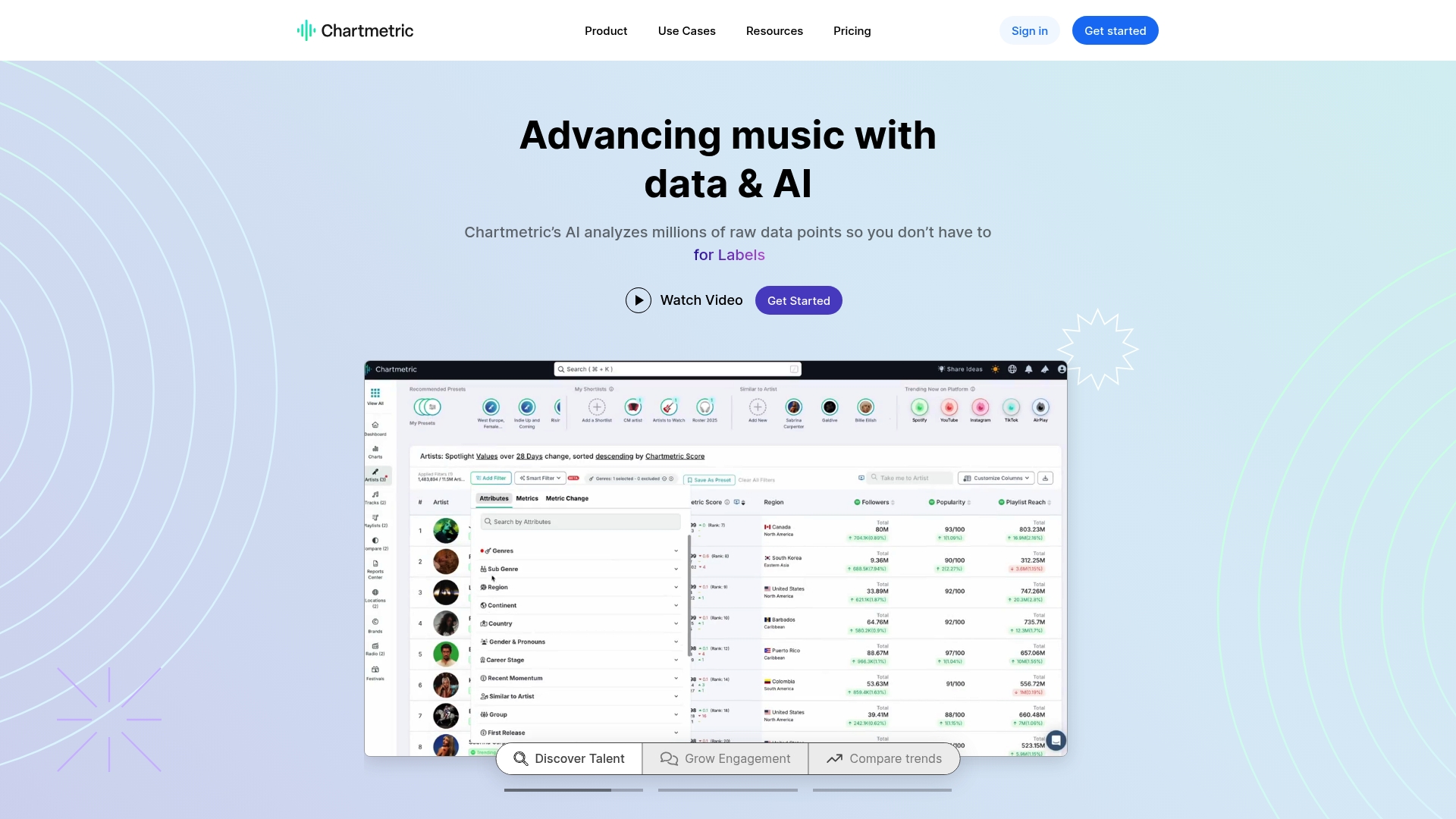
Chartmetric’s marketing materials report it tracks over 12 million artists across streaming and social platforms, a scale that changes how you validate early signals for A&R or campaign targeting.
The platform packages artist, playlist, track, radio, and curator analytics with custom APIs and tailored services for managers and labels. Use it when you want a single source to compare reach and momentum across channels.
Core Features
Chartmetric consolidates cross-platform metrics into focused views so you can act faster on trends.
- Artist analytics for audience growth and follower velocity.
- Playlist analytics to monitor placements and curator impact.
- Curator analytics to identify tastemakers and outreach targets.
It also offers radio airplay tracking, music charts, A&R discovery tools, brand analytics, and API access for deeper workflows. A short trial of a few dashboards gets you a clear picture of what moves for a specific artist.
Key Differentiator
Chartmetric’s marketing materials state it leverages machine learning to analyze millions of raw data points, turning disparate plays, playlist adds, and social signals into comparative scores and trend lines. That processing focus makes it easier to spot early momentum rather than guessing from isolated metrics.
If you rely on scored signals to prioritize signings or budget ad spend, this is where Chartmetric stands apart.
Pros
-
Centralizes cross-service metrics so you stop switching tabs. That consolidated view speeds weekly reporting for managers and labels.
-
Dashboard design is generally intuitive, which reduces onboarding time for new team members or interns.
-
Strong A&R tooling helps surface emerging artists and playlist curators, useful for talent teams tracking long tail discovery.
-
Frequent data updates mean charts reflect recent activity, which matters when you have a campaign running and need near real time feedback.
Cons
-
The interface can feel cluttered at times, making quick lookups slower when dozens of panels are open.
-
Limited free access and trial options reduce the ability for solo artists to evaluate the platform hands on.
-
Pricing can be high for smaller teams, pushing indie artists toward lighter or free tools.
When It May Not Fit
If you are a solo artist on a strict budget and you only need basic streaming totals, Chartmetric’s cost and feature depth can be overkill. Likewise, if you want an ultra-minimal dashboard for day to day posting, the UI density may slow you down rather than speed you up.
Teams that need extensive free trials or a pay-as-you-grow entry point should look elsewhere first.
Notable Integrations
Chartmetric connects directly to major platforms you care about:
- Spotify
- Apple Music
- YouTube
- TikTok
These integrations let you compare traction across streaming, short video, and social engagement without manual exports.
Who It’s For
Managers, label A&R teams, digital marketers, and music supervisors who need comparative signals across platforms. It fits groups that make signing, playlisting, and campaign allocation decisions based on cross-service momentum rather than single-source reports.
Real World Use Case
A label uses Chartmetric to flag three emerging artists showing correlated playlist growth and rising social traction. The A&R team prioritizes one for a test marketing push, measures playlist retention over two weeks, and reallocates ad spend toward the act with sustained lift.
Pricing
Pricing details are listed on the vendor site with tiered plans. Chartmetric advertises plans starting at $5/month for individual artists up to $150/month for industry professionals, plus API and custom services for enterprise needs.
Website: https://chartmetric.com
StrmMusic
At a Glance
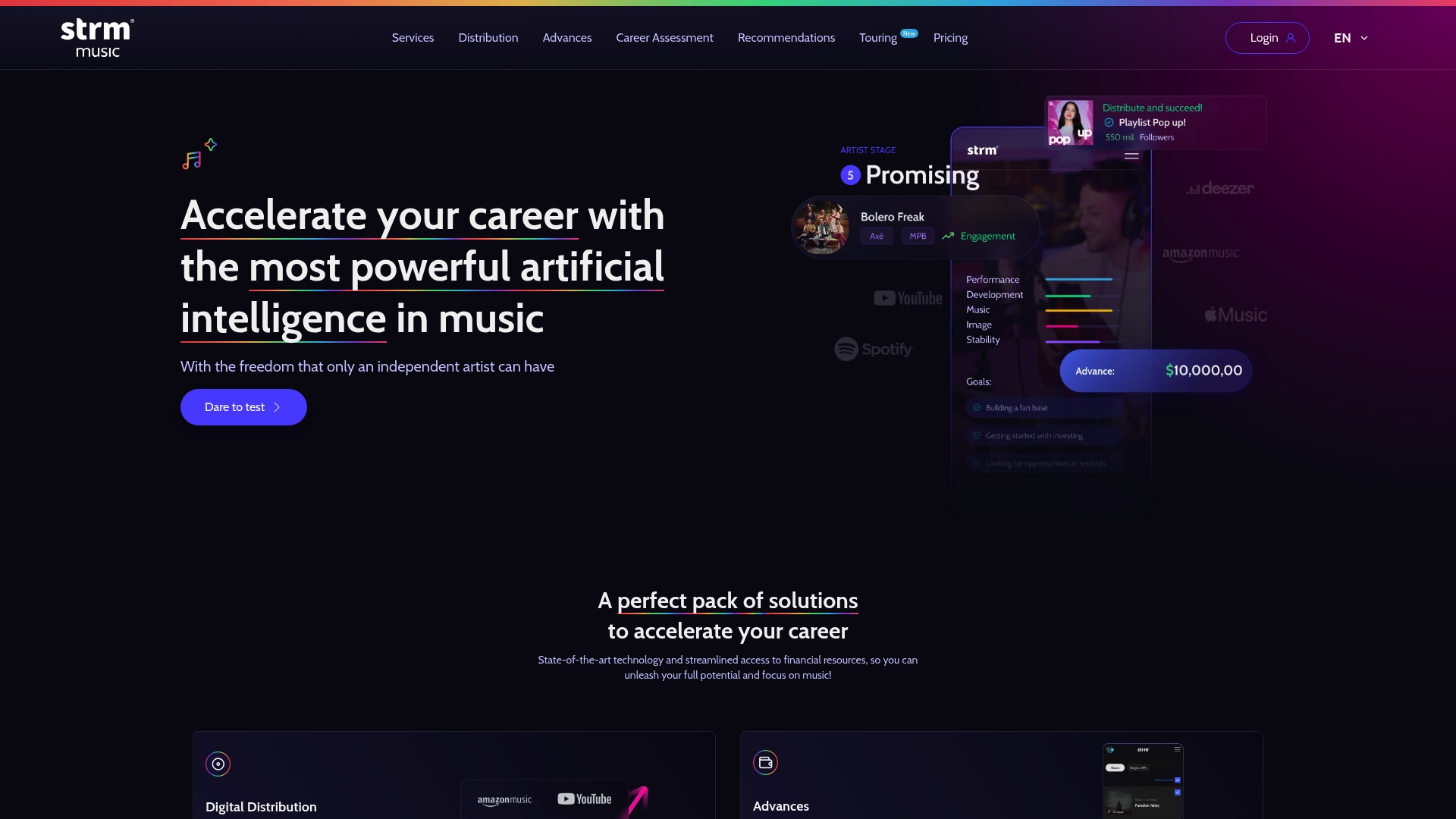
The vendor advertises advances on streaming royalties up to $1 million, a headline figure that shifts how some artists plan release budgets and marketing. StrmMusic pairs that financial offer with AI driven career scoring and distribution to major platforms.
Core Features
StrmMusic focuses on a tight set of tools that matter to recording artists and small labels.
- Digital distribution to major streaming services with a dashboard that tracks release status and metadata.
- AI powered career assessment that scores releases and suggests next steps based on your catalog and performance signals.
- Advances on streaming royalties handled inside the app for faster access to cash when approved.
- Networking tools for producers and composers to collaborate inside the platform.
Key Differentiator
StrmMusic combines distribution, finance, and recommendations in one workflow so artists do less context switching. Its materials highlight personalized recommendations that change depending on an artist’s career stage and goals, which feels more targeted than a generic distribution upload.
Pros
-
Quick initial distribution and a dashboard that gives concrete tips for metadata and release timing. That reduces avoidable mistakes that delay cataloging on stores.
-
Comprehensive career analytics that go beyond plays to show trends and comparative signals across releases. Those reports help prioritize which songs to push to playlists.
-
The platform supports mobile driven advances and production of payouts through an accessible interface. The advance claim above is central to this capability.
-
Flexible plan options map to different stages, from discovery to label scale, so you only pay for higher level services when you need them.
-
Industry ties and a support network are visible inside the product, which can help with introductions and A&R visibility.
Cons
-
User reviews indicate delays in the music review process, creating trust issues when artists expect a fixed publish window.
-
Reported payout timelines for advances are sometimes slower than promised, which undermines cash flow planning for tight budgets.
-
The product documentation offers limited detail on technical integration steps, which frustrates users who need to connect ISRCs, splits, or third party tools.
When It May Not Fit
If you need ironclad, guaranteed release windows for sync deals or timed marketing campaigns, the reported review delays make StrmMusic a riskier choice.
If you require immediate, contractually guaranteed payouts on a fixed schedule, the occasional payout slippage will be a problem for financial planning.
Who It’s For
Independent artists and small labels that want distribution plus data informed guidance and occasional financing in one app. Good for teams that want a single control point for releases, analytics, and artist recommendations.
Real World Use Case
An indie artist prepares a global single release, uses the career assessment to pick the lead single, requests a modest advance to fund a video, and manages metadata and collaborators inside the same account. The artist keeps creative focus while the platform handles distribution and reporting.
Pricing
Plans vary by need and scale. Entry level access is available for free exploration, while paid tiers include Essentials up through Accelerate, Smart Distribution, and Label Services for higher volume or label grade features. Exact fees are set by plan and use case.
Website: https://strmmusic.com
MAVA Music Marketing Platform
At a Glance
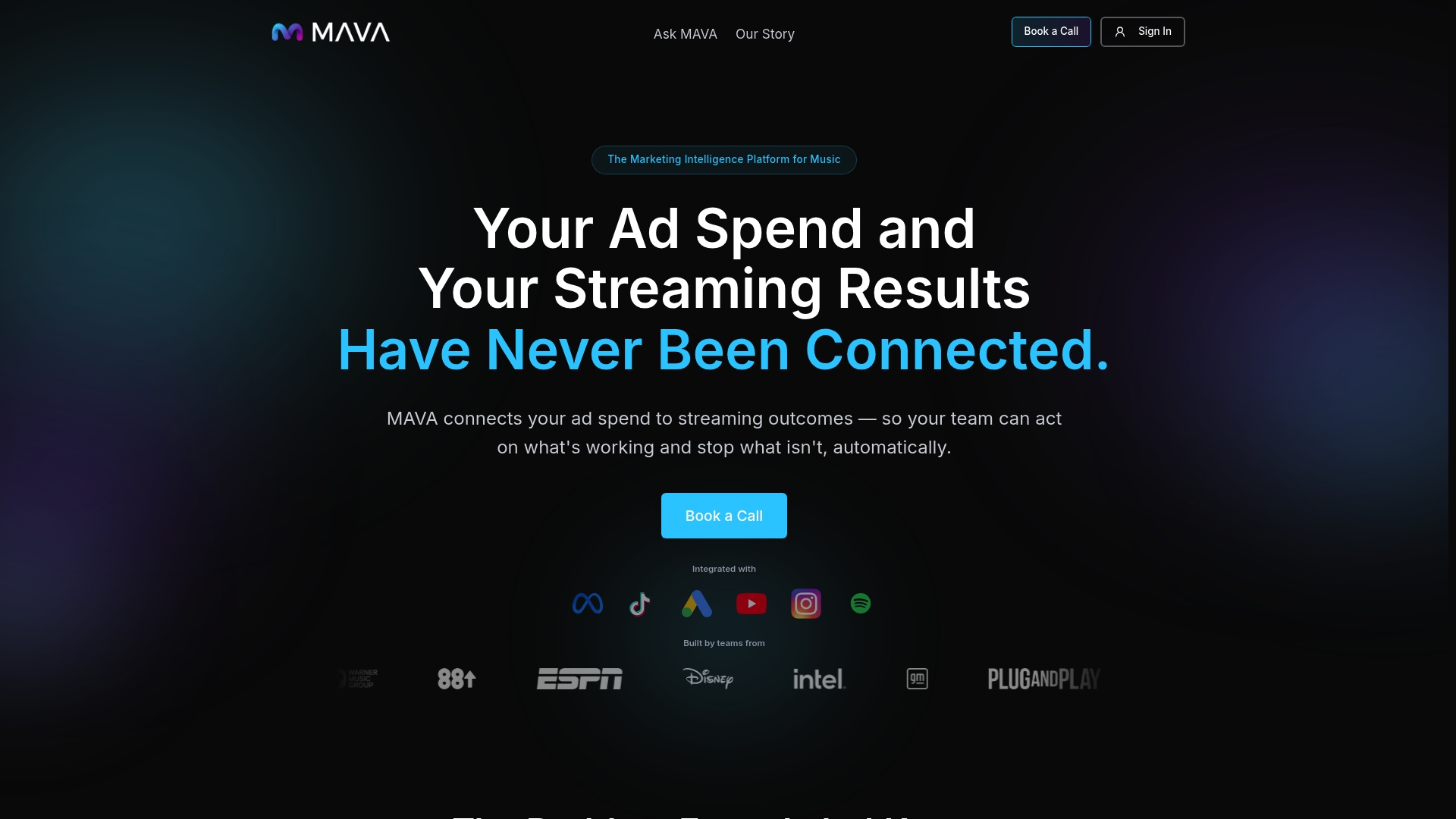
Starts at $200 per month for up to five artists, an entry point that signals MAVA targets teams managing multiple active campaigns. The platform connects ad spend to Spotify streaming outcomes and adds automation to pause underperforming ads and detect organic momentum.
MAVA was built by enterprise engineers and industry veterans and positions itself as a system that scales from small rosters to label-level operations.
Core Features
- Automated ad spend pausing for underperforming creative or audiences so budget stops leaking into low-return ads.
- AI driven recommendations that surface optimization moves and reallocation suggestions across channels.
- Attribution to Spotify linking specific ad spend to streams and measurable outcomes.
- Continuous organic momentum detection to spot breakout content early.
- Full-stack reporting that pulls Meta, TikTok, Google Ads, YouTube, Instagram, and Spotify into one view.
Key Differentiator
MAVA’s central differentiator is the tie between ad dollars and streaming outcomes on Spotify plus automated performance management and momentum detection. That linkage turns campaign reporting into operational signals: budgets can be moved or paused automatically when the system flags weak return or sudden organic lift.
Pros
- Connects marketing dollars to measurable streaming results, so campaign decisions follow outcomes rather than guesswork.
- Automation prevents wasted spend by pausing low-performing ads across major channels without manual intervention.
- Momentum detection helps teams act on breakout moments quickly, giving paid campaigns a better chance to amplify organic traction.
- Designed to scale from small artist rosters to larger label operations, which reduces the need to stitch together multiple tools as a roster grows.
- Integrates the main ad platforms and Spotify into one reporting surface, cutting down on reconciliation work across dashboards.
Cons
- Public reviews and sources do not list clear product weaknesses, which makes it harder to benchmark trade offs against competitors.
- The platform’s orientation toward roster-level management means solo artists or teams running one-off campaigns may not get full ROI from the feature set.
- Advanced users who rely on bespoke analytics stacks may find some workflows constrained by MAVA’s opinionated automation.
When It May Not Fit
If you run single artist campaigns with minimal ad spend, the roster-focused pricing and operational model could be overkill. If your team wants complete raw data exports to a custom warehouse before any vendor logic runs, MAVA’s automated controls might feel limiting.
Notable Integrations
- Meta
- TikTok
- Google Ads
- YouTube
- Spotify
Who It’s For
Labels, artist management teams, and marketing departments running active digital ad campaigns across platforms who need faster insight into what drives streams. Best for teams managing multiple artists or roster slices rather than a single DIY release.
Real World Use Case
A label uses MAVA to monitor campaigns across Meta, TikTok, and Google Ads. Underperforming ads are paused automatically, freed budget is reallocated to better creative, and the system detects organic lift on TikTok so paid support is scaled up around a breakout post.
Pricing
Starts at $200 per month for up to five artists. The pricing model is roster based and scales with the number of artists under management.
Website: https://mavatech.ai
ORPL
At a Glance
Distribution, playlist pitching, branding help, and a one-click artist website builder all grouped into a single artist-facing service is the headline here. ORPL packages promotion and distribution with industry news so artists can run more of a release from one place.
Core Features
-
Music distribution to Spotify, Apple Music, YouTube, and TikTok, listed as the channel endpoints artists can push releases to.
-
Promotion services covering radio pitching, media outreach, playlist pitching, plus YouTube and Meta advertising options.
-
Build your own artist website with one click alongside brand development support from strategic planning to visual identity.
-
An editorial feed with industry news and trend analysis intended to help artists plan releases and campaigns.
Key Differentiator
ORPL’s defining angle is that it combines distribution, promotional services, branding tools, and editorial content under a single roof geared specifically at artists. That makes it more of a unified service listing than a narrow boutique agency, useful when you want promotion and site-building in one workflow.
Pros
-
The combined service model reduces the number of separate vendors you must contact for a release. You can schedule distribution, add playlist and radio pitching, and start paid ads from the same service listing.
-
Promotion options cover both traditional outlets and paid channels, which helps artists who want radio outreach alongside Meta or YouTube campaigns.
-
The one-click website builder lets you publish a landing presence quickly and keeps release links, press text, and visual identity in the same place as your promo plan.
-
ORPL offers branded consultation from industry experts, which can help translate a basic release into a coherent campaign if you need strategic direction.
-
The vendor presents user testimonials that praise clarity and free practical features, which suggests some accessible entry points for emerging artists.
Cons
-
No service in the listing guarantees playlist placement or stream milestones; the product materials state results depend on campaign variables and content quality.
-
The reach and effectiveness of promo services will vary by market and campaign specifics, so outcomes are not uniform across territories.
-
The dataset does not list independent third-party reviews that identify concrete weaknesses, leaving gaps for buyers who prefer externally verified comparisons.
When It May Not Fit
If you need guaranteed editorial placement or fixed performance outcomes, ORPL is not the right match. Teams that require enterprise analytics, deep audience modeling, or integrated AI campaign orchestration should look for platforms with specialized data modules.
Who It’s For
Independent artists, small bands, and solo creators who want a single editorial-style listing that bundles distribution, playlist and radio promotion, visual branding, and a quick website. It suits artists who prefer fewer vendors and hands-on consultation over building a toolchain from scratch.
Real World Use Case
An independent singer-songwriter distributes a single to major services, targets Ukrainian Spotify playlists through the platform’s pitching option, launches a short Meta ad test, and publishes a simple artist site for press and pre-saves. ORPL holds the campaign components in one place so the artist spends less time juggling vendors.
Website: https://orpl.app
Comparing Music Artist Management Platforms
Selecting the right management platform for independent musicians requires a mix of features that support not only artistry but also professional growth. This comparison highlights the notable tradeoffs and strengths among the reviewed platforms.
Balancing Cost Effectiveness and Feature Breadth
UpNComer offers a consolidated platform for managing music releases, marketing campaigns, and audience engagement at $27 per month. Its unique integration of ad, distribution, mastering, and analytics outshines others in reducing operational complexity for single users. However, alternatives like Chartmetric provide more specialized analytics at a broader industry level, appealing to those with extensive needs but at higher costs.
Catering to Audience Engagement
StrmMusic emphasizes financial flexibility by offering large advances on streaming royalties directly through its portal. For smaller acts needing financial assistance aligned with sophisticated analytics, it presents a compelling choice. Meanwhile, platforms like MAVA focus on connecting ad spend directly to Spotify stream performance, excelling in efficiency for managing multi-artist rosters with automated ad budget adjustments across campaigns.
Best Fit Scenarios
- UpNComer stands out for independent artists seeking a cohesive toolset for release promotion, audience tracking, and campaign management without the need for outsourcing or multiple subscriptions.
- Chartmetric suits industry professionals and A&R teams who require extensive cross-platform analytics to understand trends and discover emerging talents comprehensively.
- StrmMusic fits smaller artists and labels that prioritize data-guided career forecasting paired with financial services such as royalties advances.
- MAVA best supports management teams operating multi-artist rosters, focusing on maximizing stream count per ad dollar spent through integrated performance-based automation.
- ORPL aligns with solo creators who prioritize simple, integrated solutions for branding, website creation, and basic promotion.
Why Choose UpNComer
While alternatives like Chartmetric or StrmMusic cater to specific needs such as analytics or royalty advances, UpNComer offers a balanced and affordable entry point for independent musicians seeking independence from label contracts. This makes it particularly suitable for those ready to actively engage with their growth tools without overwhelming upfront investments. For larger teams or those seeking advanced extensive analytic capabilities, other platforms remain competitive in niche areas.
Music Artist Management Software Compared
When selecting a music artist management platform, consider which toolset aligns best with your needs for distribution, analytics, and promotion quality.
| Platform | Core Feature | Key Differentiator | Best For | Pricing | Limitation |
|---|---|---|---|---|---|
| UpNComer | Integrated marketing, analytics, and production tools | AI automation for analytics and campaign workflows | DIY musicians taking control of releases | $27/month | Certain modules are still under development. |
| Chartmetric | Cross-platform metrics and tailored analytics | Machine learning for trend scoring and A&R prioritization | Managers and labels | $5–$150/month | Limited trial options and cluttered interface. |
| StrmMusic | Digital distribution and royalty advances | Combines financial support with analytics | Independent artists needing flexibility | Plan-based | Delays in review processes for releases. |
| MAVA | Spotify-linked ad performance and automation | Budget reallocations based on organic traffic detection | Teams managing multiple campaigns | $200/month | Overkill for single-artist campaigns or minimal ad spend. |
| ORPL | Distribution coupled with promotional and branding services | One-click setup for artist websites and promotional tools | Emerging artists wanting simpler workflows | Not disclosed | Campaign results can vary widely based on content quality and target market. |
Discover an All-in-One UpNComer Solution for Your Music Growth Needs
Finding powerful yet simple-to-use tools as an independent artist can feel overwhelming when exploring Unhurdmusic.com alternatives. UpNComer brings marketing, distribution, fan engagement, playlist pitching, AI mastering, and streaming analytics together in one platform. This unified approach removes the hassle of juggling multiple services, giving you full control with AI-powered guidance tailored for indie musicians seeking smarter campaign strategies and real-time audience insights.
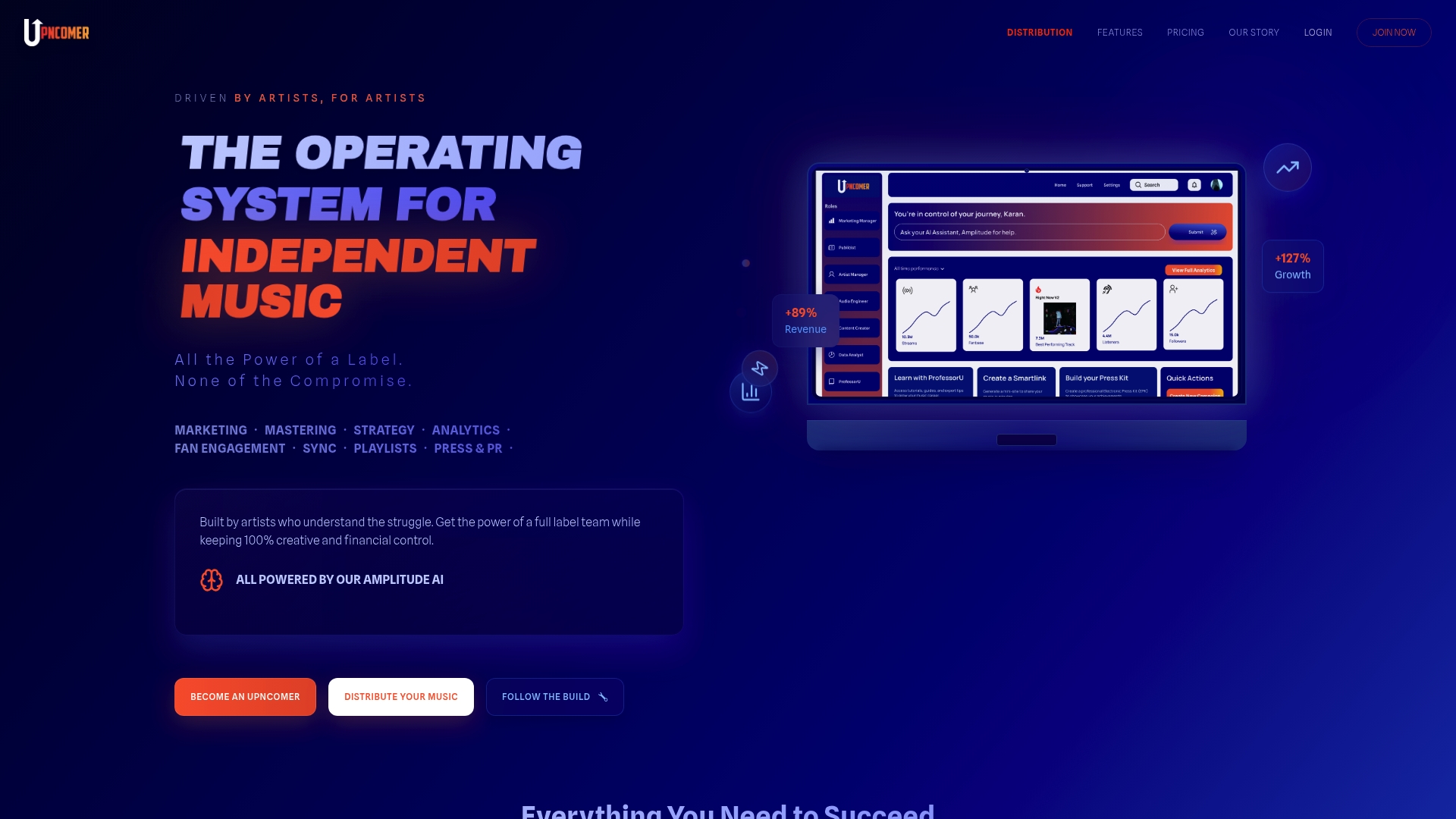
Experience how UpNComer can replace costly agency fees and fragmented subscriptions. Visit UpNComer to launch integrated ad campaigns, master tracks, manage releases, and analyze streaming data—all from one place. Get started now and take charge of your music career with tools designed to help you grow sustainably and confidently.
Frequently Asked Questions
What is the primary advantage of UpNComer for independent artists?
UpNComer offers a cost-effective suite of label-style tools starting at $27 per month, which significantly reduces operating costs for DIY artists. Its Growth Engine module efficiently integrates ad campaigns, helping artists manage their marketing without needing external help. This approach allows artists to focus on their music while maintaining control over their revenue.
How does UpNComer compare with StrmMusic regarding financial offers?
StrmMusic provides advances on streaming royalties up to $1 million, which can be beneficial for artists needing immediate cash flow to fund projects. In contrast, UpNComer excels in offering a fully integrated platform to plan releases and engage fans, making it more suitable for artists seeking comprehensive management tools rather than just financial support.
Can UpNComer help me manage my music analytics effectively?
Yes, UpNComer includes the Data Analyst feature, which surfaces real-time analytics about listener cohorts and platform performance, allowing artists to adapt their marketing strategies during a campaign. This capability supports proactive decision-making to enhance artist growth and engagement without having to rely on third-party tools.
What tools does UpNComer provide for music promotion?
UpNComer features an integrated approach to release promotion through its Growth Engine and upcoming modules for playlist pitching and press outreach automation. This ensures that all aspects of promoting a release are handled in one place, simplifying the process for independent artists.
Is UpNComer suitable for solo musicians?
UpNComer is designed with the needs of independent artists in mind, making it a great option for solo musicians who want to run robust music marketing campaigns without the complexities of managing multiple subscriptions or outsourcing tasks. The platform’s user-friendly tools facilitate artist development while encouraging ownership and control over their music assets.