Why Artist Development Tracks Milestones for Career Growth

Artist development is the deliberate process of tracking specific milestones to guide an artist’s growth and build a sustainable music career. Without these markers, you are essentially releasing music into a void with no way to measure whether your efforts are working. Why artist development tracks milestones comes down to one core truth: measurable progress creates direction, and direction creates momentum. The typical path to financial sustainability spans 3 to 5 years, with an average of 7.8 years from first release to award nomination. That timeline demands a system, not just ambition.
Why artist development tracks milestones: the core framework
Milestone tracking in artist development refers to the practice of setting and monitoring specific, measurable progress markers across every dimension of your music career. These markers include audience size, release frequency, live performance count, publishing registration, and streaming engagement. The industry term for this practice is career benchmarking, and it sits at the center of every serious artist management plan.
The reason milestone tracking works is structural. Without defined checkpoints, you cannot tell whether a slow month reflects a strategy problem or simply the natural rhythm of a multi-year development arc. Labels and A&R teams operate on 18–36 month investment cycles, expecting market response only after 12–24 months. That context matters for independent artists too. If the people with the most resources in the industry build in that much runway, you need to as well.
Milestones also create accountability without requiring a manager. When you write down a goal, you are 42% more likely to achieve it. That statistic reflects something real about how the brain processes commitment. A milestone written down and reviewed weekly becomes a decision-making tool, not just a wish.

What are typical artist development milestones and how are they measured?
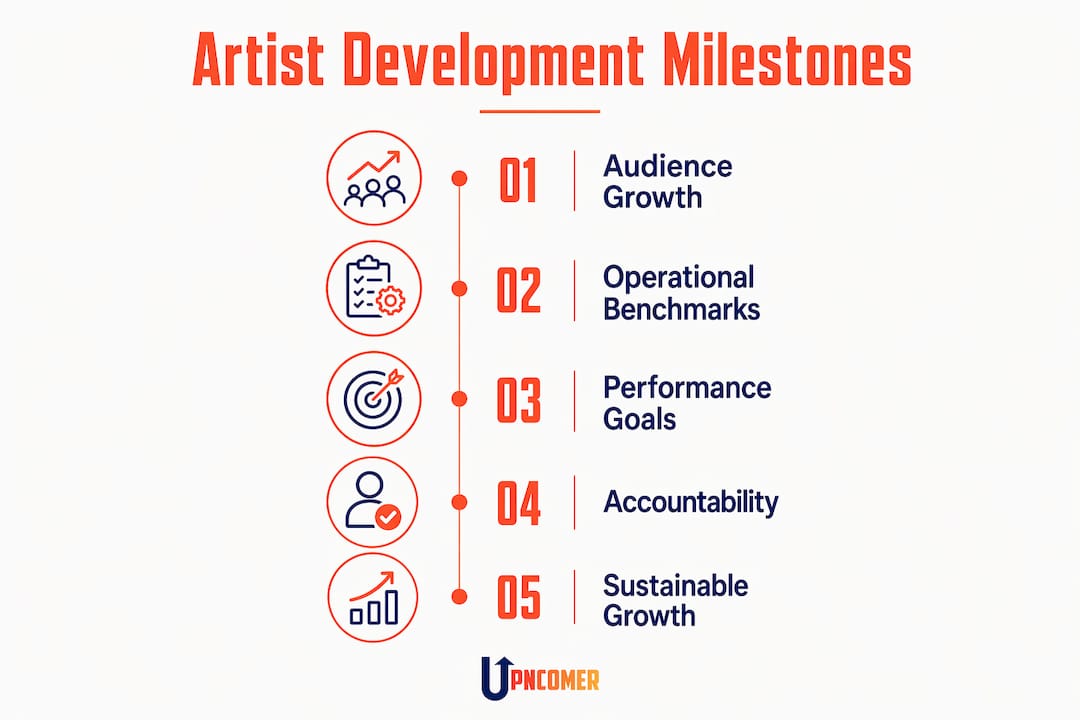
Artist milestones fall into three categories: audience metrics, operational benchmarks, and performance goals. Each category requires different tracking methods and serves a different strategic purpose.
Audience growth metrics
These are the numbers that tell you whether people are actually connecting with your music:
- Monthly Spotify listeners: Year 1 artists should target 2,000–5,000 monthly listeners as a realistic baseline
- Instagram followers and engagement: 500–2,000 followers with a 2–4% engagement rate signals an active, not just passive, audience
- Email subscribers: 100–300 subscribers in year 1 gives you a direct communication channel that no algorithm can cut off
- Live performances: 4–8 shows in year 1 builds real-world proof of audience demand
Operational benchmarks
These milestones are fully within your control, which makes them the best place to start:
- Publishing registration with a PRO (ASCAP, BMI, or SESAC)
- Metadata completeness across all distributed releases
- A consistent release cadence (at minimum, one single every 6–8 weeks)
- A verified artist profile on Spotify for Artists and Apple Music for Artists
Performance goals
These include playlist placements, sync licensing inquiries, press features, and support slots on tours. They are harder to control but critical to track because they signal external validation.
Pro Tip: Use SMART criteria (Specific, Measurable, Achievable, Relevant, Time-bound) to convert every milestone into a concrete target. “Get more streams” is not a milestone. “Reach 3,000 monthly Spotify listeners by the end of Q3” is.
| Milestone category | Example target | Tracking method |
|---|---|---|
| Audience growth | 2,000 monthly Spotify listeners | Spotify for Artists dashboard |
| Fan engagement | 3% Instagram engagement rate | Native analytics or third-party tools |
| Operational | Publishing registered within 30 days of first release | PRO account confirmation |
| Live performance | 6 shows in year 1 | Personal performance log |
| External validation | 1 playlist placement per quarter | Pitch tracking spreadsheet |
Understanding audience data is the foundation for setting any of these targets accurately.
How does tracking milestones shape artist reputation and engagement?
Milestones are not just internal progress markers. They are strategic signals that shape how industry intermediaries and audiences perceive you. Reaching a milestone and communicating it publicly reframes your trajectory in the eyes of fans, playlist curators, and press contacts.
“Milestone events such as memoir releases, televised honors, and landmark performances create powerful signals that deepen fan loyalty and convert casual fans into community members.”
That insight applies at every career level, not just for established artists. Your first 100 email subscribers is a milestone worth announcing. Your 50th live show is a story worth telling. These moments give your audience a reason to feel invested in your growth, which converts passive listeners into superfans who show up for every release.
The reputational mechanics work like this:
- A press feature signals legitimacy to curators who have never heard of you
- A sold-out local show signals demand to a booking agent considering you for a support slot
- A sync placement signals commercial viability to a label or publisher
- A growing email list signals direct audience ownership to any potential partner
Each milestone you reach and document becomes part of your artist narrative. That narrative is what gets you the next opportunity. Tracking milestones gives you the raw material to build that story with music manager reporting and consistent communication.
Why consistent milestone tracking prevents burnout and supports sustainable growth
Most independent artists fail to scale because they try to compress a multi-year development arc into a short sprint without infrastructure. That compression leads directly to burnout, not success. Milestone tracking prevents this by giving you a realistic map of where you are in the arc.
The key distinction is between outputs and outcomes. Outputs are things you control: releasing music, posting content, pitching to playlists, booking shows. Outcomes are things you cannot control: streams, follows, press coverage, viral moments. Sustainable milestone tracking focuses primarily on outputs, with outcomes serving as feedback signals rather than pass/fail grades.
Here is a practical framework for pacing your development without burning out:
- Set a 12-month output goal. Decide how many releases, shows, and pitches you will complete in the year. These are your non-negotiable commitments.
- Review outcome metrics quarterly. Check your streaming growth, follower counts, and email list size every three months. Look for trends, not single data points.
- Build decision thresholds. Define in advance what outcome numbers would prompt a strategy change. For example: “If I have fewer than 1,000 monthly listeners after two releases, I will reassess my promotion approach.”
- Protect creative time. Schedule at least two days per week where you are not looking at analytics. Tracking is a tool, not a lifestyle.
- Celebrate output milestones, not just outcome milestones. Finishing a recording session, completing a pitch campaign, or booking your first out-of-state show all deserve recognition.
Pro Tip: The streaming era demands a circular development process: release, gather feedback, refine, repeat. Build that loop into your milestone calendar so you are always learning from data, not just reacting to it.
Sustainable artist growth relies on sustained, intelligent attention to career milestones rather than chasing viral or one-off moments. One breakout moment without a system to capture and convert that attention is a missed opportunity, not a career.
How to effectively track and use artist development milestones in practice
The most practical approach to milestone tracking uses a layered goal structure. Artists should set long-term direction goals, medium-term output goals, and weekly anchors to maintain momentum without losing focus.
The three-layer goal system
Direction goals are your 2–3 year vision. They answer the question: what kind of artist do you want to be known as, and in what market? These do not change often.
Output goals are your 6–12 month commitments. They are specific and countable: four releases, 10 live shows, 500 new email subscribers, one sync pitch campaign.
Weekly anchors are the daily and weekly habits that make output goals inevitable: two hours of writing per day, one pitch email per week, one social post per day.
Metrics worth tracking by channel
- Streaming: monthly listeners, saves-to-streams ratio, skip rate, playlist adds
- Social: follower growth rate, engagement rate, story views, link clicks
- Email: open rate, click rate, list growth, unsubscribe rate
- Live: tickets sold, merch revenue per show, repeat attendees
The music analytics guide from Upncomer covers how to interpret these numbers in context, not just in isolation.
Reading the data patterns that matter
| Pattern | What it signals | What to do |
|---|---|---|
| High streams, low saves | Discovery without connection | Strengthen your artist story and call to action |
| High saves, low playlist adds | Fans love it, curators haven’t found it | Increase playlist pitching volume |
| Email open rate above 40% | Strong core audience | Prioritize email for new release announcements |
| Flat follower growth for 60+ days | Content or promotion needs adjustment | Test new content formats or ad targeting |
Tracking these patterns converts fleeting discovery into loyal fan retention. That is the real goal of milestone tracking: not to hit a number, but to build a system that keeps working.
Key Takeaways
Artist development tracks milestones because measurable progress markers are the only reliable way to build a sustainable music career without a label’s infrastructure behind you.
| Point | Details |
|---|---|
| Milestones create direction | Without defined checkpoints, you cannot distinguish a strategy problem from a natural development phase. |
| Year 1 targets are specific | Aim for 2,000–5,000 monthly Spotify listeners, 100–300 email subscribers, and 4–8 live shows. |
| Milestones build reputation | Reaching and communicating milestones signals credibility to fans, curators, and industry contacts. |
| Output focus prevents burnout | Track what you control (releases, pitches, shows) and use outcomes as feedback, not grades. |
| Layered goals sustain momentum | Direction goals, output goals, and weekly anchors work together to keep your career moving forward. |
The uncomfortable truth about milestone tracking I’ve seen artists ignore
I’ve watched a lot of independent artists treat milestone tracking as something managers do, not something artists do. That assumption costs years. The artists who grow consistently are not necessarily the most talented. They are the ones who know their numbers, review them regularly, and adjust without drama.
The hardest part is not setting the milestones. It is resisting the urge to abandon them the moment a release underperforms. One slow release does not invalidate a 12-month plan. But without a milestone system, you have no way to know that. You just feel like you are failing.
The streaming era has made this more urgent, not less. Discovery is easier than ever, but retention is brutal. Tracking listener behavior patterns like replay rate and saves-to-streams ratio tells you whether you are building an audience or just getting lucky with an algorithm. Those are very different things, and only one of them leads to a career.
My honest advice: start with three milestones for the next 90 days. Make them output-based. Review them every two weeks. That practice alone will put you ahead of most independent artists working today.
— Karan
Upncomer gives you the system to track what matters
Building a milestone tracking system from scratch takes time most artists do not have. Upncomer is built to handle that infrastructure for you, so you can stay focused on the music.
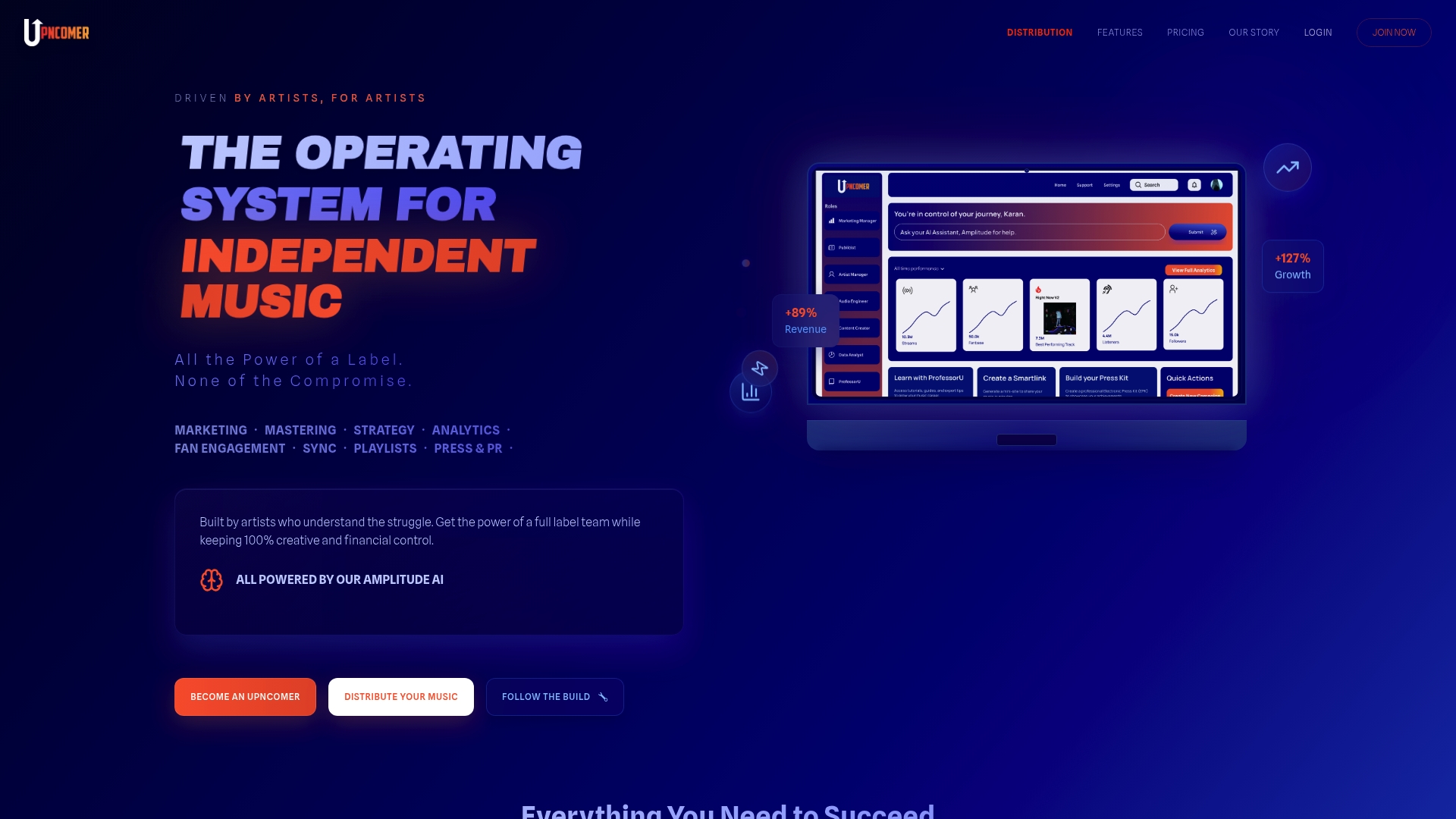
The platform’s Growth Engine and Artist Manager modules give you a centralized place to monitor streaming analytics, audience insights, and campaign performance in real time. Amplitude AI reads your data and surfaces the patterns that matter, so you are not guessing what to do next. Whether you are mapping your first-year milestones or reviewing a 12-month output plan, Upncomer’s community and platform tools keep everything in one place. Independent artists who want the full picture of their career growth can explore everything Upncomer offers and see how the platform fits their current stage.
FAQ
What does milestone tracking mean in artist development?
Milestone tracking in artist development means setting and monitoring specific, measurable progress markers across audience growth, releases, live performance, and industry recognition. These markers tell you whether your career is moving forward and where to adjust your strategy.
How many monthly Spotify listeners should a year 1 artist target?
Year 1 artists should aim for 2,000–5,000 monthly Spotify listeners as a realistic baseline, alongside 100–300 email subscribers and 4–8 live performances.
Why do artists burn out without milestone tracking?
Artists burn out when they try to compress a multi-year development arc into a short sprint without infrastructure. Milestone tracking provides structure and realistic pacing, separating controllable outputs from uncontrollable outcomes.
How does reaching a milestone help with industry reputation?
Milestones act as signals to playlist curators, booking agents, press contacts, and potential partners. Each documented achievement adds credibility to your artist narrative and opens doors to the next opportunity.
What is the layered goal system for artist development?
The layered goal system uses three tiers: long-term direction goals (2–3 year vision), medium-term output goals (6–12 month commitments), and weekly anchors (daily habits). Together, they keep your career moving without losing focus on what matters most.