Spotify Growth for Independent Artists: 2026 Guide

Spotify growth is defined as the measurable increase in your monthly listeners, followers, streams, and saves on the platform over time. For independent artists, it is the clearest signal that your music is reaching new ears and building a sustainable career. Spotify now has 761 million monthly active users and 293 million Premium Subscribers as of Q1 2026. That scale means the opportunity is real, but so is the competition. The artists who win are the ones who treat Spotify as a system to understand and work with, not just a place to upload tracks and hope.
What does Spotify growth actually require?
Before you run any campaign or pitch any playlist, you need the right foundation in place. Spotify growth depends on three things working together: a properly set up artist profile, clean metadata, and a clear understanding of your streaming data.
Start with Spotify for Artists. This free account gives you access to your real-time streaming analytics, listener demographics, and the ability to pitch unreleased tracks directly to Spotify’s editorial team. Without it, you are flying blind. Verification through Spotify for Artists also adds a blue checkmark to your profile, which builds credibility with new listeners.

Here is a quick breakdown of the core tools and features every independent artist should know:
| Tool or Feature | What It Does | Why It Matters |
|---|---|---|
| Spotify for Artists | Profile management and analytics dashboard | Required for editorial pitching and data access |
| Spotify Canvas | Short looping video attached to your track | Increases shares and saves |
| Spotify Marquee | Paid promotional tool targeting recent listeners | Converts casual listeners to followers |
| Spotify Codes | Scannable codes linking to your music | Useful for physical and social promotion |
| Metadata fields | Genre tags, mood tags, release date, ISRC | Feeds the algorithm and improves discoverability |
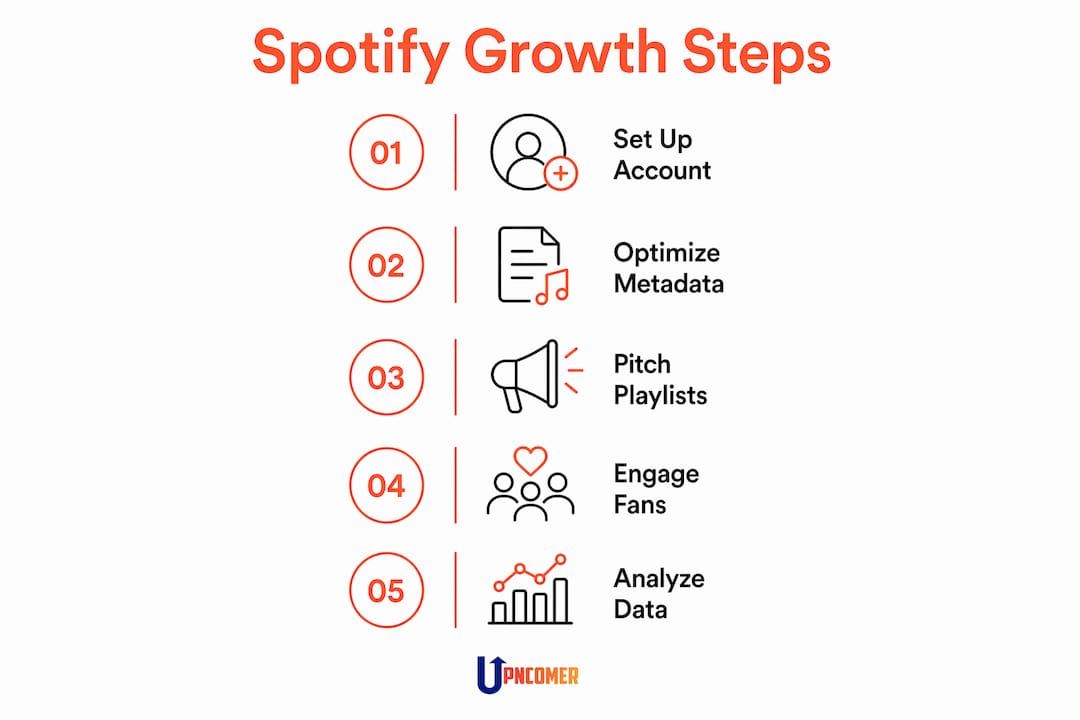
Metadata is the part most artists skip, and it costs them. Metadata optimization is one of the primary ways Spotify’s algorithm decides who to surface your music to. Genre tags, mood descriptors, and accurate release credits all feed into Spotify’s personalization engine. Get these wrong and the algorithm cannot place you in front of the right listeners.
Pro Tip: Submit your track to Spotify editorial at least seven days before release through Spotify for Artists. Late submissions are not reviewed, and missing this window means missing your best shot at playlist placement on release day.
How to grow your Spotify audience step by step
Growing your audience on Spotify is not one move. It is a sequence of decisions that compound over time. Here is how to approach it with intention.
-
Optimize your profile and metadata before release. Your artist bio, profile photo, and header image should reflect your current sound. Every track needs accurate genre tags, mood tags, and a release date set at least a week out. AI-driven personalization on Spotify relies heavily on this data to match your music to the right listeners.
-
Pitch to editorial playlists through Spotify for Artists. You get one pitch per unreleased track. Write a concise pitch that describes the mood, instrumentation, and target listener. Be specific. “Indie folk for late-night drives” beats “chill acoustic music” every time.
-
Target algorithmic playlists through listener behavior. Playlists like Discover Weekly and Release Radar are triggered by saves, repeat listens, and playlist adds. The more listeners save your track in the first 48 hours, the stronger the algorithmic signal. Ask your existing fans to save, not just stream.
-
Use Spotify Canvas on every track. Canvas videos loop silently behind the track while it plays. Tracks with Canvas see higher share rates. A simple, visually compelling loop takes 30 minutes to create and can meaningfully lift your numbers.
-
Engage the free tier listener. Spotify’s Freemium funnel is designed to build listening habits before converting users to paid subscribers. Free tier listeners are not worth less. They are your top of funnel. Get them to follow you and they will see your new releases in their feed.
-
Localize your outreach. Spotify’s subscriber growth is led by Latin America and Europe, which together account for over 60% of subscribers. If your music fits those markets, run social campaigns in Spanish or Portuguese. Culturally resonant outreach converts far better than generic English posts.
-
Pitch to independent playlist curators. Editorial playlists are competitive. Independent curator playlists are more accessible and can drive real streams. Use playlist pitching tools to find curators in your genre and send personalized, short pitches.
Pro Tip: Release music consistently, ideally every four to six weeks. Spotify’s algorithm rewards active artists. A long gap between releases causes your algorithmic playlist placements to fade.
How do analytics help you refine your Spotify strategy?
Data is not just a report card. It is a map. The artists who grow fastest are the ones who check their numbers weekly and adjust based on what they find.
Your most important metrics inside Spotify for Artists are streams, saves, listener demographics, and the save-to-stream ratio. A high save-to-stream ratio tells you listeners are connecting deeply with a track. A low ratio on a track with high streams usually means it is being played passively, often through someone else’s playlist, without sticking. That distinction changes how you promote it.
Listener demographics show you where your audience lives, what age they are, and what other artists they listen to. This is gold for targeted music marketing. If 40% of your listeners are in Brazil and you have never posted in Portuguese, you are leaving growth on the table.
Upncomer’s Data Analyst module and Amplitude AI go deeper than the native Spotify dashboard. They pull cross-platform streaming data, identify audience patterns, and surface insights that help you time releases, plan ad campaigns, and understand which tracks are actually building your fanbase versus just collecting passive plays. You can read more about applying these insights in this music analytics guide.
- Streams: Total plays. Useful for tracking reach, but not the whole story.
- Saves: The strongest signal of genuine fan interest. Prioritize this metric.
- Listeners vs. followers: Listeners are passive. Followers see your new releases. Convert listeners to followers through direct calls to action on social media.
- Playlist adds: Shows how often listeners are adding your track to their own playlists. High playlist adds signal broad appeal.
- Retention rate: How far into the track listeners get before skipping. Low retention on the intro means you need to rethink your opening eight seconds.
Pro Tip: Cross-reference your Spotify listener geography with your social media audience location. A mismatch often reveals an untapped market where your music is resonating but you have no presence yet.
Common mistakes that kill Spotify audience expansion
Most artists do not fail on Spotify because of bad music. They fail because of avoidable process mistakes. Knowing what not to do is just as useful as knowing what to do.
| Ineffective approach | Effective approach |
|---|---|
| Skipping metadata tags | Fill every genre, mood, and credit field before release |
| One editorial pitch, no follow-up strategy | Combine editorial pitching with curator outreach and social campaigns |
| Releasing music and going silent | Engage fans with Canvas, social posts, and Spotify Codes for weeks after release |
| Ignoring free tier listeners | Treat free tier listeners as top-of-funnel and convert them to followers |
| Relying on one playlist for all streams | Diversify across editorial, algorithmic, and independent curator playlists |
Over-reliance on a single playlist is the most common trap. An editorial placement feels like a breakthrough, and it can be. But if that playlist removes your track after two weeks and you have not built followers or engaged your audience, your streams drop back to zero. The playlist is a door opener, not a career.
Spotify’s AI-enhanced features like audiobooks and fitness integrations are creating new listener habits on the platform. Artists who ignore these shifts miss new discovery surfaces. Staying current with how Spotify is evolving is part of the job now.
Neglecting fan engagement after a release is another costly mistake. Spotify Codes, for example, let you put a scannable link on physical merch, flyers, or social posts that takes listeners directly to your track. Most artists never use them. The ones who do create a direct bridge between offline moments and streaming plays.
Key takeaways
Spotify growth requires consistent execution across metadata, playlist pitching, fan engagement, and data-driven adjustments, not a single viral moment.
| Point | Details |
|---|---|
| Set up Spotify for Artists first | You need this account to pitch editorial playlists and access your streaming analytics. |
| Metadata drives discoverability | Accurate genre and mood tags feed Spotify’s algorithm and determine who hears your music. |
| Save-to-stream ratio matters most | A high ratio signals genuine fan connection and triggers stronger algorithmic recommendations. |
| Localize your outreach | Latin America and Europe lead subscriber growth; tailor campaigns to those markets if your music fits. |
| Diversify your playlist strategy | Combine editorial, algorithmic, and independent curator playlists to avoid over-reliance on one source. |
The part most growth guides skip
By Karan
I have watched a lot of independent artists treat Spotify like a lottery. They upload a track, pitch one playlist, and wait. When nothing happens, they assume the algorithm is rigged or the platform does not work for artists like them. That framing is the real problem.
Spotify is not a lottery. It is a feedback system. Every save, skip, and share tells the algorithm something about your music and your audience. The artists I have seen grow consistently are the ones who read that feedback and respond to it. They are not necessarily the most talented. They are the most attentive.
The other thing I would push back on is the idea that playlist placement is the goal. It is not. The goal is followers. A follower sees every new release in their feed. A passive listener who found you through a playlist and never followed you is gone the moment that playlist moves on. Every campaign you run should have one conversion goal: get that listener to press the follow button.
Spotify projects 778 million MAUs by Q2 2026 and is aiming for 1 billion subscribers by 2030. That growth creates more discovery surfaces, more algorithmic playlists, and more listeners who have never heard your music. The platform is expanding. The question is whether your strategy is expanding with it.
Stay adaptable. The artists who grew on Spotify five years ago used different tactics than the ones growing today. The platform changes. Your approach should too.
— Karan
How Upncomer helps you build on Spotify
Growing on Spotify without the right tools is like trying to run a campaign without knowing your numbers. Upncomer brings together the infrastructure independent artists need to execute consistently.
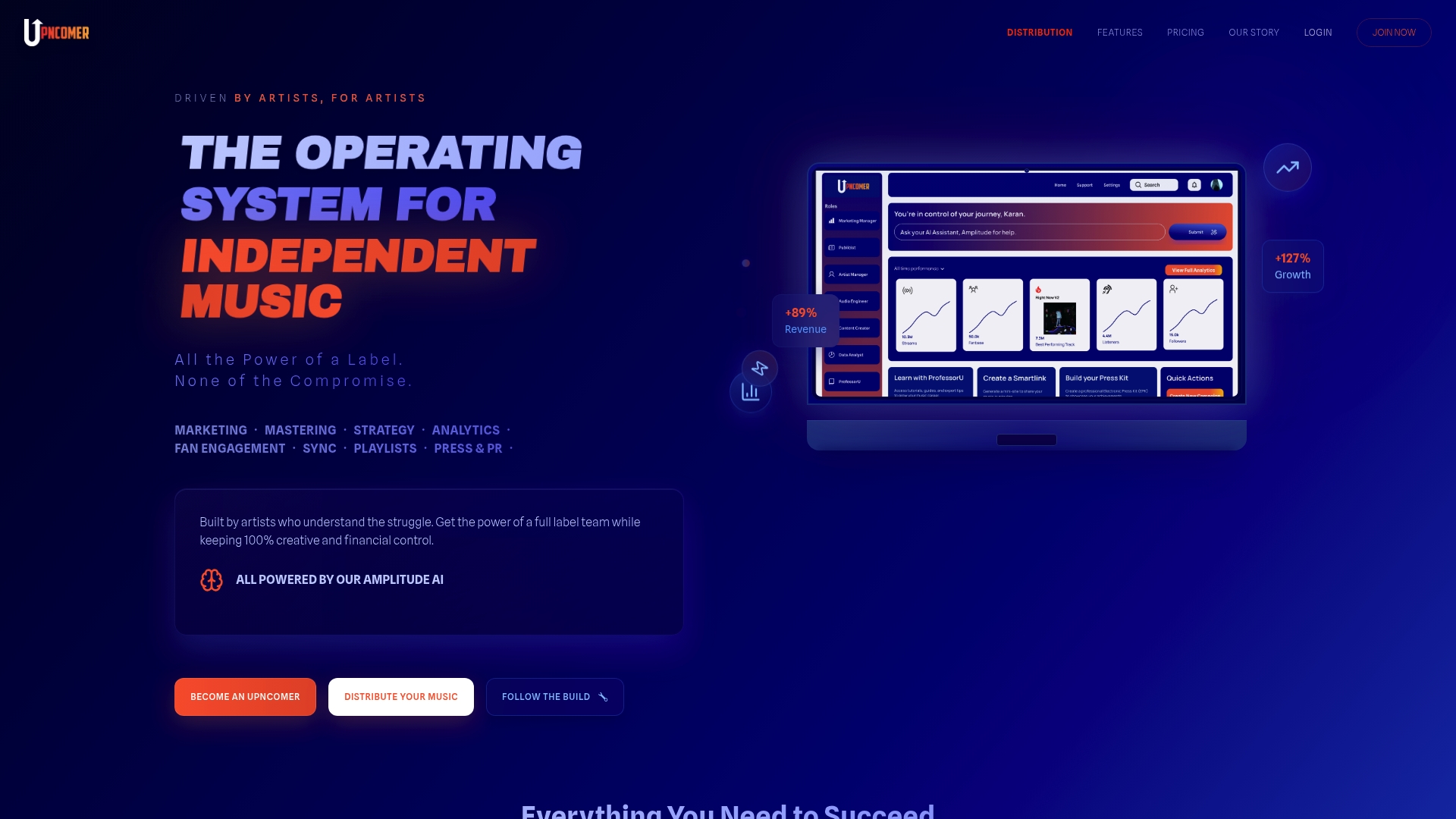
The Growth Engine module handles playlist pitching and release promotion in one place. The Data Analyst and Amplitude AI modules give you the streaming insights and audience data to make decisions based on what is actually working. The Distribution module gets your music onto Spotify and every other major platform with full metadata control from day one. If you want to see how other independent artists are using these tools, the Upncomer community updates page is updated regularly with platform news and artist resources. You do not need a label to build a real career. You need the right system.
FAQ
What is Spotify growth for independent artists?
Spotify growth refers to the measurable increase in monthly listeners, followers, streams, and saves an artist earns over time. For independent artists, it is the primary indicator of audience expansion and career momentum on the platform.
How many users does Spotify have in 2026?
Spotify reached 761 million monthly active users and 293 million Premium Subscribers as of Q1 2026, representing 12% and 9% year-over-year growth respectively.
How do I increase Spotify followers as an independent artist?
Convert passive listeners to followers by asking your audience directly on social media, using Spotify Codes on promotional materials, and releasing music consistently so followers have a reason to stay engaged.
What metrics should I track to boost Spotify streams?
Track your save-to-stream ratio, listener retention rate, playlist adds, and listener geography. These metrics reveal which tracks are building real fans versus collecting passive plays, and where to focus your audience growth efforts.
Does Spotify’s free tier matter for artist growth?
The free tier is a critical part of Spotify’s growth engine. Free tier listeners build listening habits that often convert to paid subscriptions, and they represent a large pool of potential followers for independent artists.