Mixing Engineer Role Explained for Independent Musicians
A mixing engineer is the professional who takes every separate recorded track and blends them into a single, polished stereo mix. Understanding what is mixing engineer role means recognizing that this person sits between the raw recording session and the final master, shaping how your song actually sounds to listeners. They are not the producer who directed the performance, and they are not the mastering engineer who prepares the file for streaming platforms. The mixing engineer’s job is sonic balance, clarity, and emotional impact. Getting this role right is one of the most consequential decisions you will make in your release process.
What does a mixing engineer do?
A mixing engineer blends individual audio tracks into a balanced, professional-sounding stereo mix after recording is complete. Every instrument, vocal, and sound effect lives on its own track. The mixing engineer’s job is to make all of those elements work together as one cohesive piece of music.
The core mixing engineer duties include:
- Volume balancing: Setting relative levels so the kick drum, bass, vocals, and guitars each occupy the right amount of sonic space without competing.
- Equalization (EQ): Cutting or boosting specific frequencies to carve out room for each element. A muddy low-mid frequency on a guitar can mask the bass, so the engineer removes it.
- Compression: Controlling the dynamic range of individual tracks so nothing jumps out unexpectedly or disappears in the mix.
- Spatial effects: Adding reverb and delay to create depth and dimension. A dry vocal sitting flat in the center sounds unnatural. Reverb places it in a believable acoustic space.
- Panning: Placing instruments left, right, or center in the stereo field to create width and separation.
- Automation: Riding faders, adjusting effects, and changing EQ settings throughout the song so the mix evolves dynamically and keeps the listener engaged.
Beyond the creative work, mixing engineers also deliver specific technical outputs. Industry standard deliverables include final mixes in high-quality WAV or AIFF formats, plus alternate versions like instrumentals, acapellas, and TV mixes. Session notes covering sample rate, bit depth, and tempo accompany the files to ensure compatibility at the mastering stage. That documentation matters more than most independent musicians realize.
Pro Tip: Always ask your mixing engineer for a “stem mix” in addition to the full stereo mix. Stems are grouped submixes of drums, bass, vocals, and instruments. They give you flexibility for remixes, sync licensing, and future re-releases without starting from scratch.
How does a mixing engineer differ from producers and mastering engineers?
Role confusion is one of the most common problems independent musicians run into. The three roles overlap in home studio settings, but they serve distinct functions in a professional workflow.
| Role | Primary focus | When they work |
|---|---|---|
| Producer | Artistic direction, arrangement, performance | During recording |
| Mixing engineer | Sonic blending of all recorded tracks | After recording, before mastering |
| Mastering engineer | Final stereo file polish for commercial formats | After mixing is complete |
Producers direct the creative and performance elements during recording. They decide the tempo, the key, the arrangement, and whether the second chorus needs a key change. Mixing engineers focus purely on sonic engineering after those creative decisions are locked. They do not rewrite parts or change the arrangement. They shape the sound of what was already recorded.
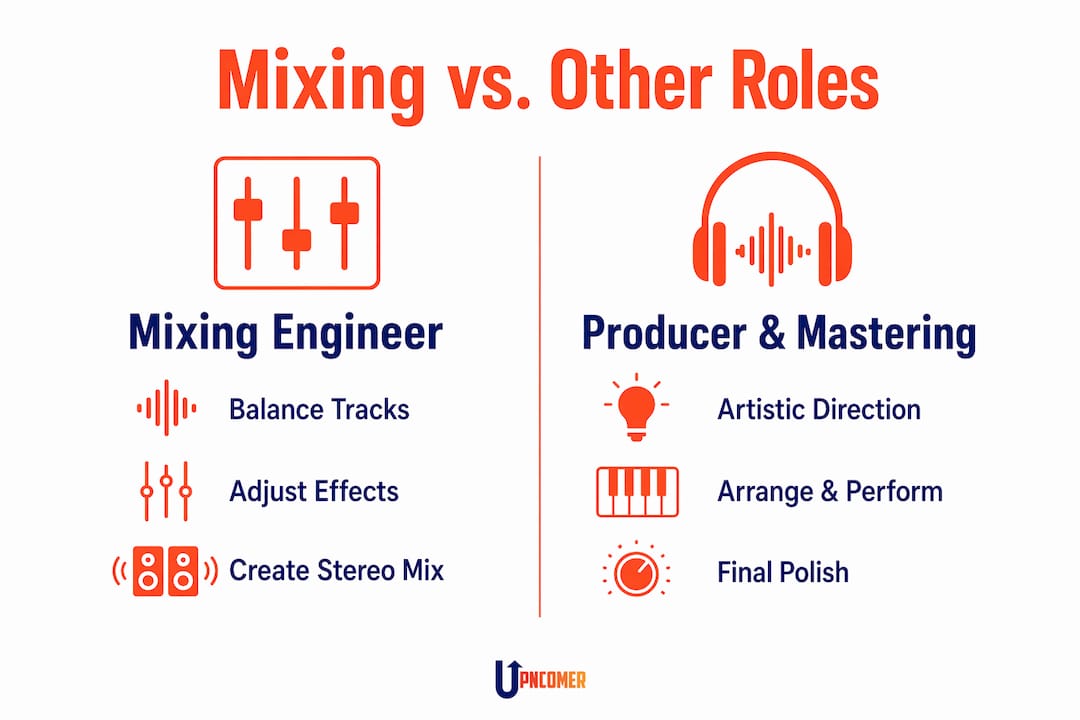
Mastering engineers work on the finished stereo mix the mixing engineer delivers. Mixing and mastering are distinct processes. Mixing balances individual stems. Mastering polishes the final stereo file to meet commercial loudness standards and format requirements for Spotify, Apple Music, and vinyl. Combining both roles in one session limits objectivity and quality control.
In home studio and indie setups, one person sometimes handles all three roles. That is a practical reality, not a best practice. Separating mixing and mastering, even when you handle production yourself, leads to a more objective and higher-quality result.
What skills and tools does a mixing engineer need?
The mixing engineer role balances engineering precision with artistic intuition. Technical fluency alone does not make a great mix. Taste and judgment matter just as much as knowing how to use a compressor.
The core technical skills include:
- Critical listening: Hearing problems in a mix before they become obvious to a casual listener. This skill takes years to develop and cannot be faked.
- DAW proficiency: Deep knowledge of a Digital Audio Workstation like Pro Tools, Logic Pro, or Ableton Live, including signal flow, routing, and session management.
- Plug-in knowledge: Understanding when to reach for an EQ, a compressor, a limiter, a saturator, or a reverb, and knowing which type fits the situation.
- Gain staging: Setting proper signal levels at every stage of the chain so the mix stays clean and headroom is preserved for mastering.
- Translation testing: Testing mixes across multiple playback systems including studio monitors, headphones, earbuds, phone speakers, and car stereos. A mix that sounds great on studio monitors but falls apart on earbuds has failed its most important test.
The least glamorous but most underrated skill is session organization. Receiving clean, organized multitrack sessions with proper naming conventions and metadata is critical to a mixing engineer’s efficiency. A disorganized session costs time and money. Engineers who receive messy files often charge more or push back the timeline.
Pro Tip: Before sending files to a mixing engineer, consolidate all audio regions to the same start point, remove unused tracks, label every track clearly (e.g., “Lead Vox,” “Kick In,” “Gtr L”), and include a reference track of the sound you are going for. This alone can cut revision rounds in half.
How to collaborate effectively with a mixing engineer
The quality of your collaboration directly affects the quality of your mix. Knowing how to work with a mixing engineer is a skill in itself, and most independent musicians learn it the hard way.
-
Deliver organized session files. Poor file management causes delays and additional costs. Export stems at the correct sample rate and bit depth, consolidate regions, and label every track. Include a text document with tempo, key, and any special instructions.
-
Share reference tracks. Send two or three songs that represent the sound you want. Reference tracks give the engineer a sonic target and reduce the chance of misaligned expectations. Be specific about what you like: the drum sound, the vocal width, the low-end weight.
-
Communicate your vision clearly upfront. Tell the engineer what the song is about emotionally, not just technically. A ballad about loss needs a different approach than a club track built for a festival stage.
-
Understand revision limits. Most mixing engineers include two to three rounds of revisions in their fee. Revisions are for adjustments, not for changing the fundamental direction of the mix. Changing your mind about the arrangement after mixing has started costs extra.
-
Respect the role boundary. Mixing engineers do not own the creative rights of your music. Technical mix changes differ from creative rights, so clarify agreements upfront if you are working with someone new. The mix is a technical service, not a co-write.
A professional mix also pays dividends beyond the song itself. Playlist curators, sync licensing supervisors, and label A&R teams all notice production quality immediately. A well-mixed track gives you a real shot at playlist pitching success and opens doors that a rough demo never will. Your music release checklist should treat professional mixing as a non-negotiable step, not an optional upgrade.
Key Takeaways
A mixing engineer’s core function is to blend recorded tracks into a balanced, emotionally resonant stereo mix that translates across every playback system.
| Point | Details |
|---|---|
| Core mixing engineer role | Blending individual tracks into a polished stereo mix after recording is complete. |
| Key duties | Volume balancing, EQ, compression, spatial effects, panning, and automation. |
| Role distinctions | Producers direct recording; mixing engineers shape sound; mastering engineers finalize for release. |
| Essential skills | Critical listening, DAW proficiency, gain staging, and translation testing across playback systems. |
| Collaboration best practice | Deliver organized session files and clear reference tracks to reduce revisions and costs. |
The part most musicians skip, and why it costs them
Here is what I have seen consistently: independent musicians spend months writing and recording a song, then rush the mix because they are eager to release. They either skip professional mixing entirely or hand off a disorganized session and expect miracles. The result is a track that sounds amateur on streaming platforms, no matter how good the songwriting is.
The mixing engineer role is not just a technical checkbox. It is where a song either comes to life or stays flat. The best mixing engineers I have worked with describe their job as “serving the song,” which means knowing when to add and when to pull back. That restraint, knowing when the mix is done, is harder than any technical skill. Over-processed mixes are just as common as under-processed ones, and both kill the emotional impact of a track.
The democratization of mixing tools has made this more complicated, not simpler. Every independent musician now has access to the same plug-ins that professional studios use. But access to tools does not equal the ear to use them well. A compressor in the wrong hands does more damage than no compressor at all. If you are producing your own music, invest time in developing your listening skills before you invest in more gear.
The future of mixing for independent artists runs through AI-assisted tools and hybrid workflows. AI mastering is already mainstream. AI-assisted mixing suggestions are coming fast. But the human judgment at the center of a great mix, the taste, the emotional read of a song, is not going anywhere. Use the tools. Build the ear. And when the song deserves it, bring in a professional.
— Karan
How Upncomer helps you release music that’s ready for the world
Getting a professional mix is one step. Getting that mix in front of the right listeners is another challenge entirely.

Upncomer is built for independent artists who want both. The platform brings together music distribution, streaming analytics, playlist pitching tools, and AI-powered guidance through Amplitude AI, all in one place. You do not need a label or a fragmented stack of separate services. Whether you are preparing your first release or scaling a catalog, Upncomer gives you the infrastructure to release with confidence. Join the Upncomer community and get access to the tools, resources, and support that help your music reach the people who need to hear it.
FAQ
What is a mixing engineer’s main job?
A mixing engineer blends all individual recorded tracks into a single, balanced stereo mix. They adjust volume levels, EQ, compression, effects, and automation to create a cohesive and emotionally resonant final sound.
How is mixing different from mastering?
Mixing balances individual stems and tracks within a session. Mastering takes the finished stereo mix and polishes it to meet commercial loudness and format standards for streaming platforms and physical media.
What files should I send to a mixing engineer?
Send consolidated audio stems at the correct sample rate and bit depth, with every track clearly labeled. Include session notes covering tempo, key, and bit depth, plus two or three reference tracks that represent your target sound.
Do mixing engineers own any rights to my music?
Mixing engineers do not own the creative rights to your music. Their work is a technical service. Clarify agreements in writing before the project starts to avoid any confusion about ownership or derivative use.
How long does mixing typically take?
Mixing timelines vary based on session complexity and the engineer’s workload. A single song with a well-organized session typically takes one to three business days, with additional time for revision rounds.