Label Revenue Streams Explained for Independent Artists

Label revenue streams are the multiple income sources a record label earns from an artist’s music and related activities, spanning recorded royalties, touring, merchandise, sync licensing, publishing, and brand deals. Understanding these streams is not just useful for industry professionals. It is the foundation of every smart career decision you will make as an independent artist. Organizations like ASCAP and BMI collect performance royalties on behalf of rights holders, while streaming platforms distribute master recording income directly to labels. Knowing where the money flows, and who takes what cut, puts you in a far stronger position when evaluating any deal.
What are the primary label revenue streams from recorded music?
Recorded music is the core of any label’s income model. When your track streams on Spotify or Apple Music, the label collects the master recording royalty. Under traditional major label deals, artists receive 15–25% of net recording revenue after recoupment. That means the label keeps 75–85% of every dollar your music earns from streams, downloads, and physical sales.
Physical and digital sales still contribute to label income, though streaming now dominates. Labels also collect neighboring rights royalties when master recordings are broadcast on radio or used in public spaces. These royalties flow through collection societies and represent a steady, often overlooked income layer.
Recoupment is the mechanism that delays your share of this income. The label recoups its advance, recording costs, and marketing spend from your royalty account before you see a cent. Many artists never reach recoupment, which means the label earns continuously while the artist earns nothing from recordings.
- Master royalties: Label keeps 75–85%, artist receives 15–25% after recoupment
- Streaming income: Paid per stream to the label, then split per contract terms
- Physical and digital sales: Label earns from wholesale margins and royalty splits
- Neighboring rights: Collected via societies like SoundExchange for broadcast use
Pro Tip: Register your master recordings with SoundExchange even before signing any deal. You are entitled to the artist’s share of neighboring rights royalties regardless of your label arrangement.
How do labels monetize additional revenue streams beyond recordings?
Labels do not stop at recorded music. Modern label contracts reach into touring, merchandise, sync licensing, and publishing, each with its own share structure.

Touring income is one of the most significant non-recording revenue sources for artists. Labels typically take 10–25% of net touring income after expenses are deducted. The “net” calculation matters enormously here. Tour expenses including production, crew, and travel come out first, and then the label’s percentage is applied to what remains. That structure can shrink your actual take-home significantly.
Merchandise is another major income layer. Labels participating in merch revenue typically take 15–30% of merchandise revenues, covering both online store sales and venue sales. For a touring artist moving real volume at the merch table, that percentage adds up fast.
Sync licensing is where labels often command their highest share. When your music lands in a film, TV show, or advertisement, the label can take 30–50% of the sync fee on the master side. Labels justify this by pointing to their relationships with music supervisors and their role in negotiating placements. Whether that justification holds up depends on how active your label actually is in pitching your catalog.
| Revenue stream | Typical label share | Notes |
|---|---|---|
| Touring income | 10–25% of net | Calculated after tour expenses |
| Merchandise | 15–30% | Covers online and venue sales |
| Sync licensing | 30–50% | Master side only; publishing is separate |
| Publishing | Varies by deal | Some labels own or co-own publishing rights |
| Brand partnerships | Negotiated case by case | Often 20–30% in 360 structures |
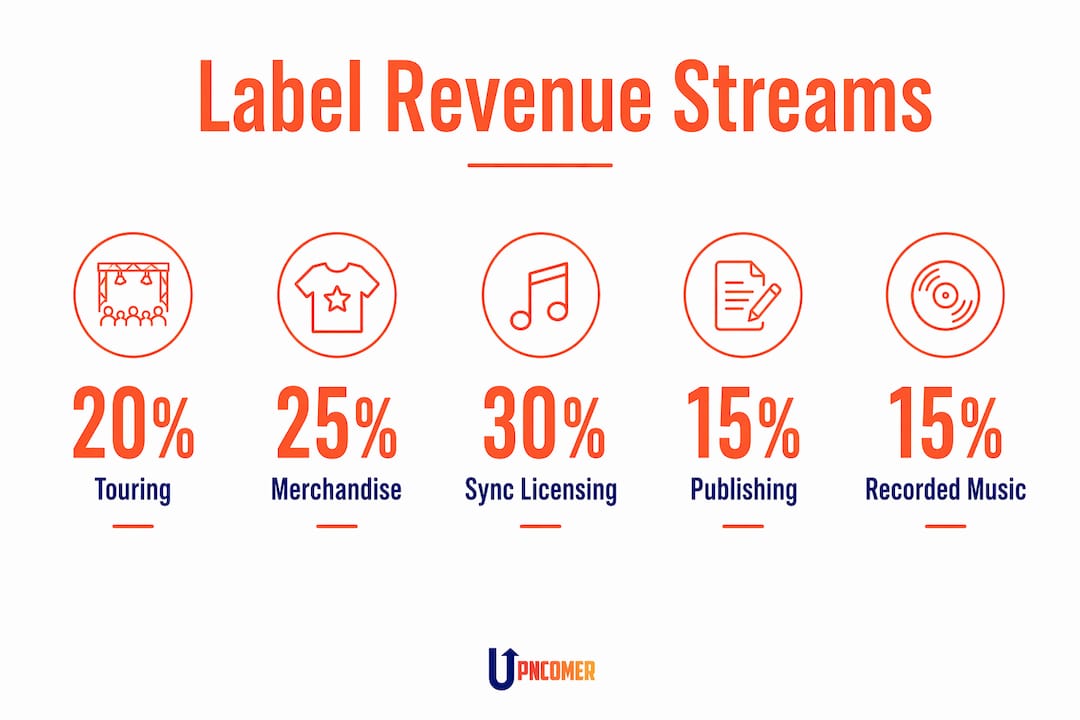
Publishing income is a separate but related stream. Some labels own or co-own the publishing rights to an artist’s compositions, collecting mechanical royalties, performance royalties through ASCAP or BMI, and sync publishing fees. If your label controls your publishing, they earn from both the master and the composition every time your song is used.
What are 360 deals and how do they affect artist income?
A 360 deal is a contract where the label takes a percentage of every revenue stream an artist generates, not just recorded music. These deals became common as streaming eroded physical sales revenue, and labels looked for ways to stay profitable by sharing in an artist’s total career income.
Under a typical 360 structure, labels take 10–35% across non-recording streams like touring, merchandise, and brand deals, while retaining 75–85% of master recording revenue. That is a wide net. A label participating in your touring income, your merch, your sync deals, and your brand sponsorships is earning from almost everything you do as a working artist.
360 deals were developed as labels sought to share income across all artist activities due to shrinking recording revenues. The stated rationale is that labels invest heavily in artist development, marketing, and promotion, so they deserve a share of the career value they help build. The counterargument is that many labels provide minimal support beyond the initial advance, yet continue collecting across all streams for the life of the contract.
Pro Tip: Before signing any 360 deal, ask your entertainment lawyer to define exactly which revenue streams are included and request a cap on the label’s participation period for each stream. Touring participation that expires after three years is very different from one that runs for the life of the contract.
The practical impact on your income is significant. If your label takes 20% of net touring income, 20% of merch, and 40% of sync fees, you are running a business where a large partner collects from every department without sharing in your day-to-day costs. That math can work in your favor if the label delivers real marketing muscle and genuine sync placements. It rarely works in your favor if the label is passive.
How do recoupment, advances, and contract structures affect when you get paid?
Advances are recoupable loans against future royalties, not free income. Artists only start earning royalties after advances and all recoupable expenses are fully paid back from their royalty account. Many artists never reach that threshold, which means the label earns from their music indefinitely while the artist’s royalty balance stays negative.
Recoupable expenses go far beyond the advance itself. Recording costs, mixing, mastering, music video production, marketing campaigns, and even some tour support can all be charged to your royalty account. Without marketing caps in your contract, there is no ceiling on what the label can spend and charge back to you.
Producer points are deducted from your royalty share before recoupment is calculated, stretching your recoupment timeline further. If your royalty rate is 20% and the producer takes 4 points, you are actually earning 16% while the label recoups against the full cost of the record.
Cross-collateralization is the clause that catches many artists off guard. It allows the label to combine earnings and debts across multiple projects, so profits from your successful second album can be applied to the deficit from your first. You can have a charting record and still see zero royalties because the label is clearing old debt first.
- Advance: A loan against future royalties; recouped before you earn anything
- Recoupable expenses: Recording, video, marketing, and sometimes tour support
- Producer points: Deducted from your royalty rate, extending recoupment
- Cross-collateralization: Links multiple projects under one debt pool
- Marketing caps: Contractual limits on recoupable marketing spend; negotiate for these
Pro Tip: Always negotiate a “net receipts” definition in your contract. Vague language around what counts as recoupable can cost you years of royalty income. Get every deduction category listed explicitly.
How do modern label services and distribution models change the equation?
Label services models offer a real alternative to traditional 360 deals. Under a label services arrangement, you retain ownership of your masters and receive a wider range of services, from marketing to distribution, in exchange for a revenue share on recordings only. The label does not participate in your touring, merch, or brand deals.
A typical label services deal might take 50% of net recording revenue while leaving everything else entirely in your hands. That is a higher recording split than you would get from pure independent distribution, but it comes with genuine marketing and promotional support. The key difference from a 360 deal is scope. You are paying for a specific service, not handing over a percentage of your entire career.
Distribution-only deals go further in your favor. Most independent distribution arrangements let artists keep 70–85% of recording revenue with no participation in any other stream. You own your masters, you collect your royalties directly, and you build your audience data yourself.
- Traditional label deal: Label owns masters, 75–85% recording revenue, potential 360 participation
- Label services deal: Artist owns masters, label takes ~50% of recordings, no touring or merch share
- Distribution-only deal: Artist owns masters, keeps 70–85% of recording revenue, full control
The trade-off is support. A distribution-only deal gives you maximum financial control but zero label infrastructure. That is where tools like Upncomer’s Growth Engine and Distribution fill the gap, giving independent artists access to streaming analytics, audience insights, and release promotion without surrendering ownership or income.
Understanding audience data also changes your negotiating position. When you can show a label or services partner real fan engagement numbers, you negotiate from strength rather than hope.
Key Takeaways
Label revenue streams span recorded royalties, touring, merchandise, sync licensing, and publishing, and the deal structure you sign determines how much of each stream you actually keep.
| Point | Details |
|---|---|
| Recording royalty splits | Artists receive 15–25% of net recording revenue under traditional major deals after recoupment. |
| 360 deal scope | Labels take 10–35% of non-recording streams and 75–85% of master revenue in 360 structures. |
| Recoupment delays earnings | Advances, producer points, and cross-collateralization can prevent artists from ever seeing royalties. |
| Sync licensing share | Labels typically take 30–50% of sync fees on the master side due to their placement role. |
| Services models protect ownership | Label services deals let artists retain masters and limit label participation to recording revenue only. |
Why I think most artists sign bad deals because they don’t read the revenue map
I have seen artists walk into 360 deal signings excited about the advance and completely blind to the touring and merch clauses buried on page 14. The advance number is the headline. The revenue participation terms are the actual deal.
The uncomfortable truth about label revenue streams is that labels are not hiding anything. The structures are documented, the percentages are standard, and the recoupment math is straightforward once you understand it. The problem is that most artists never take the time to learn the map before they start the trip. By the time they realize the label is collecting from every stream, the contract is signed and the advance is spent.
What changed my perspective was working with artists who had built real audience data before approaching any label conversation. When you know your streaming numbers, your merch conversion rate, and your ticket-to-fan ratio, you can calculate exactly what a label’s participation is worth to you in dollar terms. That calculation almost always reveals that a services deal or a distribution-only arrangement is the better financial choice for artists who already have momentum.
The artists who benefit most from 360 deals are typically those at the very beginning of their careers, with no audience and no income from any stream. In that case, the label’s investment in building your career from zero has real value. For artists who already have fans and revenue, giving up 20% of touring and merch income is a very expensive form of marketing.
Use music analytics to build your case before any deal conversation. Know your numbers. Know what each stream is worth. Then decide what you are willing to share and with whom.
— Karan
How Upncomer helps you build revenue without giving it away
Independent artists no longer need a label to access professional-grade tools for distribution, marketing, and audience growth.
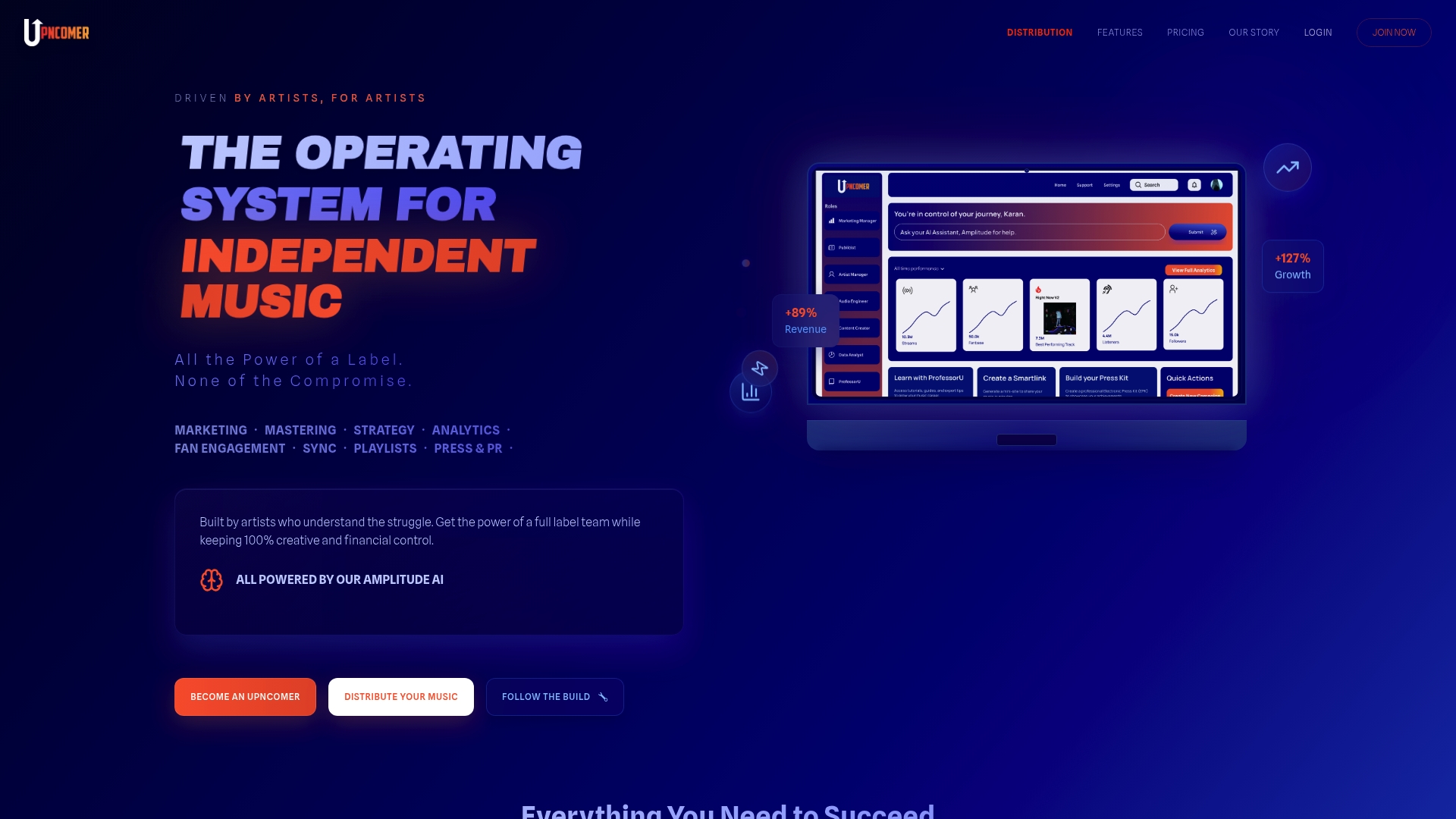
Upncomer’s Distribution service puts your music on every major platform while keeping your masters and your revenue in your hands. The Growth Engine and Amplitude AI give you real-time streaming analytics and audience insights, so you understand exactly which fans are driving income and where to focus your next release campaign. The community updates feed keeps you current on industry shifts, deal structures, and monetization strategies as they evolve. Whether you are evaluating your first label conversation or building a fully independent income model, Upncomer gives you the data and infrastructure to make decisions from a position of knowledge rather than guesswork.
FAQ
What are label revenue streams?
Label revenue streams are all the income sources a record label earns from an artist’s music and career activities. These include master recording royalties, streaming income, touring participation, merchandise, sync licensing, publishing, and brand deals.
How much do artists earn from label recording deals?
Artists typically receive 15–25% of net recording revenue under traditional major label deals, but only after the label has fully recouped its advance and all recoupable expenses.
What is a 360 deal in music?
A 360 deal is a contract where the label takes a percentage of every revenue stream an artist generates, including touring, merchandise, and brand partnerships, in addition to the standard master recording share.
How does recoupment affect artist royalties?
Recoupment means the label withholds all royalties until the advance and recoupable costs are fully paid back. Artists with large advances or high marketing expenses may never see royalty payments.
What is the difference between a 360 deal and a label services deal?
A label services deal lets the artist retain master ownership and limits the label’s share to recording revenue only, while a 360 deal extends the label’s participation across all income streams including touring and merchandise.