Artist Income Diversification Strategy for Independent Musicians

An artist income diversification strategy is a structured approach to generating revenue from multiple related sources so that no single platform, label deal, or income type controls your financial stability. Sociologists William J. Byrnes and Pierre-Michel Menger describe diversification as structurally necessary for creative career sustainability, not just a nice-to-have. The music industry has always been volatile. Streaming payouts fluctuate, algorithms shift, and touring income can disappear overnight. Building multiple complementary income streams is how independent artists protect their creative freedom and build careers that last.
What is an artist income diversification strategy?
An artist income diversification strategy means deliberately building several revenue streams that work together rather than competing for your time. The goal is not to do everything at once. The goal is to create a financial structure where one stream supports another, so a slow month on streaming does not wipe out your rent. Complementary income sources increase resilience against economic shifts and fluctuating audience interest. That is the core principle: your income streams should reinforce each other, not pull you in opposite directions.
The industry term for this approach is portfolio career, a concept well established in creative labor research. You are not just a musician. You are a creative business operating across multiple revenue channels simultaneously.
What are the main income streams available to independent artists?
Independent artists have more revenue options today than at any point in music history. The challenge is knowing which ones fit your brand, your audience, and your available time. Here is a breakdown of the main categories:
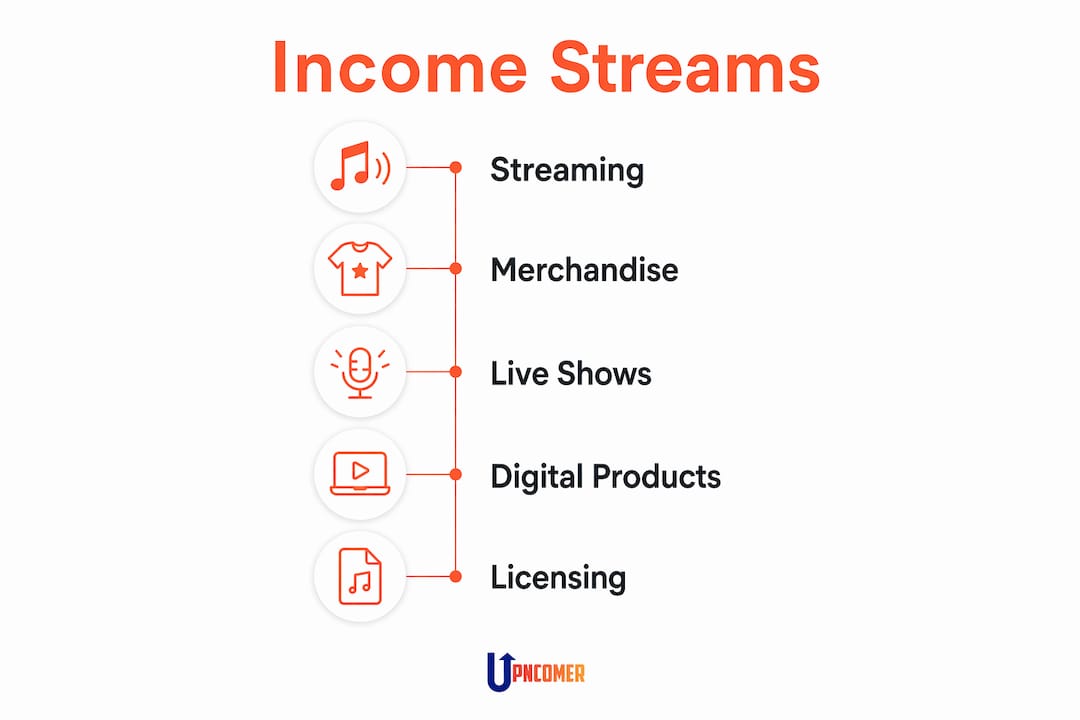
- Original music sales and streaming. Streaming sits at the top of your funnel. It builds awareness and drives fans toward higher-value purchases. Music distribution is the foundation that gets your catalog onto every platform.
- Sync licensing and royalties. Licensing your music for TV, film, ads, and video games generates passive income from your existing catalog. The same recordings earn money in multiple contexts without additional creative work.
- Digital products. Sample packs, preset bundles, sheet music, and production templates are evergreen products. The digital goods market is projected to reach $825 billion in 2026. That scale signals real demand for downloadable creative assets.
- Online courses and workshops. The e-learning market is projected to exceed $460 billion by 2026. Mid-tier course pricing typically runs $97–$497, with premium coaching above $997. Teaching what you know is one of the most direct ways to monetize your skills.
- Print-on-Demand merchandise. Artists can sell apparel, prints, and accessories without holding inventory. Print-on-Demand now uses localized global fulfillment, which removes shipping complexity entirely.
- Crowdfunding and patronage. Platforms built around recurring fan support let superfans pay monthly for exclusive content, early access, and direct connection. This model converts casual listeners into reliable income.
- Live performances and sessions. Live income is active, not passive, but it feeds every other stream by building the audience that buys your digital products and merchandise.
The distinction between passive and active income matters here. Active income requires your direct time and presence. Passive income, once set up, earns while you sleep. A healthy artist income strategy includes both, with passive streams growing over time.
How do you evaluate and select the right income streams?
Choosing the right revenue mix starts with knowing your audience. You need to understand who your fans are, what they buy, and how they engage with your content. Audience data tells you whether your listeners skew toward merchandise buyers, course takers, or superfan supporters. Without that data, you are guessing.
Follow this process to evaluate income streams before committing:
- Audit your existing audience. Where do your fans spend time? What content gets the most engagement? Streaming analytics and social data reveal purchasing behavior patterns.
- Match streams to your strengths. If you produce beats, sample packs are a natural fit. If you teach well on camera, a course makes sense. Misaligned streams feel forced and rarely convert.
- Calculate the real time cost. Every income stream has a setup phase that is labor-intensive. New income sources often require distinct marketing plans and function like separate businesses. Factor that in before you commit.
- Prioritize streams that share infrastructure. A merchandise line that uses your existing visual brand costs less to launch than a completely new product category. Shared infrastructure reduces overhead.
- Start with two or three streams maximum. Spreading across too many channels at once dilutes your focus and produces mediocre results across the board.
Pro Tip: Run a 90-day test on any new income stream before scaling it. Track revenue, time spent, and audience response. Cut what does not perform. Double down on what does.
The biggest mistake artists make is chasing every opportunity that looks profitable. Alignment with your brand and audience is what converts. A misaligned stream will drain your energy and produce little return.

How do you build and automate diversified income streams?
Building sustainable multiple income streams requires two things: the right infrastructure and automation. Without both, you will spend all your time on fulfillment and administration instead of creating music.
Own your media channels
Your website and email list are your most valuable business assets. Owning your audience through direct channels means algorithm changes on streaming platforms or social media do not cut off your income. Email lists drive repeat purchases. A website with SEO-optimized content brings consistent traffic without paid ads.
Build evergreen products
Evergreen digital products sell indefinitely without requiring your active involvement after launch. A sample pack you create once can generate revenue for years. Automated evergreen funnels with traffic, conversion, and retention zones sustain income without constant social media pressure. The funnel works while you focus on your next release.
Automate payment to delivery
True scalability depends on automating the entire payment-to-delivery process. Manual fulfillment creates bottlenecks that prevent you from scaling. When a fan buys your sample pack at 2 AM, the file should deliver instantly without you touching anything. E-commerce platforms with automated delivery handle this natively.
Use Print-on-Demand for merchandise
Print-on-Demand removes inventory risk entirely. You upload designs, set prices, and the fulfillment partner handles production and shipping. Businesses can launch with under $50 investment. That low barrier makes it one of the most accessible passive income streams for independent artists.
| Income stream | Setup effort | Automation potential | Passive after launch? |
|---|---|---|---|
| Digital downloads | Medium | High | Yes |
| Print-on-Demand merch | Low | High | Yes |
| Online course | High | Medium | Mostly |
| Sync licensing | Medium | Low | Yes |
| Live performances | Low | None | No |
Pro Tip: Use your music release checklist to coordinate income stream launches with new releases. A new single is the perfect moment to drop a related sample pack or limited merch run.
Promotion is not optional. Even the best evergreen product needs consistent traffic. Content SEO, playlist pitching, and online music promotion all feed the top of your funnel and keep sales moving.
What are the common challenges in diversifying artist income?
Diversification is not without friction. Most artists hit the same walls. Knowing what to expect makes it easier to push through.
- Time management collapses fast. Running three income streams while writing and recording is genuinely hard. Block dedicated time for business tasks separate from creative work. Mixing the two kills both.
- Burnout is real. Maintenance overhead across multiple streams adds up. If a stream requires constant attention to stay alive, it is not truly passive. Cut it or automate it.
- Profitability is not always obvious. Track revenue and time spent for every stream monthly. Some streams look active but produce almost nothing per hour of effort. Artists who juggle too many disparate sources often experience burnout or dilution of focus. Regular audits prevent this.
- Marketing complexity multiplies. Each income stream needs its own promotional angle. Batch your content creation and repurpose across channels to reduce the load.
- Market changes require adaptation. Streaming payout rates shift. Platform algorithms change. Build flexibility into your strategy so you can pivot without losing income.
“Diversification is not only for volume increase but risk management. Building income sources that support each other creates resilience against economic risks and fluctuating audience interest.”
The artists who sustain long careers treat their income strategy like a living document. They review it quarterly, cut what is not working, and reinvest in what is growing.
Key Takeaways
A sustainable artist income diversification strategy requires complementary streams, owned media, and automation working together from the start.
| Point | Details |
|---|---|
| Start with two or three streams | Launching too many streams at once dilutes focus and produces weak results across the board. |
| Own your audience channels | Email lists and websites outperform rented platforms for long-term income stability. |
| Automate product delivery | Instant automated delivery is what separates scalable passive income from a second job. |
| Align streams with your brand | Misaligned income streams rarely convert; match products to your existing audience behavior. |
| Review profitability quarterly | Cut underperforming streams and reinvest time and resources into what is actually growing. |
Why I think most artists approach diversification backwards
Here is what I have seen over and over: artists add income streams to solve a cash flow problem right now. They launch a merch store, start a Patreon, and list a course all in the same month. Then they wonder why nothing gains traction. The problem is not the streams. The problem is the sequence.
The artists who build genuinely resilient income start by owning their audience first. Before any product launch, they build an email list and a website that captures traffic. That owned media becomes the engine that sells everything else. Without it, every new stream starts from zero every time.
I also think the “passive income” framing misleads a lot of artists. Nothing is passive at the start. Setting up each new income source requires considerable marketing effort, customer support, and system building. The passive part comes later, after the infrastructure is solid. Expecting passive income to feel easy in month one is how artists burn out and quit.
My honest recommendation: pick one digital product, build the funnel properly, automate the delivery, and promote it consistently for six months before adding anything else. Patience here is not a weakness. It is the strategy. Once that first stream runs on its own, adding the next one is dramatically easier because the infrastructure already exists.
— Karan
How Upncomer helps artists build sustainable revenue
Independent artists building multiple income streams need data, automation, and a clear view of what is working. Upncomer brings all of that into one place.
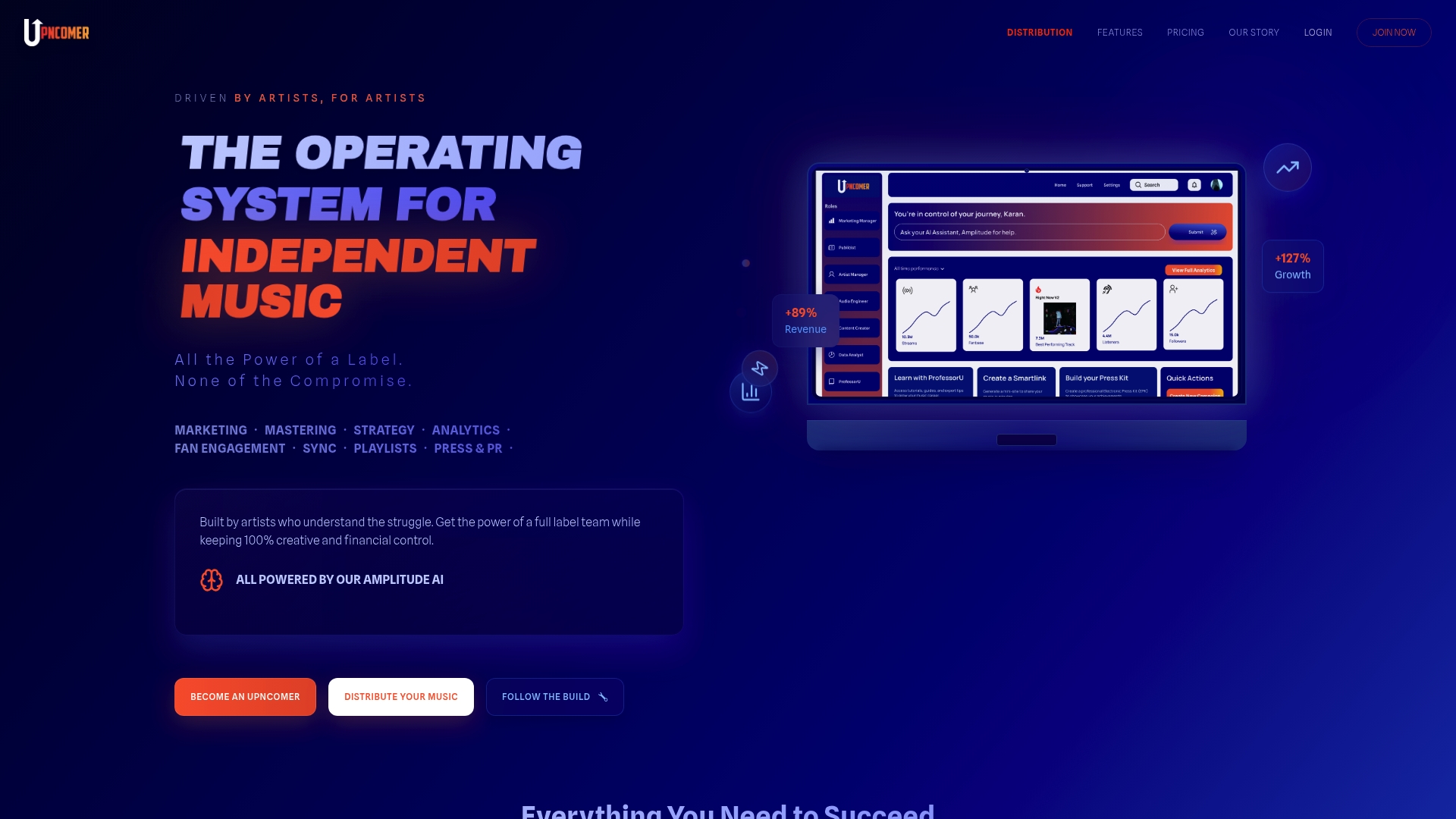
Upncomer’s Growth Engine and Amplitude AI give you real-time audience insights so you know exactly which fans are ready to buy, which releases are gaining momentum, and where to focus your promotional energy. The Artist Manager and Data Analyst modules help you track performance across every revenue channel without switching between disconnected tools. Whether you are planning a release, pitching playlists, or building your first digital product funnel, Upncomer gives you the infrastructure that major-label artists take for granted. Join the Upncomer community and get the tools, strategy, and support to grow your income on your own terms.
FAQ
What is an artist income diversification strategy?
An artist income diversification strategy is a structured plan to generate revenue from multiple complementary sources, such as streaming, digital products, licensing, and merchandise, so that no single income type controls your financial stability.
How many income streams should an independent artist have?
Start with two or three streams that align with your existing audience and brand. Adding too many streams at once leads to burnout and diluted results before any single stream matures.
What is the easiest passive income stream for musicians?
Digital downloads, such as sample packs, presets, and sheet music, are among the most accessible passive income streams. Once set up with automated delivery, they generate revenue without ongoing effort.
How long does it take for artist income diversification to work?
Most artists see meaningful results from a new income stream after three to six months of consistent promotion. The setup phase is labor-intensive; the passive phase comes after the funnel and automation are in place.
Does Upncomer help with artist income diversification?
Upncomer provides streaming analytics, audience insights, campaign management, and workflow automation that help independent artists identify and grow multiple revenue streams from one platform.