Top 5 Independent Artist Tools Alternatives 2026
Juggling separate tools for music distribution, promotion, and royalty tracking wastes your energy and scatters campaign results. Most music artist management platforms either gate key features behind higher-priced tiers or require cobbling together services from multiple vendors to get a complete workflow. This comparison highlights pricing, automation, and rights retention across five top artist management tools so you can choose a platform that matches your DIY music goals.
Table of contents
Upncomer
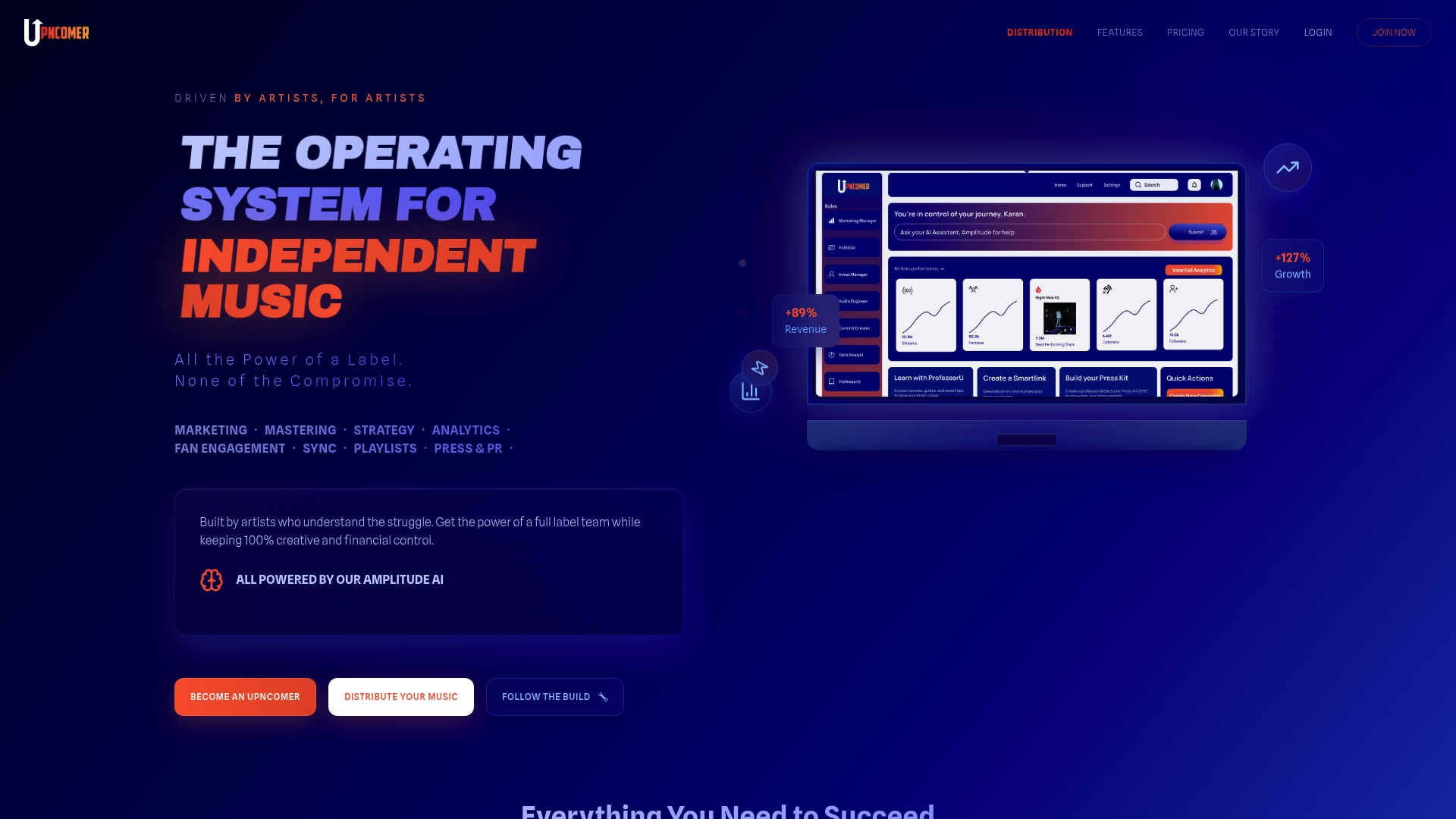
At a glance
The Pro plan starts at $27 per month. That price point is unusually low for a platform that bundles distribution, marketing, mastering, and analytics. Upncomer packages those tools into a single interface so you do not need separate vendors for release promotion, ad campaigns, and basic mastering.
Core features
Upncomer focuses on end to end release and career management for DIY artists. The platform couples automated workflows with musician-focused tooling so you can run campaigns and track results without juggling spreadsheets.
- AI-powered distribution that pushes releases to hundreds of platforms worldwide.
- AI mastering and mixing to prepare release-ready audio inside the same account.
- Real-time analytics and audience insights for campaign adjustments and release planning.
- Playlist pitching automation and content creation tools help with promotional outreach and social scheduling.
Key differentiator
The platform’s integrated AI-powered automation covers marketing, distribution, mastering, and analytics in one system. That design replaces several specialized services and agencies you would otherwise hire separately. For self-managed artists, this reduces the overhead of coordinating multiple tools and vendors.
Pros
-
Comprehensive replacement for multiple services. You can move distribution, basic mastering, playlist pitching, and campaign management into one account.
-
Affordable subscription relative to hiring a marketing or management team. The $27 per month Pro plan lowers the barrier for artists with limited budgets.
-
AI-driven automation handles repetitive tasks like ad targeting, campaign optimization, and release routing, which frees time for writing and performing.
-
Artists keep 100% of their royalties and rights while using the service, so you do not give up ownership for growth support.
-
Built-in education and a community component give guidance on using tools and shaping campaigns.
Cons
- Several promised features, including expanded press outreach and advanced content modules, are marked as coming soon and are not fully available at launch.
Who it’s for
Solo independent artists and DIY producers who want to self-manage releases and promotion without hiring a full team will get the most value. It fits artists who know their creative direction and want software to execute distribution, ads, and basic mastering. Artists expecting white glove, hands-on agency support may find the platform’s automation a poor match.
Unique value proposition
Artists using Upncomer keep 100% of their royalties and rights while accessing tools normally reserved for label-backed campaigns. That single fact changes the economics of hiring outside help. For a predictable monthly cost you avoid revenue splits and gain a set of integrated tools that handle distribution, ads, and analytics in one workspace.
Real world use case
According to the vendor, Karan, an independent artist with 100,000 monthly listeners, used Upncomer to replace his marketing team and saw a 400 percent increase in streams over three months while retaining full control of royalties. That example shows how the platform can concentrate tasks formerly spread across agencies into a single execution path. Your results will vary based on genre, strategy, and hands-on effort.
Pricing
The Pro plan lists $27 per month with annual billing options available. There is no permanent free tier, but the vendor advertises a free trial and account setup that does not require a credit card. The predictable subscription model makes budgeting for promotion and distribution simpler than variable agency retainers.
Website: https://upncomer.co
ORPL
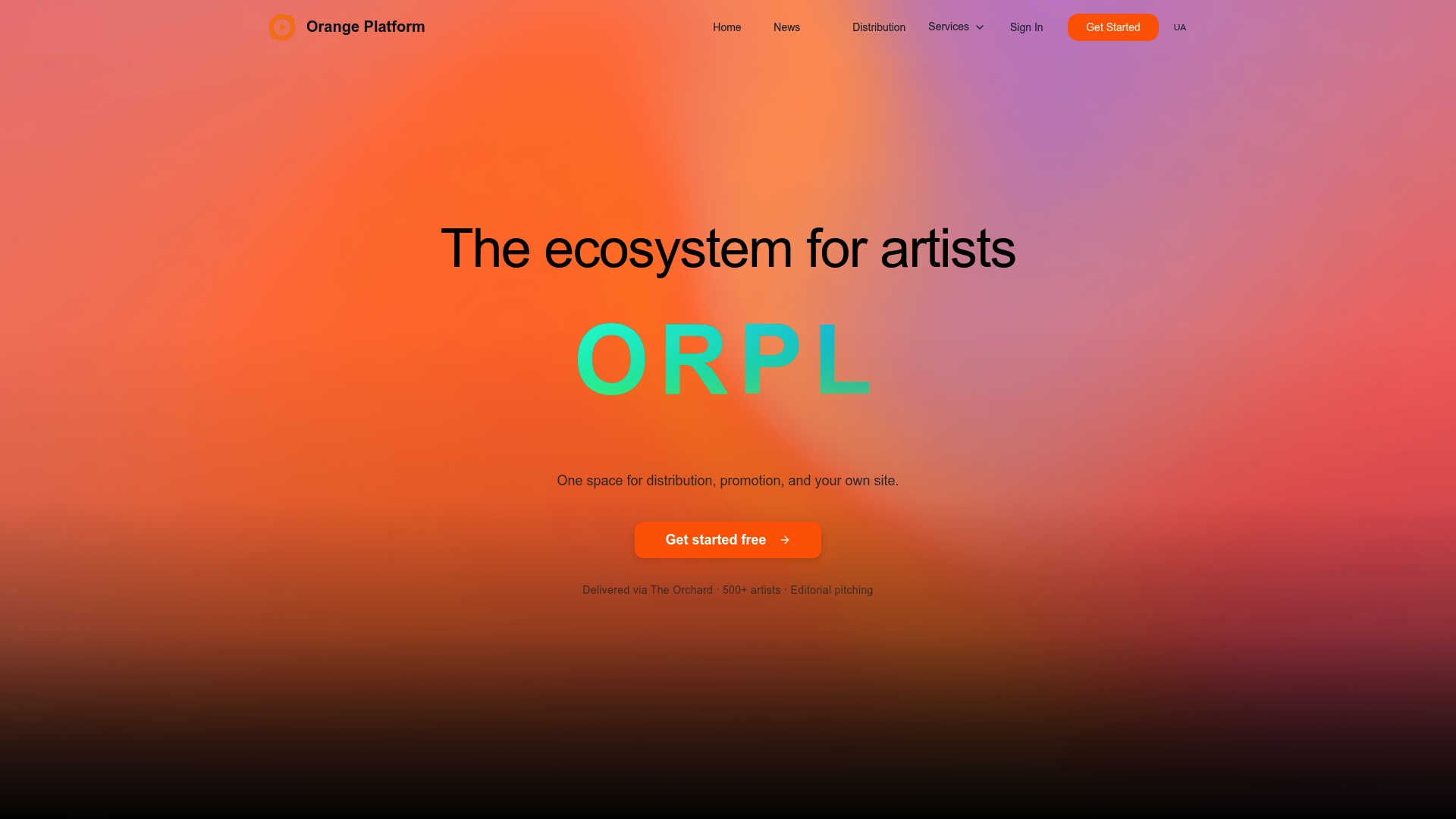
At a glance
ORPL reports supporting over 500 artists through a collaboration with The Orchard. The platform packages distribution, playlist pitching, promotional services, and website tools into a single workflow. That setup aims to let artists move from upload to promotion without switching platforms. The vendor frames the product as useful for both solo artists and small labels.
Core features
ORPL focuses on release execution and promotion with a compact feature set. The main capabilities listed by the vendor include:
- Distribution to Spotify, Apple Music, YouTube Music, TikTok. Automated ISRC and UPC assignment are part of the flow.
- Playlist pitching that routes releases to curators and placement teams.
- Release day checklist plus article support to manage launch tasks.
- AI covers and videos to generate quick visual assets for single and EP campaigns.
- Artist website creation that claims minimal setup for a public profile and links.
Key differentiator
ORPL centers on offering distribution and promotion inside the same product. Its notable angle is the mix of automated distribution with services for playlist pitching, radio and media outreach, and paid social campaigns. That combination targets artists who prefer a single dashboard for both upload and active promotion rather than stitching separate vendors together.
Pros
- Offers distribution plus promotion in one place, so you can manage upload and campaign tasks without switching tools.
- Automated assignment of ISRC and UPC simplifies release prep for artists who dislike administrative steps.
- Includes built in playlist pitching and media outreach options, which saves time compared to sourcing those services separately.
- Built in AI cover and video tools speed up visual asset creation for single releases and socials.
- Website creation and branding tools reduce the setup time for a public artist page.
Cons
- Several users report dissatisfaction and poor customer support experiences.
- The product has limited third party verified reviews, so public feedback is sparse and mixed.
- Some customers question the consistency of promotional outcomes and perceived value.
When it may not fit
If you need enterprise grade support or proven, extensive public reviews, ORPL may not be the right match. Agencies and larger labels managing high volume releases might prefer a partner with dedicated account teams. If you require audited success metrics or deep third party validation, the platform lacks that visible track record.
Who it’s for
ORPL suits independent musicians and small labels that want an integrated way to release music and run promotion from one dashboard. It fits artists who value quick setup, self managed playlist pitching, and bundled promotional services. It is less suited to teams that need white glove account support or verified performance reporting.
Real world use case
An indie artist prepares a single and uses ORPL to assign ISRC and UPC, build a release day checklist, and generate a cover and short promo video with the AI tools. The artist launches distribution to streaming platforms, submits to playlists through the pitching feature, and runs Meta ads from the same account. The website builder then hosts a landing page for pre saves and mailing list sign ups.
Pricing
ORPL lists a free tier, a PRO plan at ₴399/mo, and a single payment release pack for ₴999. Pricing mixes subscription and one off purchase options to suit occasional releases or ongoing campaigns.
Website: https://orpl.app
Artist results
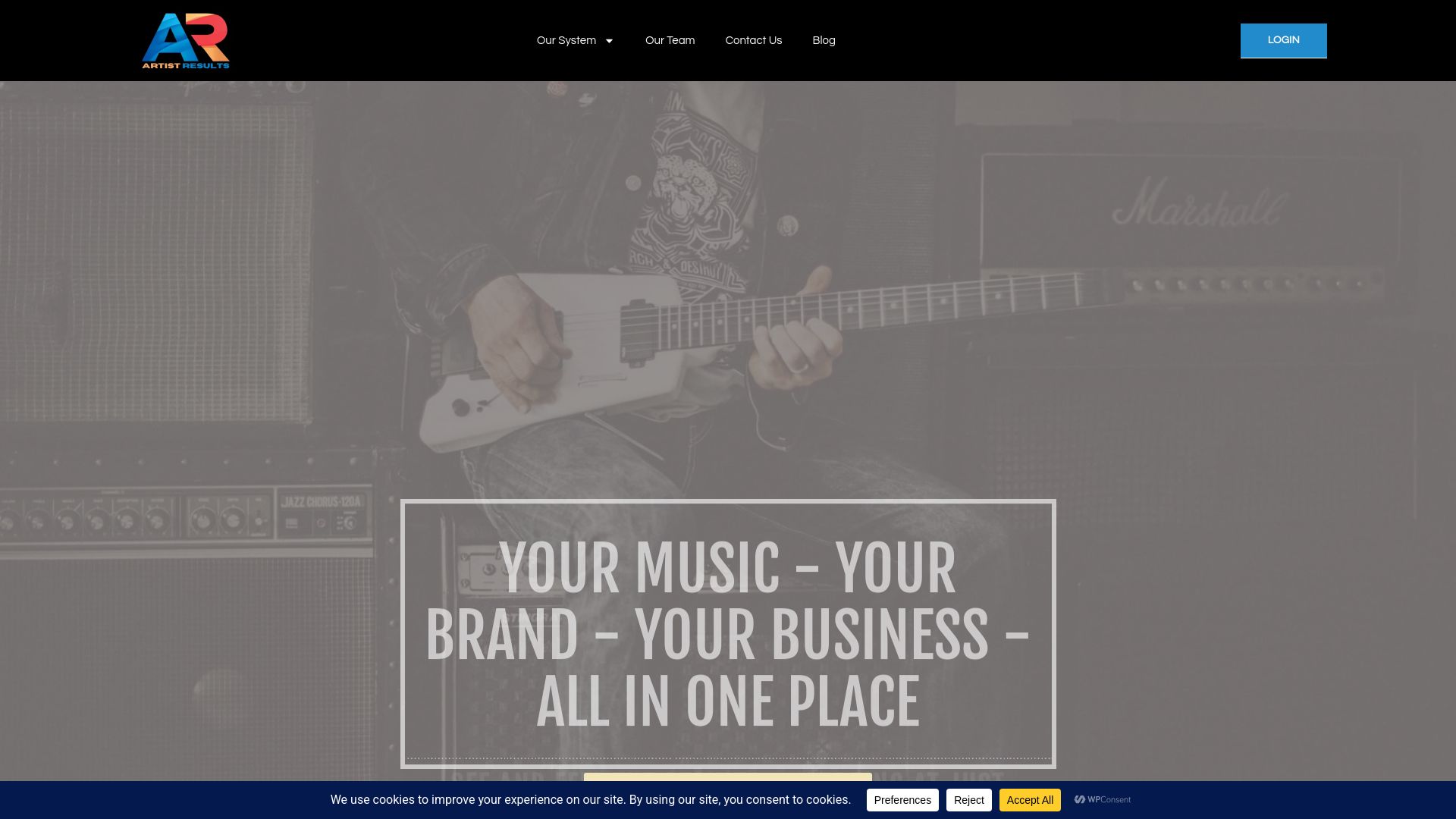
At a glance
Rights and publishing tools include management for ISRC, ISWC, and PRO numbers. The platform bundles media storage, EPK creation, tour logs, and royalty tracking inside one dashboard. Pricing starts at $15.99 per month. That setup aims to cut the time you spend switching between separate services.
Core features
Artist Results centers on features indie teams actually use. It offers automated EPK creation with embedded media and a media catalog for masters, stems, and artwork. Rights and publishing controls track ISRC, ISWC, and PRO identifiers and collect royalty data. The dashboard schedules social posts and runs campaign automation. It also stores tour history and organizes contacts for outreach.
Key differentiator
The clearest angle is purpose built workflow automation and multiple artist support tailored for indie musicians. Unlike Upncomer, which acts like a full operating system for music teams, this product narrows focus to artist business tasks such as EPKs, rights management, and tour prep. That narrower scope can make setup faster for small managers who need a single workspace.
Pros
-
Artist Results reports it can significantly increase streaming numbers in some user experiences. Users who see growth credit focused promotion and consolidated campaign tracking.
-
Includes helpful marketing guidance and templates that simplify common tasks for independent artists. Those templates speed up email and social campaigns.
-
Built in tools cover industry specific needs such as media storage, EPK generation, and rights identifiers. That reduces reliance on separate file servers and spreadsheets.
-
Supports multiple artist accounts and royalty tracking so small managers can keep bookkeeping and splits in one place. That saves administrative time for managers handling several acts.
-
Some user reviews mention clear workflow gains and improved professionalism for press pitches. The platform centralizes assets for one click sharing.
Cons
-
Several users report inconsistent results from promotion services and suspect bot driven activity. That creates polarized sentiment in reviews.
-
Support communication can be slow or unclear for complex royalty or rights questions. You may need outside help for tricky splits.
-
Aggressive promotion techniques have reportedly led to platform strikes or account issues for some clients. That risk affects artists worried about long term streaming integrity.
-
The platform may promise outcomes that do not materialize for every campaign. Expect variable results depending on how you use the tools.
When it may not fit
If you need a full public website or an integrated direct to fan store, Artist Results may fall short. The product lacks deep ecommerce features and may miss advanced marketing automation found in dedicated tools. Large teams that require enterprise reporting or complex API integrations will likely need a more open platform.
Who it’s for
Active independent musicians and small artist managers who release regularly and want a single place for promotional assets, rights tracking, and tour history. It fits teams that need multiple artist accounts and prefer a guided setup rather than building a stack from individual apps.
Real world use case
A manager uploads masters and artwork, generates an EPK for a festival pitch, schedules a two week social campaign, and ties streaming royalty reports to a single artist record. That workflow removes manual file sharing and keeps booking history ready for incoming offers.
Pricing
Pricing starts at $15.99 per month. Higher tiers unlock multiple artist management, advanced royalty tracking, and email marketing templates on premium plans. The vendor advertises tiered plans that scale with added features for managers and labels.
Website: https://artistresults.com
MNGR
At a glance
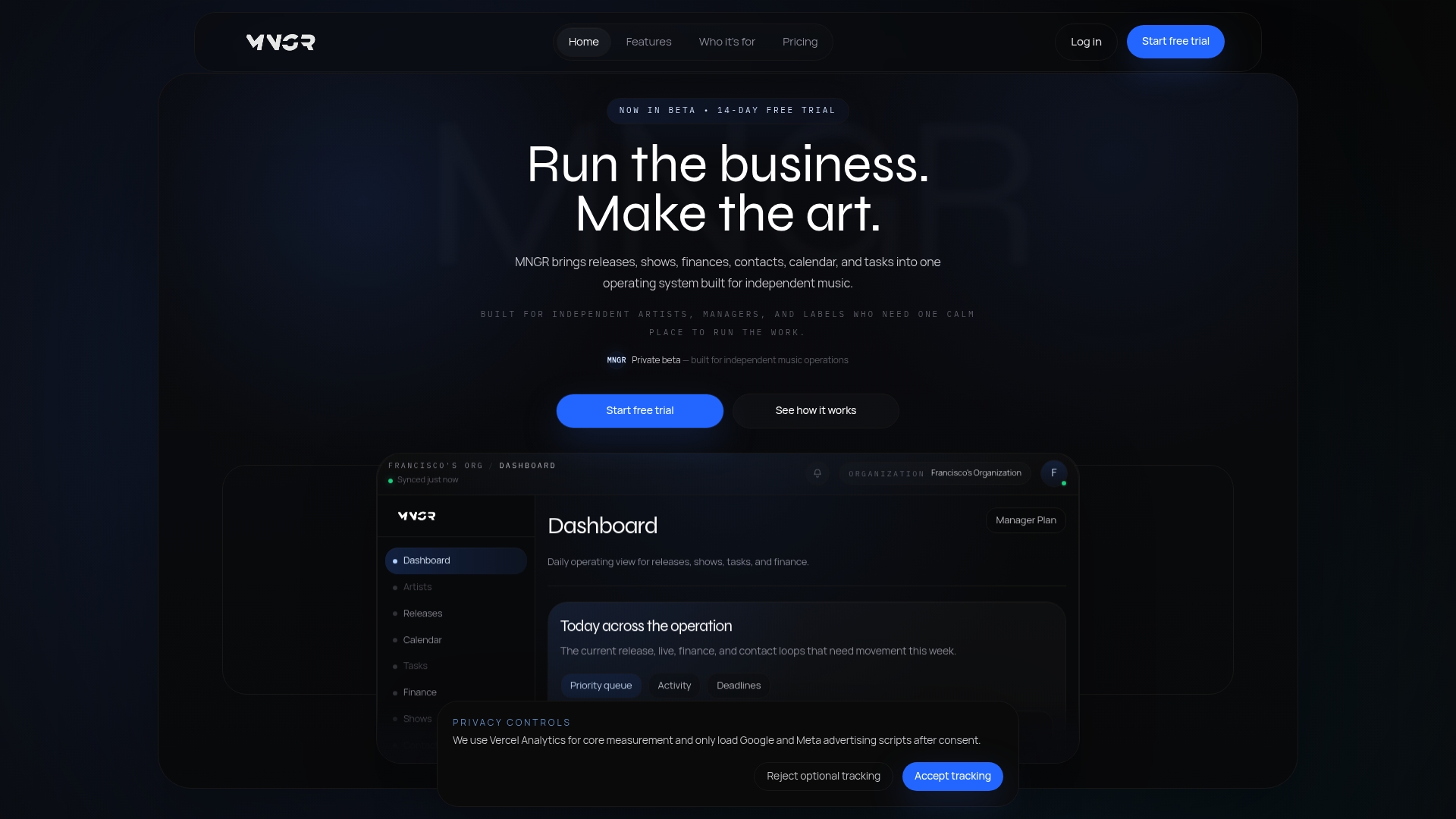
Plans start at $19 for solo users and go to $99 for label plans, and the vendor offers a 14-day free trial. MNGR gathers releases, shows, finances, contacts, calendar, and tasks into a single operating view. That focus reduces the number of separate apps you must juggle when managing a music career.
Core features
MNGR presents a unified dashboard that shows releases, shows, finances, contacts, calendar, and tasks in one place. The platform includes a daily operating view for managing current activities and a pipeline for release and show deadlines. Financial tracking breaks down income and expenses by source. Contact and communication tracking records submissions and follow-ups to keep relationships visible.
Key differentiator
MNGR focuses on operational management for independent music professionals. The product is built to hold the day to day of artists, managers, and small labels inside a single system. Compared with Upncomer, MNGR aims more at centralizing operations and finance tracking rather than offering AI-guided campaign and growth modules.
Pros
-
Single-pane operations. The dashboard reduces context switching by showing releases, shows, tasks, and calendar together. That helps small teams move faster on deadlines.
-
Financial clarity. Tracking income and expenses by source makes royalty and gig accounting easier to reconcile during payout conversations.
-
Collaboration features. Built-in team seats and API access let managers add collaborators and connect basic workflows to other tools.
-
Pricing transparency. The vendor lists clear plans and allows a trial so you can test full feature access before paying.
Cons
-
External user reviews report significant dissatisfaction with reliability and customer support. These reports include claims of slow responses and unresolved billing questions.
-
Several reviewers allege subscription and billing issues, which could cause interruptions for paid accounts.
-
There are few independent case studies or third-party success stories available to verify long term effectiveness.
When it may not fit
If you need guaranteed uptime and fast, accountable support for critical release dates, this product may not meet that requirement. Teams that rely on a vendor to resolve urgent payment or access problems should be cautious. Large labels that need enterprise SLAs will likely need a different vendor.
Who it’s for
Independent musicians, managers, and small labels who want one place to run releases, shows, and basic accounting. It fits users who prefer operational control over advanced marketing automation. Small teams that handle logistics and bookkeeping internally will get the most value.
Real world use case
An independent artist uses MNGR to schedule a release, book local shows, and track ticket and streaming income in one view. The manager assigns follow-ups to contacts, checks the pipeline for promotion deadlines, and exports financial summaries for tax time.
Pricing
Monthly tiers start at Solo $19, Manager $49, and Label $99. Annual billing applies with roughly a 17% discount on each plan. The vendor advertises a 14-day free trial to test full feature access.
Website: https://trymngr.com
Label spark
At a glance
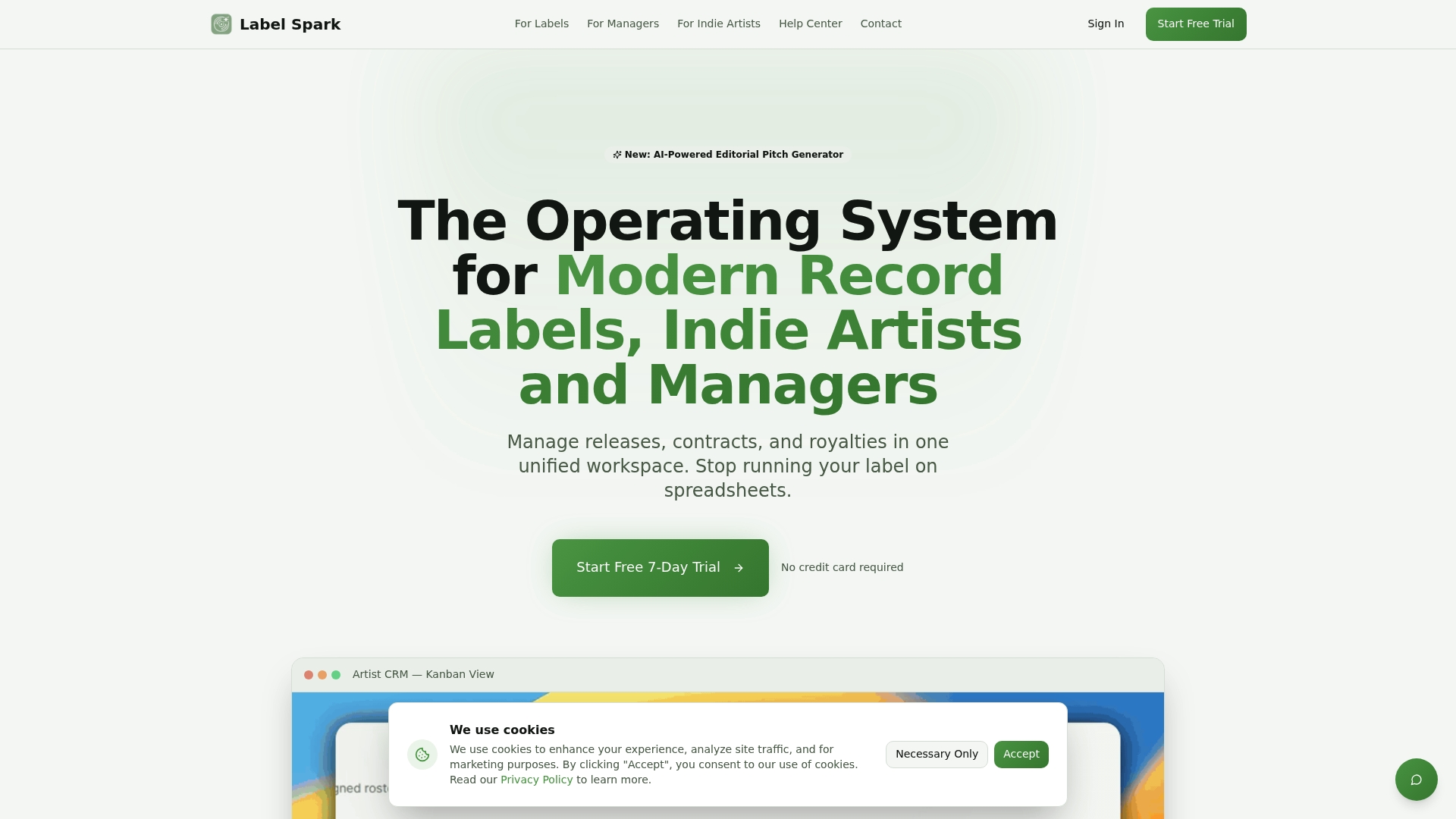
Label Spark lists an Indie Manager plan at $29/month and a Label Pro plan at $99/month. The platform combines release scheduling, contract signing, and royalty waterfalls into one environment for labels and managers. That concentration of label operations replaces multiple spreadsheets and scattered email threads with a single workspace.
Core features
Label Spark centralizes tools a small label typically keeps in separate apps.
- Visual release pipelines with Kanban and Gantt views for planning release dates and tasks.
- Contract management with legally binding electronic signatures and a self service artist onboarding portal.
- Royalty waterfall tracking and recoupment management that maps splits and advances.
- Artist CRM for relationship tracking and demo submission portal with waveform previews and status updates.
- Influencer and venue management modules, team task controls with granular permissions, and an asset vault for version controlled media storage.
- Financial dashboards for income, expenses, and royalty splits plus an AI powered editorial pitch generator.
Key differentiator
Label Spark focuses on replacing a label’s operational stack with one package. Its strength is the mix of visual workflows, permissioned team collaboration, and AI powered pitch generation bundled at flat monthly rates. That combination leans toward users who want fewer moving parts rather than stitching many single purpose tools together.
Pros
-
All in one management approach reduces the need to switch between spreadsheets and email. This lowers administrative friction for small teams.
-
The visual release pipelines make schedules and bottlenecks obvious. Managers can move items across stages instead of emailing task updates.
-
The platform includes royalty waterfall tracking, which keeps splits and recoupment calculations in one place. That can cut reconciliation work each month.
-
Built in electronic contract signing and a demo portal simplify artist onboarding. You can collect signatures and demo feedback without extra services.
-
Pricing tiers cover solo managers and larger teams, and the vendor states there is no revenue sharing. That keeps royalties with the label or artist.
Cons
-
There are no third party user reviews available for validation of real world reliability. That lack of external validation raises due diligence work for buyers.
-
The feature set is broad and can feel complex for users who only need simple release tracking. Smaller teams may face a learning curve.
-
Pricing could be restrictive for solo artists who only need lightweight tools. The value only appears once you use multiple modules.
When it may not fit
Label Spark may not fit if you only need a basic release calendar and prefer free or low cost tools. It also may overdeliver for artists who avoid team collaboration features. Teams that require many specialized third party integrations will find the platform has no required integrations and may lack certain niche connectors.
Who it’s for
This product fits independent label managers, small to medium music teams, and solo artists who want professional grade operations under one roof. It suits users who handle contracts, royalties, and release campaigns and who prefer a single system to manage those tasks. If you run multiple artist rosters, the permissioning and financial dashboards will be useful.
Real world use case
A small independent label uses Label Spark to map a three month release pipeline across marketing, distribution, and clearance tasks. The label collects electronic signatures for licensing, calculates splits in the royalty waterfall, and stores masters in the asset vault. That workflow replaced several spreadsheets and cut back on status update emails.
Pricing
Plans start at $29/month for the Indie Manager tier and $99/month for Label Pro. The vendor advertises add on storage options and emphasizes no required integrations or revenue sharing. Expect storage add ons to affect final monthly cost.
Website: https://labelspark.com
Comparison of alternatives
Independent musicians face diverse needs when selecting tools for managing creation, distribution, and promotion. Comparing available platforms helps reveal the most effective choice based on specific priorities.
Analytical subsection 1: integration
Upncomer excels by integrating AI-driven tools for distribution, mastering, analytics, and marketing within a single system. This enables users to save time and costs by reducing reliance on separate vendors. Competitors like Artist Results focus instead on rights management and centralized dashboards but lack integrated AI workflows. While this integration is advantageous for independent users managing their work alone, specialized teams might prefer separate, more focused tools for each domain.
Analytical subsection 2: target audience support
ORPL provides a competitive alternative by emphasizing promotional capabilities such as playlist pitching, AI content creation, media outreach, and a built-in website builder. These features make it advantageous for users with a strong emphasis on enhancing visibility and audience engagement. By comparison, MNGR focuses on operational management, offering tools for finance tracking and task coordination. Consequently, the choice between these platforms largely depends on whether an artist prioritizes promotion or broader administrative functionality.
Best fit
- Self-managed independent artists who want affordable access to AI-driven release tools will benefit from Upncomer.
- Teams with a focus on enhancing audience visibility and leveraging promotional content should explore ORPL.
- Music managers requiring consolidated operations and visualization tools for managing multiple clients will find MNGR beneficial.
- Labels needing detailed contract and artistic relationship management tools paired with financial dashboards should consider Label Spark.
- Venues or collaborative creators emphasizing media cataloging and royalty tracking may appreciate Artist Results.
Our pick
For independent artists prioritizing centralized campaign management and cost-effective tools, Upncomer is recommended. Its AI-assisted automation addresses common distribution, marketing, and mastering challenges within a single subscription. However, artists focusing on specific goals like extensive promotional campaigns or financial management might find alternatives like ORPL or MNGR better suited to their immediate needs, based on the comparison provided.
Here is a comparison table to help identify the best music artist management software for your needs.
| Product | Core Feature | Key Differentiator | Pricing | Notable Limitation |
|---|---|---|---|---|
| Upncomer | Integrated distribution, marketing, mastering | AI-enabled workflows | $27/month Pro plan | Some features are pending rollout |
| ORPL | Combined release and marketing management | Playlist inclusion service | Starting at ₴399/mo | User support and satisfaction concerns |
| Artist Results | Asset and rights tracking with EPK creation | Focused on rights/task management | $15.99/month | Reported inconsistent promotional service outcomes |
| MNGR | Comprehensive operations dashboard | Broad task and finance tracking | $19/month Solo | Some reviews note service unreliability |
| Label Spark | Comprehensive label management toolkit | Royalty waterfall tracking | $29/month Indie Manager | Complexity may be overkill for simpler needs |
Simplify your music career with Upncomer
The article highlights the challenge independent artists face juggling multiple tools for distribution, marketing, mastering, and analytics. These fragmented workflows often burn artists out before real growth can happen. Upncomer solves that by bringing every essential independent artist tool into one AI-powered operating system. This means you can manage music distribution, playlist pitching, ad campaigns, fan engagement, streaming analytics, and even AI mastering all from a single platform designed just for DIY musicians.
Stop wasting time switching between confusing vendors and start making smarter, data-driven decisions with Upncomer’s streamlined workflows and real-time audience insights. Artists keep 100% of their royalties while accessing the kind of support usually reserved for label-backed acts.
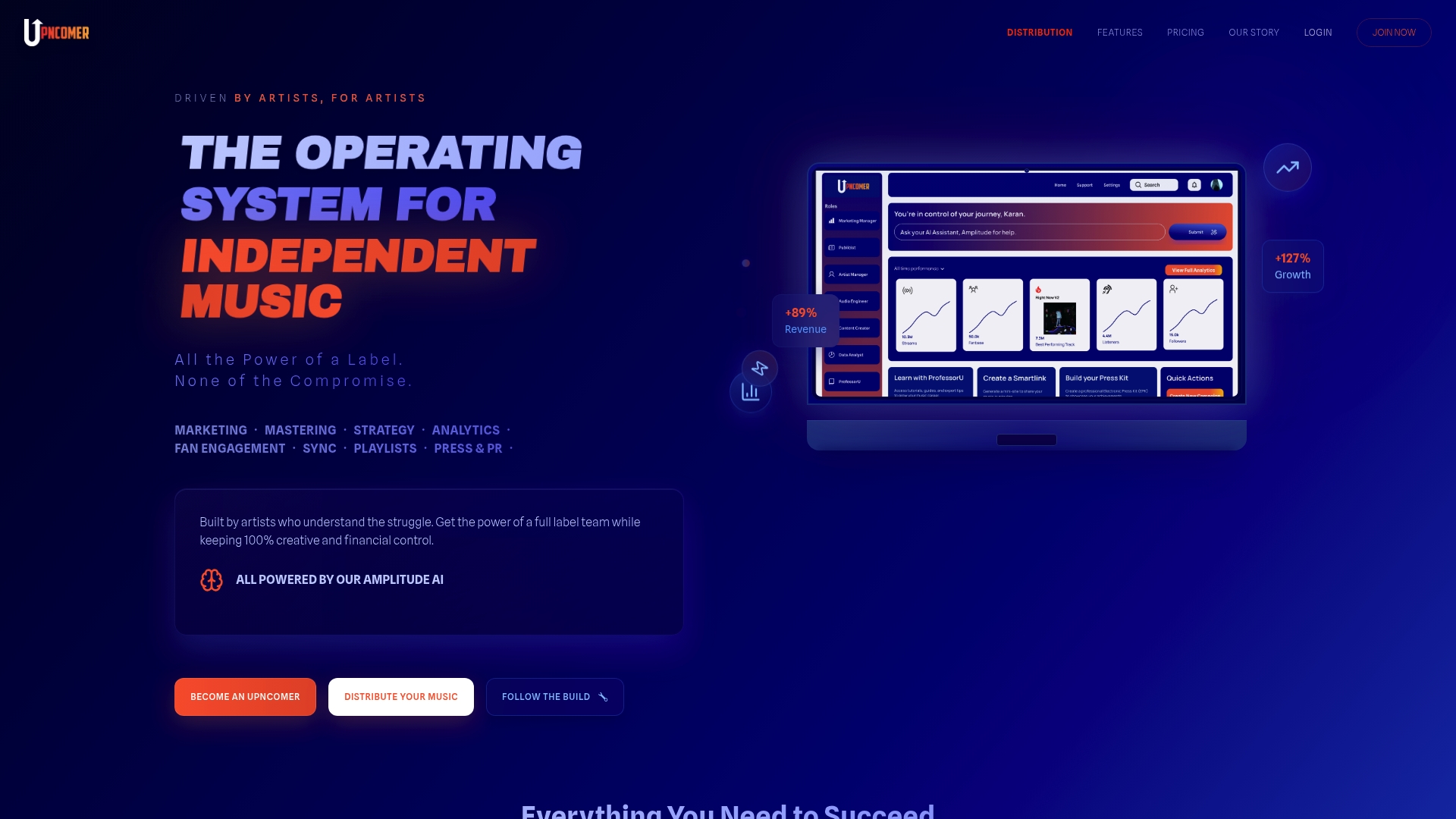
Discover how to cut the overhead of managing scattered services and focus on your music. Visit Upncomer to explore AI-driven music marketing tools and launch your next release with confidence. Import your tracks and watch your streams grow with integrated campaign management today.
FAQ
What features make Upncomer stand out for independent artists?
Upncomer excels with its AI-powered distribution, allowing independent artists to release music across hundreds of platforms seamlessly. This feature simplifies the release process while also providing tools for marketing, mastering, and analytics in one place. Artists can leverage these capabilities to grow their fanbase effectively.
How does Upncomer compare to ORPL in terms of promotion and distribution?
ORPL offers strong playlist pitching and promotional services, appealing especially to artists who prefer dedicated media outreach. However, Upncomer’s integrated AI-driven automation covers distribution and marketing within a single platform, making it more efficient for artists looking to streamline their efforts without juggling multiple tools.
Can i find affordable music artist management tools like Upncomer?
Yes, Upncomer’s Pro plan starts at $27 per month, which is relatively low compared to hiring a full marketing or management team. This pricing enables independent musicians to access essential tools without overspending, facilitating their music distribution and promotion efforts.
What limitations should i be aware of with Upncomer?
Artists should note that while Upncomer provides many powerful features, some tools, like advanced press outreach and certain content modules, are still labeled as coming soon. Users might need to consider these limitations when planning their campaigns.
How can Upncomer assist with my release planning?
Upncomer includes real-time analytics and audience insights, enabling artists to adjust their campaigns based on immediate feedback. This data can help in making informed decisions during release planning, maximizing engagement and reach.
Which platform is better for comprehensive artist management: Upncomer or artist results?
Artist Results focuses on features like EPK creation and rights management, valuable for artists needing in-depth marketing support. Yet, Upncomer provides a broader array of tools in one interface, facilitating a more integrated and convenient management experience for independent artists.