Why Artist Managers Track KPIs to Grow Careers

Most people assume artist management runs on instinct, connections, and hustle. And sure, those things matter. But the managers who consistently build sustainable artist careers? They run on data. Specifically, they track key performance indicators, or KPIs, to measure what’s actually working. Understanding why artist managers track KPIs is the difference between reacting to problems after they’ve already cost you and catching them early enough to change course. This article breaks down exactly what KPIs mean in a music industry context, which ones matter most, and how to build a system that turns numbers into decisions.
Table of Contents
- Key Takeaways
- Why artist managers track KPIs: the real reason
- The KPIs that actually matter in artist management
- Common pitfalls in KPI tracking
- Integrating KPI tracking into daily management workflows
- My take on what KPIs actually changed in how I work
- How UpNComer makes KPI tracking practical for music teams
- FAQ
Key Takeaways
| Point | Details |
|---|---|
| KPIs replace guesswork | Tracking performance indicators gives managers objective signals instead of gut feelings alone. |
| Financial KPIs protect margins | Metrics like Gross Margin and CLV:CAC reveal whether the artist’s career is actually profitable. |
| Vanity metrics mislead | High follower counts mean nothing without conversion data tied to real business goals. |
| Review cadence drives action | Weekly, monthly, and quarterly KPI reviews create a culture of proactive decisions, not passive reporting. |
| Tools reduce manual tracking | Platforms with built-in dashboards and analytics make KPI monitoring practical at any team size. |
Why artist managers track KPIs: the real reason
KPI stands for key performance indicator. The word “key” is doing a lot of work there. Not every number you can pull from Spotify for Artists or an email platform qualifies. A genuine KPI is a metric that is directly tied to a specific business or career goal, and it tells you whether you are on track or off track in a way that lets you do something about it.
There is an important distinction between raw metrics and actual KPIs. Monthly listeners is a metric. Monthly listener growth rate, measured against a target tied to your next label pitch or booking fee negotiation, is a KPI. The difference is context and intention.
Artist managers use KPIs to do four things that gut instinct simply cannot do reliably:
- Track financial health. Are revenue streams growing? Is the management commission sustainable relative to the cost of running operations?
- Monitor fan engagement. Are streams converting to superfans? Is the audience growing in the right markets for the artist’s touring strategy?
- Measure operational efficiency. How much time is spent on billable versus non-billable management work? Are campaigns delivering return on investment?
- Create accountability. KPIs provide a shared language across everyone involved in an artist’s career, from agents to publicists to label partners, so everyone knows what success looks like and where gaps are appearing.
That last point is underrated. When a manager walks into a meeting with an agent or a label A&R, speaking in KPIs rather than vibes changes the entire dynamic. You become someone who can prove artist momentum, not just describe it.
Understanding the components of artist development that drive measurable outcomes is where the KPI conversation starts.
The KPIs that actually matter in artist management
Not all KPIs deserve equal attention. Below is a breakdown of the categories artist managers should be monitoring, with real context on what benchmarks mean in practice.
Financial KPIs
| KPI | What it measures | Why it matters |
|---|---|---|
| Gross Margin % | Revenue minus direct costs, as a percentage | Shows whether management operations are actually profitable |
| Customer Acquisition Cost (CAC) | Cost to sign and onboard a new artist client | CAC targets below $500 are considered healthy for music marketing operations in 2026 |
| CLV:CAC Ratio | Lifetime value of an artist vs. cost to acquire them | Ratios above 3:1 signal a business worth scaling |
| Average Revenue Per Client | Total revenue divided by active artist roster | Helps managers decide when to grow the roster vs. deepen existing relationships |
The CLV:CAC ratio is one that most artist managers overlook entirely. If you spend $2,000 in time, tools, and pitching to land a new artist client, but that artist generates $15,000 in commission over three years, your ratio sits at 7.5:1. That is a strong business. But if the same spend lands an artist who generates $1,800 before leaving for a bigger management company, you have a problem that no amount of new signings will fix long-term.
Operational and engagement KPIs
Billable Utilization Rate measures what percentage of your management team’s time actually drives revenue. If your team spends 60% of their hours on admin, chasing invoices, or coordinating logistics that a tool could handle, that is a KPI screaming for process changes.
On the fan side, track playlist adds and save rate alongside monthly listener numbers. A track with 500,000 streams but a 2% save rate suggests casual listeners, not a building fanbase. A track with 80,000 streams and a 12% save rate? That is an artist building real retention. The Spotify for Artists dashboard gives you the raw data. Your job is to turn it into a KPI tied to a specific growth target.

Pro Tip: Set a review trigger, not just a review date. If your playlist save rate drops below a threshold you define in advance, that triggers an immediate conversation about the next release strategy. Don’t wait for the monthly review to notice a trend that’s already two weeks old.
Common pitfalls in KPI tracking
This is where most management teams fall apart. They either track too many numbers, track the wrong ones, or collect data and do nothing with it.
The most common trap is vanity metrics. Follower counts, total stream numbers, and social media impressions feel like success until you ask the “So what?” test. If a metric cannot directly inform a decision, it is not a KPI. Effective KPI design starts with business questions, not data availability. Ask “What decision will this help me make?” before adding any indicator to your dashboard.
Here are the most damaging mistakes and how to sidestep each one:
- Tracking too many KPIs at once. Human cognition has real limits. Research on decision-making shows cognitive limits restrict focus to roughly 5 to 9 meaningful chunks of information. If your management dashboard has 40 metrics, it has zero KPIs.
- No ownership assigned. A KPI without a named person responsible for it is just a number. KPI ownership means someone is accountable for interpreting the signal and coordinating the response when something shifts.
- Relying only on lagging indicators. Stream counts and royalty statements tell you what already happened. Only 11% of organizations use process KPIs that predict future performance. Mix in leading indicators like pre-save numbers, email list growth rate, and ad click-through rates to catch problems before they become losses.
- No defined thresholds. A KPI without a target is not a KPI. Define what “good” looks like and what triggers a review or pivot.
Pro Tip: Audit your current tracking setup once a quarter. For every metric you review, ask: “Did this change how we acted in the last 90 days?” If the answer is no, cut it.
Integrating KPI tracking into daily management workflows
Knowing which KPIs to track is half the job. Building a system that keeps them visible and useful is the other half.
Here is a review cadence that works in practice:
- Weekly operational check. Review fan engagement, ad campaign performance, and any active campaign metrics. This is where you catch anomalies early.
- Monthly financial review. Go through Gross Margin, CAC, Average Revenue Per Client, and any outstanding invoices or delayed payments. Compare against targets set at the start of the quarter.
- Quarterly strategic review. Step back and look at CLV:CAC, roster health, and whether the overall business is tracking toward its annual goals. This is the meeting where you decide to add artists, cut underperforming campaigns, or shift focus markets.
The structure matters because KPI management as a strategy-to-action framework only works when reviews are consistent, not reactive. Data collected but never reviewed is just noise.
One often-missed element is how you communicate KPI results to your artists. Most artists are not numbers people, and throwing a spreadsheet at them will not build trust. Instead, translate KPIs into career narratives. “Your save rate increased 40% this quarter, which means your fanbase is becoming stickier” lands very differently than “save rate: 8.4%.”
When presenting to agents, labels, or brand partners, lean on monitoring performance in real time as proof that you run a professional operation. Managers who show up with data get taken more seriously in negotiations.
The best dashboards are built around exceptions, not totals. A well-designed dashboard does not show you everything. It shows you what’s off. Exception-driven dashboards surface the indicators that crossed a threshold, so your team spends their energy on what needs attention rather than scrolling through green numbers that require no action. Pair this with leading and lagging indicators and you have a system that both confirms results and gives you advance warning.
My take on what KPIs actually changed in how I work
I was skeptical of KPIs for longer than I’d like to admit. There is something that feels reductive about turning an artist’s career into a spreadsheet. Music is emotional. Art is unpredictable. I used to think the best management was intuitive, responsive, and relationship-driven.
Here is what changed my mind. I watched a talented artist on a well-resourced team lose an entire touring window because nobody caught that ticket pre-sales were underperforming three weeks out. The data existed. Nobody had assigned ownership for it, and nobody had set a threshold that would have triggered a conversation. That was not a creativity problem. It was a KPI problem.
What I’ve learned is that data does not replace instinct. It sharpens it. When I look at streaming analytics, I am not trying to reduce an artist to a number. I am trying to understand where the momentum already exists so I can direct energy and budget there, rather than guessing. The artists I have seen grow fastest are the ones whose managers can walk into any room and say exactly what is working, why, and what comes next. That confidence comes from data.
The counterintuitive lesson is that tracking fewer KPIs, but owning them deeply, creates better decisions than monitoring everything. Pick five. Know them cold. Move on them fast.
— Karan
How UpNComer makes KPI tracking practical for music teams
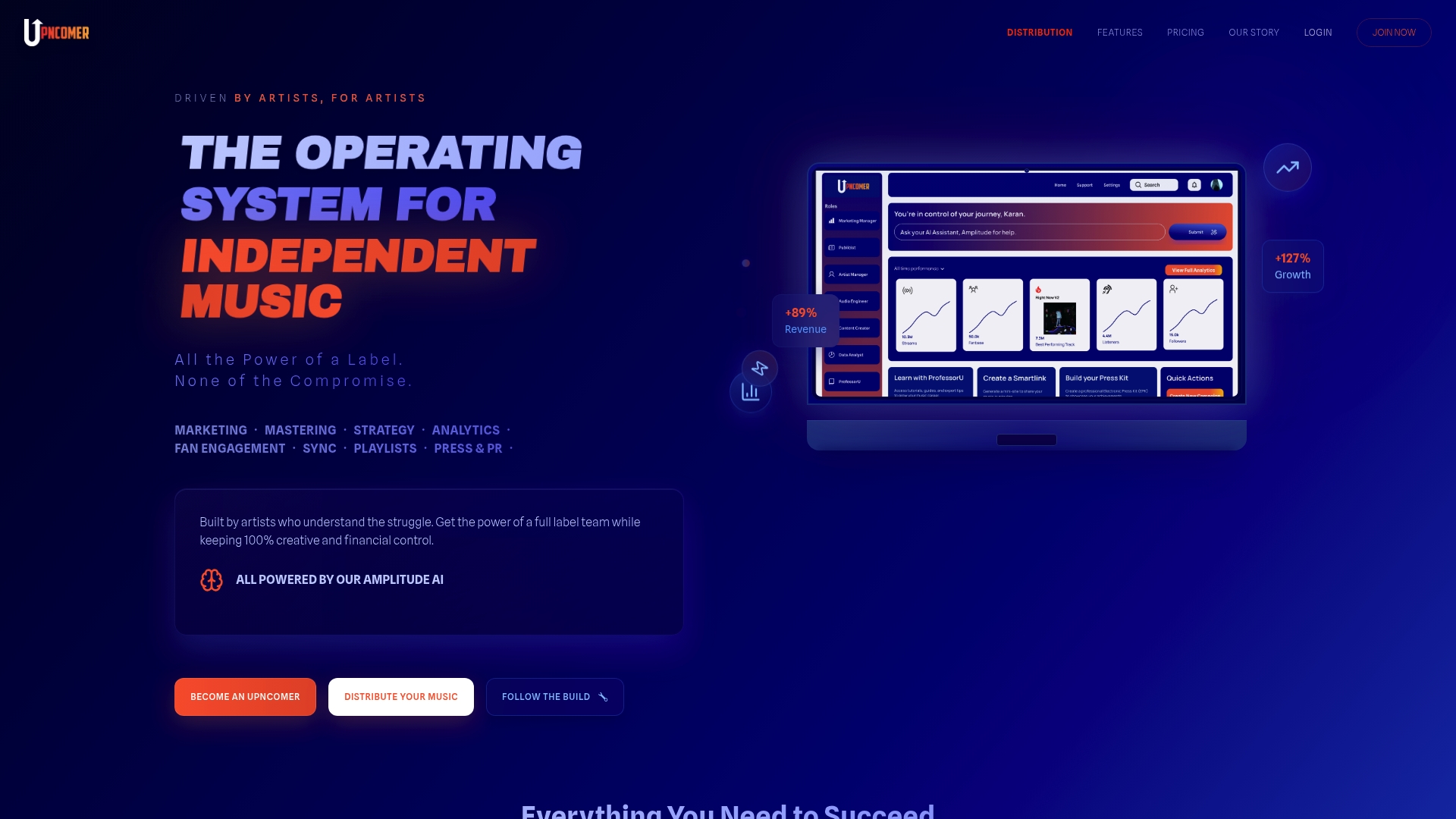
Tracking the right KPIs means nothing if your tools are scattered across five platforms and a spreadsheet. UpNComer brings streaming analytics, audience insights, ad campaign management, and workflow automation into one place designed for music teams. The Data Analyst and Artist Manager modules give you a real-time view of the metrics that actually move careers, while Amplitude AI helps you interpret what the data is telling you and what to do next. If you are ready to manage artists with the same data infrastructure that major-label teams use, UpNComer is built for that.
FAQ
What are KPIs in artist management?
KPIs, or key performance indicators, are specific metrics tied to career or business goals that help artist managers measure progress, track financial health, and make data-informed decisions about artist development and campaigns.
Which KPIs should artist managers track first?
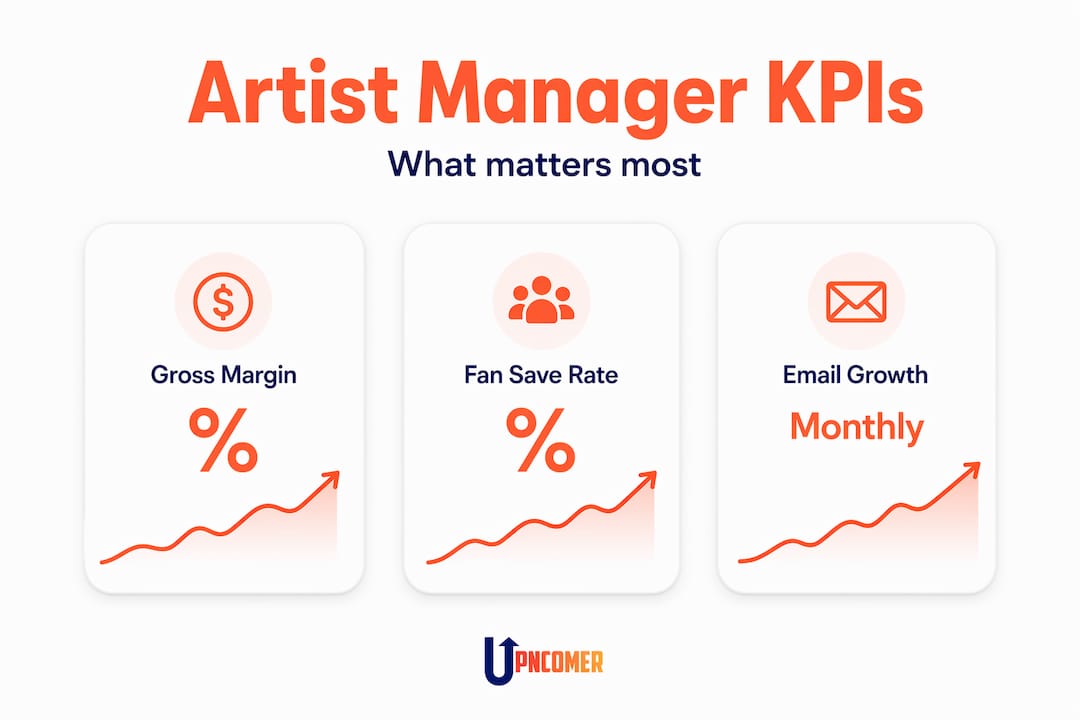
Start with Gross Margin, fan save rate on streaming, and email list growth rate. These three cover financial health, audience quality, and long-term fan retention without overwhelming your team with data.
How often should artist managers review their KPIs?
Weekly reviews work best for active campaigns, monthly reviews for financial performance, and quarterly reviews for overall business and career strategy. Regular cadence is what separates data-driven teams from reactive ones.
What is the difference between vanity metrics and real KPIs?
Vanity metrics like total follower count look good but do not drive decisions. Real KPIs answer “So what?” by linking directly to a goal and triggering specific action when they shift above or below a defined threshold.
Can small or independent management teams benefit from tracking KPIs?
Absolutely. Smaller teams actually benefit more because their resources are tighter. Tracking even three to five focused KPIs helps independent managers prioritize where to spend time, money, and creative energy for the biggest return.