Music Production Analytics: What It Is and Why It Matters

What is music production analytics?
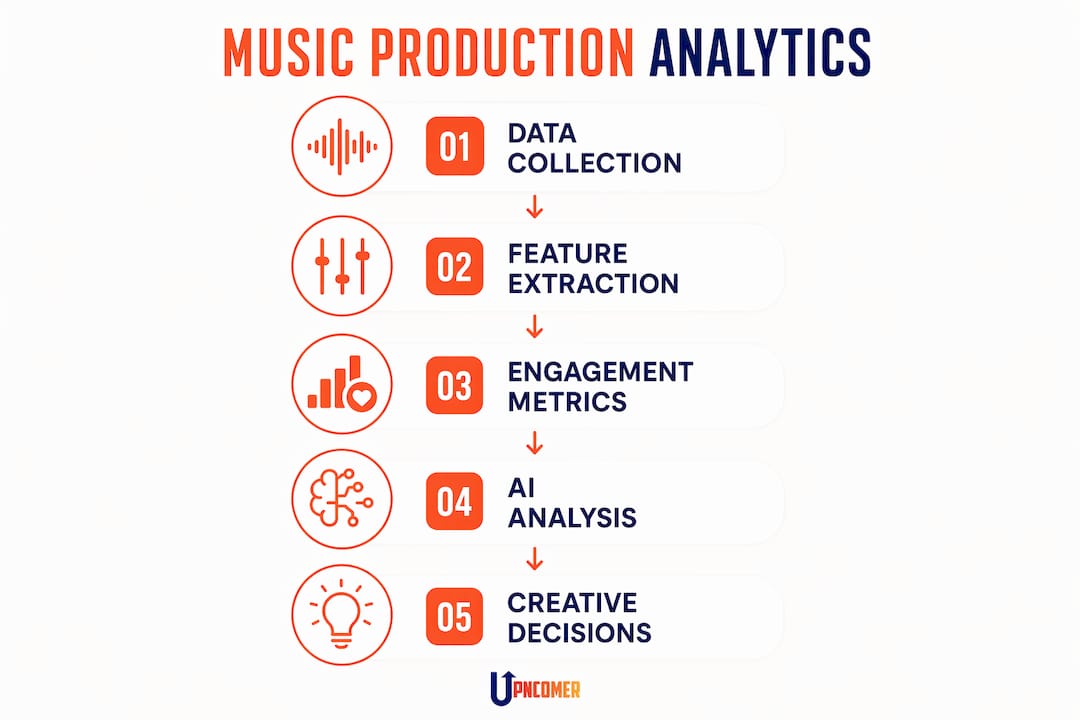
Music production analytics is the practice of using data, technology, and AI to systematically examine the creative, technical, and commercial elements of recorded music. Think of it as a feedback loop between your instincts as a producer and the measurable reality of how your music lands with listeners.
The core targets of any production analysis include:
- Emotion conveyed — how the track makes listeners feel, tracked through sentiment data and listener behavior
- Arrangement structure — how sections are organized and how they hold attention over time
- Performance nuances — timing, dynamics, and expressive qualities in the playing or programming
- Vocal qualities — tone, pitch accuracy, delivery style, and how vocals sit in the mix
- Mix decisions — frequency balance, spatial placement, loudness, and overall sonic clarity
Data sources range from streaming platform dashboards and listener feedback to AI-powered tools that detect beats, map chord progressions, and flag structural patterns. Berklee Online, one of the most respected music education institutions in the world, offers dedicated music production analysis courses that train producers to apply these frameworks systematically. On the technology side, Yamaha’s music analysis research has pushed beat detection and acoustic modeling forward, giving producers more precise tools for understanding what is actually happening inside a track.
What are the key elements analyzed in music production?
Production analysis goes deeper than just listening harder. It gives each element a framework so you know what you are actually evaluating.
- Emotion and mood — Does the track deliver the feeling it promises? Listener skip rates and repeat plays are early signals that the emotional arc is working or falling flat.
- Arrangement — Where does energy build? Where does it drop? A well-analyzed arrangement reveals whether your verse, pre-chorus, and chorus transitions are earning their place or losing momentum.
- Performance — Subtle timing variations, velocity dynamics in MIDI, and breath control in vocals all affect how human a track feels. Guided listening techniques taught in Berklee Online’s critical analysis courses train producers to hear these details intentionally.
- Vocals — Pitch, tone, reverb tail length, and presence in the mix each shape how a vocal connects. Analyzing reference tracks against your own work reveals gaps you might not catch in a single session.
- Mix decisions — Low-end clarity, stereo width, and loudness normalization all affect how a track translates across speakers, earbuds, and car stereos.
Understanding these five elements together gives you a complete picture of why a track works or where it loses the listener. No single element tells the whole story.
How do you analyze music production effectively?

The most reliable approach combines structured listening with data interpretation. A widely used framework breaks production down into four analytical layers: composition, arrangement and instrumentation, sound design and production, and mixing and mastering. Working through each layer in sequence prevents you from jumping to mix fixes when the real problem is an arrangement issue.
Practical techniques that work:
- Deep listening sessions — Listen on multiple playback systems (studio monitors, earbuds, phone speaker) and note where the track loses you
- Reference track comparison — A/B your mix against a commercially released track in the same genre to identify frequency and dynamic gaps
- Streaming metric review — Save rates and skip rates reveal listener engagement far more accurately than raw stream counts
- Listener feedback collection — Structured surveys or fan responses give qualitative context that numbers alone cannot provide
- Platform cross-referencing — Spotify’s algorithm favors newer releases over catalog tracks, so always cross-reference platform data with historical trends before drawing conclusions
Pro Tip: Set a regular analytics review date and treat it like a production session. Patterns in your data only become visible over time, not just weeks. Seasonal shifts in listener behavior and fan segment changes are the kind of insights that only show up with consistent tracking.
Engagement metrics like repeat listen rate and listener conversion rate are more predictive of long-term career growth than follower counts or total streams. Focus your analysis there.
What technology powers music production analysis?
AI has changed what is possible in music analysis. Tools can now detect beats, map chord progressions, identify song structure sections, and flag tempo variations automatically, work that once required hours of manual transcription.

| Technology | What it does | Practical application |
|---|---|---|
| Beat detection | Identifies tempo, grid alignment, and rhythmic patterns | Quantify groove and timing feel in a mix |
| Chord recognition | Maps harmonic progressions across a track | Compare your harmonic choices to genre norms |
| Song structure analysis | Labels intro, verse, chorus, bridge, and outro sections | Identify where listeners drop off |
| NLP and sentiment analysis | Reads lyrical content and emotional tone | Predict how lyrics connect with target audiences |
| Acoustic feature extraction | Measures energy, danceability, valence, and loudness | Benchmark tracks against playlist editorial criteria |
Yamaha’s music analysis technology has been particularly influential in acoustic modeling and beat detection research, contributing to the precision that modern DAW plugins and analysis tools now rely on. NLP-driven analytics analyze lyrical sentiment and correlate it with audience engagement patterns, giving producers a clearer read on whether a song’s emotional message is landing.
One important caveat: predictive models explain only a portion of what makes a song popular. Marketing timing, playlist placement, and cultural context all play roles that no algorithm fully captures. Use AI analysis as a compass, not a verdict.
How do independent artists benefit from music production analytics?
For independent artists, music analytics is the difference between guessing what your audience wants and actually knowing. The benefits are concrete.
- Identify listener segments — Demographic and geographic data reveal who is actually streaming your music, which shapes where you tour, which playlists you pitch, and how you write your next release
- Track income streams — Monitoring streaming royalties, sync placements, and direct sales together reveals which revenue sources are growing and which need attention
- Plan releases strategically — Tracking analytics consistently over months uncovers seasonal patterns and fan behavior trends that weekly snapshots miss entirely
- Improve catalog performance — Data visualization helps you spot catalog gaps and identify which moods or genres are driving your growth
- Refine your production choices — When a specific sonic texture or song structure consistently generates higher save rates, that is a signal worth building on
The key mindset shift is treating analytics as guidance rather than rules. Data tells you what happened. Your creative judgment decides what to do about it. That balance is what separates artists who grow sustainably from those who chase metrics and lose their voice.
Upncomer: an AI-powered platform for music analytics and artist growth
Upncomer is built specifically for independent artists who want the kind of data infrastructure that major labels have always had, without giving up creative or financial control.
The platform brings together tools that would otherwise require five or six separate subscriptions:
- Amplitude AI — AI-powered guidance that interprets your data and suggests next steps for growth
- Streaming analytics — Real-time performance tracking across platforms, so you see what is working as it happens
- Audience insights — Demographic and behavioral data that tells you who your fans are and how to reach more of them
- Campaign management — Ad campaign tools built for music releases, not generic e-commerce
- AI mastering via UrStudio — Professional-grade mastering without the studio booking
- Fan engagement systems — Tools for building direct relationships with your audience beyond the algorithm
- Distribution — Release management that connects to the platforms where your listeners already are
- ProfessorU — Educational resources that help you understand your data and make better production decisions
Upncomer empowers independent artists with resources that were previously out of reach for artists without label backing. The Growth Engine and Artist Manager modules handle the operational side so you can stay focused on making music.
How artists have used analytics to improve their productions
Real-world applications of music production data analysis follow a few consistent patterns worth knowing.
Artists who track save rates and skip rates across a release cycle often discover that their strongest track is not the one they expected. A deep cut with a high save rate signals a loyal listener segment worth targeting in future playlist pitching. Shifting promotional energy toward that track, rather than the obvious single, has helped independent artists secure algorithmic playlist placement they would have missed otherwise.
Producers who run reference track comparisons using acoustic feature extraction tools frequently find that their mixes are louder but narrower than the tracks they admire. Adjusting stereo width and high-frequency air based on that data produces mixes that translate better across streaming platforms, where loudness normalization levels the playing field.
Artists who centralize their music data into visual dashboards move from reactive stats-checking to proactive planning. Instead of reacting to a bad streaming week, they spot a pattern three months out and adjust their release schedule accordingly. That shift from reactive to proactive is where analytics actually changes careers.
Key Takeaways
Music production analytics works best when you combine structured listening, engagement metrics, and AI-powered tools to make creative decisions grounded in real listener behavior.
| Point | Details |
|---|---|
| Focus on engagement metrics | Save rates and repeat listens reveal true audience connection better than stream counts. |
| Use a layered analysis framework | Break down composition, arrangement, sound design, and mix separately to find the real problem. |
| Track data consistently over months | Seasonal patterns and fan behavior trends only appear in longitudinal data, not weekly snapshots. |
| Treat AI as a compass | Predictive tools guide decisions but cannot replace creative judgment or account for marketing timing. |
| Centralize your data | Visual dashboards shift you from reactive tracking to proactive release planning and artist development. |
FAQ
What is music production analytics in simple terms?
Music production analytics is the use of data and technology to analyze how a track is made and how listeners respond to it, covering everything from arrangement and mix decisions to streaming engagement metrics.
How do you analyze music production?
Start with structured deep listening across multiple playback systems, then compare your track against reference recordings using acoustic analysis tools, and review streaming metrics like save rates and skip rates to identify where listeners engage or drop off.
What are the five key elements of music production?
The five core elements typically analyzed are emotion conveyed, arrangement structure, performance nuances, vocal qualities, and mix decisions. Each shapes how a track connects with listeners.
Is learning music production analytics difficult?
The concepts are accessible once you have a framework. Berklee Online offers dedicated courses in music production analysis that teach systematic listening and data interpretation, making the process learnable for producers at any level.
How do independent artists use music production analytics to grow?
Independent artists use analytics to identify their strongest listener segments, track income streams across royalties and direct sales, plan releases around seasonal patterns, and refine production choices based on what consistently drives higher engagement.