
6 Steps to Stop Streaming Fraud for Indie Artists, No Engineering

Streaming fraud is the deliberate manipulation of play counts, listener activity, or engagement to misrepresent genuine listening intent, through bots, fake accounts, or paid guarantee schemes. The immediate move is simple: verify every distributor and promotion partner before you work with them, log all campaign activity with timestamps, and check your dashboards weekly for spikes that don’t match your actual reach. Every major DSP and distributor has a reporting channel for exactly this.
TL;DR:
- Verifying distributor identity checks and content vetting processes can prevent fraudulent streams before release.
- Regularly monitoring spikes in streams, unusual source regions, and low device diversity helps identify suspicious activity early.
- Maintaining detailed records of campaigns, timestamps, and promotional contracts facilitates swift evidence collection and escalation.
- Automated fraud detection relies on multiple signals and machine learning models, but human review remains essential to avoid false positives.
- Contact your distributor immediately with collected evidence if you suspect streaming fraud, and ensure the reporting route is confirmed.
Table of Contents
- Common Forms of Streaming Fraud to Watch For
- How Platforms and Distributors Detect Fraud
- Pre-Release and Promotion Checklist for Artists and Managers
- What Distributors, DSPs, and the Industry Are Doing About It
- An Artist-Facing Workflow for Monitoring, Triage, and Evidence
- Immediate Escalation: What to Send and Who to Contact
- Why a Prevention-First Culture Matters More Than Fast Fixes
- An Integrated Way to Centralize Monitoring and Evidence
- FAQ
- Sources
Common Forms of Streaming Fraud to Watch For
Fraud shows up in a handful of recognizable patterns, and knowing them helps you spot trouble before it tanks your royalties or your algorithmic standing.
- Bots and streaming farms: automated scripts or farmed devices repeat-play tracks to inflate counts artificially.
- Fake account networks: batches of accounts created solely to stream, follow, or save tracks without real listeners behind them.
- Account takeover and credential stuffing: stolen logins used to stream tracks the real account holder never chose.
- Password sharing and playlist farming: shared credentials or coordinated playlist adds that create engagement with no organic audience behind it.
- AI-generated reuploads: duplicate or synthetic tracks uploaded to siphon streams meant for the original.
Each of these distorts two things at once: your royalty payout, because Spotify excludes detected artificial streams from royalty calculations, and your recommendation signals, because algorithms read fake engagement as a false read on what listeners actually want. That second effect often hurts more than the first. A track that gets flagged can lose its spot in algorithmic playlists long after the fraudulent streams themselves are removed.
How Platforms and Distributors Detect Fraud
Detection systems rarely rely on one signal. They layer several together: device and encoding counts, session length patterns, and license acquisition heuristics similar to what streaming engineering teams use to spot anomalies when clean labeled data is scarce.
- Device and distinct-encoding counts flag when too many plays trace back to too few unique sources.
- Session patterns catch streams that start and stop in ways no real listener behaves.
- Account-level analysis gets compared against track-level analysis, since a spike on one song versus a spike across an entire account tells a different story.
That comparison matters because track-level anomalies can produce false positives. A single viral moment, a sync placement, or a surprise playlist add can look statistically identical to manipulation if the system only checks one layer. This is why detection increasingly combines rule-based heuristics with machine learning and why those models need regular retraining. Research on online fraud detection shows that static models degrade as fraud tactics evolve, a problem called concept drift, and recommends drift detectors like ADWIN and DDM paired with incremental retraining to keep accuracy from decaying over time.
Because no detection system is perfect, human review has to happen before any punitive action. Automated flags are a starting point for investigation, not a verdict, and that gap is exactly why keeping your own records matters so much once you reach the escalation stage.
Pre-Release and Promotion Checklist for Artists and Managers
Most fraud problems get easier to solve, or avoid entirely, when you build a few habits into your release process before a single stream happens.
- Choose distributors that run KYC and content vetting. IFPI’s Streaming Integrity Initiative frames identity verification and content checks as baseline distributor responsibility, so ask directly how a distributor screens new uploads.
- Verify reporting channels before you need them. Confirm the current DSP and distributor contact routes now, since channels change and you don’t want to be searching during a crisis.
- Require transparency from any promo or playlist service. Ask for written deliverables and a clear process, and treat any guarantee of streams or placement as a hard no.
- Record everything. Save metadata, contributor credits, campaign spend, influencer contacts, and timestamps for every promotional push, ideally using a release checklist you reuse for every drop.
- Set baseline metrics per territory. Know what normal looks like for your audience so a spike in an unfamiliar region actually means something.
- Harden your accounts. Unique passwords, multi-factor authentication, and regularly signing out of old sessions close the door on account takeover.
Pro Tip: Build your promo documentation habit around one rule: if you can’t produce a timestamp and a contract for a campaign, you can’t defend it later.
Vetting playlist services deserves extra attention, since that’s where guaranteed-placement offers tend to surface. Our guide to playlist pitching best practices covers what legitimate curator outreach actually looks like, which makes it easier to spot the fakes.
What Distributors, DSPs, and the Industry Are Doing About It
The industry has started treating distributors as the front line against manipulation, not just DSPs. IFPI’s Streaming Integrity Initiative lays out five commitments distributors are expected to follow:
- Know your customer through identity verification.
- Vet content before it goes live.
- Act on detected manipulation quickly.
- Share intelligence across the industry where legally possible.
- Measure and continuously improve anti-fraud systems.
When platforms catch fraud, the usual consequences include excluding the fraudulent streams from royalty calculations, pulling tracks from playlists, and issuing warnings or fees to the distributor involved, a pattern Spotify documents in its own artificial streaming guidance. Distributors that actively alert on suspicious activity and run cross-platform checks also make it harder for bad actors to simply hop from one DSP to another after getting caught.
An Artist-Facing Workflow for Monitoring, Triage, and Evidence
You don’t need an engineering team to run a basic fraud-monitoring routine, you just need a consistent checklist.
Track these signals weekly:
- Sudden spikes in streams with no matching promotion or press activity.
- Unusual source or territory breakdowns, especially regions with no fan base history.
- Low device diversity on a track that’s supposedly trending broadly.
- Session lengths that don’t match how people actually listen to your genre.
When something looks off, triage fast: snapshot your dashboard, export the relevant CSVs, gather any promo contracts and their timestamps, and pause the suspect campaign while you investigate. Automated anomaly scores are a useful trigger, but they still need a human look, since the same concept drift that challenges large-scale detection models means a score that was reliable last quarter might misfire today.
Pro Tip: Keep your analytics, campaign records, and distribution history in one place. When everything lives in separate spreadsheets and inboxes, evidence collection turns a one-day problem into a one-week one.
This is where having your streaming analytics, campaign records, and distribution data connected genuinely saves time during an investigation, rather than during normal operations.

Immediate Escalation: What to Send and Who to Contact
Once you suspect fraud, move fast and document everything.
- Export your analytics with full timestamps and user-agent or source breakdowns, plus screenshots of the anomaly.
- Pull invoices and deliverables from any third-party promo vendor involved in the campaign.
- Contact your distributor first with that evidence packed together, since they’re positioned to escalate to the DSP directly.
- Use the DSP’s current reporting route, and confirm the channel before sending anything, since addresses and forms change.
- Preserve your chain of custody on every file in case the case escalates further.
For large-scale or clearly criminal operations, rights enforcement bodies or law enforcement may need to get involved, particularly when the scale suggests organized fraud rather than a one-off bad actor.
Why a Prevention-First Culture Matters More Than Fast Fixes
Prevention beats cleanup every time. Catching fraud after the fact costs you royalties, reputation, and algorithmic trust that’s slow to rebuild. Assign someone on your team, even if that’s just you, to own monitoring, account security, and vendor vetting as an actual responsibility rather than an afterthought. Favor promotion that builds a real audience over any offer that guarantees numbers.
— Karan
An Integrated Way to Centralize Monitoring and Evidence
Running prevention manually across spreadsheets, email threads, and three different dashboards is where most independent teams lose time they don’t have. We built a platform designed to close that gap: with distribution workflows supporting KYC-friendly verification, analytics dashboards surfacing spikes and territory anomalies worth investigating, and campaign records keeping promo contracts, spend, and timestamps in one searchable place instead of scattered across tools.
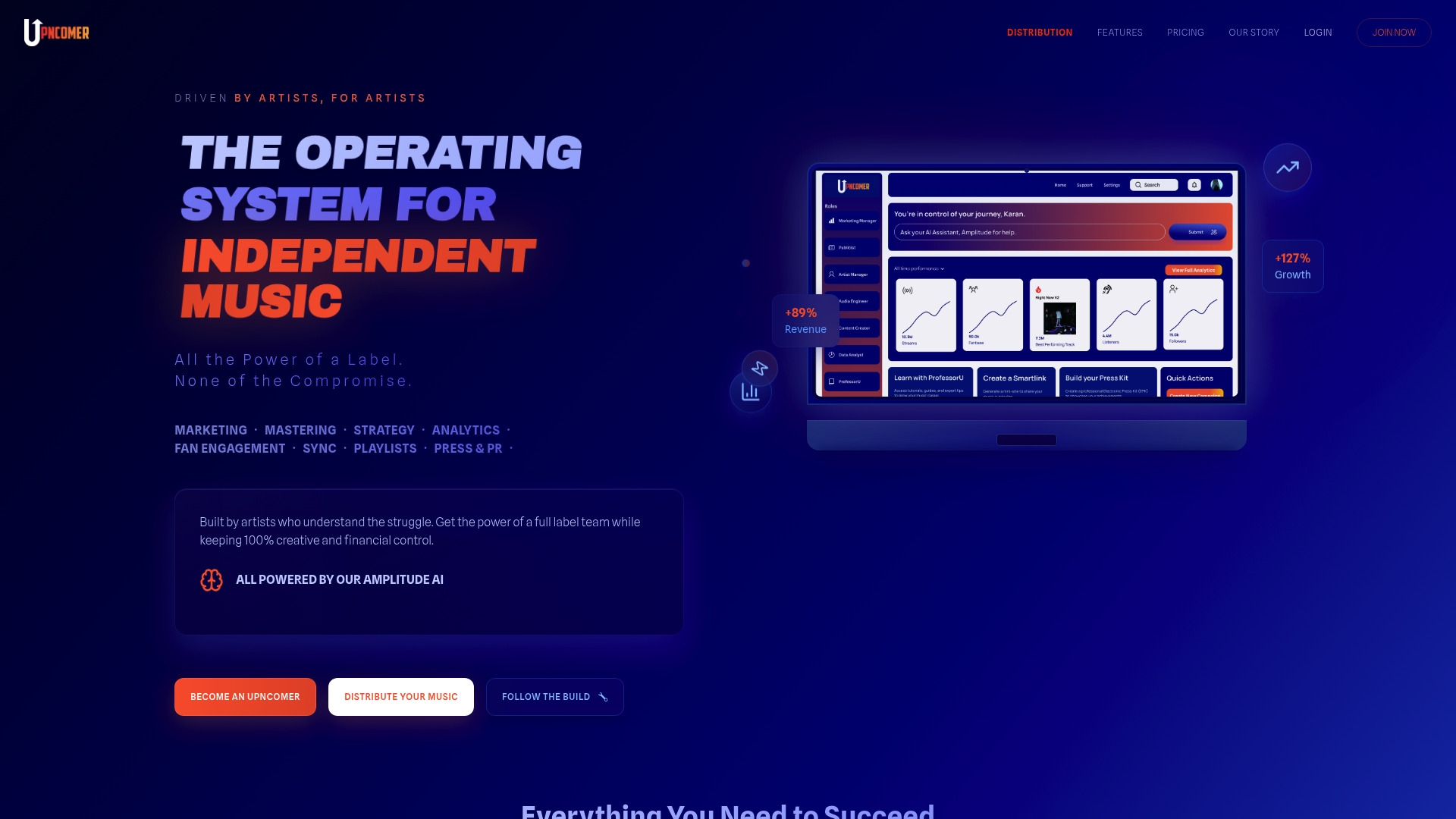
Amplitude AI adds context on top of that data, flagging patterns worth a second look so you’re not staring at raw numbers alone. If centralizing your monitoring and evidence trail sounds useful, check out UpNComer Pro and see how the modules fit your release workflow.
FAQ
How many streams does it take to make $10,000?
Payout rates vary widely by platform, listener location, and subscription tier, so there’s no single stream count that applies to every artist. Royalty calculations also exclude any streams flagged as artificial, which is one more reason clean, organic numbers matter more than raw volume.
Can Spotify detect fake streams?
Yes. Spotify defines artificial streaming as streams that don’t reflect genuine listening intent and uses detection systems to identify and exclude them from royalty payouts, with penalties that can extend to the distributor or the track itself.
What is the 10/80/10 rule for fraud?
This isn’t a recognized industry standard in streaming fraud prevention, and definitions of it vary depending on where you encounter it. If you see it referenced as an official framework, treat it skeptically and rely on documented sources like IFPI and IMPALA guidance instead.
How do I report suspected streaming fraud?
Start with your distributor, since they can escalate directly to the DSP with your evidence attached. IMPALA’s guidance for members recommends preserving your evidence and confirming the current reporting channel before sending anything, since routes can change.
What are common signs a promotion service is fraudulent?
Any service that guarantees a specific stream count or playlist placement in exchange for payment is a red flag, since legitimate platforms treat such guarantees as violations of their terms. Ask for written deliverables and a transparent process before paying anyone for promotion.
Sources
- IMPALA — Streaming manipulation guidance for members
- IFPI — Music companies unite in new commitment to combat streaming fraud
- Spotify — Artificial streaming (Spotify for Artists)
- ROSF: Robust Online Streaming Fraud Detection with Resilience to Concept Drift in Data Streams