Music Marketing Automation for Indie Artists: 6 Weeks, No Agency

Music marketing automation turns one-time listeners into owned fans and repeatable revenue, instead of letting discovery evaporate after a single stream. The real opportunity is pairing platforms like UpNComer with the industry’s own data, including IFPI’s findings on streaming behavior and distributor guidance from Symphonic. Pick one workflow below and build a 6-week campaign around it before your next release.
TL;DR:
- Build the fan CRM and smart link before buying ads; capture email or SMS contacts before redirecting listeners to a streaming service.
- Submit campaign materials six weeks before release, with five weeks as the minimum for marketing and playlist support; late submissions limit pitching options.
- Rotate release week ads every two to three days, then send email and text alerts as soon as the music goes live.
- Test retargeting with a randomized holdout: show the campaign to 80% of the audience, leave 20% untouched, and compare conversion rates.
- Review performance weekly and require human approval before spending above a preset threshold; track cost per engaged listener and 30 day retention rate.
Table of Contents
- High-impact automation workflows to build first
- Core automation components and the minimal stack
- Campaign templates you can automate now
- Release timing: when to submit and when automation kicks in
- Testing, measurement, and the traps that waste your budget
- How UpNComer brings these automations into one system
- Balancing automation with creative authenticity
- Try an integrated platform to automate your next release
- FAQ
- Sources
High-impact automation workflows to build first
Start with the fan funnel: discovery, capture, nurture, conversion. Each stage has a specific job, and automation should carry listeners from one to the next without you manually chasing every lead.
- Discovery: short-form video clips and ad creative pointed at a smart link, not straight to a DSP.
- Capture: the smart link collects email or SMS opt-ins before redirecting to streaming.
- Nurture: a welcome sequence introduces your story, then triggered emails follow listening behavior.
- Conversion: automated offers for merch, tickets, or a deluxe release close the loop.
Two more workflows round out a starter stack:
- A content loop that batches posts, schedules them, and feeds your best-performing clips into paid amplification automatically.
- A pitching sequence that sends playlist and press submissions on a schedule, then auto-follows-up after a set number of days with no response.
If you’re a solo artist, start with the smart link and email nurture. Adding a content loop and pitching automation next can help expand your reach and engagement.
Core automation components and the minimal stack
You don’t need a dozen subscriptions to automate your marketing, but you do need a few categories covered. Here’s what each one must do:
- Ad automation: test creative variants automatically, apply audience targeting rules, and pace budget so spend doesn’t front-load into the first 48 hours.
- Fan CRM: capture email, SMS, and DM contacts in one place, then segment by engagement level, not just by platform.
- Smart links and pre-save tools: collect contact info at the point of discovery, before the listener reaches a DSP and forgets you exist.
- Analytics: cohort analysis and listening-pattern tracking that shows which songs, cities, or playlists are driving repeat listens, not just raw stream counts.
- Playlist and press pitching automations: submission tracking tied to your release timeline, so pitches go out on schedule instead of the week before release.
Pro Tip: Build your fan CRM before you spend a dollar on ads. Paid traffic sent to a page with no capture mechanism is traffic you pay for twice.
Campaign templates you can automate now
A release cycle breaks cleanly into three phases, and each one has its own automated actions.
Pre-release (6 weeks out):
- Week 6: announce the release date, open pre-save capture.
- Weeks 5 to 4: run awareness ads driving to the smart link, start content loop posting.
- Weeks 3 to 2: send nurture emails with behind-the-scenes content, retarget engaged viewers.
- Week 1: final countdown push, remind pre-savers the release is imminent.
Release week:
- Rotate ad creative every 2 to 3 days to avoid fatigue.
- Trigger a “just dropped” email and SMS blast the moment the release goes live.
- Shift ad spend toward retargeting anyone who engaged but hasn’t streamed yet.
Post-release retention:
- Automate a re-engagement sequence for fans who opened emails but didn’t convert to a stream or purchase.
- Follow with a merch or ticket offer two to three weeks after release, once initial streaming data settles.
Watch these KPIs weekly: cost per email or SMS signup, save-to-stream conversion rate, and repeat listener percentage. Early signals here tell you whether to scale the campaign or rework the creative before you’ve spent your full budget.
Release timing: when to submit and when automation kicks in
Timing determines whether your automation has anything to work with. According to Symphonic’s distributor guidance, you should submit marketing drivers and campaign materials about six weeks before release, with five weeks as the minimum for marketing and playlist support. Miss that window and your automated pitching sequence has nothing to send.
Build your checklist around these milestones:
- 6 weeks out: final mix and master delivered, artwork locked, marketing drivers submitted to your distributor.
- 5 weeks out: playlist pitches and press materials submitted, smart link live, pre-save campaign begins.
- 2 to 3 weeks out: ad creative finalized, content loop scheduled, retargeting audiences built.
- Release day: triggers fire automatically, so your attention stays on engagement rather than logistics.
Our release checklist for independent artists walks through each asset in more detail if you want a fuller rundown.
Testing, measurement, and the traps that waste your budget
Automation without measurement is just guessing faster. The single biggest trap is attributing growth to a campaign that would have happened anyway, so build in a randomized holdout: run your sequence on 80% of your retargeting audience and leave 20% untouched, then compare conversion rates between the two groups.
Prioritize owned-data conversions over vanity metrics. A spike in impressions means nothing if it doesn’t translate to email signups, saves, or streams you can trace back to the campaign.
- Review performance weekly, not monthly, so you catch underperforming creative before it burns through budget.
- Keep a human approving any spend increase above your set threshold, since automation should recommend, not decide alone.
- Track cost per engaged listener, conversion rate from listener to fan, and 30-day retention rate as your core dashboard.
Pro Tip: If you can’t trace a metric back to an owned channel (email, SMS, or a direct message list), treat it as a signal, not a result.
Industry reporting from Forbes notes that artists and teams are leaning on marketing automation and AI specifically to make this kind of accountable, data-driven testing possible at a scale a solo artist couldn’t manage manually.

How UpNComer brings these automations into one system
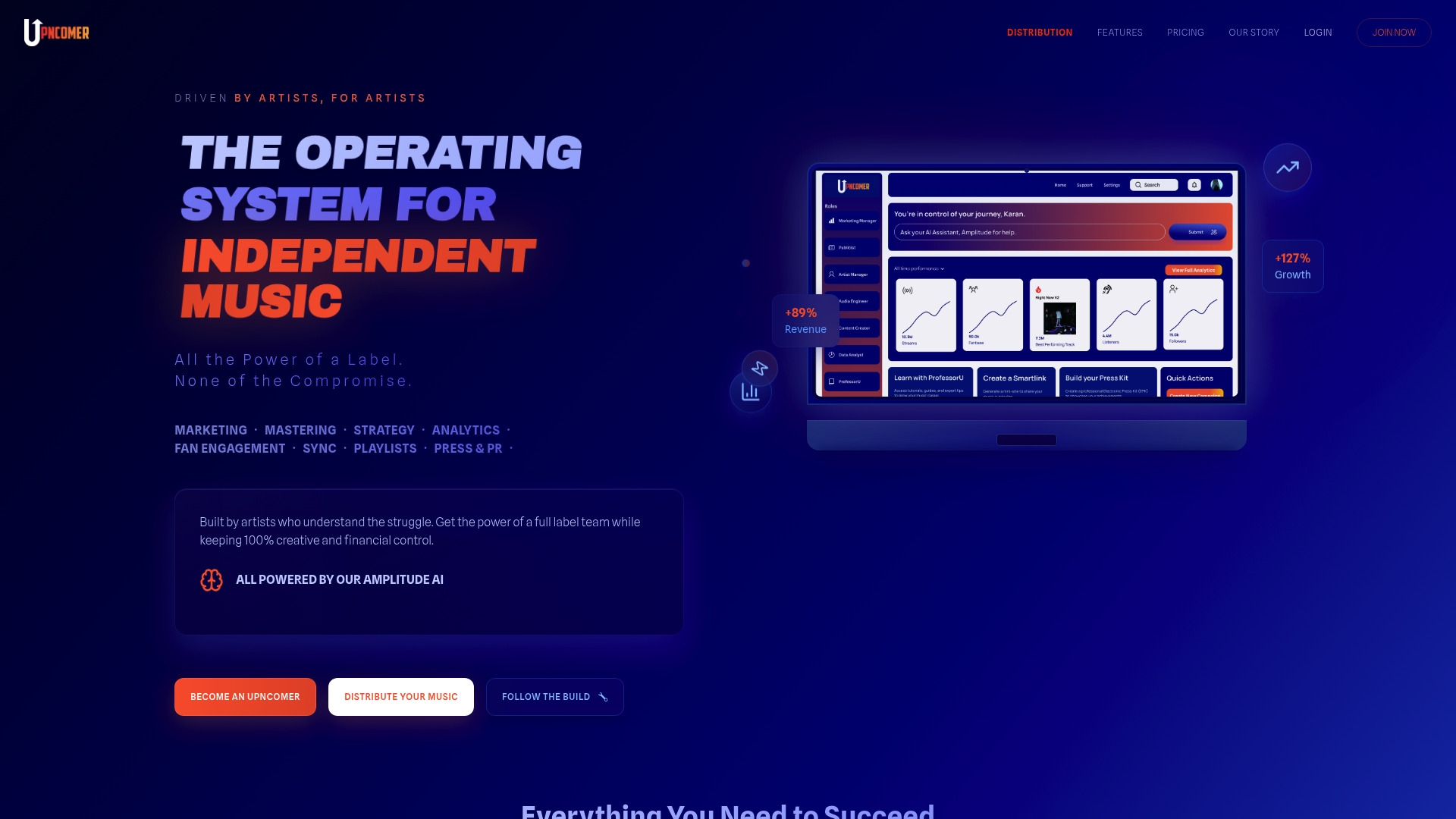
We built UpNComer so you don’t have to stitch these workflows together from five separate tools. The platform includes tools that handle ad automation, creative rotation, budget pacing, audience data analysis with targeting recommendations, release timeline coordination, retention metrics in one dashboard, and linking release metadata to marketing drivers for aligned pitching automations.
In practice, that looks like:
- Setting up a campaign once and letting it route through targeting, analytics, and follow-up sequences automatically.
- Reviewing one dashboard for cost per engaged listener instead of logging into separate ad, email, and analytics platforms.
- Adjusting a single targeting rule and having it apply across your current ad sets without rebuilding each one.
For more on building your toolkit, see our guide to music marketing tools for independence.
Balancing automation with creative authenticity
Automation should handle repetition, not your voice. The risk isn’t that automation replaces authenticity, it’s that artists let a system write their captions and lose the thread between campaigns. Keep the message yours, automate the delivery, and measure whether fans are sticking around, not just showing up.
— Karan
Try an integrated platform to automate your next release
Running a fan funnel, ad campaign, and pitching sequence across separate apps eats the time you should spend making music. We built UpNComer so a solo artist can run the same kind of coordinated campaign a label team would, without hiring one. Growth Engine and Amplitude AI handle targeting and creative testing, Artist Manager keeps your 6-week calendar on track, and Distribution connects your release metadata to your marketing drivers automatically, with no subscription fee and a 6% royalty split on distributed music.
If you’re ready to put a campaign together, UpNComer Pro starts at $27 per month or $300 per year, and you can review distribution details on our distribution page. For a grounded reminder that owning your audience list matters across creative fields, this partner piece on book marketing covers similar lessons on list-building and metadata hygiene. Set up your release in UpNComer and start your first automated campaign today.
FAQ
How can AI be used in music marketing?
AI supports music marketing by automating ad creative testing, audience targeting, and content scheduling, which lets independent artists run campaigns that would otherwise need a full team. Industry coverage from Forbes notes artists increasingly using these tools to scale promotion efficiently. Platforms like UpNComer apply this through modules such as Amplitude AI, which analyzes audience data and adjusts targeting recommendations as a campaign runs.
What are the big 4 in the music industry?
The term usually refers to the major recorded music groups that historically dominated distribution and marketing resources, though independent artists today can access comparable tools through distributors and all-in-one platforms. This article focuses on how independent artists can build equivalent automation and marketing capability without major-label infrastructure. The specific company names shift with industry consolidation, so it’s worth checking current ownership structures before citing them as fact.
How much does music PR cost?
Publicity costs vary widely depending on scope, from self-managed pitching to agency retainers, and no single figure applies across the industry. Independent artists can reduce this cost by automating playlist and press pitching sequences themselves rather than paying an agency for manual outreach. Our guide to playlist pitching best practices breaks down a self-managed approach in more detail.
How much does marketing automation cost?
Costs depend on which tools you combine, from free scheduling apps to paid ad platforms and CRM software. UpNComer Pro, which bundles ad automation, fan CRM, analytics, and release coordination into one subscription, is available for $27 per month or $300 per year. Distribution through UpNComer carries no subscription fee, with revenue shared through a 6% royalty split instead.
When should I submit marketing materials before a release?
Industry guidance from Symphonic recommends submitting marketing drivers and campaign materials about six weeks before release, with five weeks as the minimum for marketing and playlist support. This lead time gives pitching automations and ad campaigns enough runway to build momentum before release day. Missing this window limits how much playlist and press support your team can secure in time.
Sources
- IFPI Engaging with Music 2023 (full report)
- Marketing Drivers Are Now in SymphonicMS - Symphonic Blog
- As AI reshapes music, artists embrace marketing automation - Forbes