Music Ad Funnels for Indie Artists: 5 Stages, Ads, and KPIs

A music ad funnel is the structured path that moves a stranger on social media through five stages, Awareness, Interest, Consideration, Conversion, and Advocacy, until they become a fan who streams, saves, and shows up again. The highest-leverage workflow for independent artists is simple: test 1 to 2 platforms with small daily budgets, scale whatever creative wins, and use native streaming tools to close the loop. Everything below breaks that down by stage, platform, budget, and metric.
TL;DR:
- Give each funnel stage its own goal and metric, from awareness reach and cost per view to conversion saves and advocacy’s 30 day return rate.
- Choose platforms by asset: Meta or TikTok for vertical clips, YouTube for low cost awareness views, and Spotify Ad Studio for listening based conversions.
- With $300 to $500 per release, test three to five ad combinations at $10 to $15 daily, then double winners every two to three days.
- Lead with the hook immediately, use vertical video with captions, and test three to nine variants for three to five days before judging.
- Diagnose weak results before changing spend: low watch time or click rates point to creative, while clicks without saves point to the destination or offer.
Table of Contents
- The Five Fan Funnel Stages and What to Do at Each One
- Picking the Right Platform: Meta, TikTok, YouTube, and Spotify Ad Studio
- Campaign Phases, Timelines, and a Sample Budget Plan
- Creative and Targeting: What to Test and in What Order
- Measuring What Matters: KPIs, Benchmarks, and Diagnosis
- How an Artist OS Coordinates the Whole Funnel
- What Independent Artists Get Wrong About Ad Funnels
- Run Your Ad Funnel Without Juggling Five Different Tools
- FAQ
- Sources
The Five Fan Funnel Stages and What to Do at Each One
Each stage of the funnel needs its own ad objective, its own destination, and its own metric. Trying to sell a stream from someone who has never heard your name wastes budget, and trying to build brand awareness with a listener who already follows you wastes momentum.
- Awareness: objective is reach or video views, destination is a short teaser, and the metric to watch is cost per view. A 15 second Reels clip of your hook works better here than a full song.
- Interest: objective is engagement or traffic, destination is your smart link or profile, and the metric is click-through rate.
- Consideration: objective is traffic to a pre-save or Countdown Page, and the metric is landing page conversion rate.
- Conversion: objective is streams or saves, destination is Spotify Marquee or a smart link set to click-to-stream, and the metric is save rate.
- Advocacy: objective is retargeting your engaged listeners toward merch, playlist follows, or superfan offers, and the metric is 30 day return rate.
Mapping ad spend to these stages keeps you from running one generic campaign and hoping it works everywhere at once.
Picking the Right Platform: Meta, TikTok, YouTube, and Spotify Ad Studio
Each major ad platform rewards a different kind of effort, and platform choice should follow where your creative and audience already live rather than chasing whatever’s trending.
- Meta (Facebook and Instagram): strongest for controllable, interest-based targeting, and Reels or Stories ads are the go-to format for awareness and retargeting.
- TikTok: best for viral reach through Spark Ads, especially when you already have organic traction worth amplifying with spend.
- YouTube: usually the cheapest cost per view through skippable in-stream ads, which makes it efficient for pure awareness plays.
- Spotify Ad Studio: the only platform built for in-listening conversion, using audio ads, video takeovers, Marquee, and Showcase to turn listening sessions directly into saves and follows.
The practical rule is to test 1 to 2 platforms per release, not all four, and pick based on where your assets are strongest. If your best creative is a vertical clip with a visible hook, that points you toward Meta or TikTok. If your strength is the song itself, Spotify Ad Studio does more of the conversion work for you.
Campaign Phases, Timelines, and a Sample Budget Plan
A music ad funnel campaign generally runs in four phases, each with its own job and its own spend pattern, adapted from the phased budget approach many independent artists use for a single release cycle.
For a total budget of $300 to $500 per release, that works out to roughly $10 to $15 per day during the testing window, with the rest reserved for scaling whatever performs.
- Launch 3 to 5 creative and audience combinations at low daily spend during pre-release.
- Identify the top 1 to 2 performers by cost per stream and save rate once release week begins.
- Shift most of the remaining budget toward those winners and let the rest expire.
- Keep the single best-performing ad running at a reduced budget through the evergreen phase.
Scale winners by doubling their daily budget every 2 to 3 days rather than all at once, which gives the algorithm room to keep finding similar listeners without resetting its learning.
Creative and Targeting: What to Test and in What Order
Creative is the real targeting lever in most music ad accounts, and the first 1 to 2 seconds decide whether anyone keeps watching.
- Lead with your strongest hook immediately, not a logo, a build-up, or a slow intro.
- Shoot vertical 9x16 video and add captions or lyric overlays, since many viewers start with sound off.
- Produce variants covering 3 different song parts (intro, hook, bridge) so you’re testing the song, not just the edit.
- Run 3 to 9 total variants per campaign, not one or two, so the algorithm has real options to sort through.
For audience testing, move through this sequence: start with interest and artist-name seed audiences, layer in people who’ve already engaged with your content, build a lookalike from your most engaged fans, and finally retarget anyone who’s clicked, watched, or saved. Our Reels ideas for musicians collection is a useful starting point if you’re short on format ideas for the first round of testing.
Pro Tip: Run each of your 3 to 9 variants for 3 to 5 days at a daily budget in the range of $10 to $15 before judging it, since a single day of data almost never tells you anything reliable.
Measuring What Matters: KPIs, Benchmarks, and Diagnosis
Raw stream counts feel good, but retention metrics predict long-term growth far better than volume alone. The KPIs worth tracking at each stage are cost per stream, save rate, 30 day return rate, click-through rate, and cost per thousand impressions (CPM).
A save rate above a moderate threshold are a useful indicator that a track is resonating, not just getting played.
- If watch time or click-through rate is low, the creative is the problem, not the targeting.
- If people click but don’t save, the destination or the offer needs fixing, often the landing page itself.
- If every number across the board is thin, you likely need more budget or a longer learning period before judging the campaign.
This diagnostic approach, isolating targeting, creative, or budget rather than changing everything at once, comes from standard funnel diagnostics used across performance marketing, and it applies just as well to a music campaign as it does to any other product launch. Our own save rate benchmarks go deeper into what realistic targets look like by genre and audience size.
How an Artist OS Coordinates the Whole Funnel
Running five funnel stages across four platforms by hand means juggling spreadsheets, ad managers, and streaming dashboards at the same time, which is exactly the kind of fragmented workflow an integrated system is built to replace.
- Growth Engine handles audience building and campaign scheduling across the awareness and interest stages.
- Amplitude AI reads performance data and surfaces which creative or audience combination to scale.
- Distribution, smart links, and countdown tools work together to carry listeners from an ad click straight into a stream or save.
- Unified analytics keep cost per stream, save rate, and return rate in one dashboard instead of four separate logins.
That kind of coordination matters most during release week, when decisions about scaling or killing an ad need to happen daily, not whenever you find time to check five different apps. For readers who want the broader funnel framework before diving into execution, our guide to the music marketing funnel walks through the concept end to end.
What Independent Artists Get Wrong About Ad Funnels

Most artists either spread $20 across six platforms or dump their whole budget into one untested ad, and both mistakes burn money before you learn anything useful. Test narrow, scale slowly, and value a returning listener over a thousand passive impressions.
If you take one thing from this guide, set a 7 to 14 day test at $10 a day on a single platform this week and watch your save rate before you spend another dollar.
— Karan
Run Your Ad Funnel Without Juggling Five Different Tools
Everything in this guide, campaign phasing, creative testing, save rate tracking, platform selection, can be managed in one place when you build your funnel on an integrated platform. Instead of switching between an ad manager, a spreadsheet, and a separate analytics tool to see whether your release week test actually worked, we bring campaign management, streaming analytics, and distribution into a single dashboard so the diagnostic checklist above takes minutes instead of hours.
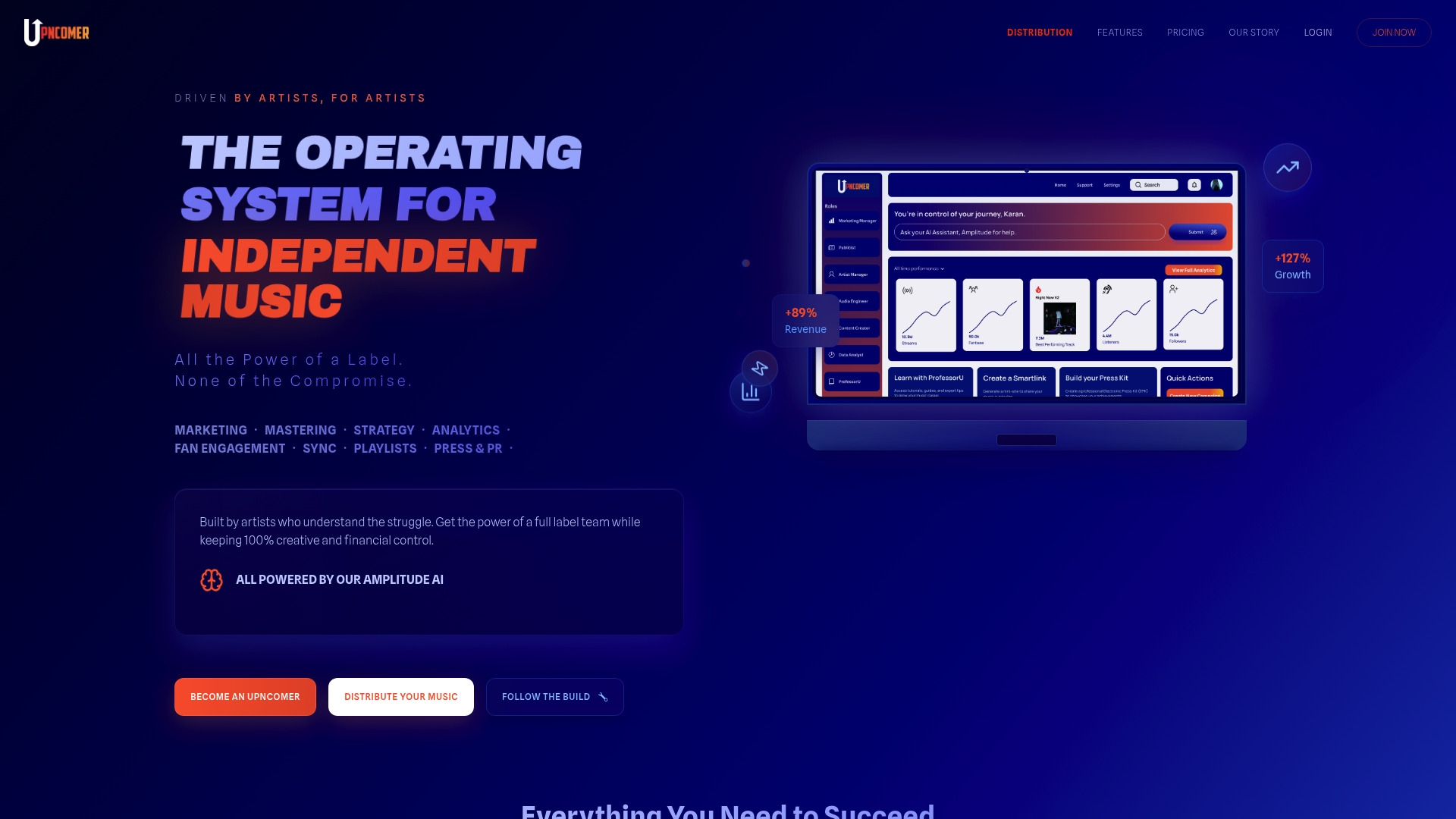
- Launch and schedule ad tests across platforms without rebuilding campaigns from scratch each time.
- Track cost per stream, save rate, and return rate in one place as your campaign moves through each phase.
- Distribute your release and generate smart links and countdown pages from the same workflow, with distribution carrying only a royalty split and no subscription fee.
If you’re ready to put this playbook into practice, check UpNComer Pro starting at $27 per month, or explore distribution to get your next release funnel-ready. Artists testing playlist placements alongside paid ads can also look at Playlist Pilot’s smart link guide for curator outreach strategies that pair well with a conversion-stage campaign.
FAQ
What is an ad funnel?
An ad funnel is a structured sequence of advertising steps that moves someone from first discovering you to becoming a loyal customer or fan. In music, that sequence maps to five stages: Awareness, Interest, Consideration, Conversion, and Advocacy, each with its own ad objective and destination.
What is the best way to advertise music?
The most effective approach is testing 1 to 2 platforms at a low daily budget, scaling whatever creative and audience combination performs, and using native streaming tools like Countdown Pages to convert interest into saves. Countdown Pages published at least 7 days before release are linked to nearly double the pre-saves compared to later publishing.
What are the 5 stages of a sales funnel?
Applied to music, the five stages are Awareness, Interest, Consideration, Conversion, and Advocacy. Each stage calls for a different ad objective, from building reach early on to retargeting engaged fans toward merch or playlist follows later.
Does the marketing funnel still exist?
Yes, the funnel concept still holds, though platforms now compress some stages together through algorithmic targeting and retargeting pools. For independent artists, thinking in stages still matters because it tells you which metric to watch and which ad objective to choose at each point in a release cycle.
How much should I budget for a music ad campaign?
A reasonable starting budget is $300 to $500 per release, split across pre-release, release week, sustain, and evergreen phases. Testing typically runs at a daily budget in the range of $10 to $15 per creative variant for 3 to 5 days before you shift spend toward the winners.
Sources
- How to market your music | Berklee Online TakeNote
- Countdown Pages – Spotify for Artists
- Best Places to Advertise Music in 2026: A Complete Guide for Independent Artists - Music24
- What’s Working with Meta Ads for Music — Passive Promotion