Ship Your Next Release: Artist Development Courses for DIY Artists

Artist development courses teach release planning, music marketing, distribution basics, streaming analytics, playlist pitching, and fan growth so you can run a measurable campaign for your next release. They work best for DIY artists, managers, and small teams who want structure instead of scattered YouTube tutorials. Pick a project-driven course tied to an actual release date, not a vague curriculum you might finish someday.
TL;DR:
- Only courses that require completing real projects, such as submitting actual playlist pitches and running campaigns, prepare artists for measurable results.
- The optimal course should include deliverables like a release timeline, campaign brief, and analytics dashboard, with evidence of work submitted or executed.
- Short, project-based courses or sprints fit artists with upcoming releases, while longer cohorts benefit those building skills for the future, depending on urgency.
- Platforms like UpNComer enable artists to execute, track, and measure campaign components directly within one system, bridging the gap between learning and action.
- Failing to run the campaigns built during the course remains the main obstacle to deriving real value from artist development education.
Table of Contents
- What good artist development courses actually teach
- How to choose the right course for your stage and schedule
- Course formats and sample syllabi
- Hands-on projects and skills to practice during or after a course
- Apply course learning to a real release: a compact mini plan
- Why UpNComer maps to course outcomes
- Different types of artist development courses and their focus areas
- Key skills and competencies developed in artist development courses
- Success stories and case studies of artists who benefited from courses
- How artist development courses integrate with broader career planning
- Potential challenges or common pitfalls in artist development courses
- Long-term artist development isn’t a sprint
- Run your course projects inside one system
- FAQ
- Sources
What good artist development courses actually teach
A course worth your time builds around deliverables, not lectures. You should walk away with a release timeline, a campaign brief, a playlist pitch you’ve actually sent, and a working analytics dashboard, not just notes.
Here’s what substance looks like in practice:
- Release planning module: produces a dated timeline from pre-save setup through post-release follow-up.
- Marketing module: results in a campaign brief covering audience segments, ad budget, and content calendar.
- Playlist pitching module: has you write and submit a real pitch, not a hypothetical one.
- Ad campaign module: walks you through building a small test cohort with a defined budget and goal.
- Analytics module: ends with a dashboard tracking saves, intent rate, and follower conversion.
The best programs ask for evidence that the work happened: a submitted pitch, a screenshot of a live ad set, or a dashboard pulled from your own release data. A course that only tests you on terminology, without ever making you touch a real campaign, teaches theory you’ll forget within a month. Look for instructors who reference actual platform tools like Spotify for Artists or campaign managers rather than describing marketing in the abstract. If a program can’t show you what a finished project looks like, that’s a gap worth asking about before you pay.
How to choose the right course for your stage and schedule
Before you commit money or weeks of your time, run the course against a short checklist. Most programs reveal their quality within the first module description.
- Does the syllabus name specific learning outcomes (a release plan, a pitch, a dashboard) rather than general promises like “grow your fanbase”?
- Is there a required hands-on project tied to a real or simulated release?
- Can you reach the instructor or a mentor with questions, or is it a one-way video library?
- Is there a community component (cohort, Discord, forum) where you can compare notes with other artists?
- Does the program show any evidence of outcomes, such as alumni case studies or completed project examples?
- Does the cost and time commitment match your current release timeline?
Watch for red flags: no final project, promises of guaranteed streams or followers, and no way to interact with anyone else taking the course. A program that sells transformation without requiring work rarely produces it.
Your decision often comes down to urgency. If you have a release in the next four to eight weeks, pick a short, project-based sprint that maps directly onto your timeline. If you’re building skills for the next year of your career, a longer cohort with mentorship and peer feedback pays off more.
Pro Tip: Email the course provider before buying and ask to see one sample deliverable, like a finished campaign brief. Their answer tells you more than any sales page.
Course formats and sample syllabi
Format matters as much as content. The same curriculum delivered as a four week sprint, an eight week cohort, or a self paced library will fit very different schedules and levels of self motivation.
- 4-week sprint: daily or near-daily tasks building toward one deliverable, usually a complete release campaign for a song dropping soon.
- 8-week cohort: staged milestones spread across two months, with mentorship check-ins and peer review built into the schedule.
- Self-paced: a library of templates and recorded lessons you move through on your own, which works only if you supply your own accountability.
Whatever the format, expect the module breakdown to cover roughly the same ground: marketing fundamentals, distribution setup, pitching mechanics, analytics interpretation, and some form of community or peer work. A four week sprint compresses these into daily sprints toward a release date. An eight week cohort spaces them out with feedback loops. Self-paced tracks hand you the same material but leave the pacing, and the discipline, to you. If you tend to lose momentum without deadlines, a cohort or sprint format will serve you better than a self-paced course, no matter how good the content is.
Hands-on projects and skills to practice during or after a course
The projects below convert course material into something you can point to as proof of work, whether or not your course requires them.
- Build a release timeline and campaign brief covering pre-save, content calendar, and ad windows for your next single.
- Run a small segmented test campaign targeting a narrow audience, such as lapsed listeners, to see how they respond before scaling spend.
- Write and submit an editorial playlist pitch, following Spotify’s guidance to pitch at least 7 days before release and fill in every context field about your story and genre.
- Set up an analytics dashboard tracking three priority metrics: intent rate, saves, and follower conversion.
- Run a 30-day fan reactivation test using email or direct messaging to re-engage past listeners around a release.
Each project should produce something concrete, a document, a live campaign, a dashboard, that you could show a manager or label if the conversation ever came up.
Pro Tip: Treat the playlist pitch as a writing exercise, not a form to fill in quickly. Editors weigh story and community context alongside the track itself, so a thin pitch underperforms even a strong song.
Apply course learning to a real release: a compact mini plan
Course material only matters once it touches a real release date. Use this as a working template.
- Weeks 8 to 6: finalize mixing and mastering, set a release date, and draft your campaign brief.
- Weeks 6 to 4: submit your editorial playlist pitch, aiming for well over the 7-day minimum Spotify recommends, and build your content calendar.
- Weeks 4 to 2: launch a Countdown Page, since publishing one at least 7 days before release nearly doubles pre-saves, and start your first small ad cohort.
- Week 1: confirm distribution settings are locked, review early pre-save numbers, and finalize your release-day content.
- Weeks 0 to 4 post-release: track intent rate, saves, and streams daily; this is your short-term KPI window.
- Months 1 to 3 post-release: watch catalog lift and reactivation of past listeners as your medium-term KPI window.
Your course release checklist should plug directly into this timeline: the campaign brief from your marketing module, the pitch text from your pitching module, and the dashboard from your analytics module all have a specific week where they get used, not just completed and filed away.
Why UpNComer maps to course outcomes
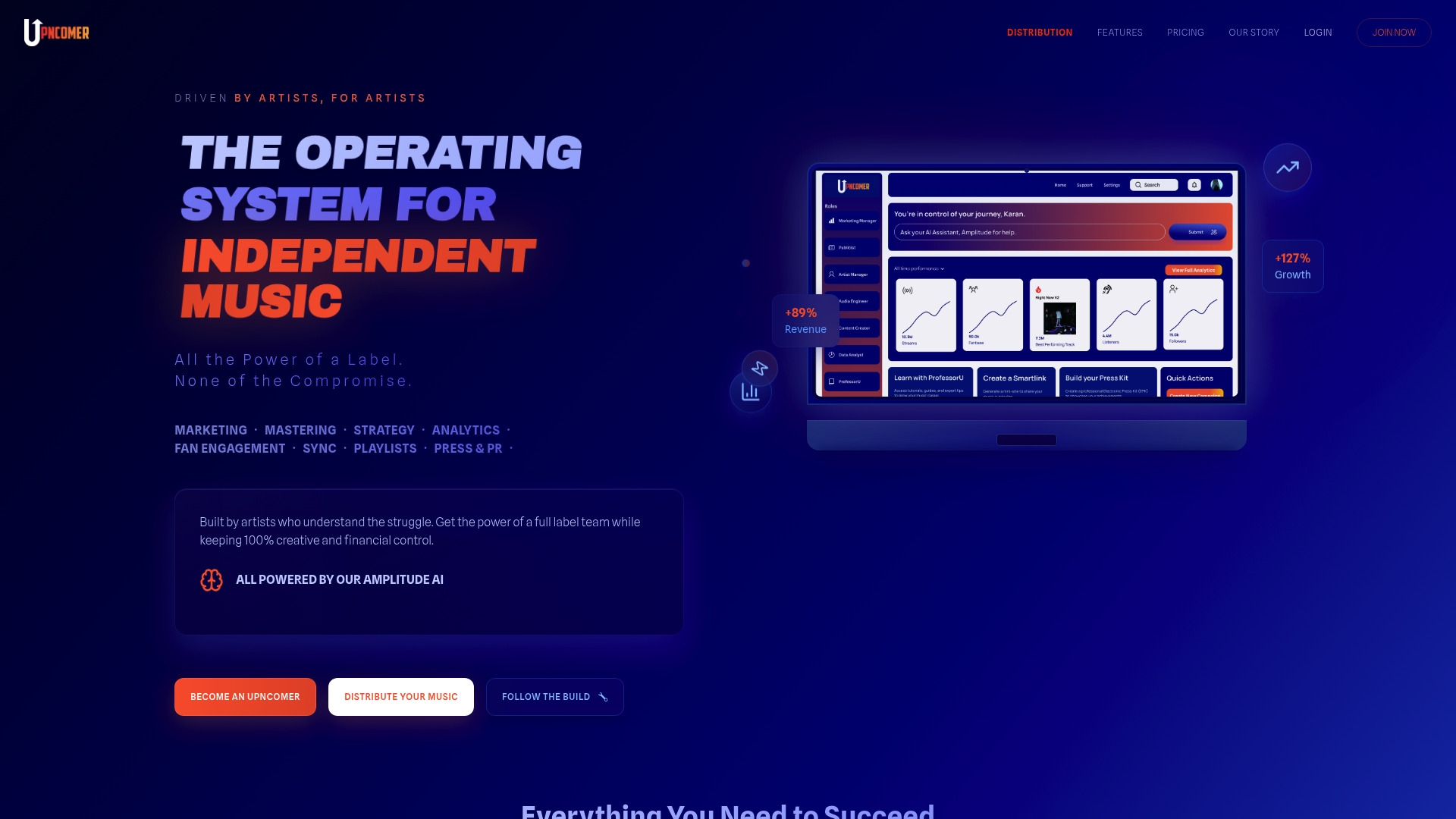
Course deliverables are only useful once you can execute and measure them, which is where an integrated platform closes the gap between lesson and campaign. We built UpNComer as an AI-powered operating system that brings marketing, analytics, fan engagement, mastering, content creation, distribution, playlist pitching, and campaign management into one place. Amplitude AI pairs with tools for ad campaigns, streaming analytics, audience insights, fan engagement, and smart links, so a campaign brief from a course module becomes a live, trackable campaign instead of a document. The goal is full creative and financial control, with the kind of resources larger operations rely on, minus the fragmented tool stack and agency fees.

Different types of artist development courses and their focus areas
Not every program covers the same ground, and the label “artist development” gets applied loosely. Before enrolling, confirm which lane a course actually sits in.

Career and marketing courses focus on the business side: release strategy, audience segmentation, playlist pitching, distribution, and streaming analytics. These are the programs most relevant if your goal is running better campaigns and growing a sustainable income from your music.
Vocal and performance training centers on technique: breath control, range, stage presence, and live performance skills. Valuable for a working artist, but it won’t teach you how to pitch a playlist editor or read a campaign dashboard.
Songwriting and production courses dig into craft: structure, melody, arrangement, and sometimes collaboration with producers or co-writers. These sharpen the music itself rather than the strategy around releasing it.
Branding and image courses cover visual identity, social presence, and public-facing storytelling, often overlapping with marketing but focused more on aesthetics than campaign mechanics.
For the independent artist managing their own release, a marketing and career-focused course tends to deliver the most immediate return, since it directly produces a usable campaign rather than a skill you’ll apply somewhere down the line. That said, pairing a marketing course with occasional vocal or songwriting coaching builds a more complete artist over time.
Key skills and competencies developed in artist development courses
A well-built course should leave you able to do specific things, not just understand concepts in the abstract.
You should come out able to build a realistic release timeline from scratch, segment an audience into meaningful groups for targeted spending, and write a playlist pitch that gives editors genuine context instead of a generic blurb. You should also be comfortable reading an analytics dashboard well enough to know which numbers actually matter, like intent rate and save conversion, rather than chasing raw play counts.
Beyond the mechanical skills, the stronger programs build judgment: knowing when a campaign isn’t working and needs to change direction, understanding how a single release fits into a longer career arc, and recognizing the difference between a vanity metric and one tied to real fan behavior. Industry commentary on artist development points to narrative and consistency as the throughline connecting these skills, since a campaign built on a clear story and sustained community effort tends to outperform a scattered series of one-off promotional pushes.
Success stories and case studies of artists who benefited from courses
Rather than pointing to named individuals, it’s more useful to look at what documented campaign approaches reveal about what works. One Spotify for Artists case study found that targeted campaigns using audience segments drove real engagement: 18% of a targeted group of casual and lapsed listeners streamed a new album after seeing the campaign, averaging 10 active streams per listener. That’s the kind of outcome a well-run audience segmentation project, the sort many courses require as a final deliverable, is designed to produce.
Separately, Spotify has documented how staged “staircase” campaign strategies, using tools like Marquee, Discovery Mode, and Showcase across multiple releases, can deepen fan engagement release over release rather than treating each single as an isolated event. Courses that teach this staged approach, instead of one-off promotional bursts, tend to better reflect how real campaigns compound over time. The common thread across these examples isn’t a single tactic but a structure: a defined audience, a clear timeline, and a willingness to measure results and adjust rather than guess.
How artist development courses integrate with broader career planning
A course is a component of your career plan, not a replacement for one. The modules you complete, release strategy, marketing, pitching, analytics, should feed into a longer-term view of where you want your catalog and audience to be in a year, not just how your next single performs.
That means treating each release as a data point rather than a one-time event. The analytics dashboard you build in a course should carry forward from release to release, so you can see whether your save rate or intent rate is actually improving over time. The audience segments you define for one campaign should inform who you target on the next one. Course work that stays isolated to a single project, completed and then forgotten, loses most of its long-term value.
This is also where working with a manager or a structured platform matters. A course teaches you the skills; ongoing career planning asks you to apply them consistently, release after release, while tracking whether your fan base is actually growing in a durable way, through owned channels like email and Discord, rather than only through algorithmic reach you don’t control.
Potential challenges or common pitfalls in artist development courses
The most common failure point isn’t a bad course. It’s finishing one and never running the campaign it trained you to build. Industry guidance on foundational development specifically cautions against skipping these foundational steps, like proper ad setup, outreach, and analytics tracking, expecting to catch up on the next release. That habit tends to repeat itself indefinitely.
Other pitfalls show up earlier. Some learners pick a course based on polished marketing rather than curriculum substance, then discover there’s no real project requirement once they’re a few modules in. Others choose a format that doesn’t match how they actually work, enrolling in a self-paced library when they know they need deadlines and peer accountability to finish anything.
A few practical fixes address most of this: commit to a specific release date before you start the course, so the material has somewhere real to land. Choose a format honestly matched to your work style rather than the cheapest or shortest option. And treat the final project as non-negotiable, even if the course doesn’t strictly require submission, because the act of running a real campaign is what turns course material into a transferable skill.
Long-term artist development isn’t a sprint
Most artists treat development like a single push before one release, then let it lapse. The ones who actually build careers treat community and consistency as the work, not a one-off campaign. Pick a project-first course, commit to the full workload, and keep learning past the finish line. Our blog resources are there when you need the next template.
— Karan
Run your course projects inside one system
Course modules teach you what to build. We built UpNComer so you’re not assembling that campaign across six disconnected tools afterward. Our Growth Engine and Amplitude AI handle the audience segmentation and ad cohort work your marketing module covers, while our Distribution tools connect directly to the playlist pitching workflows your course should be teaching you to run.
| Course deliverable | Where it plugs into UpNComer |
|---|---|
| Campaign brief | Growth Engine ad campaign setup |
| Playlist pitch | Distribution and pitching workflow |
| Analytics dashboard | Amplitude AI streaming and audience insights |
| Fan reactivation test | Fan engagement and CRM tools |
Pro Tip: Run your first course project inside a real platform instead of a spreadsheet. You’ll catch setup mistakes before they cost you a release window.
Independent artists shouldn’t have to choose between learning strategy and having somewhere to execute it.
Distribution comes with no subscription fee, just a royalty split, and our UpNComer Pro plans start at $27 per month or $300 per year for the full toolset. If you’ve just finished a course and have a campaign brief sitting in a document, check our pricing and put it to work on your next release.
FAQ
What do artist development courses actually cover?
They typically cover release planning, music marketing, distribution basics, playlist pitching, and streaming analytics, usually built around a final project tied to a real or simulated release. The strongest programs require a deliverable, like a campaign brief or a submitted playlist pitch, rather than only video lessons.
How much time should I expect an artist development course to take?
Formats range from four week sprints with daily tasks to eight week cohorts with staged milestones, plus self-paced libraries you move through at your own speed. Choose based on your release timeline: a sprint fits an upcoming release, while a cohort suits longer-term skill building.
When should I submit a playlist pitch after taking a course?
Spotify’s own guidance recommends pitching at least 7 days before your release date and filling in every context field about your story and genre. Many courses use this as the benchmark for their pitching module deadline.
Does UpNComer replace an artist development course?
UpNComer isn’t a course, it’s a platform for executing and measuring the campaigns those courses teach you to build, covering marketing, analytics, distribution, and fan engagement in one place.
What’s the biggest reason artists don’t see results after a course?
The most common issue is finishing the modules without ever running the actual campaign, according to industry guidance on artist development. Committing to a release date before starting the course gives the material somewhere real to land.
Sources
- Pitching music and videos to playlist editors — Spotify for Artists
- How targeted audience segments drove engagement — Spotify for Artists case study
- Fan study — new releases — Spotify for Artists
- Authentic community building in marketing & artist management — Music Business Association