AI Music Marketing: A Practical Guide for Artists

AI music marketing is the strategic use of artificial intelligence tools to promote music, target audiences, and maximize ad spend for independent artists. Platforms like Ad Box and Rocketship have made this approach accessible without a major label budget. The core idea is simple: AI handles the data-heavy, repetitive work so you can focus on making music and building real fan relationships. This guide breaks down the best tools, the audience trends you need to know, and the exact strategies that work in 2026.
What are the most effective AI tools for music marketing?
The strongest AI tools for music promotion fall into two categories: ad automation and audience intelligence. Both solve real problems that used to require expensive agencies or marketing teams.
Ad automation tools like Ad Box let you launch targeted campaigns on Meta and TikTok starting from $20, using models trained on 125 million fan data points. That scale of training data means the targeting decisions are grounded in real listener behavior, not guesswork. Campaign testing typically requires $50–$200 to gather enough data for meaningful audience segmentation.
Audience intelligence tools like Rocketship take a different approach. Rocketship evaluates tracks across 80 parameters, including audio, lyrics, and cultural context, analyzing more than 250,000 songs over 50 years. The output is a release strategy with a content calendar and platform recommendations tailored to your specific track. That is the kind of pre-release intelligence that used to cost thousands of dollars from a marketing consultant.
Here is what these tools actually do for your workflow:
- Ad Box automates Meta and TikTok ad creation, placement, and budget pacing with minimal setup
- Rocketship identifies your best target demographics and suggests the right social platforms before you release
- AI content planners generate posting schedules, caption ideas, and asset briefs based on your release timeline
- Streaming analytics platforms track listener behavior in real time so you can adjust campaigns mid-flight
AI handles coordination and data analysis well. It does not replace the creative instinct behind a great hook or a genuine fan moment.
Pro Tip: Pair any AI ad tool with a consistent organic content schedule. Paid ads amplify reach, but organic short-form video builds the trust that converts a listener into a fan.
How has listener perception of AI music shifted?
Audience attitudes toward AI-generated music are moving in one clear direction. Consumer interest in AI-created music declined from -13% to -20% between may and november 2025, with Gen Z and Gen Alpha leading that skepticism. About one-third of listeners report indifference to AI music rather than active dislike, but the trend is not moving in a positive direction.
This matters for your marketing strategy in a specific way. If your promotion relies heavily on AI-generated content, including AI vocals, AI-written lyrics, or fully synthetic tracks, you are swimming against the current of listener sentiment. The risk is not just lower streams. It is lower trust, which is harder to rebuild than a bad release week.
Transparency about AI use is a competitive advantage, not a liability. Artists who show their creative process and acknowledge where AI fits in their workflow maintain stronger fan engagement than those who stay silent.
The practical takeaway is this: use AI as a production and marketing assistant, not as the artist. When you share behind-the-scenes content showing your human decisions, your edits, and your creative choices, you give fans a reason to invest in you as a person. That connection is what drives superfans, merch sales, and long-term loyalty.
There is also a legal dimension. Fully AI-generated content risks copyright issues because the US Copyright Office generally requires human creative input for protection. If you use AI tools in production, keep your edits and decisions in the loop. That human input is what secures your ownership rights.
Paid vs. organic: how do you combine both for maximum reach?
The most effective approach to digital marketing for artists is not choosing between paid ads and organic content. It is stacking them deliberately.
The stacking strategy works like this: you publish consistent short-form organic videos on TikTok, Instagram Reels, and YouTube Shorts to build familiarity and trust. Then you run AI-optimized paid ads to amplify the content that is already performing. The organic layer warms up the audience. The paid layer scales what is already working.
| Factor | AI-driven paid ads | Organic content |
|---|---|---|
| Speed to reach | Fast, within hours | Slow, builds over weeks |
| Cost | Requires budget ($20+ per test) | Free but time-intensive |
| Targeting precision | High, data-driven | Low, algorithm-dependent |
| Trust building | Moderate | High |
| Scalability | High with budget | Limited by your output |
| Ad fatigue risk | High without oversight | Low |
A few common pitfalls to avoid:
- Skipping the test phase. Spend $50–$200 testing audience segments before scaling any campaign.
- Ignoring metadata. Poor audio tagging excludes your music from AI-driven playlists and sync opportunities. Fix your metadata before you spend a dollar on ads.
- Letting AI run unsupervised. Ad fatigue is real. Rotate creative assets and monitor pacing manually even when the AI is handling placement.
- Forgetting playlist pitching. AI ad spend and playlist placement work together. Pitching to editorial playlists on Spotify adds a credibility signal that paid ads cannot replicate.
Custom Lookalike Audiences built from your Spotify listener data are one of the most underused tools in automated music promotion. You upload your existing fan data, and the ad platform finds new listeners who behave like your best fans. That targeting precision is what separates a $20 test that works from one that burns out.
Pro Tip: Build a music marketing funnel before you run a single ad. Knowing where listeners go after they hear your music determines which ad objective you should actually be optimizing for.
How do you integrate AI tools into your full career workflow?
AI works best as infrastructure for artists, handling coordinated planning and data analysis so you can focus on the creative work. The mistake most independent artists make is treating AI tools as one-off solutions rather than building them into a repeatable system.
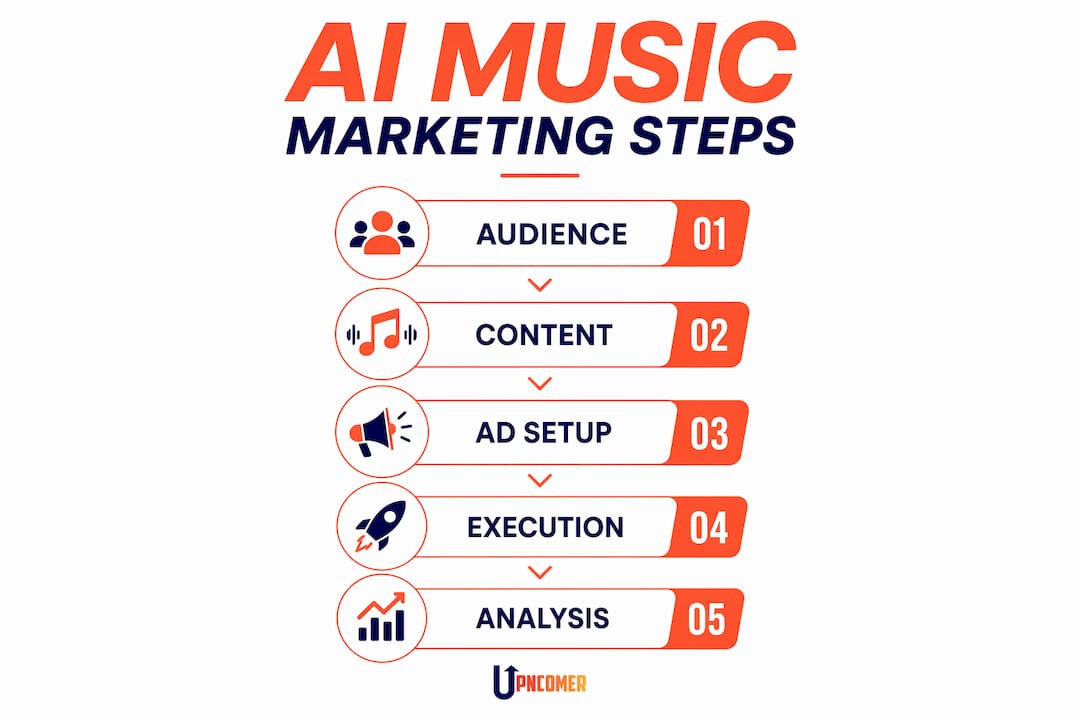
A practical integration looks like this:
- Pre-release: Use Rocketship or a similar tool to analyze your track, identify your audience, and build a content calendar 6–8 weeks before release
- Release week: Activate AI ad campaigns with a test budget, publish organic content daily, and pitch to playlists simultaneously
- Post-release: Monitor streaming analytics in real time, adjust ad spend based on which audience segments are converting, and identify which content formats drove the most saves and follows
- Ongoing: Feed performance data back into your next campaign. Every release teaches the AI more about your audience.
Platforms like Upncomer bring these functions together in one place. Upncomer’s Amplitude AI module provides AI-powered guidance across campaign planning, audience insights, and performance feedback. The Growth Engine handles ad campaign management and release promotion. The Artist Manager and Data Analyst modules support scheduling, fan engagement, and real-time streaming analytics so you are not jumping between five different dashboards.
AI marketing is also shifting toward what practitioners call execution intelligence. Tools like Influur Pulse monitor cultural momentum in real time, allowing music teams to act on viral trends as they happen rather than after the moment has passed. That kind of responsiveness used to require a full marketing team on standby.
The human-in-the-loop principle applies here too. AI can flag a trending sound or suggest a posting time, but you decide whether it fits your brand. Keep creative and legal decisions in your hands. Use AI to surface the information faster.
Key Takeaways
AI music marketing works best when artists use it as operational infrastructure, combining automated paid promotion with consistent organic content and human creative oversight.
| Point | Details |
|---|---|
| Start with a test budget | Spend $50–$200 testing audience segments before scaling any AI ad campaign. |
| Transparency builds trust | Artists who show their human creative process maintain stronger fan engagement over time. |
| Fix metadata first | Proper audio tagging is required for AI-driven playlist placement and sync opportunities. |
| Stack paid and organic | Combine AI-optimized ads with short-form organic video for the best reach and conversion results. |
| Keep humans in the loop | AI handles data and planning; creative decisions and copyright compliance stay with you. |
Why I think most artists are using AI marketing backwards
Most independent artists I see approach AI music marketing the same way: they sign up for a tool, run one ad campaign, get mediocre results, and conclude that AI does not work for them. The problem is not the tool. It is the order of operations.
AI ad platforms are amplifiers. They make what is already working louder. If your organic content is not connecting, if your metadata is a mess, if your release has no clear audience in mind, then a $200 ad campaign will just accelerate the confusion. The artists who get real results from AI-driven promotion do the foundational work first. They know their audience, they have a content system, and they use AI to scale what is already resonating.
The other thing I keep seeing is artists treating AI as a shortcut around the hard parts of fan connection. It is not. AI can get your music in front of the right ears faster. But the moment a listener lands on your profile, the relationship is entirely human. Your story, your consistency, your authenticity. Those are not things any tool can generate for you.
The artists who will build lasting careers with AI are the ones who use it to free up time for those human moments, not replace them. That is the actual opportunity here, and it is a significant one if you approach it with that mindset.
— Karan
How Upncomer supports your AI marketing workflow
Independent artists no longer need a label or an agency to run professional-grade marketing campaigns. Upncomer brings together the tools that make that possible in one place.
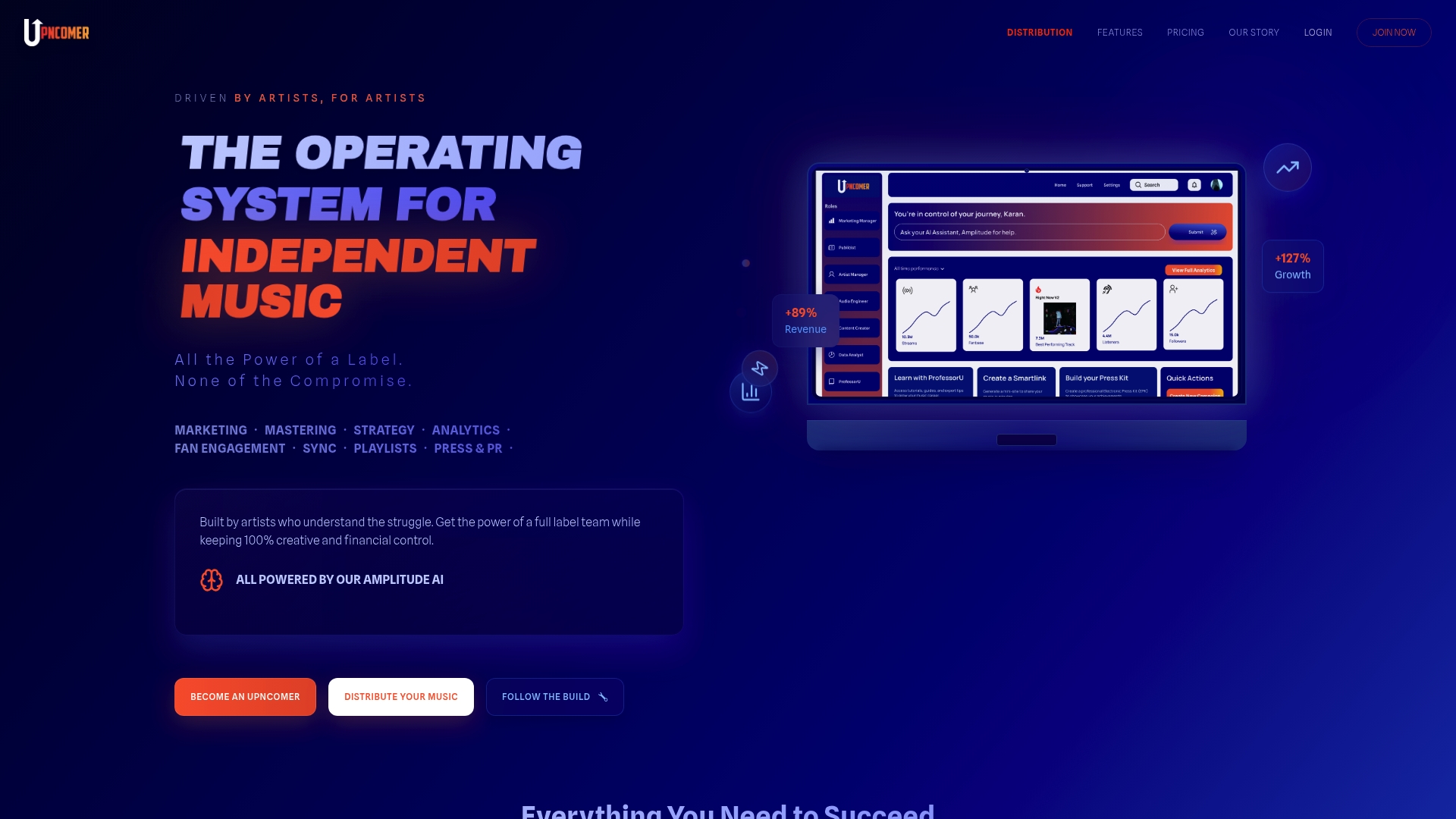
Upncomer’s platform includes Amplitude AI for campaign guidance, the Growth Engine for ad management and release promotion, and the Artist Manager and Data Analyst modules for fan engagement and audience data. Artists also get access to AI mastering through UrStudio, playlist pitching support through Publicist, and educational resources through ProfessorU. Everything connects so you are not rebuilding your workflow for every release. Check the Upncomer community updates page for the latest tools, resources, and artist news.
FAQ
What is AI music marketing?
AI music marketing is the use of artificial intelligence tools to automate and improve music promotion, audience targeting, and ad campaign management. It covers everything from AI-powered ad platforms to audience analytics and content planning.
How much does it cost to start AI-driven music advertising?
Tools like Ad Box let artists launch targeted campaigns starting from $20. Campaign testing typically requires $50–$200 to gather enough data for meaningful audience segmentation.
Does AI-generated music hurt an artist’s reputation?
Consumer interest in AI-generated music declined from -13% to -20% between may and november 2025, particularly among Gen Z listeners. Artists who are transparent about their creative process and human input maintain stronger fan trust.
What is the stacking strategy in music promotion?
The stacking strategy combines consistent organic short-form video content with AI-optimized paid ads. Organic content builds trust and familiarity, while paid ads scale the content that is already performing well.
Do I need to worry about copyright if I use AI tools?
The US Copyright Office generally requires human creative input for copyright protection. Artists using AI in production should maintain their own edits and creative decisions to secure ownership rights over their work.