Own Your Art: Why Traditional Distributors Are Losing Ground
Own your distribution, and you keep the margin, the fan data, and the final say on your work. That is the core reason artists need to move away from traditional distributors in 2026: the economics have shifted, and the tools to go direct finally work.
Do this first: claim your fan contact data (email and phone, not just followers) and put up a direct sales page or pre-order landing this week. As of Q1 2026, artists are increasingly rejecting recoupable advances in favor of retaining master ownership, a shift that says something simple: the industry itself is realizing commission drag and recoupment structures quietly erode long-term earnings.
- Audit what rights you currently hold or have signed away.
- Build one owned channel (email list or storefront) before you touch anything else.
- Treat platforms like UpNComer as infrastructure for the transition, not a replacement middleman.
Pro Tip: Before you cancel or renegotiate anything, export every email address, phone number, and sales record you can access from your current distributor or gallery portal. That list is the one asset no contract renegotiation can win back for you later.
Key Takeaways
Artists gain measurable control over margin, fan data, and release decisions the moment they own their distribution instead of routing it through a traditional gatekeeper.
| Point | Details |
|---|---|
| Audit rights first | Confirm master or copyright ownership and export fan contact data before changing anything else. |
| Commission drag is structural | Gallery splits near 40 to 50 percent and label recoupment both compound against artists over time. |
| Direct sales lift margin | Selling direct can retain 85 to 95 percent of revenue versus typical gallery splits. |
| Stage the transition | Use a 6-month roadmap covering audit, e-commerce setup, migration, soft launch, and scaling. |
| UpNComer supports the shift | Its Distribution, Data Analyst, and Publicist modules map directly onto the roadmap’s migration and scaling phases. |
Table of Contents
- Why Artists Need to Move Away From Traditional Distributors
- What You Actually Gain by Owning Your Distribution
- Which Direct Distribution Models Actually Work
- A 6-Month Roadmap to Ditch Distributor Dependency
- The Minimal Tech Stack for Owning Your Distribution
- When a Traditional Distributor Still Makes Sense
- The Data Behind the Shift Toward Artist Independence
- How UpNComer Supports Your Move to Independent Distribution
- Sources
- FAQ
Why Artists Need to Move Away From Traditional Distributors
The math rarely works in the artist’s favor. Traditional distributors, labels, and galleries built their business models around volume and recoupment, not around any single artist’s long-term earnings, and that structural mismatch is the real reason so many creators are walking.
Here’s what actually breaks down:
- Commission percentages that stack against you. Gallery splits commonly take a substantial portion of sales revenue, and label deals often layer distribution fees on top of recoupable costs before an artist sees a dollar.
- Recoupable advances that behave like loans. An advance feels like free money until you realize it accrues against future royalties, sometimes for years, with interest-like terms buried in the contract language.
- Opaque royalty reporting. Many artists still receive quarterly statements with no line-item breakdown of streams, territories, or sync placements, making it nearly impossible to audit what you’re owed.
- Thin A&R and creative development. Distributors and labels increasingly prioritize catalog volume over nurturing individual careers, which means less support unless you’re already a top earner.
- Prioritization by scale, not by artist. If you’re not moving the needle on a distributor’s quarterly numbers, you get deprioritized in playlist pitching, marketing spend, and even basic customer service.
A painter losing 50 percent of a sale to a gallery and a musician watching a label recoup an advance against master royalties are facing the same underlying problem: someone else controls the ledger. Analysis from Joel Gouveia argues that distribution itself has become a commodity, while the real value now lives in services artists can rent piece by piece instead of signing away permanently.
Risk callout: The compounding harm is the part most artists underestimate. Losing 10 percent of margin on one release feels survivable. Losing it for a decade, on a catalog, while also losing the audience data that would let you sell directly next time, is a career-shaping mistake.

Pro Tip: Ask for a full royalty statement broken down by territory and platform before signing anything. If a distributor or label can’t produce one on request, that’s your answer about how transparent your future statements will be.
What You Actually Gain by Owning Your Distribution
Retaining control changes the economics immediately, not eventually. Selling direct to consumers can let artists keep 85 to 95 percent of revenue, compared to the 40 to 50 percent typical of gallery splits, and the same logic applies to musicians who own their masters instead of recouping through a label.
The gains break into three categories:
- Financial. Higher per-sale margin on art, higher per-stream and per-sync royalty capture on music, and full ownership of merch and licensing revenue.
- Audience and data. You own the email list, the CRM, and the lifetime-value math on every fan, which means you can run a real repeat-sales strategy instead of guessing.
- Operational. You decide release timing, pricing, metadata, and who gets first access, instead of waiting on a distributor’s release calendar or a gallery’s exhibition slot.
This is exactly the shift showing up in the data: artists are moving toward master ownership and transparent dashboard reporting instead of accepting recoupable advances that quietly reduce long-term earnings. Independent distribution, done right, functions less like a gamble and more like a partnership where risk and transparency both sit closer to the artist.
Pro Tip: If you’re selling direct, price for your actual margin, not the market’s expectation of what a gallery-repped or label-backed price should look like. You’re not paying 40 to 50 percent to anyone else, so your floor price can be lower while your take-home stays higher.
Which Direct Distribution Models Actually Work
There’s no single “right” way to go direct. The model that fits a painter looks nothing like the model that fits a touring musician, and picking the wrong one wastes months you don’t have.
- Direct-to-fan e-commerce. A storefront (Shopify, Squarespace, or similar) you control fully. Pros: highest margin, full pricing control. Cons: you own fulfillment, customer service, and traffic generation.
- Subscription and membership models. Patreon-style recurring support or a paid newsletter. Pros: predictable revenue, deep fan relationships. Cons: requires consistent content output to justify the recurring charge.
- Pop-up and nomadic exhibitions. Short-term, self-curated shows instead of long gallery representation. Reporting on artists giving galleries a swerve shows this model growing fast among mid-career visual artists. Pros: flexible, lower overhead than permanent representation. Cons: you handle venue logistics and promotion yourself.
- Licensing portals and self-pitched sync. Musicians pitching directly into sync libraries and licensing marketplaces. Pros: no gatekeeper taking a placement cut. Cons: requires learning a genuinely different pitching skill set.
- Cooperative or peer-run representation. Small collectives of artists sharing costs for space, marketing, or shipping. Pros: shared overhead, shared audience. Cons: requires trust and clear agreements upfront.
A painter early in their practice might start with pop-up shows and a simple storefront. A mid-tier musician might combine a subscription tier with self-pitched sync licensing. An early-career multimedia artist often does best starting with a cooperative, since shared costs make the first year survivable. Artsy’s reporting on artists bypassing dealers documents exactly this range of approaches across career stages.
The costs people underestimate almost every time: fulfillment logistics for physical work, and the actual hours required for rights management and metadata cleanup on a music catalog.

A 6-Month Roadmap to Ditch Distributor Dependency
You don’t need to burn every bridge in one week. A staged transition protects your income while you build the replacement infrastructure.
- Months 0 to 1: Audit rights and data. Pull every contract you’ve signed and confirm who owns your masters or your image rights. Export every fan contact you can access from current platforms.
- Months 1 to 2: Set up e-commerce and CRM. Choose one storefront and one email platform. Don’t overbuild here; get something live.
- Months 2 to 3: Migrate your catalog and prepare release assets. Clean metadata, organize high-resolution files or masters, and prep everything for a direct release or sale.
- Months 3 to 4: Soft-launch sales and email campaigns. Test pricing and messaging with your existing audience before scaling ad spend.
- Months 4 to 6: Scale marketing, sync pitching, and licensing outreach. This is where you push distribution and promotion harder, now that the infrastructure is proven.
Ballpark costs: a basic storefront runs $20 to $50 a month, payment processing typically takes 2.5 to 3 percent per transaction, fulfillment or print-on-demand adds per-unit costs that vary by product, and a one-time legal review of your existing contracts often costs a few hundred dollars, money well spent before you sign anything new.
Legal checklist before you sign anything else:
- Confirm master ownership or copyright status in writing, not by assumption.
- Check for transfer or termination rights and note any option windows on renewal.
- Negotiate simple, specific clauses: reporting frequency, audit rights, and a capped commission where possible.
- Get a rights reversion clause if you’re entering any new representation deal at all.
Checkpoint at month 3: If your direct sales are covering even a modest chunk of what a distributor or gallery previously generated, keep going independently. If you’re stalled on reach or discovery, that’s the moment to consider a selective, limited-term hybrid partnership rather than a full return to the old model.
Pro Tip: Build your music release checklist around this same timeline so your creative calendar and your business transition move together instead of competing for your attention.
The Minimal Tech Stack for Owning Your Distribution
You need six categories of tools, not fifty. Overbuilding your stack is one of the fastest ways to burn out before you make your first sale.
- E-commerce storefront for direct sales of physical work, merch, or digital downloads.
- CRM and email platform to own your fan relationships instead of renting them from a social algorithm.
- Payment provider with transparent fee structures and fast payout timing.
- Fulfillment or print-on-demand service if you’re shipping physical goods.
- Streaming distribution portal for musicians, ideally one offering transparent royalty accounting and sync portals rather than opaque quarterly statements.
- Royalty and split management with analytics so you can track lifetime value per fan and per release, not just top-line revenue.
When you’re picking each tool, weigh cost structure, whether you actually own the data it collects, how well it integrates with the rest of your stack, and whether it scales past your first hundred customers without a painful migration.
For musicians specifically, understanding what independent distribution actually offers versus a traditional label deal makes this selection process much faster.
Pro Tip: Set up your CRM to automatically tag every post-sale customer and trigger a simple onboarding sequence. That single automation is often the difference between a one-time buyer and a superfan who buys your next three releases.
When a Traditional Distributor Still Makes Sense
Going independent doesn’t mean going it alone forever. Some situations genuinely call for a traditional partner, and pretending otherwise sets you up to reject good opportunities out of principle alone.
Consider staying hybrid when you need a large institutional placement, a deep curator relationship built over years, a major sync opportunity that only a label’s existing relationships can unlock, or global retail distribution you can’t build yourself in the near term.
If you do sign anything, negotiate hard:
- Limit the term length so you’re never locked into a decade-long deal.
- Protect reversion rights so ownership returns to you after the term ends.
- Demand transparent, itemized reporting with real audit rights.
- Cap the commission percentage wherever the leverage allows it.
Red flags to walk away from: perpetual master ownership transfer, recoupment schedules that aren’t spelled out in plain numbers, and exclusivity clauses with no defined end date.
Pro Tip: Structure any revenue-sharing deal so the distributor earns a percentage of net new sales they generate, not a cut of your existing direct audience. That keeps your catalog control intact even while you’re getting outside help.
The Data Behind the Shift Toward Artist Independence
The Q1 2026 shift is real and it’s measurable in behavior, not just sentiment. Artists are increasingly rejecting recoupable advances in favor of master ownership and dashboard-based reporting that lets them see exactly where their money comes from.
Curator Matt Carey-Williams distills the motivation behind artists abandoning traditional dealers into three words: competition, control, and money. Artists are tired of competing for gallery attention, tired of ceding creative control, and increasingly aware of exactly how much money that arrangement costs them.
That triad shows up across mediums. Visual artists cite the same frustrations musicians do, and the tools now exist for both to act on it.
A Note From UpNComer
Every recommendation in this article assumes one thing: the tools to go independent finally work well enough to make the transition realistic, not just idealistic. UpNComer builds toward that reality because we watch artists get caught between wanting control and not having the infrastructure to hold it. Start small, protect your data first, and build outward from there.
How UpNComer Supports Your Move to Independent Distribution
UpNComer replaces the fragmented toolkit that usually stalls this transition, without asking you to sign away your masters to get there. The platform combines Distribution with royalty split management, Amplitude AI for campaign guidance, an Artist Manager module for organizing your workflow, a Data Analyst dashboard for streaming and audience analytics, UrStudio for AI mastering, a Publicist module for press and playlist pitching, and a Content Creator tool for keeping your release calendar moving.
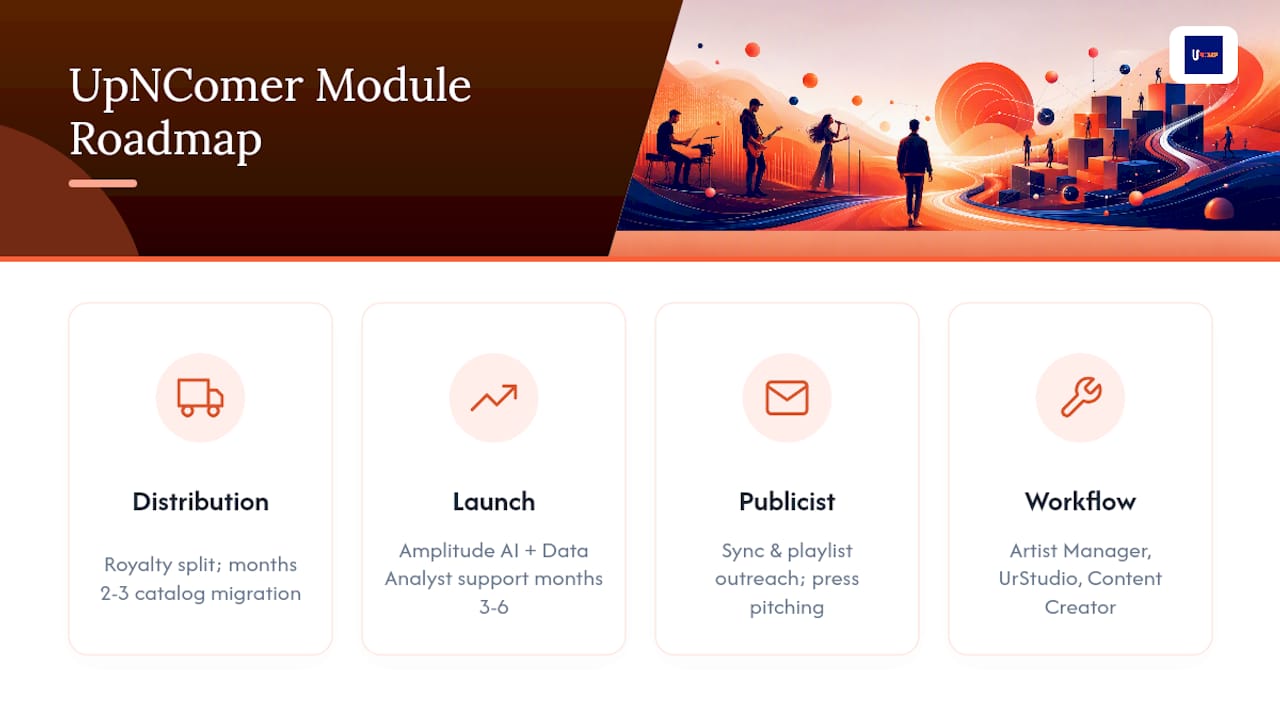
Map that directly onto the 6-month roadmap above: UpNComer’s Distribution and royalty tools cover your months 2 to 3 catalog migration and rights tracking, Data Analyst and Amplitude AI support your soft-launch and scaling phases in months 3 to 6, and the Publicist module handles the sync and playlist outreach you’d otherwise be doing cold. Pricing runs on a subscription model with distribution monetized through a modest royalty split rather than a flat fee, so you’re not paying twice for the same service.
If you’re ready to see how the pieces fit your own catalog, visit UpNComer’s story and platform overview and start mapping your transition timeline against what the platform already automates.
Sources
- Taking back control: why master ownership is the future of music – Pressbooks (CUNY)
- Embracing independence: meet the artists giving galleries a swerve – The Art Newspaper
- How artists are bypassing their dealers and selling directly to collectors – Artsy
- Why Artists Are Abandoning Traditional Deals for Strategic Independent Distribution in 2026 – Alte Magazine
FAQ
What is the 70/30 rule in art?
It typically refers to revenue splits where the artist keeps less than half and a gallery or platform takes more than half, often around 40 to 50 percent.
What distributor do most artists use?
There’s no single dominant choice; independent musicians often compare several distribution platforms based on royalty transparency and pricing, and tools like UpNComer’s Distribution module are built specifically to make that comparison easier.
How much does an artist make from a $100 ticket sale?
This varies widely by venue deal and promoter cut, but after venue fees, promoter splits, and any booking agency commission, artists frequently see a fraction of the gross ticket price rather than the full amount.
Why did art move away from realism?
That shift was driven by changing artistic movements and technology like photography, not by distribution economics; it’s a separate art-history question from why artists today are leaving traditional galleries and labels.
How do I start selling my music or art directly?
Begin by owning your fan email list and setting up one direct sales channel, whether that’s a storefront for physical work or a distribution portal like UpNComer for streaming royalties and splits.