The Spotify Algorithm Explained for Artists and Music Pros

Spotify decides what to recommend by feeding your listening actions, your account metadata, and a track’s audio and content features into machine learning ranking models, including transformer-based systems like Mostra, to build a personalized, ordered stream just for you. The output isn’t one algorithm. It’s a pipeline that weighs your taste profile against a track’s audio DNA, then balances what keeps you listening against what keeps creators getting discovered.
Three input categories drive nearly everything:
- Behavioral signals: skips, saves, playlist adds, replays, searches
- User metadata: device type, approximate location, language, followed artists
- Content features: danceability, key, tempo, and other audio attributes assigned during ingestion
Pro Tip: Spotify’s own documentation confirms recommendations lean on a listener’s taste profile built from listening actions, account details, and content characteristics — so an artist’s job is to influence that profile-building process, not to “beat” a single algorithm.
You’ll also see the terms algotorial (human-curated pools with algorithmic ordering) and Discovery Mode (a paid promotional signal) throughout the industry, and both matter for how your music actually reaches ears. UpNComer builds its analytics and pitching tools around exactly these mechanics, which is the practical thread running through this entire guide.
Key Takeaways
Spotify’s recommendations come down to how well your metadata, early engagement, and retention metrics feed a multi-objective ranking system built to balance listener satisfaction against creator reach.
| Point | Details |
|---|---|
| Taste profile drives everything | Built from behavioral signals, metadata, and content features, and updated continuously by engagement. |
| Skip rate is an early warning | The 30-second rule means early skips send stronger negative signals than late ones. |
| Algotorial playlists split exposure | Editors build a pool; algorithms personalize order, so listeners see different tracks from the same playlist. |
| Mostra balances competing goals | Counterfactual decoding lets Spotify weigh creator reach against user satisfaction without retraining. |
| UpNComer operationalizes the signals | Data Analyst and Growth Engine track skip rate and save-to-play ratio to guide campaign adjustments. |
Table of Contents
- How the Spotify Algorithm Works: The Pipeline Explained
- What Signals Actually Feed Spotify’s Recommendation Engine
- The Models Behind Spotify’s Music Discovery Process
- Editorial, Algorithmic, and Algotorial Playlists Explained
- How Artists Can Influence Spotify’s Recommendations
- Discovery Mode, Licensing, and Platform Rules
- Privacy, Safety, and What Spotify Won’t Recommend
- Turning Signals Into a Release Workflow With UpNComer
- Where Spotify’s Recommendation System Falls Short
- What Artists Get Wrong About Discovery
- Put This Framework to Work With UpNComer
- Sources
- FAQ
How the Spotify Algorithm Works: The Pipeline Explained
Before any recommendation reaches your screen, a track passes through several distinct stages. Understanding this pipeline matters because it tells you where your metadata, your mix, and your early engagement numbers actually get evaluated.
- Ingestion: Distributors deliver metadata (ISRC, credits, genre tags, release date) alongside the audio file itself.
- Feature extraction: Signal processing tools, descended from the acoustic attribute framework Echo Nest pioneered, calculate danceability, key, tempo, energy, and loudness. Human musicology tagging adds genre and mood labels the raw signal can’t capture alone.
- Candidate generation: The system pulls a broad pool of tracks that plausibly fit a listener based on collaborative patterns (what similar listeners liked) and content similarity (tracks that sound or tag alike).
- Ranking and decoding: A scoring model orders that candidate pool for the individual listener, weighing satisfaction signals against other objectives like creator reach.
This two-stage retrieval structure (generate a wide candidate pool, then rank it tightly) is standard in large-scale recommendation systems because scoring every song in the catalog for every listener in real time isn’t computationally realistic.
Your taste profile sits at the center of stage four. It’s not a static tag Spotify assigns once. It updates continuously as your engagement events roll in, which is why:
- Skipping five dance tracks in a row shifts your Discover Weekly noticeably by the next week
- Saving an obscure jazz record can quietly nudge Release Radar toward similar smaller acts
- A long, uninterrupted listening session sends a stronger positive signal than a single save
For artists, this means the moment your feature extraction happens (accurate genre tags, clean metadata, correct release date) is just as important as what happens after release, when listener behavior starts training the model on your track specifically.
What Signals Actually Feed Spotify’s Recommendation Engine

Not every signal carries equal weight, and understanding the hierarchy helps you know what to actually optimize for.
Explicit signals are the clearest, most direct declarations of intent:
- Saves and library adds
- Follows (both artist and playlist)
- Playlist adds by listeners themselves
- Skips, especially early skips within the first several seconds
Skip behavior gets special treatment. Spotify’s product design around the 30-second rule means a stream typically counts toward play metrics only once playback crosses roughly that mark, which is why a skip at second 12 registers very differently in the data than a skip at second 45. A pattern of early skips across many listeners is one of the strongest negative signals a track can generate, and it tends to suppress future algorithmic placement fast.
Implicit signals are quieter but still meaningful:
- Session length and whether a listener stays through an entire album or playlist
- Completion rate on individual tracks
- Replays within the same session (a strong positive signal, often stronger than a save)
- Seek and rewind behavior, which can indicate a listener is drawn to a specific section of a track
User attributes shape who a track gets shown to, not whether it performs well:
- Non-precise location and language
- Device type
- The listener’s existing follow graph and genre history
Content attributes determine which candidate pool a track lands in during retrieval:
- Audio features: danceability, key, tempo, loudness, energy
- Release date (fresh releases get short-term visibility boosts in surfaces like Release Radar)
- Editorial tags and credits, including producer and songwriter metadata
Contextual signals round things out. Time of day, day of week, and broader listening trends all shift which candidates rise to the top of a ranked list, which is part of why a track can perform well in a Monday-morning commute context and fall flat in a Friday-night party context.
The Models Behind Spotify’s Music Discovery Process
Two foundational techniques still anchor most of what happens under the hood, even as newer models layer on top.
Collaborative filtering looks at patterns across millions of listeners: if people who liked Track A also consistently liked Track B, the system infers a relationship between the two, independent of what either track actually sounds like. Content-based filtering works the opposite direction, comparing a track’s own audio features and metadata against tracks a listener has already engaged with. Most production recommendation systems blend both, because collaborative filtering alone struggles with brand-new releases that have no listening history yet, and content-based filtering alone misses cultural context that pure audio analysis can’t detect.
Audio-based embeddings, the numerical representations models use to compare songs mathematically, get built from the same signal-processing pipeline that traces back to Echo Nest’s original acoustic attribute framework, now paired with deep learning layers trained on listener behavior.
The more advanced leap is transformer-based set encoding, where a model doesn’t score songs one at a time but considers an entire candidate set together, learning how tracks relate to each other in sequence. This is where Mostra comes in. Spotify Research describes Mostra as a transformer-based, multi-objective set encoder that applies counterfactual decoding to rebalance competing goals at the moment of ranking, without retraining the underlying model every time priorities shift.
Mostra’s counterfactual decoding lets Spotify tune recommendations for creator-facing objectives, like reach for emerging artists, on the fly. It’s an operationally efficient way to rebalance short-term listener satisfaction against platform-wide goals for a service serving hundreds of millions of listeners.
Evaluation in this world isn’t just about accuracy. Engineers track satisfaction (SAT) scores, catalog diversity, and creator reach as separate, sometimes competing, metrics, which is exactly why a track can be a great content match and still lose out to a track that better serves the platform’s broader mix of goals.
Editorial, Algorithmic, and Algotorial Playlists Explained
Not all playlists work the same way, and the distinction changes how you should pitch.
- Editorial playlists are built entirely by human curators, with a fixed track order every listener sees.
- Algorithmic playlists (Discover Weekly, Release Radar) are generated entirely by models, with zero human curation per listener.
- Algotorial playlists blend both: editors assemble a candidate pool of tracks, then an algorithm personalizes the final selection and order for each individual listener.
This hybrid model explains a phenomenon that confuses a lot of artists: two people can open the “same” playlist and see completely different tracklists. Editors expand the pool of candidates, which genuinely widens opportunity for lesser-known acts, but it also means getting added to the pool doesn’t guarantee every listener sees your track. Exposure gets split across the whole pool based on individual taste profiles.
Pro Tip: If you see “Made for [username]” on a playlist byline, that’s your signal it’s a personalized algorithmic or algotorial playlist, not a static editorial one. Pitching for placement there works differently than pitching a fixed editorial list, because there’s no single gatekeeper decision, just an ongoing chance to enter the candidate pool.
Understanding this pool dynamic should reshape how you think about playlist pitching entirely. It’s not one submission, one yes or no. It’s an ongoing bid for inclusion in a rotating candidate set.
How Artists Can Influence Spotify’s Recommendations
You can’t rewrite Spotify’s ranking model, but you can control nearly every input it reads. Here’s the order of operations that actually moves the needle.
- Fix your metadata before release day. Correct ISRC codes, accurate genre tags, complete producer and songwriter credits, and the right release date all feed directly into content-attribute matching during ingestion.
- Coordinate your first-week signals. Pre-saves, synchronized playlist adds, and promotional pushes timed to launch day concentrate positive engagement when the algorithm is watching most closely.
- Prioritize retention metrics over reach metrics. A high completion rate and a low skip rate matter more to long-term algorithmic favor than a spike in raw plays that don’t hold attention.
- Watch your save-to-play ratio. A track that gets saved by a smaller audience often outperforms, algorithmically, a track that gets played widely but skipped early.
- Pitch editorial playlists with pool dynamics in mind, following structured pitch guidance built for indie artists rather than treating it as a one-shot submission.
The metadata checklist alone catches most avoidable losses:
- ISRC assigned and matched correctly across all territories
- Genre tags reflect how the track actually sounds, not just an aspirational label
- Release date set with enough runway for pre-save campaigns
- Full credits listed, since editorial teams and collaborative-filtering systems both use them
Pro Tip: Track skip rate and completion rate weekly, not monthly. A skip-rate spike in the first 10 days after release is the earliest warning sign that your track isn’t matching the audience it’s being shown to, and catching it early gives you time to adjust your promotion and targeting before the algorithm locks in a negative read.
Your dashboard should flag three trigger thresholds: skip rate climbing above your historical average, save-to-play ratio dropping week over week, and completion rate falling below prior releases. Any one of those crossing its threshold is your cue to adjust ad targeting or playlist strategy immediately, not at the end of the release cycle.

Discovery Mode, Licensing, and Platform Rules
Discovery Mode is often misunderstood as a shortcut into editorial placement. It isn’t. Spotify’s own documentation is direct: Discovery Mode is a commercial signal that can raise the probability of algorithmic recommendation in certain surfaces, but it doesn’t guarantee editorial playlist inclusion and doesn’t override poor engagement.
That distinction carries a real trade-off. Discovery Mode trades a royalty rate reduction on incremental streams for increased algorithmic visibility, which can work well for a track with strong content-market fit that just needs a nudge. It backfires when used on a track that isn’t resonating, because the extra plays it generates often skip early, which then feeds negative signals right back into the same model.
Licensing and regional availability create separate, non-negotiable limits. A track unavailable in a listener’s territory simply can’t enter that listener’s candidate pool, no matter how strong its other signals are.
- Discovery Mode: paid visibility boost, algorithmic surfaces only, no editorial guarantee
- Licensing gaps: hard exclusion from candidate pools in restricted regions
- Content moderation violations: can remove eligibility for recommendation entirely, regardless of engagement
Pro Tip: Spotify explicitly states that commercial signals like Discovery Mode don’t override listener engagement data when that data shows low satisfaction. Treat Discovery Mode as an amplifier for a track that’s already testing well, not a fix for one that isn’t.
Privacy, Safety, and What Spotify Won’t Recommend
Recommendation models draw on a defined, limited set of user data: non-precise location, device type, language, and listening events like plays, skips, and saves. Spotify does not use precise GPS location for this purpose.
Content that violates platform policy, whether through copyright issues, safety violations, or other rule breaks, gets excluded from recommendation eligibility regardless of how strong its engagement signals look. A track with a phenomenal completion rate still won’t surface if it’s been flagged for a policy violation.
- Behavioral data used: plays, skips, saves, searches
- Attribute data used: language, device, approximate location
- Excluded regardless of performance: content in violation of platform rules
Specific jurisdictional rules and data-handling practices vary, so check Spotify’s own policy documentation for details relevant to your region.
Turning Signals Into a Release Workflow With UpNComer
Knowing the mechanics only pays off once you translate them into a repeatable release process. Here’s how the signals above map to concrete action.
| Signal | Where to track it | Action to take |
|---|---|---|
| Skip rate | Data Analyst | Adjust ad targeting or swap creative if early skips spike |
| Save-to-play ratio | Data Analyst | Reallocate promotion budget toward audiences with higher saves |
| Playlist pool inclusion | Growth Engine | Time pitching campaigns around pre-save windows |
| Metadata accuracy | Distribution | Audit credits and genre tags before submission |
| Fan engagement trends | Artist Manager | Identify superfans worth prioritizing for early listens |
A practical four-week release checklist looks like this:
- Week 0: Metadata locked, credits verified, pre-save live through Distribution.
- Week 1: Monitor skip rate daily; target a completion rate above your last release’s baseline.
- Week 2: Compare save-to-play ratio against catalog average; adjust targeting through Growth Engine if it’s lagging.
- Week 3: Review playlist pool inclusion and pitch follow-ups for algotorial placements.
- Week 4: Full campaign retrospective using Data Analyst dashboards to set the next release’s baseline.
A signal you don’t track is a signal you can’t act on. The gap between artists who grow steadily and those who stall usually isn’t talent. It’s whether anyone was watching the dashboard in week one.
Amplitude AI can flag which of these thresholds needs attention without you manually cross-referencing five different reports every week.
Where Spotify’s Recommendation System Falls Short
No recommendation system is neutral, and Spotify’s is no exception. The same mechanics that make personalization useful also create structural blind spots worth knowing about.

Filter bubbles are the most cited limitation. Once your taste profile locks into a lane, collaborative filtering keeps reinforcing that lane, because it’s optimizing for predicted satisfaction, not exposure diversity. A listener who streams mostly one genre will keep getting served that genre, which narrows discovery over time rather than widening it. Journalistic analysis of Spotify’s system has pointed to microgenre categorization and heavy personalization as factors that can narrow discovery rather than expand it, even as the platform markets itself around discovery.
Cold-start bias hits new and emerging artists hardest. Collaborative filtering needs listening history to work, so a brand-new release with zero engagement data has nothing for the model to compare against, which is exactly why early, coordinated first-week signals matter so much.
Popularity feedback loops compound the problem. Tracks that already have strong engagement get shown to more candidate pools, which generates more engagement, which reinforces further placement. Breaking into that loop from zero is measurably harder than staying in it once you’re there.
Genre and language skew shows up too. Audio feature libraries built primarily around Western pop conventions can undertag or mis-tag music from underrepresented genres and non-English catalogs, which can quietly limit how far those tracks travel through content-based matching. None of this makes the system unusable. It just means artists working outside dominant genre norms need to lean harder on metadata precision and direct promotion rather than relying on algorithmic discovery alone.
What Artists Get Wrong About Discovery
The biggest misconception I see among independent artists is treating the algorithm like a single gatekeeper you either please or don’t. It’s a layered system making thousands of small, context-dependent decisions, and most of those decisions are shaped by things entirely within an artist’s control before a single stream happens: metadata accuracy, release timing, and whether the first listeners you reach are actually the right audience for the sound.
Conventional advice tends to obsess over gaming algorithmic playlists. That’s backward. The research points somewhere more useful: retention signals like completion rate and save-to-play ratio carry more long-term weight than raw play counts, and those signals respond directly to audience targeting quality, not algorithmic tricks.
If you take one thing from this, prioritize your first 10 days after release. That’s the window where cold-start bias is strongest and where your own coordinated signals do the most work the model can’t yet infer on its own. Get the right people listening first, and the algorithm has real data to work with instead of guesses.
Put This Framework to Work With UpNComer
Reading about skip rate and save-to-play ratios is one thing. Watching them move in real time, and knowing exactly when to adjust, is another. UpNComer’s Data Analyst module pulls streaming behavior into dashboards built around the exact signals covered in this guide, while Growth Engine handles the campaign timing and audience targeting that improve those numbers before the algorithm locks in its read on a release.
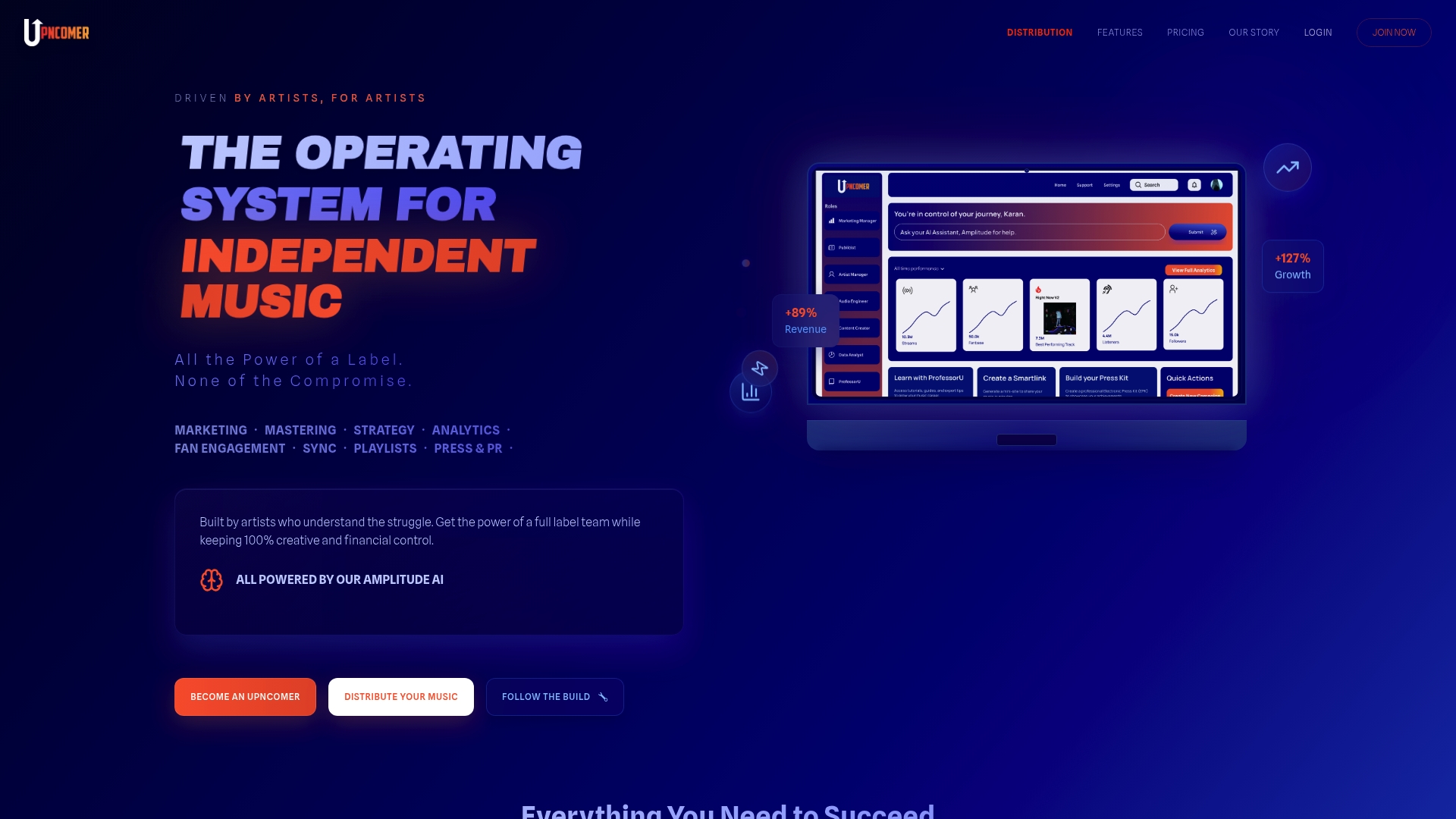
Distribution keeps your metadata clean from day one, with no subscription fee attached since it runs on a straightforward royalty split, and Amplitude AI flags threshold breaches so you’re not manually checking five reports every week. If you’re planning a release and want your first-week signals working for you instead of against you, start with UpNComer’s distribution tools and get your metadata and release timeline locked before day one.
Sources
- Understanding recommendations on Spotify — Safety & Privacy
- Mostra: Balancing multiple objectives for music recommendation — Spotify Research
- Humans + Machines: A look behind playlists powered by Spotify’s algotorial technology — Spotify Engineering
FAQ
What is the 30-second rule on Spotify?
Spotify’s play-counting design generally credits a stream toward metrics only after a listener plays a track past roughly the 30-second mark, which is why skips before that point send a much stronger negative signal to the recommendation model.
How many streams does it take to make $10,000 on Spotify?
Per-stream payouts vary by market, subscription mix, and royalty agreements, so there’s no single stream count that applies to every artist; distribution terms and reporting through a service like UpNComer’s Distribution module are the most reliable way to see your actual royalty math.
What is the “1,000 true fans” idea some artists reference?
It’s a framework suggesting an artist can sustain a career by cultivating a core of deeply engaged superfans rather than chasing mass reach, and it lines up with what the algorithm rewards: retention and repeat engagement over raw play counts.
What does “top 2% listeners” mean on Spotify?
It’s a personalized annual stat, most visible during Spotify Wrapped, showing that a listener’s engagement with a specific artist ranks in the top 2% of that artist’s total audience based on their individual listening activity.
Does pitching editorial playlists still matter if algotorial playlists dominate discovery?
Yes. Editorial teams still decide which tracks enter the candidate pool that algorithms personalize from, so a well-crafted editorial pitch remains one of the few direct levers an artist has over algorithmic exposure.