Indie Artists: Validate a Market With a $50 Multilingual Test
Yes, independent artists should use multilingual marketing when their streaming data already shows pockets of international listenership. Start by prioritizing markets from that data, not guesswork, then launch small tests: subtitles, lyric cards, and one localized landing page. Fix your metadata and rights first. Watch saves, repeat listens, follows, and landing-page conversion before you spend real money scaling anything.
TL;DR:
- Target markets with at least 500 organic monthly streams, focusing on engagement metrics like saves, repeats, and follows before scaling efforts.
- Fix all metadata, rights registration, and use hreflang tags and region-specific landing pages to ensure technical localization is complete before launching campaigns.
- Different assets require either direct translation for facts or transcreation for emotional content to resonate authentically with each audience.
- Start small with a $50 to $150 ad spend in one market, measure KPIs, and only scale if organic signals like follows and saves show clear improvement.
- Use tools like UpNComer for unified analytics, content creation, and campaign management to streamline workflow and reduce reliance on multiple platforms.
Table of Contents
- Why Multilingual Marketing Matters for Artists
- How to Pick and Prioritize Target Markets Using Your Data
- Website, DSP Metadata, and Technical Localization
- Translation vs. Transcreation: What to Adapt and How
- Measurement and Testing: KPIs, Budgets, and When to Scale
- Tools and Workflow for Lean Multilingual Execution
- Common Mistakes and Your First 8-Week Checklist
- How UpNComer Maps to This Workflow for Independent Artists
- Balancing Cultural Authenticity With Data-Led Experiments
- Try UpNComer to Run Your First Multilingual Test
- Sources
- FAQ
Why Multilingual Marketing Matters for Artists
Streaming platforms don’t care what language you release in. Your fans do, and that gap is where the money gets left on the table.
A listener who finds your track through an algorithmic playlist is a passive number. A listener who reads a caption in their own language, watches a subtitled performance clip, or lands on a bio page written for their region turns into something else: a fan who saves the song, follows the artist page, and shows up again next release. That shift from passive stream to active follower is the entire ROI case for multilingual promotion, and it costs almost nothing to test.
The fan behaviors worth tracking are simple:
- Saves — a listener adding the track to their library signals intent beyond a single play.
- Repeat listens — three or more plays from the same account in a week beats a thousand one-time streams.
- Follows — the strongest early signal that a market is worth deeper investment.
- Playlist adds — third-party or user-generated playlists in a target language often precede organic growth spikes.
Statistic Callout: Markets where an artist already has 500 or more organic monthly streams represent a real, testable opportunity, not a cold-start gamble.
You don’t need a Spanish-language album or a K-pop-style comeback to benefit here. Plenty of artists have found traction simply by transcreating captions and hooks for a market their streaming numbers already point to.
How to Pick and Prioritize Target Markets Using Your Data
Before writing a single translated caption, open your distributor dashboard or UpNComer’s Data Analyst module and export listener geography by country. You’re looking for markets where a real audience already exists, not places you’d simply like to break into.
Use this sequence:
- Export country-level streaming data for the last 90 days, sorted by monthly listeners and total streams.
- Flag any country crossing the 500 organic monthly listener mark. Tools4Music treats this as a practical floor, since it filters out noise from bot traffic or one-off playlist spikes.
- Check streams-per-listener ratio. A market with low listener counts but high repeat plays often has more depth than a bigger market with shallow, one-and-done streams.
- Score each candidate market on four factors: engagement (saves and repeats), monetization potential (streaming rates and merch feasibility), logistic fit (can you actually tour or ship there), and language proximity (how much translation and cultural adaptation the market demands).
- Pick one market to pilot. Not three. One.
That last step trips up more artists than any technical mistake. Spreading a test budget across four countries dilutes your signal and makes every result inconclusive.
Pro Tip: Treat your first market pick like a science experiment with one variable. If you change language, region, and content format all at once, you won’t know which lever actually moved the needle.
Once you’ve picked your market, everything downstream, from ad spend to caption tone, gets built around that one audience.
Website, DSP Metadata, and Technical Localization
Multilingual marketing dies fast when the technical foundation underneath it is broken. Before you spend a dollar on ads or a minute on transcreation, fix these:
- Hreflang tags and basic site structure. If your website or landing pages have multiple language versions, hreflang tells search engines which version to show which visitor. Skip this and Google may show a French fan your English homepage every time.
- Language-detecting landing pages. A simple redirect or toggle based on browser language keeps international fans from bouncing off a page that clearly wasn’t built for them.
- Tour and event pages localized by region. Even a one-paragraph localized blurb outperforms a generic English tour page for conversion.
- DSP metadata accuracy. Local-language titles, correctly tagged lyric fields, accurate genre tags, and clean ISRCs all affect how platforms surface your music to regional listeners.
- Publishing registrations. PRO registration and rights cleanup matter more than most artists realize. Streams from an unregistered market can generate real plays and zero royalty capture.
This is the least glamorous section of any multilingual campaign, and it’s also the one that determines whether the fun, creative part of the strategy actually pays out. A beautifully transcreated video campaign into a market where your rights aren’t registered is a campaign that grows an audience you can’t monetize. A phased approach that builds metadata and localization infrastructure before scaling content spend consistently outperforms campaigns that skip straight to creative.
Run your metadata check before your first ad dollar goes out the door, not after.
Translation vs. Transcreation: What to Adapt and How
Not everything needs the same treatment. Some assets should be translated word for word. Others need to be rebuilt from the ground up for the market you’re targeting.
Translate directly: captions with factual information, your artist bio’s core facts, tour dates, and merch descriptions. These are informational. A literal, accurate translation serves the fan better than a creative reinterpretation.
Transcreate instead: campaign hooks, taglines, video intros, and anything meant to evoke emotion or humor. A joke that lands in English often falls flat translated word for word. Transcreation rebuilds the intent of the message in the target language’s own idiom, and it’s the difference between content that feels native and content that feels like a Google Translate afterthought.
Cheap, fast experiments to validate demand before committing to bigger investment:
- Add burned-in subtitles to your next short-form video, even using auto-generated captions as a starting draft.
- Build a lyric card in the target language for your most-streamed track in that market.
- Translate three to five recent captions and republish them as a test batch.
- Cut a region-specific short clip using footage you already have, just re-edited with local-language text overlays.
- Reach out to one or two local micro-influencers or fan accounts in that market for a shoutout or duet.
Pro Tip: Run machine translation for quick social replies and DMs to international fans; it’s fine for casual engagement. Save human review for anything going into a paid campaign, an official video, or your bio. The bar for polish is different depending on whether a fan sees it once or forever.
For channel priorities, short-form video and Stories carry the lowest cost of experimentation. Paid ads should wait until you’ve validated organic interest. Email works well for fans who already opted in, since a localized subject line alone can lift open rates without a full campaign rebuild.
Measurement and Testing: KPIs, Budgets, and When to Scale
Your test only means something if you’re watching the right numbers before, during, and after.
Track these five KPIs for every market test:
- Saves relative to total streams in that market.
- Repeat listens within a 30-day window.
- New follows on your artist profile from that region.
- Playlist adds, especially user-generated or algorithmic ones.
- Landing-page conversion if you’re driving traffic to a localized page or pre-save link.
For budget, start small: a $50 to $150 initial ad spend on a single localized creative is enough to see directional signal without overcommitting. If that spend produces a meaningfully lower cost-per-follow than your home-market average, or if saves and repeats climb faster than they did in your baseline market, that’s your green light to scale.
Statistic Callout: A beginner workflow that many artists find effective: audit your analytics, pick one market, build two localized assets, run one small ad plus organic seeding test, then measure against those five KPIs before deciding.
Structure your A/B test around one variable at a time: same audience, two creative versions, or same creative with two caption languages. Testing everything simultaneously just gives you noise instead of an answer.
Tools and Workflow for Lean Multilingual Execution
You don’t need an agency or a six-figure budget to run this playbook. You need four tool categories and a repeatable sequence.
Analytics dashboards tell you where your listeners already are. UpNComer’s streaming analytics surface country-level data alongside fan engagement signals, so you’re not toggling between three separate platforms to build your market shortlist.
AI-assisted translation and subtitling tools speed up the first draft of captions, lyric cards, and video subtitles. The reliable pattern here is draft with AI, then humanize with a native speaker before anything goes live in a paid campaign or official post.
Landing-page builders let you spin up a localized pre-save or tour page without a developer. Smart links with region detection built in remove one more point of friction between a fan and a follow.
DSP metadata checkers catch mismatched ISRCs, missing lyric language tags, or genre misclassification before a release goes live in a new market.
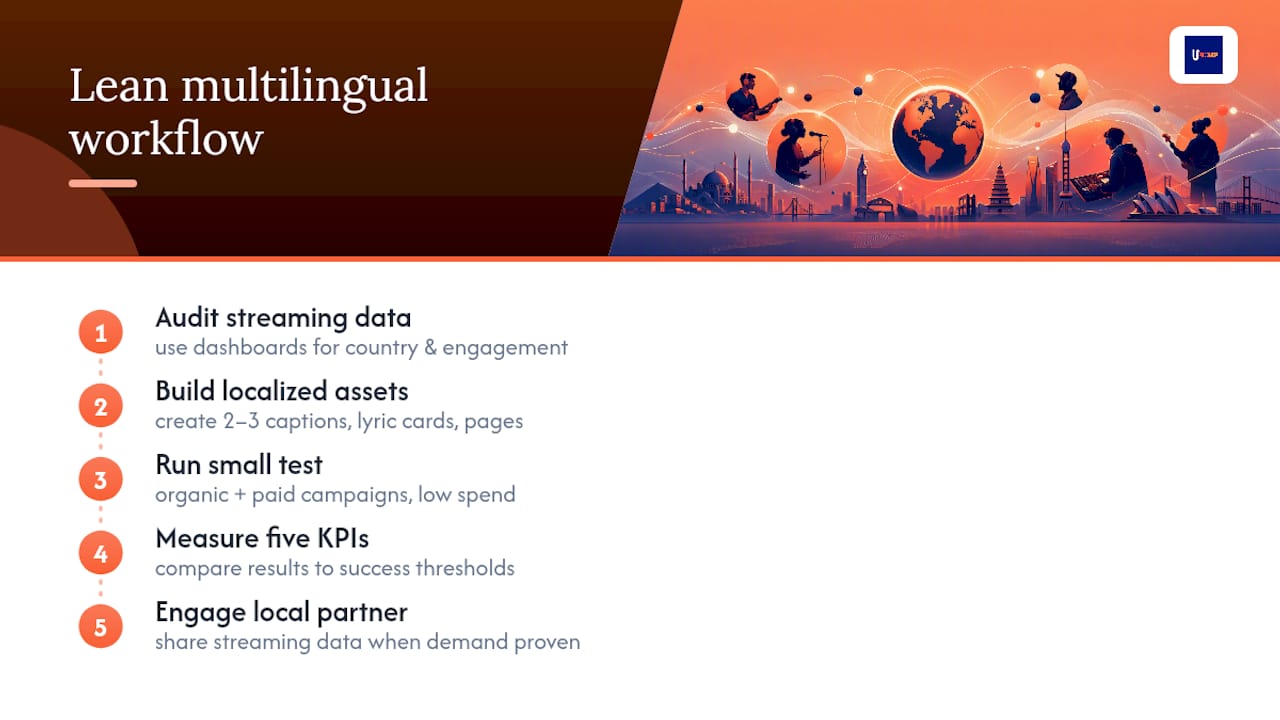
The workflow that ties it together: audit your data, build two or three localized assets, run a small test, measure against your five KPIs, then bring in a local partner (a translator, a regional influencer, or a booking contact) once the test proves demand. Brief any local partner with your streaming data attached. It’s a faster, more credible pitch than a cold outreach message with no numbers behind it.
Common Mistakes and Your First 8-Week Checklist
The most expensive mistake is skipping straight to a translated campaign without checking whether the audience exists. The second most expensive is treating translation as transcreation and publishing something that reads like it was run through a machine with no human review. The third is scaling a test before your rights and metadata are actually clean, which means you grow an audience whose royalties you can’t fully capture.
Here’s an 8-week sequence to run your first test properly:
- Weeks 1 to 2: Audit streaming data, pick one target market, fix DSP metadata and PRO registration gaps.
- Weeks 3 to 4: Build localized assets, subtitles, a lyric card, a translated caption batch, and one localized landing page.
- Weeks 5 to 6: Launch a small organic push plus a $50 to $150 ad test in the target market.
- Weeks 7 to 8: Measure your five KPIs, decide whether to scale, pull back, or pivot to a different market.
| Week | Deliverable | Key check |
|---|---|---|
| 1 to 2 | Data audit, metadata and rights cleanup | ISRCs, PRO registration confirmed |
| 3 to 4 | Localized assets built | Subtitles, lyric card, landing page live |
| 5 to 6 | Test launch | Ad spend $50 to $150, organic seeding started |
| 7 to 8 | Measurement and decision | Saves, repeats, follows, conversion reviewed |
Before any release goes live in a new market, confirm your metadata, PRO registration, pre-saves, and localized creatives are all ready on launch day. Fixing any of these after the fact costs you the first-week momentum that algorithms reward most.
How UpNComer Maps to This Workflow for Independent Artists
Every step in this playbook, the data audit, the market scoring, the asset testing, the KPI tracking, maps to a specific gap most independent artists hit when they try to run this alone with spreadsheets and five browser tabs open.
UpNComer is built as an AI-powered operating system for independent artists and music teams, bringing marketing, analytics, fan engagement, mastering, content creation, distribution, and playlist pitching into one place instead of five disconnected tools. The platform functions like a full digital music team: The platform provides guidance through AI and includes modules covering ad campaign management, streaming analytics, audience insights, fan engagement, audio mastering, smart links, and release promotion to support execution.
For an artist trying to prioritize a market, build a localized landing page, and track saves and follows in the same week, that consolidation matters more than any single feature. The platform is designed to help independent artists maintain creative and financial control while reducing reliance on multiple fragmented services, enabling decision-making from a unified dashboard.
Balancing Cultural Authenticity With Data-Led Experiments
The instinct to chase every market your streaming dashboard lights up is understandable, and it’s also how artists burn through a marketing budget without building anything lasting. Data should tell you where to test. It should never tell you how to speak to that audience.
Transcreation without cultural context reads as hollow no matter how accurate the grammar is. That’s why local partners matter before you scale, not after. Measure before you invest in a new master or a tour. Clean up your publishing and rights registration before you chase a bigger market. The artists who do this well treat data as a filter for risk, not a substitute for listening to the culture they’re entering.
— Karan
Try UpNComer to Run Your First Multilingual Test
Running the workflow in this guide by hand means juggling a distributor dashboard, a translation tool, a landing-page builder, and a spreadsheet just to launch one market test. UpNComer replaces that patchwork with one system built specifically for independent artists: streaming analytics to spot your 500-plus listener markets, campaign management to launch your test ad, and content tools to build the localized assets that make the test worth running.
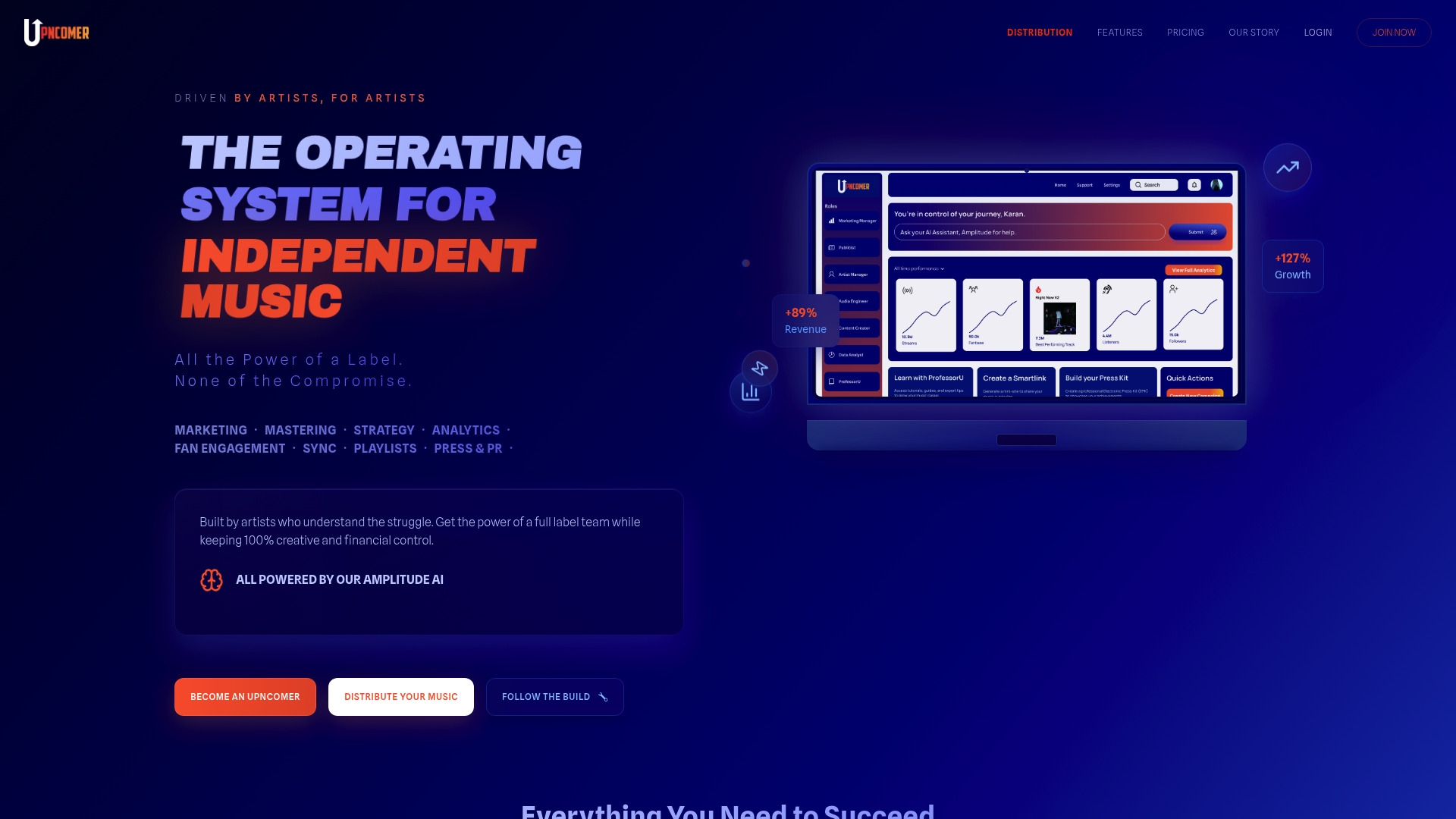
Amplitude AI helps flag which markets in your data are worth prioritizing, while the platform’s fan engagement and smart link tools let you build the localized landing page and track saves, repeats, and follows in one place instead of stitching together exports from three different apps. If you’re ready to turn a passive international audience into a tested, scalable market, explore what UpNComer offers and start your first data-backed multilingual campaign this week.
Sources
- International Music Distribution: How to Actually Build an Audience Beyond Your Home Market | Tools 4 Music
- How to Build a Global Fanbase in 2026 — lessons from BTS, Bad Bunny
- How to Build a Winning Multilingual Marketing Strategy | Crowdin
FAQ
What Is the 3-3-3 Rule for Marketing?
The 3-3-3 rule generally refers to spending three minutes on three platforms with three pieces of content daily to build consistent audience touchpoints. For multilingual testing, artists can apply a similar rhythm: three localized posts across three weeks in one target market before evaluating results.
What Are Some Effective Marketing Strategies for Artists?
Prioritizing markets using streaming data, testing lightweight localized content like subtitles and lyric cards, and tracking saves and repeat listens before scaling spend are among the most effective, low-risk strategies. Platforms like UpNComer consolidate the analytics and campaign tools needed to run these tests without juggling separate apps.
How Do You Say Artist in Different Languages?
The word varies by language: “artiste” in French, “artista” in Spanish and Italian, “künstler” in German, and “yishujia” in Mandarin. Using the correct local term matters most in bio translations and artist profile pages where accuracy builds trust with new fans.
What Are the Two Types of Multilingualism?
Multilingualism is often divided into simultaneous (learning multiple languages from early childhood) and sequential (learning additional languages after establishing a first one). For marketing purposes, the more useful distinction is between translation, adapting text directly, and transcreation, rebuilding creative intent for a new cultural context.