Batch 4 Weeks, Test 4–8: Content Pillars for Musicians

Content pillars are the 3 to 5 recurring themes that structure everything you post, so your feed reads like one artist instead of five random accounts. Start with four: music, behind-the-scenes/process, personal/interests, and promotion. Pick yours this week, then run a focused 4-week content experiment before you judge what’s working.
TL;DR:
- Focusing on four core content pillars—music, behind-the-scenes, personal interests, and promotion—helps build a recognizable artist brand and manage content workload effectively.
- Testing pillars over a month with varied formats and analyzing engagement metrics like saves, shares, and click-through rates reveals which themes resonate most with your audience.
- Most successful independent artists should start with three or four pillars, batching content creation and repurposing footage to sustain long-term, authentic engagement.
- Platform-specific adaptations include short-form videos for TikTok and Reels, deep dives for YouTube, and mixed formats for Instagram, ensuring core themes remain recognizable.
- Using AI-guided tools and analytics accelerates pillar testing, but creative decision-making remains essential; data helps refine rather than dictate content choices.
Table of Contents
- What Are Content Pillars for Musicians, and Why Do They Matter?
- How Do You Choose the Right Content Pillars?
- What Content Pillar Ideas Actually Work for Independent Artists?
- What’s the Ideal Content Mix for Musicians?
- How Do You Know If a Content Pillar Is Working?
- How Should You Adapt Content Pillars Across Platforms?
- How Does the Right Toolset Speed Up Pillar Testing?
- A Musician’s Honest Take on Building Pillars That Last
- Where to Go Deeper
- Sources
- FAQ
What Are Content Pillars for Musicians, and Why Do They Matter?
A content pillar is a recurring theme you return to on purpose, not by accident. Instead of posting whatever crosses your mind on a given Tuesday, you build around a small set of topics that express who you are as an artist. Most working musicians settle on 3 to 5 pillars because that range is wide enough to stay interesting and narrow enough to stay recognizable.
Pillars matter because fans build emotional expectations around artists the same way they do around shows. Someone who follows you for raw studio footage and diary-style captions gets confused (and eventually unfollows) if you suddenly pivot to polished promo content for three weeks straight.
Unfocused posting has a real cost. It makes your brand harder to recognize, harder to algorithmically categorize, and harder for new fans to understand in the ten seconds they spend on your profile. Clear pillars fix that by giving every post a job:
- Music pillar: shows your actual sound and craft
- Behind-the-scenes/process pillar: builds trust and intimacy
- Personal/interests pillar: makes you a person, not a product
- Promotion pillar: turns attention into streams, tickets, and sales
How Do You Choose the Right Content Pillars?
Guessing your pillars wastes weeks. Working through them in order gets you to a testable plan in one sitting.
- Audit your audience first. Check where your streaming listeners are located, which tracks perform best, and what people actually say in your comments. That data tells you what already resonates before you invent something new.
- Get clear on your identity. Ask yourself: What’s the core emotion in my music? What’s my sonic DNA? What values do I actually hold, not just claim? Brand exercises like these, including studying how peer artists present themselves, sharpen what makes you distinct.
- Brainstorm wide before narrowing. Pull ideas from your lyrics, your gear, your influences, and your daily routine. Nothing is off limits at this stage.
- Apply selection rules. Your final pillars should complement each other, feel sustainable to produce long term, and land somewhere between 3 and 5 total. More than that, and you’ll burn out trying to feed every theme every week.
- Batch and schedule one month to test. Don’t launch pillar by pillar. Produce a month of content across all of them at once, so you get a fair read on which ones actually perform.
Pro Tip: Batch a full month of content in one or two sitting sessions, then repurpose your longest clips into shorts and captions. It’s the single easiest way to protect your energy while you’re still testing what works.
What Content Pillar Ideas Actually Work for Independent Artists?
You don’t need to invent your pillars from scratch. Three starter sets cover most independent artists, and each comes with mapped post ideas you can shoot this week.
Set 1: The Classic Four (best for solo artists building a first real strategy) Music, behind-the-scenes, personal, promotion.
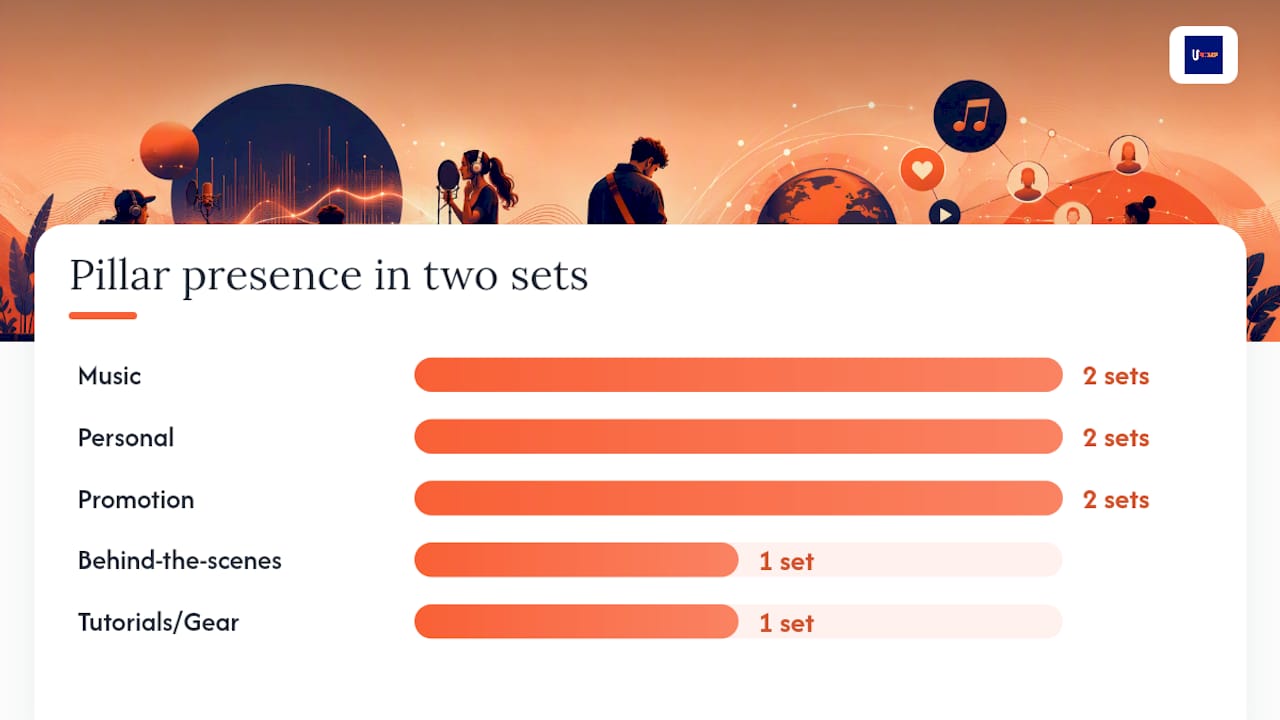
Set 2: The Educator Mix (best for artists who enjoy teaching or have a technical edge) Music, tutorials/gear breakdowns, personal, promotion.
Set 3: The Community Builder (best for artists with an active, vocal fan base) Music, fan highlights, personal, promotion.
Quick prompts mapped to each theme:
- Music: studio clip, unreleased snippet, lyric decode, cover teaser
- Behind-the-scenes/process: gear setup, mixing decision explained, songwriting voice memo, tour van chaos
- Personal/interests: a hobby outside music, a favorite album breakdown, a day-in-the-life carousel
- Promotion: merch snapshot, release countdown, pre-save reminder, tour date announcement
Adapt each idea by format: a studio clip becomes a Reel, a lyric decode becomes an Instagram carousel, and a gear breakdown becomes an email subscriber exclusive.
What’s the Ideal Content Mix for Musicians?
Most guidance points to roughly 70 to 80% non-promotional content and 20 to 30% promotional content. The idea is simple: fans stick around for the person, not the pitch, so promo needs to earn its spot rather than dominate the feed.
| Week | Music | BTS/process | Personal | Promotion |
|---|---|---|---|---|
| 1 | 2 posts | 2 posts | 1 post | 1 post |
| 2 | 1 post | 2 posts | 2 posts | 1 post |
| 3 | 2 posts | 1 post | 1 post | 2 posts |
| 4 | 1 post | 2 posts | 1 post | 2 posts |
Batch your shoots on one or two days a month, then repurpose: a single studio session can become a Reel, a carousel, and three caption ideas without you picking up a camera again.
How Do You Know If a Content Pillar Is Working?
Run each pillar for 4 to 8 weeks before drawing conclusions. Anything shorter and you’re reacting to noise, not signal. Treat the first month as data-gathering rather than a verdict, since engagement patterns take time to stabilize.
Watch these metrics:
- Engagement rate (likes, comments, shares relative to reach)
- Saves and shares specifically, which signal real value, not just a passing scroll
- Average watch time on video content
- Click-through rate to your smart links
- New mailing-list signups tied to a specific post
Statistic Callout: A pillar that consistently pulls stronger saves and shares than your other themes over a full test window is telling you something concrete about what your audience actually wants more of.
If a pillar underperforms after a fair test, revise the format before you retire it entirely. Try swapping the CTA, the thumbnail, or the length as a smaller A/B test first.
How Should You Adapt Content Pillars Across Platforms?
The same pillar can look completely different depending on where it lands, and that’s fine. What matters is that the core theme stays recognizable while the format matches the platform’s habits.
- TikTok/Reels/Shorts: front-load the hook in the first 3 seconds and shoot vertical from the start.
- YouTube: stretch your process or behind-the-scenes pillar into longer deep dives, use chapters, and invest in a strong thumbnail.
- Instagram: mix carousels with Reels for your main pillars, and use Stories for daily, lower-effort touchpoints.
- Email: turn pillar content into something exclusive, like an extended voice memo or a bonus verse, to reward subscribers for opening.
A simple repurpose checklist keeps this manageable: record long, edit short, and transcribe the audio for captions. One effective content strategy approach is to plan your monthly shoot around whichever pillar needs the most raw footage, then cut everything else from that same session.
How Does the Right Toolset Speed Up Pillar Testing?
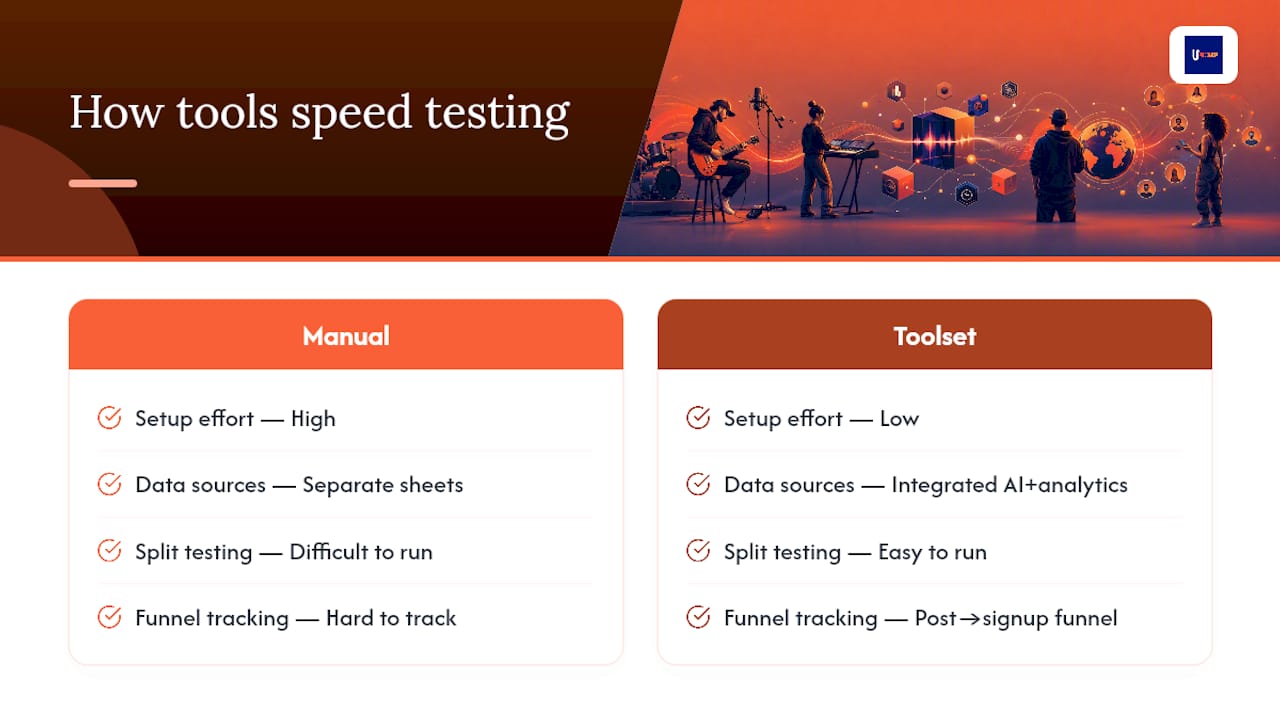
Manually tracking four pillars across five platforms gets messy fast, and that’s usually where testing quietly falls apart. Some platforms fold AI guidance together with analytics, campaign management, and content tools, so you’re not stitching together spreadsheets to see what’s working.
Two experiments this setup makes easier: splitting a pillar’s content between two audience segments to see which resonates more, and tracking a content-to-mailing-list conversion funnel from a single post through to signup. Tool-driven measurement cuts the guesswork out of iteration, but it doesn’t touch your creative choices. You still decide what gets made. The data just tells you faster what to keep making.
A Musician’s Honest Take on Building Pillars That Last
Pick pillars you’d still enjoy making at week 40, not just week 4. Metrics matter, and you should look at them honestly, but a pillar that only performs because you’re grinding through it isn’t sustainable. Authenticity holds up longer than any single viral post. Before you launch: confirm your 3 to 4 pillars, batch one month, set a measurement date, and go.
— Karan
Where to Go Deeper
For frameworks on defining your artist brand, Symphonic’s content pillar guide is a solid start. Dynamoi covers content mix ratios in more depth, and Hypebot breaks down the 80/20 brand consistency rule. For identity work, see UpNComer’s guide on how to brand yourself as an artist.
Once your pillars are locked and your content calendar is running, UpNComer’s community updates are worth following for ongoing tools and feature drops built for exactly this kind of testing. And when your promotion pillar starts converting into real listens, UpNComer’s distribution service turns that content momentum into actual streams and sales.
Sources
- How to Use Content Pillars to Define Your Artist Brand - Symphonic Blog
- The 80/20 rule and how it can make you a better, more successful musician — Hypebot
- The indie musician’s guide to building a powerful brand — Sonicbids
FAQ
What Are the 5 Content Pillars?
There’s no single fixed list. Most independent musicians work with 3 to 5 recurring themes, commonly some mix of music, behind-the-scenes/process, personal/interests, promotion, and sometimes education or fan community content.
What Is the 35-Year Rule in Music?
This isn’t an established industry standard covered by the sources here, so definitions vary widely depending on who you ask. If you’ve seen it referenced in a specific context (royalty terms, copyright reversion), check that source directly rather than relying on a general definition.
Who Refuses to Be on Spotify?
Several high-profile artists have pulled catalogs from Spotify over the years for reasons ranging from royalty disputes to platform policy disagreements, though availability shifts over time as deals change. Check an artist’s official channels for their current distribution status rather than assuming permanence either way.
How Much Does YouTube Music Pay Per 1,000,000 Streams?
Payout rates vary by region, subscription tier, and ad revenue share, and YouTube Music doesn’t publish a fixed per-stream rate. Your actual earnings depend heavily on your distributor’s deal terms and your audience’s listening habits, so check your own royalty statements for the real number.
How Many Content Pillars Should a New Artist Start With?
Start with 3 to 4. That’s enough range to keep your feed interesting without spreading your production time too thin to sustain consistently.