Artist Revenue Streams Overview for Independent Musicians
Most independent artists know what it feels like to check their streaming dashboard and feel a quiet dread. The numbers move, but the money barely does. A solid artist revenue streams overview isn’t just useful — it’s the difference between a music career that survives and one that actually grows. Streaming income alone rarely sustains a career, and the artists building real financial stability are the ones who treat their music like a business with multiple revenue sources working simultaneously. This guide breaks down every major income category, how to build your stack, and how to avoid the mistakes that keep most artists broke.
Table of Contents
- Key takeaways
- The main categories of artist income streams
- How to build your artist revenue stack
- Common pitfalls and how to avoid them
- Tools and platforms that support revenue growth
- My honest take on diversification
- Build your revenue stack with UpNComer
- FAQ
Key takeaways
| Point | Details |
|---|---|
| Streaming is just the start | Royalties are one piece of the puzzle; sustainable income requires layering multiple revenue sources. |
| Five core income categories | Recorded music, publishing, live, merch, and direct-to-fan are the foundational pillars every artist should know. |
| Build your stack step by step | Start with what you have, then add revenue sources gradually to avoid burnout and overwhelm. |
| Register your rights | PRO registration and formal business structures protect royalties you’re already earning but may be missing. |
| Use data to guide decisions | Analytics and integrated tools help you spot what’s working and where to double down. |
The main categories of artist income streams
Before you can build anything, you need to know what you’re building with. Here’s how the major artist income streams break down.
Recorded music income is what most people think of first. This includes streaming royalties from platforms like Spotify and Apple Music, digital downloads, physical sales (vinyl is genuinely back), and sync licensing fees when your music lands in a film, TV show, or ad. Spotify paid out over $11 billion to the music industry in 2025, with independent artists accounting for 50% of royalties generated on the platform. That’s real money. But per-stream rates are still fractions of a cent, which means volume alone won’t cut it.
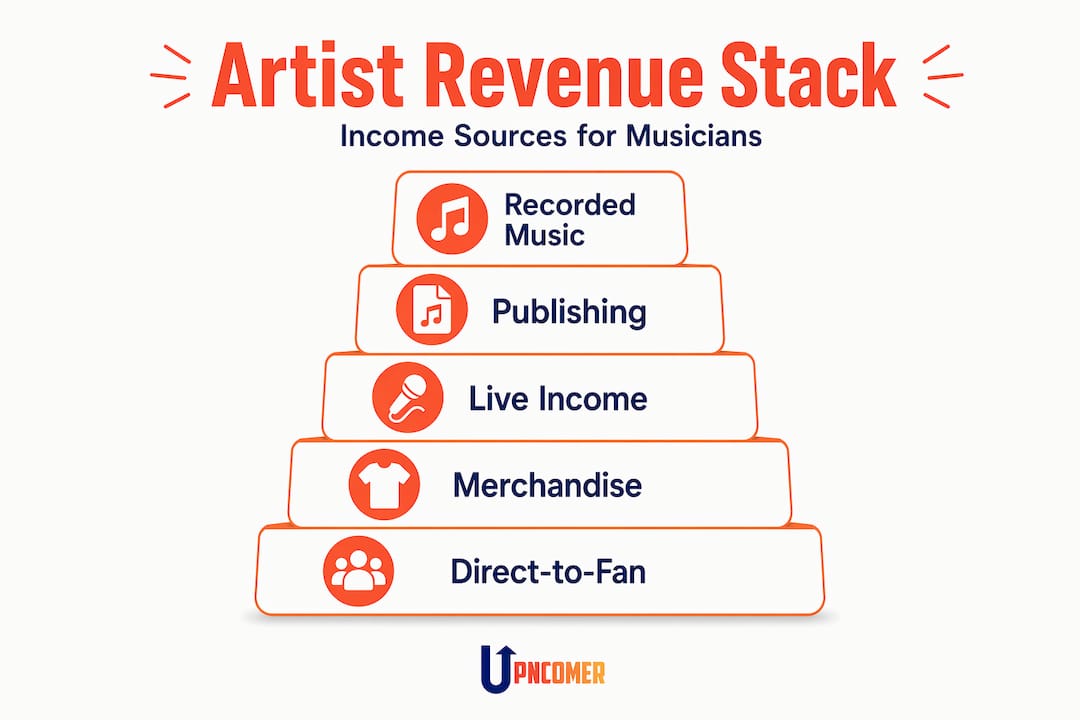
Publishing income is where a lot of independent artists leave money on the table. Publishing income includes mechanical royalties, performance royalties, sync fees, and print royalties from sheet music or lyric publications. If you write your own songs and haven’t registered with a Performing Rights Organization (PRO) like ASCAP, BMI, or SESAC, you’re giving away money every time your music gets played publicly.
Live income goes well beyond ticket sales. Live performances generate income from ticket sales, merch at shows, guarantees, and VIP experiences, and for many independent artists, a single well-run show can outperform months of streaming revenue.
Merchandise is one of the highest-margin revenue sources available to you. Merch income has high profit margins when paired with live shows or online stores and can include physical items, print-on-demand products, limited editions, and brand collaborations.
Direct-to-fan revenue is the most underused category by newer artists. Direct-to-fan strategies like Patreon, fan clubs, and exclusive content create recurring income and deepen fan loyalty in ways that streaming never will.

Here’s a quick comparison to help you see how these streams differ in effort, scalability, and timing:
| Revenue category | Upfront effort | Scalability | Income timing |
|---|---|---|---|
| Streaming royalties | Low | High | Delayed (quarterly) |
| Publishing royalties | Medium | High | Delayed (quarterly) |
| Live performances | High | Medium | Immediate |
| Merchandise | Medium | High | Immediate to short-term |
| Direct-to-fan | Medium | Medium | Recurring monthly |
| Sync licensing | High | High | Project-based |
How to build your artist revenue stack
The goal isn’t to chase every income source at once. That will burn you out before you make your first real dollar. The smarter move is to build your revenue stack in layers, starting with what you already have.
-
Maximize your streaming presence first. Think of streaming as the top of your funnel. It’s where new listeners discover you. Monitor your earnings closely using a streaming royalty calculator so you know exactly what your catalog is generating and where growth is happening.
-
Add merchandise early. You don’t need a warehouse. Print-on-demand services mean zero upfront inventory cost. Start with two or three products your audience actually wants, and test at your next live show or through your social channels.
-
Expand your live income intentionally. Smaller, targeted shows in cities where your streaming data shows listener clusters are often more profitable than chasing big venues. Add a VIP experience tier — soundcheck access, a meet-and-greet, a signed print — and watch your per-show revenue climb without needing a bigger crowd.
-
Pursue sync licensing with your existing catalog. You don’t need new music to start pitching sync. Go back through your recordings and identify tracks that could fit advertising, film, or TV. Platforms that connect artists to music supervisors make this more accessible than ever.
-
Monetize your knowledge. If you’ve been making music for a few years, you know things newer artists would pay to learn. Online workshops, one-on-one coaching, or even a simple course on your production process are legitimate revenue streams that repurpose your creative assets into multiple monetizable formats.
-
Build a direct-to-fan channel. A Patreon, a paid newsletter, or a membership community gives your superfans a way to support you monthly. Even 50 fans paying $10 a month is $500 in recurring income that doesn’t depend on an algorithm.
-
Apply the 5x Content Multiplier mindset. One song release can become a music video, a behind-the-scenes short, a lyric breakdown post, a live acoustic version, and a production tutorial. Artists maximize ROI by repurposing creative assets into at least five revenue-generating formats, multiplying income opportunities from a single project.
Pro Tip: Map out every piece of content you release and ask yourself how many ways you can monetize it before you move on. One song should open at least three to four income doors.
Common pitfalls and how to avoid them
Knowing your revenue categories and building your stack is only half the work. The other half is not sabotaging yourself along the way. Here are the mistakes that cost independent artists the most.
Relying on streaming as your only income. This is the most common trap. Payout rates fluctuate, algorithms change, and a single playlist removal can tank your monthly income overnight. Diversifying artist income across at least three categories creates a buffer that keeps you stable when one stream dips.
Not registering with a PRO. If you’re performing your own songs publicly or getting airplay and you haven’t registered, you’re forfeiting performance royalties. This is money you’ve already earned. Get registered.
Ignoring your numbers. Most artists avoid looking at their data because it feels uncomfortable. But financial discipline is key to overcoming income volatility. Pay yourself first, track every expense, and treat your spending as a strategic investment rather than a cost.
Operating without a business structure. Artists should set up formal business entities to manage contracts, revenue tracking, and intellectual property. An LLC or similar structure gives you legal protection and makes it much easier to track what’s coming in and going out.
- Audit your income monthly, not just at tax time
- Register every song with your PRO and your distributor
- Track merch costs and margins separately from music income
- Review your fan engagement metrics to spot where loyalty is strongest
- Revisit your pricing on merch, tickets, and memberships at least twice a year
Pro Tip: Set a recurring calendar reminder every 90 days to review your revenue breakdown. Knowing which streams grew and which stalled is the only way to make smart decisions about where to put your energy next.
Tools and platforms that support revenue growth
Managing multiple revenue sources for artists gets complicated fast without the right infrastructure. The good news is that the tools available to independent artists today are genuinely powerful.
| Tool category | What it does | UpNComer module |
|---|---|---|
| Streaming analytics | Tracks royalties, listener data, and growth trends | Data Analyst |
| Music distribution | Delivers your music to stores and collects royalties | Distribution |
| Fan engagement | Manages fan communities and direct-to-fan channels | Artist Manager |
| Content creation | Helps produce and repurpose content across formats | Content Creator |
| AI mastering | Delivers release-ready audio without a studio budget | UrStudio |
| PR and promotion | Pitches releases to press, playlists, and media | Publicist |
| Education and strategy | Provides guided learning on music business topics | ProfessorU |
| Ad campaigns | Runs targeted ads to grow your audience | Growth Engine |
| AI guidance | Offers personalized career strategy and decisions | Amplitude AI |
UpNComer brings all of these functions into one place, which matters more than it sounds. When your analytics, distribution, fan engagement, and content tools are all separate, you spend more time managing platforms than managing your career. An integrated system means your data talks to your strategy, and your strategy talks to your execution.
Top independent artists act as business operators, treating their creative output as a scalable brand to maximize leverage across income channels. The right tools make that possible without a full team behind you.
My honest take on diversification
I’ve watched a lot of artists chase the streaming dream and hit a wall they didn’t see coming. The numbers look promising at first. A playlist adds you, your monthly listeners spike, and for a moment it feels like things are clicking. Then the playlist drops you, the numbers fall, and the income disappears with it.
What I’ve learned is that the artists who build lasting careers aren’t necessarily the most talented ones. They’re the ones who treat their music career like a scalable business. They own their masters, they understand their publishing rights, they show up to their live shows with a merch table that actually makes money, and they have a community of fans who pay them directly every month.
The mindset shift is the hardest part. Most of us got into music because we love making it, not because we love spreadsheets. But here’s what I’ve found: once you start seeing your creative output as a brand with multiple income channels, the creative work actually gets more freeing. You’re not desperate for any single opportunity because you’re not dependent on it.
Independent creative founders thrive by paying themselves first and reducing wasteful spending. That’s not corporate advice. That’s survival strategy for artists who want to keep making music on their own terms.
Start with two revenue streams. Do them well. Then add a third. The goal isn’t to do everything. It’s to build something stable enough that you can keep creating without financial panic driving every decision.
— Karan
Build your revenue stack with UpNComer
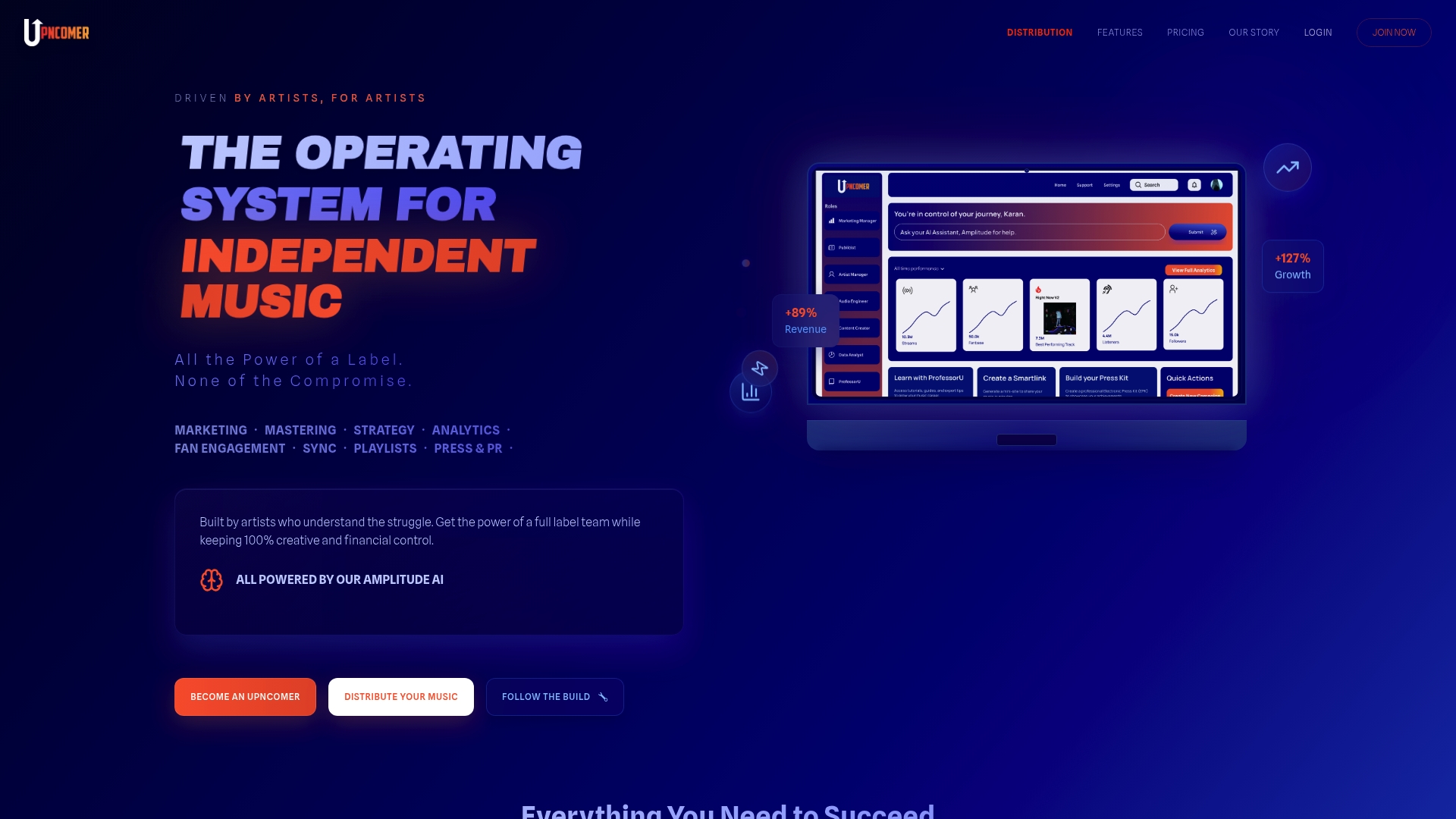
If this guide has shown you anything, it’s that building multiple revenue sources for artists isn’t about working harder. It’s about working with better tools and a clearer strategy. UpNComer is built specifically for independent artists who want to grow without a major label behind them. From tracking your streaming analytics and managing fan engagement to running ad campaigns and getting AI-powered career guidance through Amplitude AI, every module inside UpNComer is designed to help you earn more from what you’re already creating. Stop juggling five platforms and start running your music career like the business it is.
FAQ
What are the main artist revenue streams?
The five core categories are recorded music income (streaming, downloads, sync), publishing royalties, live performance income, merchandise, and direct-to-fan revenue. Most sustainable careers draw from at least three of these simultaneously.
How do independent artists earn money from streaming?
Independent artists earn per-stream royalties paid out by platforms like Spotify and Apple Music. Spotify paid out over $11 billion in 2025, with independent artists accounting for half of all royalties generated on the platform.
What is the fastest way to diversify artist income?
Adding merchandise through a print-on-demand service is one of the lowest-effort ways to open a second revenue stream quickly, since it requires no upfront inventory cost and can be promoted through channels you already use.
Do independent artists need to register with a PRO?
Yes. Registering with a Performing Rights Organization like ASCAP or BMI is how you collect performance royalties when your music is played publicly, on radio, or streamed. Without registration, those royalties go unclaimed.
How many revenue streams should an artist have?
There’s no magic number, but most financial advisors in the music industry recommend having at least three active income streams to create stability. Starting with streaming, merch, and one direct-to-fan channel gives you a solid foundation to build from.