Artist development stages: grow your music career independently
You don’t need a label to build a real music career. That idea is becoming clearer every year as independent artists rack up millions of streams, sell out tours, and land sync placements without ever signing away their masters. But here’s what most artists miss: the labels that do succeed aren’t just lucky. They follow a deliberate, phased approach to development. Understanding those stages and applying them yourself is what separates artists who gain momentum from those who stay stuck spinning their wheels.
Table of Contents
- What are the core stages of artist development?
- Stage one: Discovery and identity lock-in
- Stage two: Content, branding, and fanbase building
- Stage three: Monetization, sustainability, and scale
- Adapting development strategies in the modern era
- Why independent artists succeed by owning their journey
- Accelerate your artist journey with UpNComer
- Frequently asked questions
Key Takeaways
| Point | Details |
|---|---|
| Stages framework | Understanding each artist development stage gives you a roadmap to independence. |
| Identity first | Locking in your sound and brand early sets up every later success. |
| Consistent output | Regular content and direct fan engagement accelerate your growth more than any single viral moment. |
| Multiple revenue streams | Building income from various sources is essential for a long-term music career. |
| Adaptability | Adjusting your strategies to changing trends and platforms ensures you stay on track. |
What are the core stages of artist development?
Artist development used to mean a label signing you, locking you in a studio, and molding you into a marketable product. That model still exists, but it’s no longer the only path. For independent artists today, development is a self-directed process of building identity, audience, and income in a sequence that actually works.
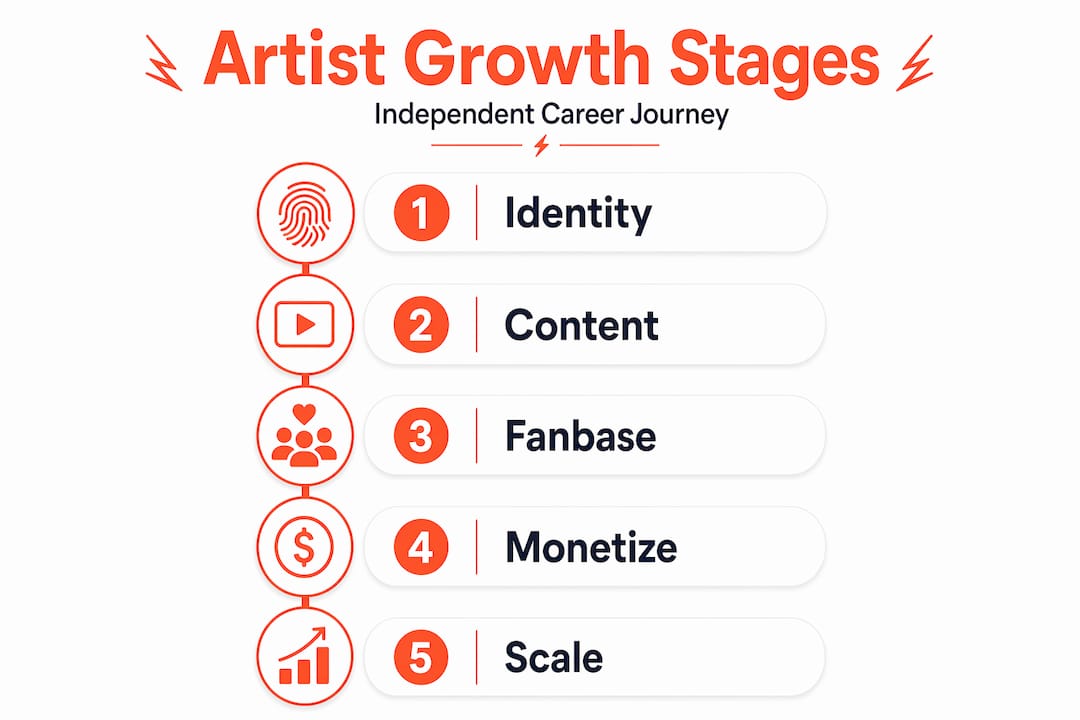
Modern artist development breaks down into four core phases:
- Discovery and identity lock-in: Clarifying your sound, story, and brand foundation
- Content and fanbase building: Creating a consistent catalog and attracting real listeners
- Monetization and sustainability: Converting attention into multiple revenue streams
- Scale and adaptation: Expanding what’s working and pivoting what isn’t
Each phase builds directly on the one before it. Trying to monetize before you’ve built a fanbase is like opening a store before anyone knows you exist. Jumping into heavy content creation before your identity is locked in means you’ll confuse potential fans and waste energy. The sequence matters.
One thing worth knowing upfront: sustainable careers take 3-7 years of consistent, focused effort. That’s not meant to discourage you. It’s meant to help you plan realistically and stop chasing shortcuts that don’t exist. Understanding artist development program components that actually move the needle is the first step toward building something that lasts.
Here’s a quick comparison of the traditional label approach versus the modern independent model:
| Factor | Traditional label path | Independent path |
|---|---|---|
| Identity control | Label-driven | Artist-owned |
| Timeline | Often 1-2 years forced | 3-7 years self-paced |
| Revenue ownership | Split heavily with label | Artist retains majority |
| Audience relationship | Label-mediated | Direct fan connection |
| Flexibility | Low | High |
Getting music branding basics right from the start gives you a serious advantage in the independent model. Your brand is your foundation, and everything else is built on top of it.
Stage one: Discovery and identity lock-in
With the big picture in place, let’s dive into the first and arguably most critical stage.
Discovery is where most artists underinvest. It feels less exciting than releasing music or performing, so people rush through it. But skipping this stage is why so many artists release project after project and never build real momentum. Without a clear identity, your music doesn’t have a home in a listener’s mind.
Identity lock-in means answering three core questions with confidence:
- Who are you as an artist? What values, experiences, and perspectives shape your music?
- What is your sound? Not just genre, but the specific emotional territory you occupy.
- Who is your audience? Not “everyone who likes music,” but the specific people who need what you make.
This stage involves honest self-analysis, genre exploration, and gathering objective feedback. Play your music for people outside your immediate circle. Study artists who influence you and identify what specifically draws you to them. Experiment with sounds, but document what feels most authentic versus what feels like imitation.
“The artists who build lasting careers are the ones who know exactly who they are before they ask anyone else to care.” — A recurring truth across every successful independent artist story.
Systems like 90-day blueprints for rapid onboarding, covering identity lock-in and release planning, give you a structured way to move through this stage without getting lost in endless self-reflection. Structure helps you make decisions and move forward.
Common pitfalls in this stage include aimless output (releasing music before your identity is clear) and trying to appeal to too many audiences at once. Both lead to the same result: a scattered catalog that doesn’t build on itself.
Pro Tip: Spend one focused week writing out your core values, your top five musical influences, and three adjectives you want fans to use when describing your music. That exercise alone will sharpen your creative decisions for every release that follows.
Investing time in branding through video during this stage helps you test how your identity translates visually before you commit to a full release strategy.
Stage two: Content, branding, and fanbase building
Once your identity is set, the focus shifts to sharing it and attracting your audience.

This is where most of the visible work happens. You’re creating music, building your visual identity, showing up consistently, and converting casual listeners into real fans. It’s exciting, but it can also burn you out if you don’t have a system.
Here’s a step-by-step approach to building your first 1,000 genuine fans:
- Release consistently. A consistent cadence every 6-10 weeks, combined with direct fan relationships built through shows, keeps your audience engaged and growing.
- Build your visual identity. Your logo, press photos, color palette, and content aesthetic should all tell the same story. Inconsistency here creates friction for new fans trying to understand who you are.
- Show up in person. Live shows, local events, and open mics are still among the most effective ways to build a core fanbase. These are people who chose to be in a room with you.
- Create content around your music, not just the music itself. Behind-the-scenes footage, lyric breakdowns, and personal stories give fans a reason to connect beyond the songs.
- Start your email or SMS list immediately. This is non-negotiable.
Pro Tip: Email and SMS lists consistently outperform social media for fan engagement. Open rates of 30-45% are common for artist email lists, compared to single-digit organic reach on most social platforms. You own your list. You don’t own your followers.
Here’s a look at how different content types perform for independent artists in this stage:
| Content type | Reach potential | Engagement depth | Ownership |
|---|---|---|---|
| Social media posts | High | Low to medium | Platform-dependent |
| Email newsletters | Medium | High | Artist-owned |
| Live performances | Low | Very high | Artist-owned |
| Short-form video | Very high | Low | Platform-dependent |
| SMS updates | Low | Very high | Artist-owned |
Tracking engagement and iterating based on feedback is what separates artists who grow from those who plateau. Check which songs get saved, which posts get shared, and which shows bring people back. That data tells you what’s working. Solid music campaign strategies help you turn that data into action rather than just observation.
For more on getting your music in front of new listeners, song promotion strategies that focus on organic reach are worth studying closely.
Stage three: Monetization, sustainability, and scale
Turning attention into income is where careers take shape. Let’s explore what this looks like.
Most artists think about revenue too late or too narrowly. Streaming royalties alone won’t sustain a career for the vast majority of independent artists. The artists who make it work build multiple streams that reinforce each other.
Here are the core revenue streams to develop over time:
- Streaming and digital distribution: Your catalog working for you passively
- Live performance: Ticket sales, guarantees, and merchandise at shows
- Merch: Physical and digital products that superfans want to own
- Sync and licensing: Music placed in TV, film, ads, and games
- Collaborations: Features, co-writes, and producer placements
- Brand partnerships: Sponsorships and endorsements as your audience grows
Catalog building, touring infrastructure, multiple revenue streams including merch, syncs, and live performance, and brand extensions are the building blocks of a truly sustainable independent career. Notice that none of those require a label.
Here’s a practical step-by-step for scaling your revenue:
- Maximize your catalog. Every song you release is an asset. Prioritize quality and release frequency to grow your passive income base.
- Build a touring infrastructure. Even small regional tours build loyal audiences and generate real income.
- Launch merch early. You don’t need a massive audience to sell merch. Even 100 superfans will buy if the product is meaningful and well-designed.
- Pitch for sync placements. Music libraries and sync agencies are accessible to independent artists. One placement can generate more income than months of streaming.
- Pursue brand partnerships strategically. Align with brands that your audience already loves. Authenticity matters more than reach here.
“The 3-7 year timeline isn’t a sentence. It’s a runway. Artists who understand this stop sprinting and start building.” — A mindset shift that changes everything about how you approach the work.
Quarterly reviews and SMART goals (Specific, Measurable, Achievable, Relevant, and Time-bound) are the systems that prevent burnout and keep you moving forward without losing direction. Schedule them like you’d schedule a studio session. For a deeper look at music income strategies that work for independent artists, the principles around diversification and direct sales are especially relevant.
Check out development program essentials to understand which infrastructure pieces support long-term monetization.
Adapting development strategies in the modern era
With the fundamentals established, here’s how to stay adaptable and future-ready as the music landscape evolves.
The stages above are a framework, not a rigid checklist. Real careers don’t move in a straight line. You might be in the monetization stage for your main project while still in the discovery stage for a new sound you’re exploring. That’s fine. What matters is knowing where your bottlenecks are and addressing them directly.
Here’s how to stay adaptive:
- Identify your current bottleneck. Is it reach, engagement, conversion, or retention? Each requires a different strategy.
- Use TikTok and short-form video for discovery, but don’t stop there. These platforms are great for reaching new listeners, but they’re terrible for building deep fan relationships. Use them as the top of your funnel, not the whole funnel.
- Prioritize live shows for superfan development. The fans who show up in person are your most valuable audience. They buy merch, bring friends, and spread the word. Quarterly reviews and SMART goals prevent burnout and help you adapt phases to your actual bottlenecks, whether that’s TikTok discovery or Spotify retention.
- Study artists who adapted successfully. Many independent artists who built sustainable careers did so by pivoting their strategy based on what their audience was actually responding to, not what they assumed would work.
Pro Tip: Schedule a 90-minute strategy review every quarter. Look at your streaming data, social engagement, email open rates, and live show attendance. Ask one question: where is growth happening, and how do I double down on it?
Staying current on key music marketing trends helps you spot opportunities before they become crowded. Explore alternatives for artist growth systems that give you more control and visibility over your development.
Why independent artists succeed by owning their journey
Here’s a perspective you won’t hear from the old-school industry.
Most conversations about artist development focus on talent or systems. And yes, both matter. But the real differentiator for independent artists in 2026 is ownership. Not just ownership of your masters, but ownership of your audience, your strategy, and your story.
Consistency over 18 or more months leads to inflection points regardless of whether you take an artistic-first or business-first approach. That’s not a theory. That’s a pattern observed across artists at every level.
Waiting to be discovered is a passive strategy in an active market. The artists who break through aren’t necessarily the most talented. They’re the ones who show up consistently, build real relationships with their fans, and treat their career like a business without losing the soul of why they make music.
The direct fan relationship is the new A&R. When you own your email list, your merch store, and your live show experience, you don’t need a label to validate your career. You have the data, the audience, and the infrastructure to make decisions on your own terms.
Understanding what matters in development means recognizing that the creative side and the business side aren’t in conflict. They’re both part of the same career. Artists who master both, even imperfectly, are the ones who build something lasting.
Accelerate your artist journey with UpNComer
If you’re ready to put these insights into practice, the right tools and community make all the difference.
UpNComer is built specifically for independent artists who are serious about growing their careers without giving up creative or financial control. Whether you’re in the discovery stage trying to lock in your identity, in the fanbase-building phase looking to run smarter campaigns, or scaling toward sustainable revenue, UpNComer brings everything into one place.
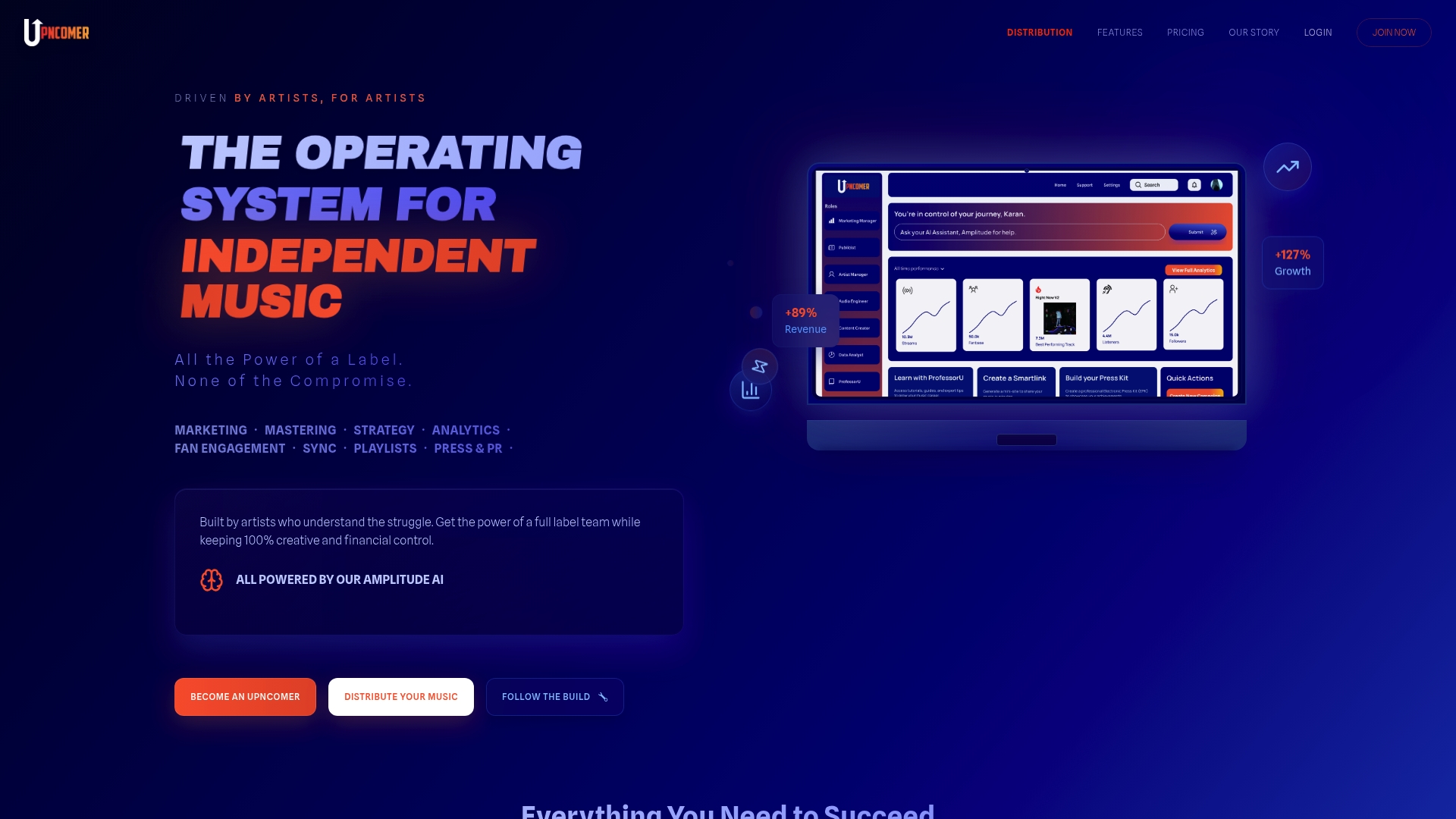
From AI-powered guidance through Amplitude AI to streaming analytics, fan engagement tools, ad campaign management, and release promotion, the UpNComer platform acts like a full digital music team. You get the kind of infrastructure that used to be reserved for major-label artists, without the label. Stop juggling ten different tools and start building with a system designed for where you actually want to go.
Frequently asked questions
How long does it usually take to become a sustainable independent artist?
For most artists, sustainable careers require 3-7 years of focused, consistent work and catalog building. There are no reliable shortcuts, but the right strategy makes every year count more.
What should I prioritize in my first year as an artist?
Focus on locking in your identity, establishing a consistent release schedule, and building your core fanbase through direct engagement. 90-day blueprints that cover identity lock-in and release planning are a practical way to structure that first year.
Why are email and SMS lists better than just social media for artists?
Email and SMS lists give you direct access to your audience with open rates of 30-45%, compared to the single-digit organic reach most social platforms deliver. More importantly, you own that list regardless of algorithm changes.
Can you skip a development stage if you go viral early?
Viral exposure can accelerate your timeline, but it doesn’t replace the work. Artists who achieve viral breakthroughs via platforms like TikTok still need a solid catalog, touring infrastructure, and direct fan relationships to convert that moment into a lasting career.