Music Press Release Template for Indie Artists: Copy & Send
Here’s a music press release template you can copy, customize, and send today:
FOR IMMEDIATE RELEASE
[ARTIST NAME] Releases New Single “[TITLE]” — [One-Line Hook About Why This Matters Now]
[CITY, STATE] — [Month Day, Year] — [Artist Name], the [genre] artist known for [one credibility marker: prior release, milestone, or press mention], releases their new single “[Title]” on [release date] via [label/distributor]. The track [describe the sound and theme in one sentence, plus what makes it stand out].
“,” says [Artist Name].
The single follows [prior release or context] and arrives ahead of [upcoming show/tour/EP, if relevant]. Stream “[Title]” here: [Smart Link].
[Artist Name] is a [one or two sentence boilerplate bio: hometown, genre, key achievements, prior press or streaming numbers].
Media Contact: [Name] | [Email] | [Phone, optional] Full EPK and photos: [Hosted EPK link]
Keep the whole thing to one page and roughly 400 to 500 words, the length editors actually read before they decide whether your story is worth a reply. Save it as plain text for email pitches or export it as a clean PDF for attachments.
Before you send it anywhere, swap out these fields:
- Artist name and genre descriptor
- Release title, release date, and format (single, EP, album)
- One credibility marker (a stat, a milestone, a past write-up)
- Streaming Smart Link and hosted EPK link
- Media contact name, email, and phone
Pro Tip: Write the headline last. Draft the body first, find the one sentence that actually surprises you, then build the headline around that.
Key Takeaways
A music press release works when it stays under 500 words, leads with one clear news hook, and links to a hosted EPK instead of attaching files.
| Point | Details |
|---|---|
| Customize the template now | Fill in artist name, release title, date, streaming link, and contact info before you draft anything else. |
| Keep it to one page | Stay within 400 to 500 words and use the proven structure: headline, lead, quote, boilerplate, contact. |
| Build your hosted EPK | Include a short bio, 3 to 5 tracks, photos, and one labeled streaming link before pitching anyone. |
| Send links, not attachments | Use unlisted streams and hosted pages so files stay current and emails load fast. |
| Plan the send, not just the write | UpNComer’s Distribution and Content Creator modules help schedule releases and track which pitches convert. |
Table of Contents
- What Belongs in a Music Press Release and Why
- Ready-to-Use Templates for Every Release Type
- Two Filled Examples to Model Your Tone After
- Seven Ways to Improve Your Pick-Up Rate
- How to Actually Send the Thing
- Where the Press Release Fits Into Your EPK
- A Realistic Take on What a Press Release Actually Does
- Turn This Template Into a Full Release Plan
- Sources
- FAQ
What Belongs in a Music Press Release and Why
A press release isn’t a bio and it isn’t a fan letter. It’s a news briefing, and editors read it the same way they read any other pitch: fast, skeptical, and looking for a reason to keep going past the first line. The proven structure that actually gets read has nine parts, and each one earns its place.
- Headline: States the news in one line. “New single out now” is not news. “First single since [milestone]” is.
- Subheadline (optional): Adds context the headline couldn’t fit, like a feature or a theme.
- Dateline: City, state, and date, right before the lead. Non-negotiable format, skip it and you look like an amateur.
- Lead paragraph: Answers who, what, when, where, and why in two or three sentences, max.
- Body paragraphs: Fill in texture, backstory, collaborators, or the arc that led here.
- Artist quote: One specific, human sentence. Not “I’m so excited,” but something only this artist would say.
- Release details: Format, date, distributor, and where to stream.
- Boilerplate bio: Two or three sentences an editor could paste into their own copy.
- Media contact: Name, email, and a link to your full EPK.
Word count matters more than most artists think. Editors skim a release in under a minute, and a 400 to 500 word release respects that. Use a plain font, label your contact info clearly, and link to assets instead of attaching them.
The hardest part isn’t formatting, it’s picking your hook. Journalists want one clear angle, not a highlight reel of your whole career. If your story is blurry, the release will fail before it’s even read. Ask yourself: why does this matter this week, to this reader, and not last month or next month? Put that answer in sentence one.
Ready-to-Use Templates for Every Release Type
Different releases need different leads, but the skeleton stays the same. Adapt the base template above using these variations.
Single release: Lead with the hook and the streaming link up top. Keep the body under 300 words since there’s less to say.
Album or EP release: Add a tracklist, a note on the concept or theme, and mention any featured collaborators in the second paragraph, not the lead.
Tour announcement: Lead with the first and last date, list the full run in a simple block, and include the ticket link immediately after the dateline.
Remix or collaboration: Name both artists in the headline, and let the quote come from whichever artist has the stronger story hook for that specific outlet.
| Output Format | Best For | Where to Use It |
|---|---|---|
| Plain text | Cold email pitches | Body of the email itself |
| PDF one-pager | Attachments, press kits | Radio, print magazines |
| Hosted EPK page | Full asset access | Blogs, playlist curators |
| Smart Link | Streaming access | Every pitch, every time |
Copy whichever version matches your release, drop it into your own document or your EPK, and start filling in the brackets.
Two Filled Examples to Model Your Tone After
Seeing a finished release makes the structure click faster than any explanation. Here’s a filled single example:
FOR IMMEDIATE RELEASE
Mara Vale Releases “Static Bloom,” Her First Single Since Signing With Independent Label Coastline Records
PORTLAND, OR — March 3, 2026 — Indie-folk artist Mara Vale releases “Static Bloom” today, her first new music since her 2024 EP crossed 500,000 streams on Spotify. The track blends analog synth textures with Vale’s signature fingerpicked guitar, written during a six-month stretch of touring solo across the Pacific Northwest.
“I wrote this on a tour bus at 2 a.m. after a show where nobody showed up,” says Vale. “It’s about deciding to keep going anyway.”
“Static Bloom” is out now on all platforms via Coastline Records. Stream it here: [smart link].
Mara Vale is a Portland-based singer-songwriter whose 2024 EP Low Tide Static was featured on three regional playlists and streamed over 500,000 times.
Media Contact: Jules Ferrara | jules@coastlinerecords.com | Full EPK: [link]
Notice what’s doing the work: the headline names a real milestone (signing with a label), the quote is specific and slightly vulnerable instead of generic excitement, and the boilerplate leads with a real number instead of a vague claim.
- The news hook lives in the headline, not buried in paragraph three.
- The quote answers “why this song, why now,” not “how does it feel to release music.”
- The boilerplate compresses an entire artist bio into two sentences an editor can lift directly.
For an album release, swap the hook to something structural: a theme, a guest producer, or a milestone like a fifth anniversary since the debut. Blogs want personality and a strong quote. Magazines want context and a boilerplate that reads like a bio. Radio wants the format, runtime, and station-ready audio link front and center.
Seven Ways to Improve Your Pick-Up Rate
Most releases don’t fail because the writing is bad. They fail because of small, fixable habits.
- Write the lead first, then cut it in half. If it still makes sense, it’s tight enough.
- Make the quote earn its spot. Cut any line that could’ve come from any artist.
- Use an unlisted streaming link, not a public one, so the editor knows they’re hearing it early.
- Tailor the pitch to the outlet. A blog wants tone. A magazine wants context. Radio wants format specs.
- Send singles two to three weeks out, albums four to six weeks out, and tour announcements as soon as dates are locked.
- Keep the file size small. Link, don’t attach, especially for audio and photos.
- Proofread the contact info last. A broken email address is the single most common reason a real interest never converts.
Pro Tip: Send the release as plain text in the body of the email, not as an attached document. Editors are far more likely to open and read something they don’t have to download first, and hosted links load faster and stay current compared to a file sitting in someone’s downloads folder.
The most common mistake isn’t structural, it’s tone. Overly promotional language (“groundbreaking,” “must-hear”) reads as a red flag to anyone who reads pitches for a living. State the facts and let the quote carry the emotion.
How to Actually Send the Thing
A great release sent badly still gets ignored. The send matters almost as much as the writing.
Subject line formulas that work:
- “New Single From [Artist] — Out [Date]”
- “[Artist] Announces First Album in Two Years”
- “Exclusive: [Artist]'s New Single, Premiering [Date]”
Open the email with one sentence that states the news, not a greeting. Something like: “[Artist Name] releases their new single ‘[Title]’ on [date], and I’d love for you to hear it first.”
Building your recipient list:
- Start with outlets and curators who’ve covered similar artists in your genre.
- Prioritize smaller, local, or genre-specific blogs over major outlets early in your career. They respond faster and cover more consistently.
- Personalize the first line of every email, even at scale. Reference something specific the outlet has covered before.
What to attach versus link:
- Never attach audio files directly, link to an unlisted stream instead.
- Provide photos through a hosted EPK page rather than email attachments.
- Send the press release as plain text in the email body, with a PDF version available on request.
Follow up once, five to seven business days later, with a short note: “Wanted to make sure this landed. Happy to send anything else you need.” One follow-up is professional. A second one, without a reply, starts to look like pressure.
Where the Press Release Fits Into Your EPK
A press release is one document. An Electronic Press Kit (EPK) is the full package that press release links back to, and a hosted web page almost always outperforms a folder of attachments because it stays current and loads fast on mobile.

| EPK Element | What to Include |
|---|---|
| Short bio | 2 to 3 sentences for quick scanning |
| Long bio | Full paragraph with career context |
| Best tracks | 3 to 5 songs, featured track first |
| Videos | 2 to 3, including live performance if available |
| Press quotes | Prior coverage or notable mentions |
| High-res photos | Downloadable, properly credited |
| Contact info | Name, email, management if applicable |
| Streaming link | One Smart Link, labeled clean/explicit if relevant |
Build the kit with a specific reader in mind. A festival booker and a blog editor want different things from the same page, so order your assets around whichever pitch you’re sending that week.
- Lead with your strongest, most recent track, not your oldest one.
- Keep the page mobile-friendly since most editors open links from their phone.
- Label file versions clearly (clean/explicit) so a reviewer doesn’t open the wrong one and move on.
Centralizing all of this matters more as your release calendar gets busier. UpNComer’s Distribution and Content Creator modules keep your streaming links, press assets, and release timelines in one place instead of scattered across drives and old email threads, and Amplitude AI can help you track which pitches actually convert into coverage or streams.
A Realistic Take on What a Press Release Actually Does
A perfect press release does not guarantee coverage. That’s the part most guides skip because it’s less exciting to say, but it’s the truth: a release only lowers the barrier to coverage. The story still has to be genuinely interesting, the fit with that outlet still has to make sense, and the timing still has to land before an editor’s plate is already full.
What that means practically is you shouldn’t measure success by “did this one release get picked up.” Measure it by whether your hook was sharp, your quote was specific, and your list was targeted. Do those three things consistently across every release, and your hit rate climbs over time even if any single pitch misses. A press release is one tool in a release plan, not the whole plan. It works best alongside a rollout calendar, an active EPK, and playlist pitching that runs on its own timeline. Rehearse your pitch out loud before you send it. If it sounds like a press release when you say it, rewrite it until it sounds like you talking to a friend about music you’re proud of.
Turn This Template Into a Full Release Plan
A press release template gets your story written, but sending it well and tracking what happens after is a different job entirely. UpNComer centralizes exactly that: distribution, EPK hosting, playlist pitching, and performance data live in one dashboard instead of five disconnected tools.
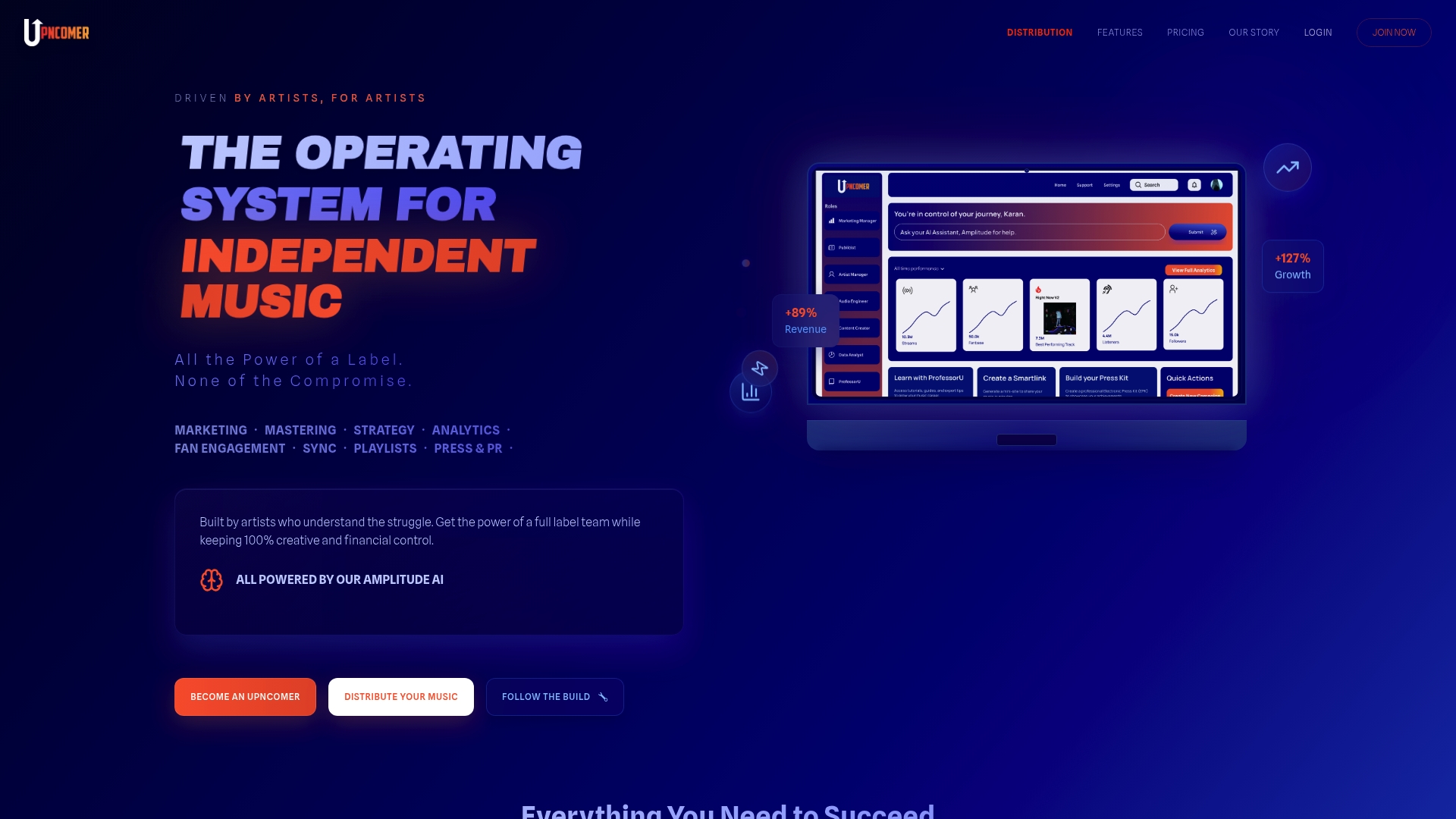
Once your release is out, UpNComer’s Distribution module gets your music onto every major platform while you keep 100 percent of your rights and pay no subscription fee for distribution, just a small royalty split. Amplitude AI then tracks which pitches, playlists, and posts are actually moving your streams, so you stop guessing what worked. Publicist and Content Creator help you build the follow-up content calendar so your press push doesn’t end the day the release goes out. If you’re ready to plan your next release from one place instead of six browser tabs, start with UpNComer’s distribution tools and get your press kit, streaming links, and campaign timeline connected before your next send.
Sources
A few tools are worth keeping on hand alongside your own template. Visme’s music press release template is design-forward and exports to PDF, JPG, or HTML5 if you want a visual one-sheet. Canva’s press release library works well for artists who want something printable and editable fast. Jotform’s PDF template is a simple, field-based option if you just want something clean and quick. PBJStories’ printable PDF shows a journalist-friendly layout for listing formats, release details, and optional tour dates.
For the writing itself, pair any design template with a plain-text version, since design tools work best alongside a text-first email pitch, not instead of one. If you want to go deeper on the outreach side, UpNComer’s guide to music PR for artists covers how to build a full pitching strategy around your release, and the artist rollout plan guide shows where your press release fits into a longer campaign timeline.
- Music Press Release: Samples, Templates & Tips
- How to Build Your First Electronic Press Kit (EPK)
- Musician Press Release Template That Works
- The art of sending your music to
FAQ
How Long Should a Music Press Release Be?
Keep it to one page, roughly 400 to 500 words, covering the headline, lead, quote, and boilerplate without extra padding.
What’s the Difference Between a Press Release and an EPK?
A press release announces one specific piece of news, while an EPK is the full asset package it links back to, including bios, tracks, videos, and photos.
Should I Attach My Music or Send a Link?
Always send a link. Hosted streams and unlisted links load faster, stay current, and avoid clogging an editor’s inbox with large files.
How Do I Find the Right News Hook for My Release?
Ask why this release matters this week specifically, not generally. A clear, single angle, like a milestone, collaboration, or backstory, beats a vague announcement every time.

Can UpNComer Help With Distribution After I Send My Press Release?
Yes. UpNComer’s Distribution module gets your release onto major platforms with no subscription fee, just a small royalty split, and Amplitude AI tracks which pitches are actually driving streams.