Top 4 Music Ads Alternatives 2026

Running music ad campaigns, tracking fan data, and linking streaming results is confusing when you juggle separate tools. Most music ad platforms force you to pay for multiple subscriptions, limit automation, or restrict campaign options behind expensive upgrades. This comparison covers pricing, automation, and feature access so you can choose a single music marketing platform that matches your release plans and ad needs.
Table of Contents
UpNComer
At a Glance
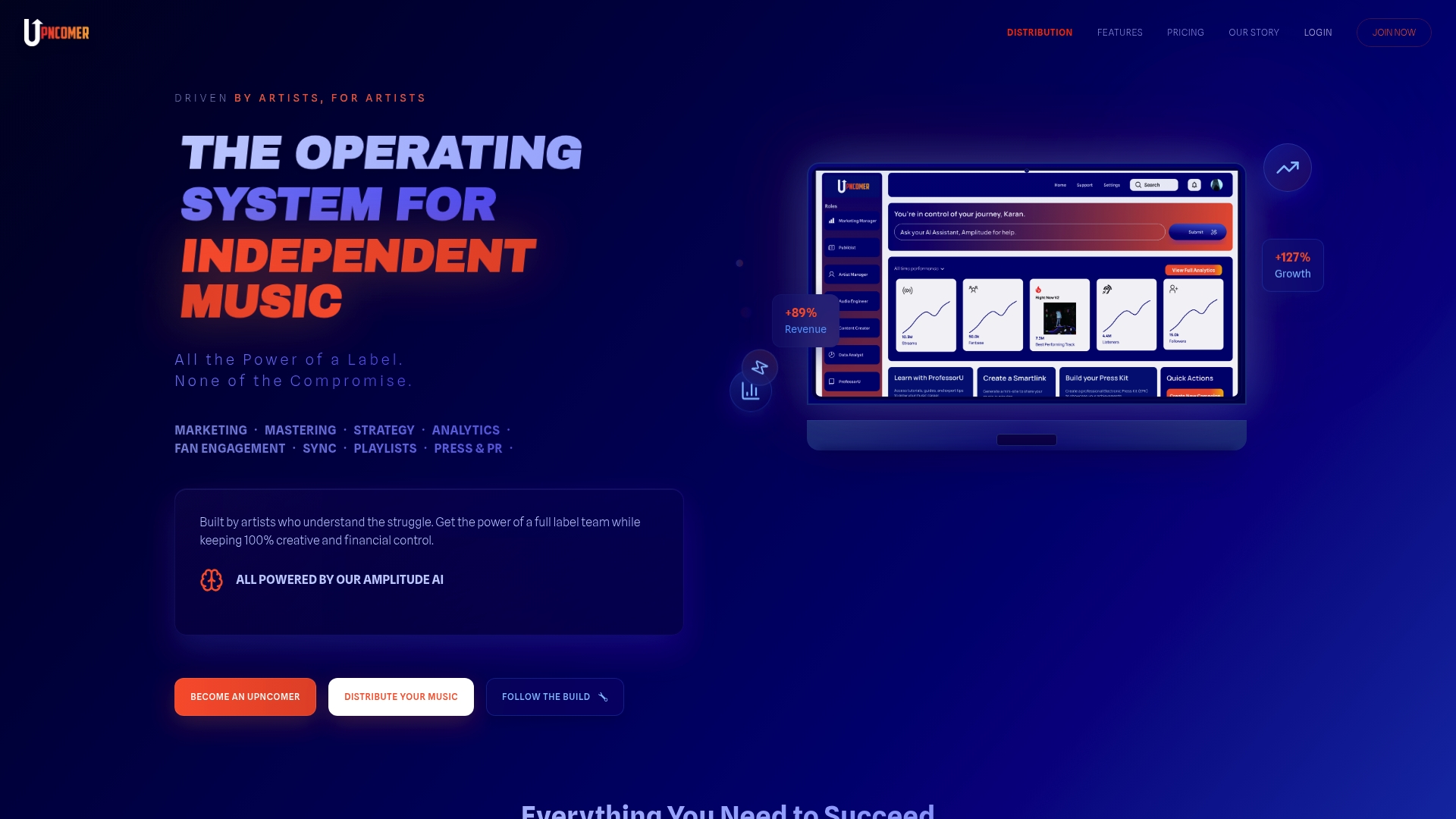
UpNComer lists a single entry price of $27/month, positioned as a substitute for multiple expensive services. The platform groups campaign management, distribution, mastering, and analytics inside one interface. That packaging aims to let an independent artist run release promotion and ads without assembling separate vendors.
Core Features
- AI-powered marketing campaigns and ad optimization that set targeting and creative tests. These tools are meant to reduce manual campaign setup and testing time.
- Artist management tools, including smart links and revenue tracking, so you can collect links and monitor payouts in one place.
- Real-time performance analytics that pull streaming and engagement data to a single dashboard for quicker decisions.
- AI content creation and scheduling for social posts and promo assets, with automated publishing workflows.
- Playlist pitching and press outreach automation through a Publicist module, plus educational content via ProfessorU, both listed as forthcoming for broader release.
Key Differentiator
The platform’s core claim is a single interface that replaces separate distribution, analytics, ad management, and mastering tools. That focus reduces the number of logins and manual handoffs when you run a release. For artists who run their own campaigns, the value is fewer moving parts and a single place to measure ad to streaming conversions.
Pros
- The price point is concrete. At $27/month the vendor positions the product as an inexpensive alternative to hiring multiple vendors or agencies.
- Integrates release tasks in one workspace. You can upload masters, launch distribution, and start a campaign without copying data across tools.
- The vendor advertises a high success rate, claiming hundreds of artists have seen growth and higher revenue using the platform.
- The vendor says artists retain 100% of royalties, which keeps ownership and payout control with the creator rather than the service.
- AI features reduce repetitive setup work. For a solo artist, that means spending more time on music and less on campaign mechanics.
Cons
- The product assumes you accept AI-driven automation. Artists who prefer hands-on, human-led management or bespoke PR will find limits to personal customization.
Who It’s For
This is for solo independent musicians and small teams who run their own marketing and want to consolidate tools. If you manage your own ads, distribution, and social posting, the platform reduces vendor juggling. If you require bespoke label-style services, this may not replace a dedicated manager or agency.
Unique Value Proposition
Amplitude AI-guided ad optimization sits at the center of UpNComer’s workflow. That feature routes campaign signals into analytics and then into distribution decisions, so creative testing, playlist pitching, and release timing share the same data set. For artists who measure ad spend against monthly listener changes, that single feedback loop replaces stitching together spreadsheets and separate dashboards.
Real World Use Case
A singer-songwriter uploads a mastered track, schedules a release, then launches an ad cohort targeted by listener data. The campaign and streaming analytics live in the same dashboard. The artist uses AI-suggested creative variations and watches which ads convert to saves and playlist adds.
Pricing
UpNComer lists a monthly Pro plan at $27/month, with annual billing options available. The vendor states there is no credit card required to start, which lowers the friction for testing the platform.
Website: https://upncomer.co
SymphonyOS
At a Glance
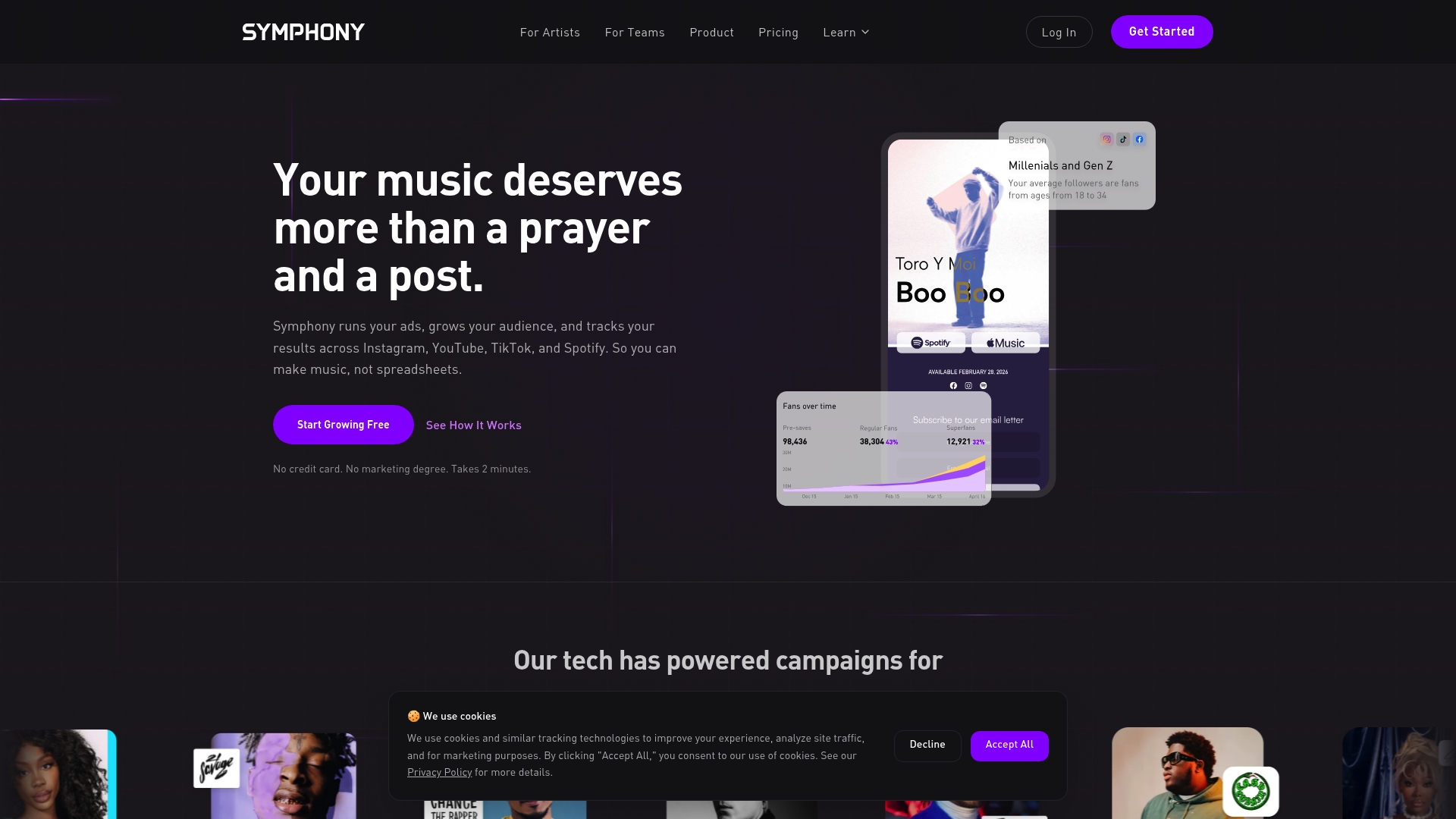
SymphonyOS reports an AI powered system that recommends audiences and adjusts bids in real time to run music ad campaigns across socials and streaming platforms. That focus on automation aims to cut the manual work of ad setup and optimization for artists and small teams. The result is a single dashboard where you can manage campaigns, fans, and multiple artist accounts.
Core Features
SymphonyOS groups marketing work into a few practical toolsets you will use every week.
- AI powered campaign creation that recommends target audiences and optimizes in real time.
- Cross platform integration with major streaming services and social networks for campaign delivery and attribution.
- Automated bid management and creative suggestions to adjust spend and assets during a campaign.
- Fan data collection with a CRM and segmentation to build mailing lists and retargeting groups.
- Centralized dashboard for managing multiple artists and teams with role based permissions and collaboration tools.
Key Differentiator
SymphonyOS centers its value on combining campaign creation, automation, and analytics in one place for music projects. The platform ties those parts together so you can set goals, run ads across platforms, and read results without moving data between tools. That approach suits teams that want fewer point solutions and more one place control over campaign flows.
Pros
-
User friendly for non marketers. The interface is aimed at artists and managers who do not live in ad platforms, so setup reads as straightforward rather than technical.
-
Integrates with streaming and social destinations. Connections to Spotify, Apple Music, and social platforms let you run and measure campaigns from the same dashboard.
-
Automation reduces manual tweaks. Automated bid management and creative suggestions keep campaigns moving without constant hands on adjustments.
-
Flexible plans for different career stages. There are free and paid tiers that scale from solo artists to team oriented marketing stacks.
-
Analytics and reporting built in. You get campaign level and fan level reporting to evaluate what actually drove streams and follows.
Cons
-
Some Trustpilot reviews report issues with campaign optimization and reporting complexity, which suggests results may vary by user experience.
-
The free plan is very limited, so you may need to upgrade to access meaningful campaign features and cross platform delivery.
-
New users can face a learning curve despite the platform aiming for simplicity. Expect an initial setup period to get segments and creatives right.
-
Reliance on the platform AI means you must monitor campaigns to keep them aligned with niche goals and creative choices.
When It May Not Fit
If you need highly customized or niche marketing tactics that rely on manual control you will find this platform restrictive. Teams that prefer separate specialist tools for analytics or creative testing may not benefit from a single dashboard approach. Also, artists who want full manual bid control may find the automation limits frustrating.
Notable Integrations
- Spotify
- Apple Music
- Deezer
- SoundCloud
- Tidal
- Shazam
- YouTube
Who It’s For
SymphonyOS fits independent artists, managers, and small label teams that want to run scaled campaigns without stitching together many tools. It also works for teams who need centralized permission controls to manage several artists at once. If you prefer fewer platforms to learn, this product can reduce admin overhead.
Real World Use Case
A small label uses SymphonyOS to launch coordinated campaigns for three new singles. The label creates audience segments, ties each campaign to streaming release dates, and lets the platform adjust bids during the first two weeks. The label then reviews built in analytics to see which audiences converted to streams and follows.
Pricing
Plans start at $0/month for the basic tier, with growth options at $39/month for artists and $99/month for full marketing stacks. The vendor also offers custom enterprise options for larger teams.
Website: https://symphonyos.co
Aura Music AI
At a Glance
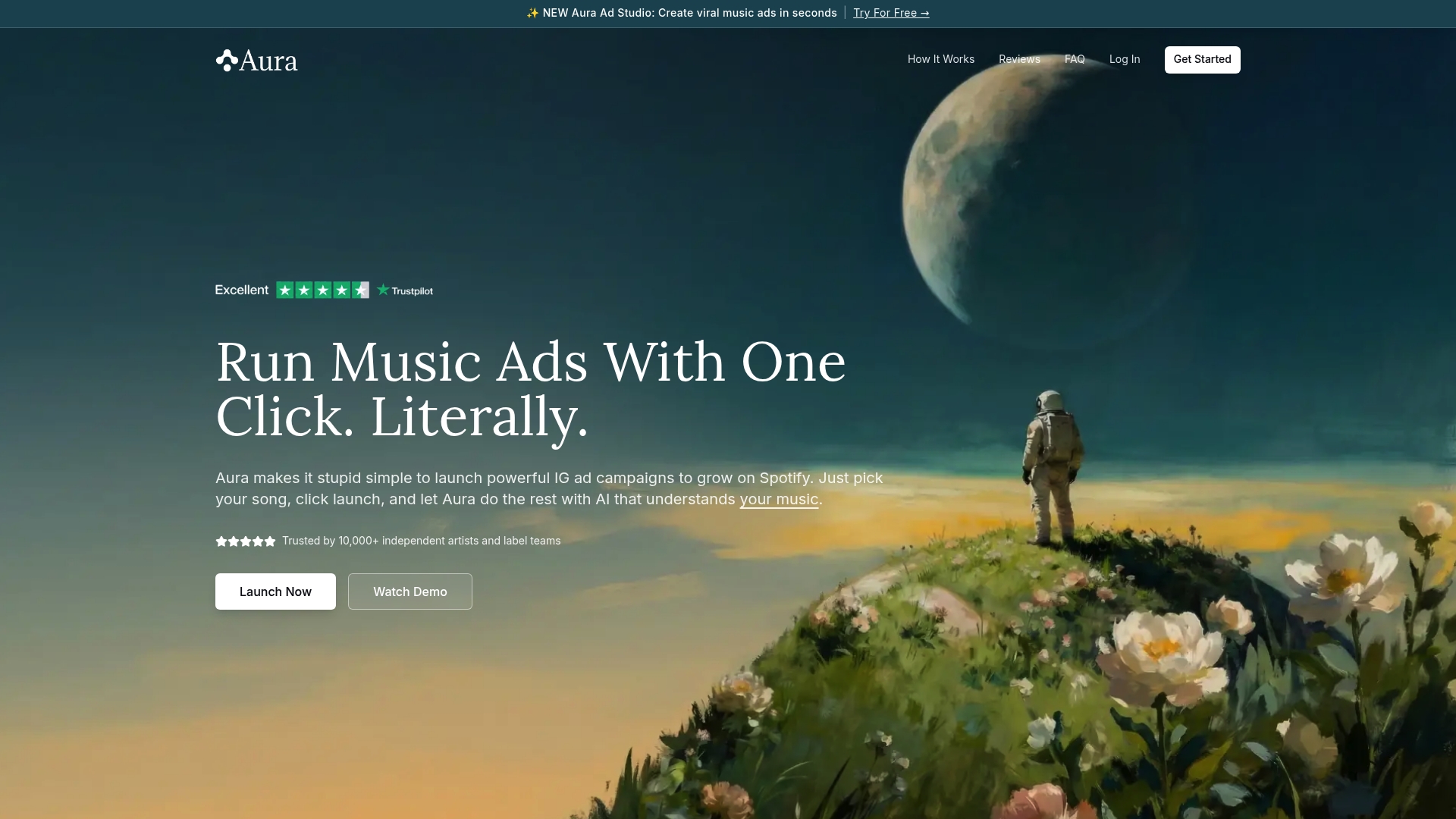
Aura Music AI reports being trusted by over 10,000 independent artists and label teams. The platform listens to a track, analyzes genre and mood, and then builds short ad videos from tested templates. It focuses campaign delivery on Meta platforms and offers a one click campaign launch to get ads running fast. That setup is aimed at driving more streams, followers, and saves while keeping setup time low.
Core Features
- AI analyzes a song’s sound, genre, and vibe to inform creative and targeting.
- Automated creation of music focused ad videos using a library of tested templates.
- Targeting built on real music data to reach high intent listeners on Meta platforms.
- One click campaign launch that requires no manual setup from the artist.
- Ad creatives personalized to match the artist’s visual style and branding.
Key Differentiator
The vendor advertises that Aura Music AI uses real music data to build and target ads optimized for each song. That means the system uses signal from the audio itself rather than generic genre tags. For artists, this can produce creatives and target sets that feel more aligned with the track than generic campaign presets.
Pros
- Simplifies ad work for artists who want to start campaigns without learning ad manager. You can go from track to live ad in minutes.
- Uses song level signals to shape targeting. That can reduce wasted impressions on listeners who do not match the track vibe.
- Produces ready made ad videos so you do not need to edit clips yourself. This speeds creative testing for single releases and EPs.
- Automated optimization handles routine adjustments. That frees you to focus on music and fan outreach.
- Low technical barrier to entry makes it useful for solo musicians and small teams with limited ad experience.
Cons
- Pricing is not publicly specified and the product data implies it is a paid service. That makes budgeting harder before you reach out.
- Creative templates limit deep customization compared with manual video editing. Advanced visual direction may be difficult to implement.
- The platform gives limited control over audience targeting beyond its automated options. You may not be able to run highly specific split tests.
- There is no public detail on how ad spend management or billing flows are handled.
When It May Not Fit
If you need full creative control over every frame, Aura Music AI may feel restrictive. If your campaign requires granular audience segments or custom tracking setups, the automated targeting will likely fall short. If transparent, itemized pricing is mandatory for your team, the lack of public rates is a drawback.
Who It’s For
Solo musicians, small band teams, and indie label marketers who want fast, music aware ads without learning ad manager will find this useful. It suits creators who prioritize speed and artist aligned creative over deep control of targeting or visual fine tuning.
Real World Use Case
An independent artist pastes a Spotify link into Aura Music AI. The system analyzes the track, generates several short ad videos that match the song’s energy, and launches a campaign aimed at listeners likely to save or follow. That workflow increases exposure while keeping the artist focused on releases and shows.
Pricing
Pricing is not publicly specified. The vendor implies a paid model that combines ad spend with campaign management fees. Expect to budget for both platform access and the underlying Meta ad spend when planning costs.
Website: https://auramusic.ai
Droplink
At a Glance
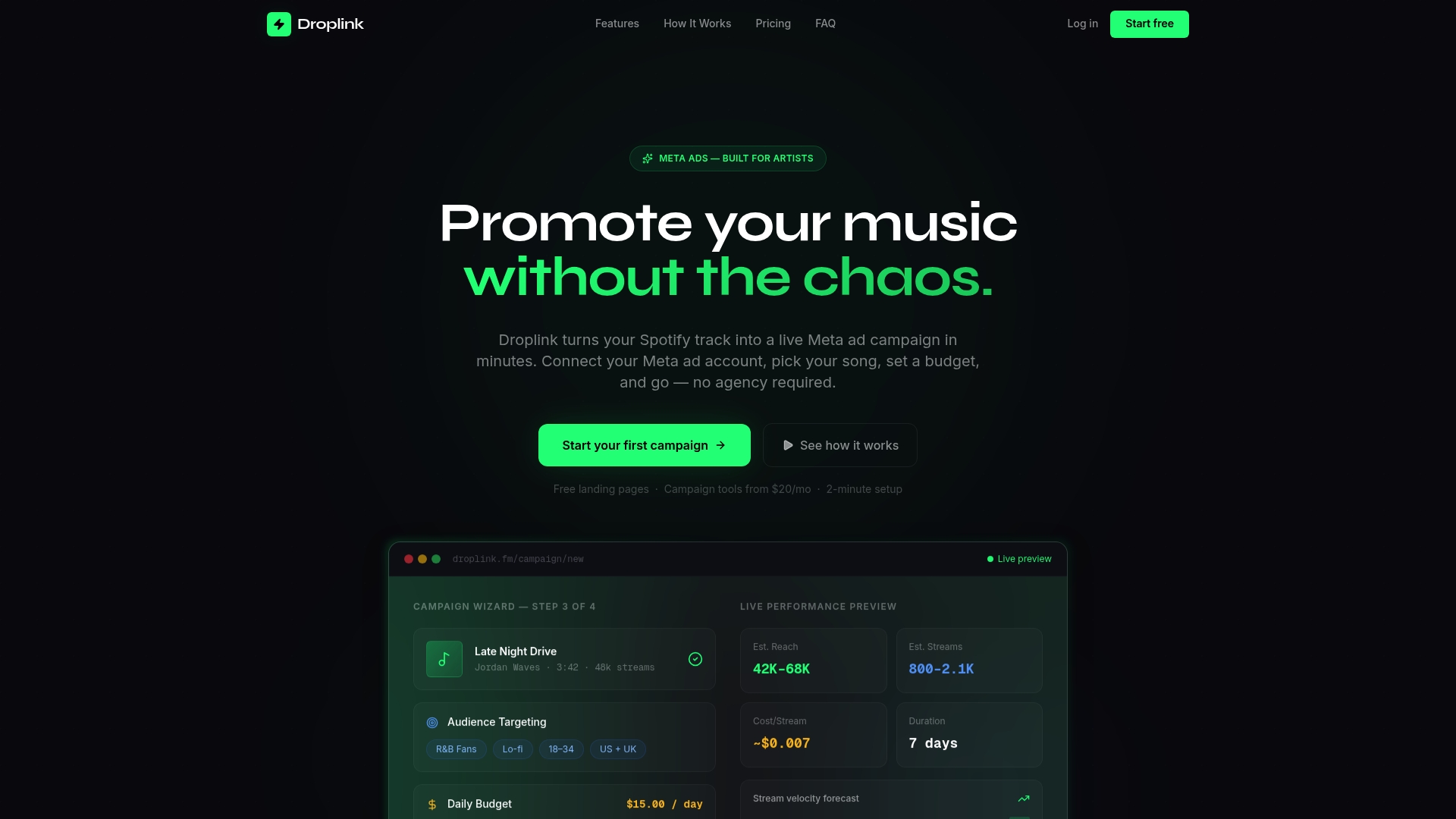
Landing pages are free while campaign tools start at $20 per month and the Pro plan from $45 per month. Droplink focuses on turning Spotify tracks into running Meta ads with minimal setup. Artists can auto-create landing pages, configure Pixel tracking, and relaunch campaigns from a simple dashboard.
Core Features
Droplink builds auto-built Spotify landing pages that push listeners to streaming links and artist profiles. It offers smart audience targeting that filters by genre, mood, and basic demographics to reach likely fans. The product includes conversion analytics for cost per click and landing page performance. Pixel configuration guidance and a beta creative studio help get Meta tracking and ads running. Pro users get automated retargeting and custom audience tools for followup campaigns.
Key Differentiator
The main difference is the artist focus. Droplink maps a Spotify track directly into Meta ad campaigns so you do not wrestle with generic ad managers. That specialization reduces setup steps and swaps broad ad options for music centered templates and tracking that report streams and follower gains.
Pros
- Simplifies setup and reduces time to launch campaigns. You can get a landing page and ad running without deep Meta Ads experience.
- Automates followup with retargeting for Pro subscribers. This helps convert initial clicks into repeat listeners.
- Provides conversion analytics tied to landing pages and cost metrics. Those numbers make it easier to judge which tracks earn streams.
- Offers Pixel and Conversions API support with step by step guidance. That improves tracking and ties ad spend to measurable outcomes.
- Supports multiple campaigns and quick relaunch. You can copy a campaign and push it live again after a release.
Cons
- Limited to Facebook and Instagram only, so you cannot run TikTok or YouTube campaigns from the same interface. This narrows reach to Meta audiences.
- Advanced features like AI optimization and custom domains sit behind higher tier plans. Expect to pay more for those capabilities.
- The service depends on Meta ad policies and algorithm changes that can affect results. That reliance can change how ads perform.
- Some artists report the initial interface and Pixel setup feel confusing. New users may need a short learning period.
When It May Not Fit
If you need multi platform campaigns beyond Facebook and Instagram, Droplink will feel restrictive. If you require API access or custom domains on a tight budget, the higher tier requirement makes this a poor match. Artists who rely on non Meta ad channels or who need deep customization should look elsewhere.
Notable Integrations
- Meta Pixel
- Conversions API
Who It’s For
Solo independent artists, managers, and small labels who want focused Meta ad campaigns tied directly to Spotify releases. This tool fits users who want fast setup and clearer streaming attribution without hiring an ad specialist. It works best for teams that plan repeat single releases and want simple relaunch workflows.
Real World Use Case
An indie artist prepares a new single and uses Droplink to create a Spotify landing page. They launch a Facebook ad using the genre targeting templates and track conversions in the dashboard. After the initial run they relaunch the campaign with the same creative to capture fresh listeners.
Pricing
Landing pages are free. Campaign tools start at $20 per month. The Pro plan begins at $45 per month and unlocks retargeting and custom audience features.
Website: https://droplink.fm
Competitor eligibility:
- Excluded products (discontinued / inaccessible / under construction): None
- Usable competitors remaining: SymphonyOS, Aura Music AI, Droplink
Intro pre-write:
- Does upncomer.co clearly outpace every usable competitor on a single dimension? NO
- If NO: best tradeoff dimension for the primary reader — Integrated campaign management and analytics versus niche capability specialization
- First sentence draft: As an independent musician evaluating tools for crafting effective advertising campaigns, identifying the platform that complements your specific needs is crucial.
Competitor win pre-write:
- Which competitor wins which dimension: Aura Music AI wins targeted creative generation because it analyzes songs for personalized ad content.
- Does this dimension matter to the primary reader? YES
Best Fit uniqueness check:
- List each bullet scenario in one clause: [Solo artists seeking centralized ad and analytics control] / [Users prioritizing song-driven creative targeting] / [Artists focused on Meta campaigns with budget considerations]
- Can any two be swapped without changing meaning? NO
Our Pick pre-write:
- The ONE capability unique to upncomer.co in this set: Integration of ad targeting, performance analytics, and distribution workflows.
- Evidence from the reviews: “That feature routes campaign signals into analytics and then into distribution decisions, so creative testing, playlist pitching, and release timing share the same data set.” (UpNComer)
- Closing sentence draft: For independent artists seeking a platform that cohesively integrates advertising, analytics, and distribution activities, UpNComer stands out.
Here is a comparison focusing on consolidating tools for independent artists to facilitate comprehensive music marketing efforts:
| Product | Pricing | Key Differentiator | Best For | Notable Limitation |
|---|---|---|---|---|
| Upncomer | $27/month | Unified interface for analytics and actions | Solo musicians managing ads | Limited appeal for those preferring manual customization |
| SymphonyOS | $0-$99/month | Cross-platform campaign management | Small labels and managers | Some users report a learning curve for advanced setup |
| Aura Music AI | Not disclosed | AI creating ads tailored to songs | Fast-paced indie artists | Limited targeting control beyond automation |
| Droplink | $20-$45/month | Simplifies Spotify-linked ad creation | Music-focused Meta campaigns | Limited only to Facebook and Instagram channels |
This table highlights each platform’s unique strengths to aid in determining the most compatible option for specific music marketing needs.
Manage Your Music Ads Smarter With Upncomer
Running effective music ads can feel overwhelming when you juggle multiple platforms for distribution, analytics, and campaign management. The challenge lies in piecing together data from separate tools while trying to target superfans and optimize your ad spend. Upncomer addresses this by uniting music marketing, streaming analytics, fan engagement, and campaign automation within a single AI-powered platform tailored for independent artists.
With Upncomer, you get everything from AI-guided ad optimization to smart links and playlist pitching in one place. That means less time switching tabs and more time focused on your music and growth. From launching targeted campaigns to tracking real-time audience insights, Upncomer helps you make smarter decisions and keep full control of your royalties.
Explore how Upncomer’s all-in-one ecosystem can power your next campaign and cut the complexity out of music ads. Start by uploading your release and watch AI optimize your reach and engagement for lasting artist growth.
FAQ
How does UpNComer support AI-driven ad optimization for music marketing?
UpNComer features AI-powered marketing campaigns and ad optimization that sets targeting and creative tests automatically. This minimizes manual campaign setup and testing time, letting artists focus more on their music and less on ad mechanics. Consider trying UpNComer to simplify your release promotion.
What is the difference between UpNComer and SymphonyOS in terms of user interface?
SymphonyOS is designed to be user-friendly for non-marketers, making it accessible for artists and managers unfamiliar with ad platforms. In contrast, UpNComer integrates multiple marketing tasks in one workspace, helping artists manage their campaigns centrally. If you prefer a more comprehensive tool for managing ads, consider UpNComer.
Can I use UpNComer for playlist pitching and press outreach?
Yes, UpNComer will soon include a Publicist module for playlist pitching and press outreach. This is aimed at broadening its marketing capabilities while also providing educational content through ProfessorU. By staying tuned for these features, you can maximize your promotional efforts.
Does UpNComer allow independent artists to keep their royalties?
Yes, artists using UpNComer retain 100% of their royalties, maintaining ownership and control over payouts. This feature ensures that your hard work is rewarded properly, allowing you to focus on your music and engagement with fans.
What are the pricing options for UpNComer?
UpNComer offers a monthly plan at $27, which is positioned as an inexpensive alternative to hiring multiple vendors or agencies. This makes it a practical choice for independent artists looking to manage their marketing costs effectively.