Playlist Pitching Services Compared: What Works in 2026

The best playlist pitching services let you pay for a real curator to listen to your song, not for a guaranteed placement. In 2026 that means a short list of credit-based platforms such as SubmitHub, Groover, Playlist Push and SoundCampaign, plus the free Spotify for Artists pitch tool, which you should use first. We cover what each one does, what it costs where the price is published, and how to avoid the services that put your account at risk.
We built UpNComer for independent artists, so we will show where our own tools fit. But the honest answer starts with the basics: no service can promise you a spot on a playlist, and the ones that do are the ones to avoid.
TL;DR
- Pitch through Spotify for Artists first. It is the only way to submit new music for Spotify’s own playlists, and it costs nothing.
- Legitimate third-party services charge for a curator’s review, not for an add. SubmitHub, Groover, Playlist Push and SoundCampaign all work this way.
- Anything that promises streams or guaranteed placement for money breaks Spotify’s rules and can cost you royalties or get your tracks removed.
- Playlist pitching works best as one part of a release plan with good targeting, clean metadata and data you actually read.
- UpNComer Pro ($27 per month or $300 per year) bundles pitching workflows, analytics and release tools in one place.
Table of Contents
- What playlist pitching services actually do
- Start free: pitching through Spotify for Artists
- The main playlist pitching services compared
- How to vet a service before you pay
- The risk you cannot ignore: fake playlists and bought streams
- Why a pitch alone rarely moves the needle
- A simple budget workflow for one release
- Our perspective: pitching is a data problem
- Where UpNComer fits
- FAQ
- Sources
What playlist pitching services actually do
A playlist submission is a request. You are asking a playlist owner, whether that is a Spotify editor, an independent curator or a system, to consider your track. In a paid campaign, a service routes your song to curators for review. The curator decides whether to add it, and no legitimate service guarantees an add.
That distinction is the whole game. You are buying attention and feedback from a person who has an audience. You are not buying outcomes.
A typical campaign looks like this:
- You connect a track link and pick genre, mood and similar-artist tags.
- The service shows you curators, or matches you with them.
- You spend credits or a campaign budget to send the song.
- Curators listen, then approve, decline or leave feedback.
- You get a report of who reviewed the song and what they decided.
The cost buys you the chance to be heard by people who would otherwise ignore a cold DM. That is a real service. It just is not a shortcut.
Start free: pitching through Spotify for Artists
Before you spend a dollar, use the editorial pitch. According to Spotify for Artists, it is the only way to submit new music for Spotify playlisting. Here is what the process requires:
- Choose one unreleased song. If you have an EP or album, you pitch a single track from it.
- Complete the genre, mood, instruments, location and story fields.
- Submit at least 7 days before release.
Those fields matter more than most artists think. They are the information a human editor uses to decide where your song might fit, so vague answers waste your one shot per release. If you want a template for the story field, our guide on how to write a Spotify editorial pitch walks through it.
The pitch tool and third-party services do different jobs. Spotify for Artists reaches Spotify’s editors for a specific release. Third-party services reach independent curators across many playlists, blogs and creators. You can and should use both.
The main playlist pitching services compared
Here is how the best-known options stack up. Coverage details come from MelodicMind’s 2026 testing of promotion services. Pricing changes often, so confirm the current figure on each provider’s own page before you pay.
| Service | Who it reaches | How you pay | Published detail |
|---|---|---|---|
| Spotify for Artists | Spotify editors | Free | One unreleased song per pitch, submitted at least 7 days before release |
| SubmitHub | Playlists, blogs, radio, influencers | Credits | You pick recipients one by one; premium credits come back if a curator does not respond within 72 hours with a real listen and approval or feedback |
| Groover | Playlists, blogs, radio stations, labels | Per-submission credits | Check Groover’s page for the current credit price and response window |
| Playlist Push | Spotify playlists and TikTok creators | Campaign budget | Check Playlist Push’s page for the current minimum |
| SoundCampaign | Spotify playlists, TikTok creators, Meta ads | Campaign budget | Campaigns start at $80; you pay for curator consideration, and unreviewed pitches are credited back |
| UpNComer Pro | Your own pitching, analytics and release workflow | $27 per month or $300 per year | Tools for planning, pitching and tracking, not a guarantee of adds |
SubmitHub
SubmitHub is the most flexible option because you choose the curators yourself. You spend credits per submission, so you control the budget one song at a time. The refund rule on premium credits is a useful accountability feature: if a curator ignores you for 72 hours, you do not pay for silence.
It works best for artists who like to research. If you are willing to read curator profiles, check what they have added recently and match your sound, you will waste fewer credits.
Groover
Groover reaches a broader set of gatekeepers, including radio stations and labels alongside playlist curators and blogs. That makes it useful if your goal is not only streams but also press, radio plays or industry attention. It is also built around responses, so you get feedback even when the answer is no.
Playlist Push
Playlist Push focuses on Spotify playlists and TikTok creators. It runs campaigns rather than letting you cherry-pick individual curators, which is simpler but gives you less control. Because campaign minimums are higher than per-submission credits, it fits artists with a defined release budget. Curators still decide independently whether to add a track.
SoundCampaign
SoundCampaign adds Meta ads to the mix of Spotify playlists and TikTok creators, and its published entry point is $80 per campaign. The detail we like is that you are paying for consideration and that unreviewed pitches are credited back. That is the right way to price this kind of service.
Other services you will see mentioned
Search results also turn up names like Musosoup, Pitch-Us, SongRocket, PlaylistDaily and SubmitLink. Some focus on longer-term curator relationships rather than one-off transactions. Evaluate every one of them with the checklist below, and read recent artist experiences, not just the provider’s own marketing.
How to vet a service before you pay
A good service is transparent about three things: who the curators are, what happens when they do not respond, and what the report shows. Before you spend, run through this list.
- Does it promise a result? Promises of streams, placements or prioritized algorithmic recommendations are a red flag. More on that below.
- Is there a refund or credit-back rule? SubmitHub and SoundCampaign both publish one.
- Can you see the curators? You want names, playlist links and recent activity, not an anonymous “network.”
- Are the playlists real? Check follower counts against how often the playlist is updated, and whether the tracks inside fit one clear genre.
- Is the price per review clear? If you cannot work out the cost of one curator listen, keep looking.
- Do reports show decisions and feedback? Add counts alone tell you little. The feedback tells you whether the song needs work.
Our own deeper guide, playlist pitching best practices for independent artists, covers targeting and follow-up in more detail.
The risk you cannot ignore: fake playlists and bought streams
This is the part that can hurt your career. Spotify’s guidance on artificial streaming says services promising streams, playlist placements or prioritized algorithmic recommendations for a fee are scams. Spotify also prohibits using any third-party service that promises streams or playlist placement in exchange for money.
The consequences are concrete. Artificial streaming can lead to no royalties being paid and to playlists or tracks being removed. A cheap bundle of guaranteed streams can erase months of real work.
How do you tell the difference between a legitimate pitching service and a stream seller?
| Legitimate pitching | Warning sign |
|---|---|
| Pays for a curator’s review | Pays for a guaranteed add |
| Shows who listened and what they decided | Shows only a total stream number |
| Refunds or credits unanswered pitches | No refunds, “all sales final” |
| Lets you choose or approve targets | Hides the playlists until after you pay |
| Honest that results vary by song | Promises a stream count or timeline |
If a spike in streams arrives from countries where you have no audience, or from playlists with huge follower counts and no engagement, treat it as a problem and not a win.
Why a pitch alone rarely moves the needle
An add is the start of the funnel, not the finish. A curator who adds your song is placing a bet that their listeners will like it. If those listeners skip it, the song drops down or off the playlist. What matters afterward is whether people save the track, follow you and come back.
That is why the best results tend to come from artists who prepare before they pitch:
- Finish the basics. Metadata, artwork and a clear genre identity should be ready before you submit anything. Our music release checklist covers the full list.
- Target narrowly. Ten well-matched curators beat a hundred random ones.
- Track what happens. Watch saves, repeat listens and follower growth, not only stream counts. Our piece on Spotify save rate benchmarks explains how to test this.
- Build an audience that does not depend on one playlist. This four-week plan for distributing music on Spotify is one take on building an engaged audience without buying streams or guaranteed placements.
- Pair pitching with other promotion. Video, social content and email all feed the same loop. See our overview of online music promotion.
A simple budget workflow for one release
You do not need a large budget. Here is a practical way to sequence a single release.
- Eight weeks out: finalize the master and metadata. Decide your one lead track.
- Four weeks out: schedule the release through your distributor so you can pitch an unreleased song.
- At least one week out: submit the Spotify for Artists pitch. Earlier is better, and 7 days is the minimum.
- Release week: run a small, targeted batch of submissions to independent curators. Start with a limited credit budget, so you can read the feedback before spending more.
- Weeks two to four: read the results. If curators keep giving the same feedback, fix it before the next release. If your save rate is healthy, put more behind it.
Treat the first campaign as research. The feedback from fifteen curators is worth more than a single lucky add.
Our perspective: pitching is a data problem
We see artists treat playlist pitching as a lottery ticket: pay, wait and hope. We think that is backwards. The artists who get something lasting out of it treat each submission as a test. They pick a hypothesis (this song suits indie-folk curators who add new releases weekly), send it to a small group, then read the reaction.

That is the idea behind UpNComer. Our Publicist module helps you organize pitching and outreach, Data Analyst helps you read streaming and audience numbers after the campaign, and Amplitude AI guides the next decision, such as what to change in your pitch or where to spend your next dollar. Artist Manager keeps the release timeline in one place, so your pitch deadlines do not slip.
We will also say this plainly: none of our tools, or anyone else’s, can guarantee you a placement. If a tool says otherwise, it is not one to trust. What good tools do is shorten the time between trying something and learning from it.
— Karan
Where UpNComer fits
If you are juggling a pitching service, an analytics dashboard, a distributor and a release spreadsheet, you are paying for the same work in four places. UpNComer Pro brings planning, pitching workflows, streaming analytics and fan engagement into one platform, for $27 per month or $300 per year.
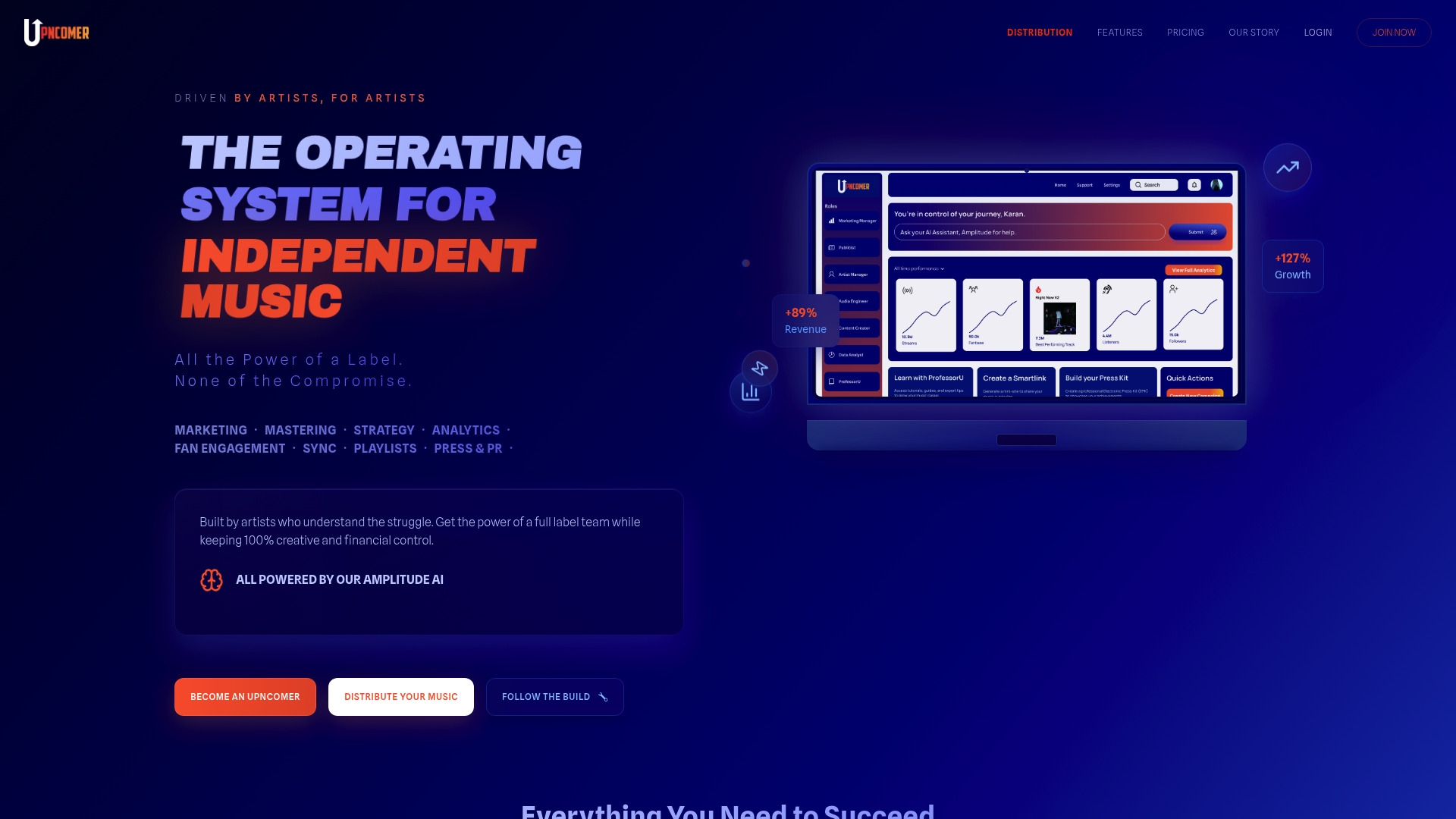
If you also need to get your music out the door, our distribution service has no subscription fee and works on a 6% royalty split. Use it alongside the pitching tools, so your release date and your pitch timing line up.
FAQ
Are playlist pitching services worth paying for?
They can be, if you treat them as paid feedback and exposure to curators and not as a way to buy results. A small, targeted budget on a song you believe in gives you real reactions and a shot at independent playlists. Pitch through Spotify for Artists first, since it is free.
Is it safe to use playlist submission sites?
It is safe when the site pays curators to review music and promises nothing about outcomes. It is not safe when it promises streams or placements for a fee, because Spotify treats those as scams and says they can lead to lost royalties and removed tracks. Check how the service handles refunds and curator transparency before you pay.
How much should I spend on playlist pitching?
Start small. Published entry points include SoundCampaign campaigns from $80, while per-submission platforms let you spend much less on a first test. Fix a budget per release, run one targeted batch, and only scale up after you see saves and follower growth.
Can a service guarantee my song gets added to a playlist?
No. Curators decide independently, and a legitimate service charges for the review, not the add. Treat any guarantee as a warning sign.
What should I do before I pitch a song?
Finish your metadata and artwork, pick the song that best represents you, and fill in every field in the Spotify for Artists pitch. Then choose curators whose playlists match your genre and mood. Our guide on pitching artists to playlists goes deeper.
Sources
- Playlisting, Spotify for Artists
- Artificial Streaming, Spotify for Artists
- Best Music Promotion Services in 2026 (Tested), MelodicMind
- How playlist submission works, playlistsubmit