How LLCs protect and empower independent musicians

Forming an LLC feels like a milestone. You pick a name, file the paperwork, and suddenly your music career feels like a real business. But here’s what a lot of independent artists don’t realize until it’s too late: the LLC itself doesn’t protect you. How you run it does. The legal shield only holds if you treat your LLC like the business it’s supposed to be, and the tax advantages are real but nuanced. This guide breaks down exactly how LLCs help musicians with legal protection, financial control, and taxes, so you can make the structure work for you instead of just looking good on paper.
Table of Contents
- Why liability protection matters for musicians
- Financial autonomy: Managing money as a musician with an LLC
- Tax implications for indie artists: How LLCs affect musician taxes
- What can go wrong: Veil-piercing and risk scenarios for musicians
- The uncomfortable truth most musicians miss about LLCs
- Take your music business to the next level
- Frequently asked questions
Key Takeaways
| Point | Details |
|---|---|
| LLC protection is not automatic | Musicians must operate their LLC as a true business to keep liability protection. |
| Separate finances are essential | Using business accounts and contracts preserves both legal and financial clarity. |
| Tax benefits aren’t always simple | LLCs default to pass-through taxation, so self-employment taxes still apply for musicians. |
| Mistakes risk personal exposure | Mixing personal and business finances or fraudulent behavior can lead to lost protections. |
| Diligence beats paperwork | Regular business practices and periodic audits are key for maintaining your LLC’s safeguard. |
Why liability protection matters for musicians
The core promise of an LLC is something lawyers call the “corporate veil.” Think of it as a wall between your personal life and your music business. If someone sues your LLC, they’re going after the business assets, not your personal bank account, your car, or your home recording setup.
For musicians, general liability risks are more real than people expect. Someone trips at your gig and breaks a wrist. A collaborator claims you violated a handshake agreement. A venue says your equipment damaged their property. A label dispute turns into a lawsuit. Any of these could drain your savings if you’re operating as a sole proprietor with no legal separation in place.
Entertainers benefit from LLCs precisely because their work puts them in so many contractual and physical situations, often without the legal infrastructure that larger companies take for granted.
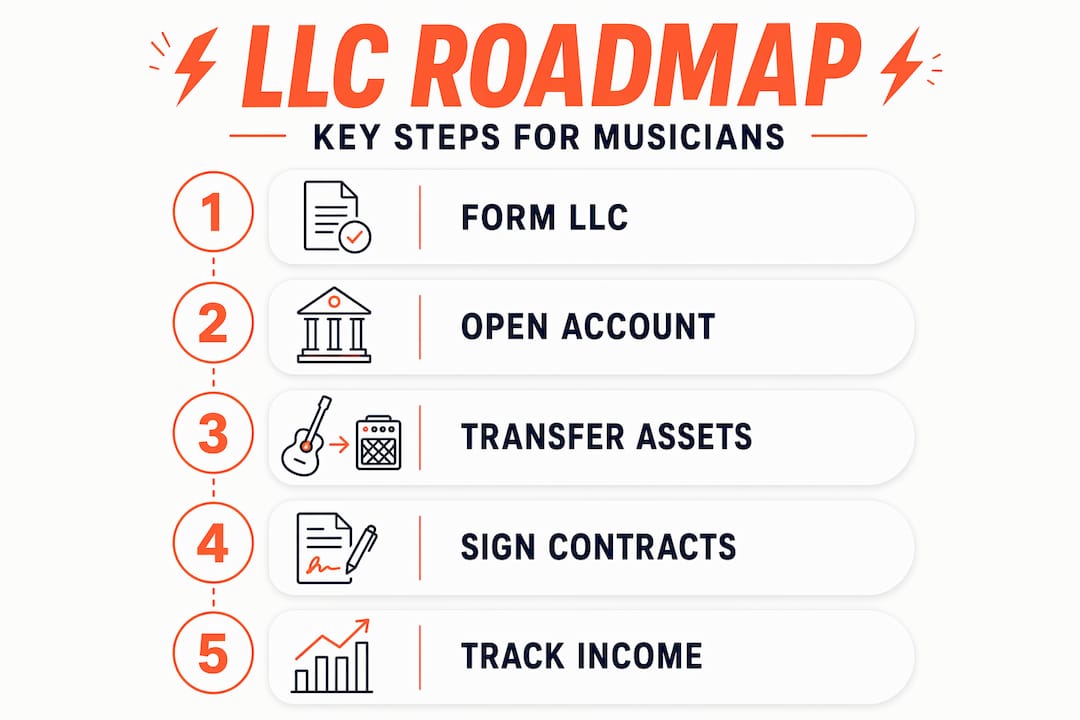
But here’s the part that matters most. LLC-based protection is not automatic; you must operate the LLC like a real business, with proper contracts and no mixing of personal and business finances, otherwise the corporate veil may be challenged. Filing the articles of organization is just the starting point. What follows is a consistent pattern of behavior that proves your LLC is a legitimate, separate entity.
Common situations where musicians need that protection include:
- Personal injury claims at live shows or rehearsals
- Copyright disputes with collaborators, producers, or labels
- Contract disagreements over performance fees or recording agreements
- Vendor disputes involving equipment rentals, studios, or promoters
- Debt obligations if a tour or project goes over budget
“An ounce of preparation in how you operate your LLC is worth a ton of legal defense in court.”
That said, the wall has cracks if you’re not careful. Courts can impose personal exposure even when you have an LLC, particularly in cases involving fraud, misuse of the entity, or undercapitalization. This is called veil-piercing, and while it’s not common, it’s not rare enough to ignore either.
You can learn more about the legal duties for LLC musicians and how to stay protected at every stage of your career.
Pro Tip: Always sign contracts, invoices, and agreements as your LLC, not as yourself personally. Write “Your Name, Member, [Your LLC Name]” on every document. This one habit alone does a lot of the heavy lifting.
Having set the stage for why LLC protection can’t be taken for granted, let’s explore how financial autonomy comes into play.
Financial autonomy: Managing money as a musician with an LLC
Once your LLC is active, the next move is getting your finances properly separated. This isn’t optional if you want the protection to hold. Open a dedicated business checking account in your LLC’s name. Get a business credit card. Route all gig payments, streaming royalties, sync licensing income, merch revenue, and session fees through that account.
An LLC can be central to a broader financial strategy that includes banking separation and asset ownership transfers, all of which preserve your liability protection and create operational clarity. When a promoter Venmos you directly, that’s a red flag. When a sync licensing company writes a check to your LLC, that’s the system working correctly.
Here’s a simple breakdown of how the financial structure looks in practice:
| Financial activity | Personal (sole proprietor) | LLC structure |
|---|---|---|
| Gig payments | Go to personal account | Paid to LLC business account |
| Equipment purchases | Personal card, mixed receipts | LLC card, clean deductible records |
| Copyright ownership | Held personally | Transferred to or created by LLC |
| Contracts | Signed as yourself | Signed as LLC member |
| Collaborator payments | Informal split | Paid through LLC with documentation |
One thing a lot of musicians skip is transferring existing assets into the LLC. Your guitars, your recording gear, your masters, your publishing catalog. If you already own these things before forming the LLC, they don’t automatically belong to it. You need either a bill of sale (where the LLC purchases the asset from you) or a capital contribution document (where you contribute the asset as your ownership stake in the LLC).

Why does this matter? Because if a lawsuit targets your LLC and the gear or copyrights are still technically in your name, they’re fair game. Transferring assets and signing contracts as an LLC also clarifies ownership when you’re working with collaborators on joint projects, which prevents messy disputes later.
Speaking of collaborations, your LLC makes group projects cleaner. You can spell out in writing who owns what percentage of a recording, who gets paid how much, and what happens if someone leaves the project. Without this structure, a co-written track can turn into a legal nightmare if someone decides their contribution was worth more than agreed.
Pro Tip: Use your LLC for every gig payment and collaborative project from day one. The more consistently you route income and expenses through it, the stronger your financial separation becomes over time.
Now that your finances are properly structured, let’s break down how LLCs affect your taxes as a musician.
Tax implications for indie artists: How LLCs affect musician taxes
This is where a lot of musicians get either overexcited or confused. The truth is somewhere in the middle.
By default, a single-member LLC is treated as a pass-through entity for federal tax purposes, meaning income flows directly to your personal tax return rather than being taxed at a business level. There’s no separate federal income tax for the LLC itself. The IRS essentially treats it as if the business doesn’t exist as a separate taxpayer. This is called “disregarded entity” status.
Here’s what that means in practical terms:
- Your LLC income gets reported on Schedule C of your personal Form 1040.
- You still owe self-employment taxes on that income, which is currently 15.3% on net earnings up to a certain threshold.
- You can deduct legitimate business expenses, including home studio costs, equipment, travel to gigs, software subscriptions, and marketing spend.
- The LLC itself doesn’t reduce your income tax rate by default.
Let’s compare the two most common structures for independent musicians:
| Tax structure | Who pays income tax | Self-employment tax | Complexity |
|---|---|---|---|
| Sole proprietor | Individual (Schedule C) | Yes, 15.3% | Low |
| Single-member LLC (default) | Individual (Schedule C) | Yes, 15.3% | Low to moderate |
| LLC taxed as S-Corp | Individual on salary and distributions | Only on salary portion | High |
So where’s the actual tax benefit of an LLC? For most independent artists just starting out, the default LLC structure doesn’t dramatically change your tax bill. The real advantages are flexibility, credibility, and the option to change tax treatment later as your income grows.
When your net income climbs into a range where the S-Corp election makes sense, typically above a certain threshold of self-employment income, your LLC can elect to be taxed differently and potentially reduce your self-employment tax burden. That’s a conversation to have with a music-savvy CPA, not something to do on your own.
You can explore LLC tax duties for musicians in more depth to understand how your specific income streams affect your tax situation.
With the legal and financial picture clear, let’s address some common scenarios and where the risks might still linger despite forming an LLC.
What can go wrong: Veil-piercing and risk scenarios for musicians
Here’s an uncomfortable reality: forming an LLC and then operating it carelessly is almost worse than not forming one at all. It creates a false sense of security. You think you’re protected, but the behavior that undermines that protection is already happening.
Veil-piercing is an exceptional remedy that courts apply based on specific facts, including fraud, misuse of the entity, and undercapitalization. It’s not something a court does lightly, but it’s not impossible either.
The most common ways musicians accidentally put themselves at risk:
- Using a personal credit card to pay for business expenses, even “just this once”
- Signing a venue contract personally instead of as the LLC member
- Depositing a performance check into a personal account because the business account wasn’t set up yet
- Running personal expenses through the LLC to inflate deductions
- Failing to maintain any written records of ownership transfers or operating agreements
- Keeping the LLC technically active but never actually using it for business transactions
LLC protection requires operating like a real business, with proper contracts and a clear separation between personal and business activity. The paperwork gets filed once. The behavior has to be consistent for years.
“The artists who lose protection aren’t usually doing anything dramatic. They’re just being casual about the details, and those details add up.”
One scenario worth thinking through: imagine you sign a touring agreement personally, not as your LLC. The tour goes sideways, you owe the promoter money, and they sue. Your LLC isn’t even in the picture because you never used it in that transaction. You’re personally on the hook.
To protect your career longevity as a performer, it pays to treat business documentation the same way you treat your instrument. With consistent care and attention, not just when something goes wrong.
A simple routine that helps: review your accounts and contracts every six months. Check that all income is flowing through the LLC, that recent contracts are signed correctly, and that no personal expenses have crept into the business account.
These potential pitfalls illustrate why diligence matters more than simply filing LLC paperwork. Let’s look at what most musicians and industry advisors overlook.
The uncomfortable truth most musicians miss about LLCs
Here’s what we’ve seen over and over again in the independent music space. Artists spend a weekend researching LLCs, file the paperwork, pick a cool business name, and then essentially forget the whole thing exists until tax season or a legal issue forces them to pay attention.
The LLC becomes a costume, not a structure.
The protection that an LLC offers isn’t legal, it’s behavioral. Yes, the legal framework creates the possibility of separation. But what actually creates that separation is the daily, weekly, monthly decisions you make about how money flows, how documents are signed, and how your business is presented to the world.
Musicians underestimate how much documentation matters. Not because anyone is watching right now, but because if something goes wrong two years from now, the paper trail from today is what determines whether you’re personally liable. Judges and opposing attorneys don’t give credit for good intentions.
There’s also a tendency to treat the LLC as a tax hack rather than a business foundation. The tax flexibility is real, but it’s a secondary benefit. The primary purpose is to create a legitimate, separate entity that can own assets, enter contracts, and absorb business risk without dragging your personal life into it.
Industry professionals who work with independent artists consistently point out that naming your LLC is the fun part. Managing it well, keeping records clean, reviewing contracts, and staying consistent is the actual work. And it’s not hard work. It just requires showing up for it.
Pro Tip: Audit your accounts and asset transfers twice a year. Look for any income that went to a personal account, any contracts signed in your personal name, and any expenses paid personally that should have gone through the LLC. Catching these early is straightforward. Fixing them in the middle of a lawsuit is expensive.
The artists who use their LLC as a genuine operating foundation, not just a nameplate, are the ones who build careers with real staying power.
Take your music business to the next level
Running your music career as a legitimate business takes more than good intentions. It takes the right infrastructure, the right habits, and the right support in your corner.

UpNComer is built specifically for independent artists who want to grow their careers without losing control. The platform gives you the tools, strategy, and educational resources to manage your music business smartly, from understanding your revenue streams to running effective campaigns and building a fanbase that actually converts. Whether you’re just setting up your LLC or already operating and looking to scale, UpNComer’s music business resources can help you connect the dots between your creative output and your long-term financial goals. Stop juggling fragmented advice and start building with a system designed for artists like you.
Frequently asked questions
Do I need an LLC to perform as an independent musician?
You don’t need an LLC to perform, but having one can protect your personal assets and increase your professionalism. LLCs create legal separation but require proper operation to actually offer that protection.
Does forming an LLC change how I pay taxes as a musician?
For most musicians, taxes remain pass-through by default, meaning income flows to your personal return, but self-employment taxes at 15.3% still apply regardless of the LLC structure.
What’s the biggest mistake musicians make after forming an LLC?
Mixing personal and business finances is the most common mistake, and it can completely undermine your protection. Commingling funds can allow courts to pierce the veil and expose you to personal liability.
Can my LLC help me manage collaborations and group projects?
Yes, using an LLC creates a clear framework for ownership, contracts, and payment splits with collaborators. Transferring ownership and signing contracts as an LLC removes a lot of the ambiguity that causes disputes.
Are there risks even if I follow all the LLC rules?
Courts can still pierce the veil for fraud or undercapitalization, but this is rare when you operate your LLC professionally. Veil-piercing is used sparingly and typically only in cases involving genuine misconduct.